Pearson Edexcel · GCSE · Psychology
Course version: 1PS0 · Version from Sept 2017
Understand Freudian theory of dreaming (Freud, 1900), including strengths…
Full specification wording
Sleep and dreaming: 9.1.4 Understand Freudian theory of dreaming (Freud, 1900), including strengths and weaknesses of the theory: a. manifest content b. latent content c. dreamwork
Freud (1900) argued dreams provide a safe outlet for repressed unconscious desires.
Checked against the Pearson Edexcel 1PS0 specification (opens in a new tab) on .
- Point 4 of 5
- 4 key terms
Study notes
From the checked teaching notes for this specification point.
The idea
Freud (1900) argued dreams provide a safe outlet for repressed unconscious desires. The 'manifest content' is the literal narrative remembered upon waking, such as dreaming of a train entering a tunnel. The 'latent content' is the hidden psychological meaning, often representing unacceptable urges. 'Dreamwork' is the unconscious process disguising latent content into manifest content to protect the dreamer from anxiety. A key strength is its foundational role in psychoanalysis and the rich qualitative data from clinical case studies. However, weaknesses include a lack of scientific falsifiability, heavy reliance on subjective interpretation, and a biased sample of patients, making the theory difficult to generalise.
What earns the marks
- Manifest content is the literal dream narrative remembered by the dreamer.
- Latent content is the hidden, unconscious meaning of the dream.
- Dreamwork is the process of disguising latent content into manifest content.
- A strength is the rich qualitative data gathered from clinical case studies.
- A weakness is the lack of scientific falsifiability and reliance on subjective interpretation.
Common mistakes and how to put them right
Confusing manifest and latent content.
Put it right: Manifest is what is 'manifested' or visible (the story), while latent is hidden (the meaning).
Stating that Freud's theory is highly scientific.
Put it right: Freud's theory is widely criticised for lacking empirical evidence and being unfalsifiable.
Believing dreamwork reveals the latent content.
Put it right: Dreamwork actually disguises the latent content to protect the dreamer; psychoanalysis is needed to reveal it.
Exam tips
- Use clear examples, such as a train entering a tunnel, to distinguish between manifest and latent content.
- When evaluating, explicitly link the lack of scientific evidence to the subjective nature of dream interpretation.
- Ensure you can define 'dreamwork' as an active, unconscious process of disguise.
Try the lesson
The start of the Sleep and dreaming: 9.1.4 Understand Freudian theory of dreaming (Freud, 1900), including strengths and weaknesses of the theory: a. manifest content b. latent content c. dreamwork lesson, made from checked teaching notes for this specification point.
Have a go first
In Freud's theory of dreaming, what is meant by the term 'manifest content'?
Listen
Freud (1900) argued dreams provide a safe outlet for repressed unconscious desires. The 'manifest content' is the literal narrative remembered upon waking, such as dreaming of a train entering a tunnel. The 'latent content' is the hidden psychological meaning, often representing unacceptable urges. Dreamwork' is the unconscious process disguising latent content into manifest content to protect the dreamer from anxiety. A key strength is its foundational role in psychoanalysis and the rich qualitative data from clinical case studies. However, weaknesses include a lack of scientific falsifiability, heavy reliance on subjective interpretation, and a biased sample of patients, making the theory difficult to generalise. A strong answer earns marks for these points. Manifest content is the literal dream narrative remembered by the dreamer. Latent content is the hidden, unconscious meaning of the dream. Dreamwork is the process of disguising latent content into manifest content. A strength is the rich qualitative data gathered from clinical case studies. A common slip: Confusing manifest and latent content. Instead, manifest is what is 'manifested' or visible (the story), while latent is hidden (the meaning). Exam tip: Use clear examples, such as a train entering a tunnel, to distinguish between manifest and latent content.
See it
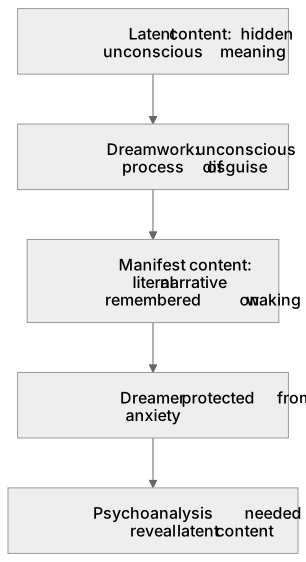
Put it in order
Put these steps in the order they happen.
- 1. Dreamwork: unconscious process of disguise
- 2. Manifest content: literal narrative remembered on waking
- 3. Latent content: hidden unconscious meaning
- 4. Psychoanalysis needed to reveal latent content
- 5. Dreamer protected from anxiety
Key words
Say what each word means before you turn the card.
Manifest content
Try answering aloud or in your head before turning the card.
Latent content
Try answering aloud or in your head before turning the card.
Dreamwork
Try answering aloud or in your head before turning the card.
Subjectivity
Try answering aloud or in your head before turning the card.
See every definition
- Manifest content
- The literal narrative of a dream that is remembered upon waking, such as dreaming of a train entering a tunnel.
- Latent content
- The hidden psychological meaning of a dream, often representing unacceptable urges.
- Dreamwork
- The unconscious process of disguising latent content into manifest content to protect the dreamer from anxiety.
- Subjectivity
- A weakness of the theory, referring to its heavy reliance on subjective interpretation.
Label the diagram
Some boxes have lost their names. Pick the right name for each number.
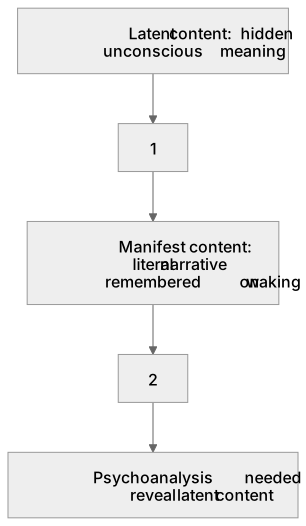
1Box 1
2Box 2
There is more to this lesson
The full lesson goes on to check your understanding and help you earn the marks. Create a free account to carry on, with your progress saved.
A week of Premium from your first lesson · Then the free plan continues · No card, no charge
Test your understanding of Sleep and dreaming: 9.1.4 Understand Freudian theory of dreaming (Freud, 1900), including strengths and weaknesses of the theory: a. manifest content b. latent content c. dreamwork
Active recall beats re-reading. Take an instant quiz now to test what you’ve learned and lock it into long-term memory.
A week of Premium from your first lesson · Then the free plan continues · No card, no charge