Pearson Edexcel · GCSE · Psychology
Course version: 1PS0 · Version from Sept 2017
Language, thought and communication - 10.2 Studies: *10.2.1 Yuki et al.…
Full specification wording
Topic 10: Language, thought and communication - 10.2 Studies: *10.2.1 Yuki et al. (2007) Are the windows to the soul the same in the East and West? Cultural differences in using the eyes and mouth as cues to recognize emotions in Japan and the United States
Yuki et al. (2007) investigated cultural differences in how people from Japan and the United States recognise emotions.
Checked against the Pearson Edexcel 1PS0 specification (opens in a new tab) on .
- Point 1 of 2
Study notes
From the checked teaching notes for this specification point.
The idea
Yuki et al. (2007) investigated cultural differences in how people from Japan and the United States recognise emotions. The procedure showed Japanese and American participants computer-generated emoticons with varying combinations of happy, sad, and neutral eyes and mouths. Participants rated the happiness of each face. Findings revealed Japanese participants gave higher happiness ratings to faces with happy eyes, whereas American participants gave higher ratings to faces with happy mouths. The conclusions suggest Japanese culture focuses on eyes, while American culture focuses on mouths. Strengths include high experimental control using standardised emoticons. Weaknesses include low ecological validity, as emoticons are not real human faces.
What earns the marks
- State that the aim was to investigate cultural differences in the recognition of emotions using facial cues.
- Describe the procedure involving Japanese and American participants rating the happiness of computer-generated emoticons.
- Identify that Japanese participants focused more on the eyes when rating emotions, while American participants focused more on the mouth.
- Explain that a weakness of the study is its low ecological validity because it used artificial emoticons rather than real human faces.
Common mistakes and how to put them right
Stating that the study used photographs of real human faces.
Put it right: The study used computer-generated emoticons with different combinations of eyes and mouths.
Confusing which culture focused on which facial feature.
Put it right: Japanese participants focused on the eyes, while American participants focused on the mouth.
Claiming the study proves all people in these countries behave this way.
Put it right: The study highlights cultural tendencies, but individual differences still exist within any culture.
Exam tips
- Be prepared to describe the specific combinations of eyes and mouths used in the emoticons, such as happy, sad, and neutral.
- When evaluating the study, explicitly use the term 'ecological validity' and explain why the use of emoticons reduces it.
- Link the findings to the conclusion by explaining why Japanese culture might focus on eyes and American culture on mouths.
Try the lesson
The start of the Topic 10: Language, thought and communication - 10.2 Studies: *10.2.1 Yuki et al. (2007) Are the windows to the soul the same in the East and West? Cultural differences in using the eyes and mouth as cues to recognize emotions in Japan and the United States lesson, made from checked teaching notes for this specification point.
Have a go first
What was the main finding of Yuki et al.'s (2007) study regarding how Japanese and American participants recognise emotions?
Listen
Yuki et al. (2007) investigated cultural differences in how people from Japan and the United States recognise emotions. The procedure showed Japanese and American participants computer-generated emoticons with varying combinations of happy, sad, and neutral eyes and mouths. Participants rated the happiness of each face. Findings revealed Japanese participants gave higher happiness ratings to faces with happy eyes, whereas American participants gave higher ratings to faces with happy mouths. The conclusions suggest Japanese culture focuses on eyes, while American culture focuses on mouths. Strengths include high experimental control using standardised emoticons. Weaknesses include low ecological validity, as emoticons are not real human faces. A strong answer earns marks for these points. State that the aim was to investigate cultural differences in the recognition of emotions using facial cues. Describe the procedure involving Japanese and American participants rating the happiness of computer-generated emoticons. Identify that Japanese participants focused more on the eyes when rating emotions, while American participants focused more on the mouth. Explain that a weakness of the study is its low ecological validity because it used artificial emoticons rather than real human faces. A common slip: Stating that the study used photographs of real human faces. Instead, The study used computer-generated emoticons with different combinations of eyes and mouths. Exam tip: Be prepared to describe the specific combinations of eyes and mouths used in the emoticons, such as happy, sad, and neutral.
See it
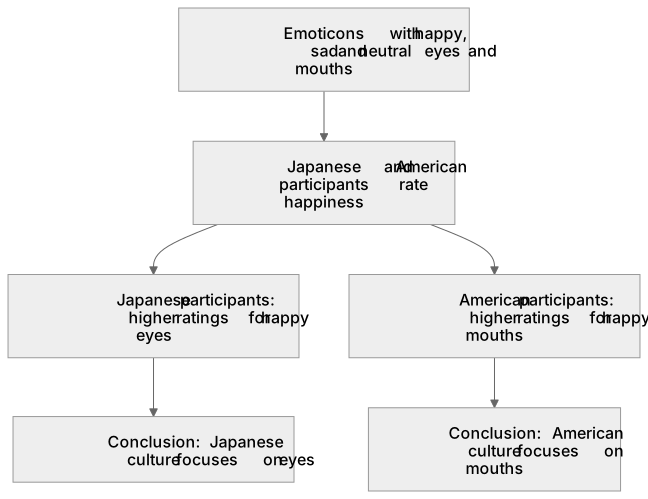
Label the diagram
Some boxes have lost their names. Pick the right name for each number.
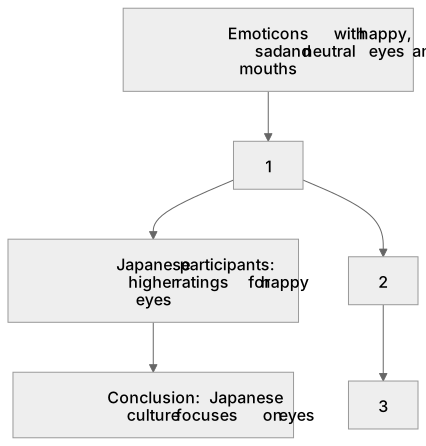
1Box 1
2Box 2
3Box 3
There is more to this lesson
The full lesson goes on to check your understanding and help you earn the marks. Create a free account to carry on, with your progress saved.
A week of Premium from your first lesson · Then the free plan continues · No card, no charge
Test your understanding of Topic 10: Language, thought and communication - 10.2 Studies: *10.2.1 Yuki et al. (2007) Are the windows to the soul the same in the East and West? Cultural differences in using the eyes and mouth as cues to recognize emotions in Japan and the United States
Active recall beats re-reading. Take an instant quiz now to test what you’ve learned and lock it into long-term memory.
A week of Premium from your first lesson · Then the free plan continues · No card, no charge