Pearson Edexcel · GCSE · Psychology
Course version: 1PS0 · Version from Sept 2017
Language, thought and communication - 10.2 Studies: 10.2.2 Boroditsky…
Full specification wording
Topic 10: Language, thought and communication - 10.2 Studies: 10.2.2 Boroditsky (2001) Does Language Shape Thought?: Mandarin and English Speakers’ Conceptions of Time
Boroditsky (2001) investigated whether language influences how we think about time by comparing English and Mandarin speakers.
Checked against the Pearson Edexcel 1PS0 specification (opens in a new tab) on .
- Point 2 of 2
Study notes
From the checked teaching notes for this specification point.
The idea
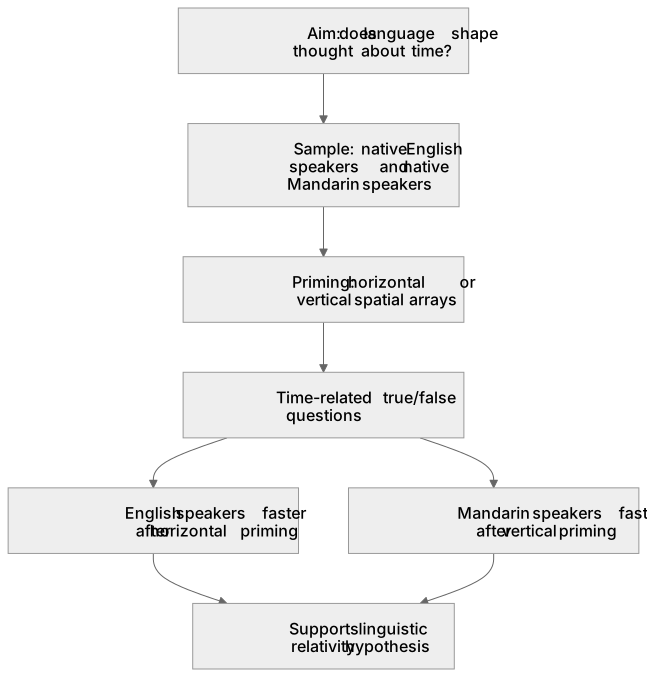
Boroditsky (2001) investigated whether language influences how we think about time by comparing English and Mandarin speakers. English speakers typically use horizontal spatial metaphors for time (e.g., looking "forward"). Mandarin speakers often use vertical metaphors (e.g., "up" for earlier events). Participants were primed with horizontal or vertical spatial arrays before answering true/false questions about time. English speakers answered time questions faster after horizontal priming, whereas Mandarin speakers were faster after vertical priming. This supports the linguistic relativity hypothesis, demonstrating that the language we speak shapes our habitual thought patterns regarding abstract concepts like time.
What earns the marks
- Identify the aim of the study as investigating whether language shapes thought regarding the abstract concept of time.
- Describe the sample as consisting of native English speakers and native Mandarin speakers.
- Explain the procedure involving spatial priming (horizontal versus vertical) followed by time-related true/false questions.
- State the findings that English speakers were faster after horizontal priming, while Mandarin speakers were faster after vertical priming.
- Conclude that the study supports the linguistic relativity hypothesis by showing language influences cognitive processes.
Common mistakes and how to put them right
Believing Mandarin speakers only use vertical metaphors.
Put it right: Mandarin speakers use both horizontal and vertical metaphors, but use vertical ones much more frequently than English speakers.
Confusing the priming directions.
Put it right: English speakers showed faster reaction times after horizontal priming, while Mandarin speakers were faster after vertical priming.
Stating the study proves linguistic determinism.
Put it right: The study supports linguistic relativity (a weaker form), showing language influences thought, not that it completely determines it.
Exam tips
- Be prepared to describe the specific spatial metaphors used by each language group in the study.
- Remember that the dependent variable was the reaction time to answer the true/false questions about time.
- Link the findings explicitly to the concept of linguistic relativity when evaluating the study's conclusions.
Try the lesson
The start of the Topic 10: Language, thought and communication - 10.2 Studies: 10.2.2 Boroditsky (2001) Does Language Shape Thought?: Mandarin and English Speakers’ Conceptions of Time lesson, made from checked teaching notes for this specification point.
Have a go first
What did Boroditsky (2001) conclude about how English and Mandarin speakers conceptualise time?
Listen
Boroditsky (2001) investigated whether language influences how we think about time by comparing English and Mandarin speakers. English speakers typically use horizontal spatial metaphors for time (e.g., looking "forward"). Mandarin speakers often use vertical metaphors (e.g., "up" for earlier events). Participants were primed with horizontal or vertical spatial arrays before answering true/false questions about time. English speakers answered time questions faster after horizontal priming, whereas Mandarin speakers were faster after vertical priming. This supports the linguistic relativity hypothesis, demonstrating that the language we speak shapes our habitual thought patterns regarding abstract concepts like time. A strong answer earns marks for these points. Identify the aim of the study as investigating whether language shapes thought regarding the abstract concept of time. Describe the sample as consisting of native English speakers and native Mandarin speakers. Explain the procedure involving spatial priming (horizontal versus vertical) followed by time-related true/false questions. State the findings that English speakers were faster after horizontal priming, while Mandarin speakers were faster after vertical priming. A common slip: Believing Mandarin speakers only use vertical metaphors. Instead, Mandarin speakers use both horizontal and vertical metaphors, but use vertical ones much more frequently than English speakers. Exam tip: Be prepared to describe the specific spatial metaphors used by each language group in the study.
See it
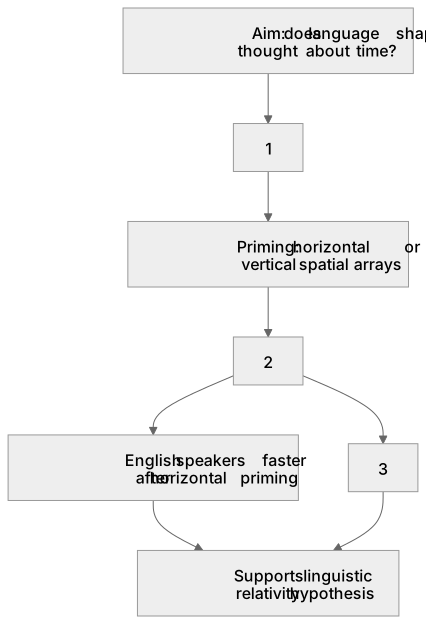
Label the diagram
Some boxes have lost their names. Pick the right name for each number.
1Box 1
2Box 2
3Box 3
There is more to this lesson
The full lesson goes on to check your understanding and help you earn the marks. Create a free account to carry on, with your progress saved.
A week of Premium from your first lesson · Then the free plan continues · No card, no charge
Test your understanding of Topic 10: Language, thought and communication - 10.2 Studies: 10.2.2 Boroditsky (2001) Does Language Shape Thought?: Mandarin and English Speakers’ Conceptions of Time
Active recall beats re-reading. Take an instant quiz now to test what you’ve learned and lock it into long-term memory.
A week of Premium from your first lesson · Then the free plan continues · No card, no charge