AQA · GCSE · Religious Studies
Course version: 8062 · Version from Sept 2018
Buddhism - 3.1.1.2 Practices: do not speak falsehoods
The fourth of the Five Moral Precepts in Buddhism requires followers to abstain from speaking falsehoods.
Checked against the AQA 8062 specification (opens in a new tab) on .
- Point 21 of 29
- 3 key terms
Study notes
From the checked teaching notes for this specification point.
The idea
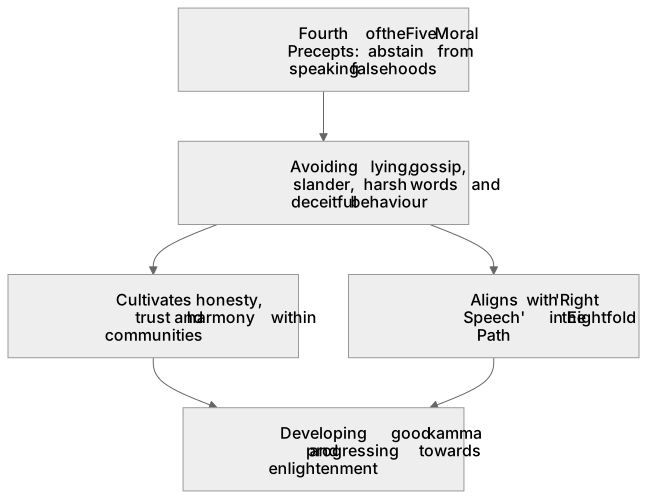
The fourth of the Five Moral Precepts in Buddhism requires followers to abstain from speaking falsehoods. This precept goes beyond simply not lying; it encompasses avoiding gossip, slander, harsh words, and deceitful behaviour. Buddhists practice this to cultivate honesty, trust, and harmony within their communities, which is essential for developing good kamma and progressing towards enlightenment. For example, a Buddhist might choose to remain silent rather than spread an unverified rumour, ensuring their speech is always truthful, kind, and beneficial. This aligns with 'Right Speech' in the Eightfold Path, demonstrating how ethical conduct underpins spiritual development.
What earns the marks
- Identifies the statement as the fourth of the Five Moral Precepts.
- Connects the precept to 'Right Speech' (samma vaca) on the Noble Eightfold Path.
- Explains the broader meaning of the precept, which includes avoiding lying, gossip, slander, and harsh or divisive speech.
- Links the practice of truthful speech to the accumulation of positive kamma and the reduction of suffering (dukkha).
Common mistakes and how to put them right
Thinking this precept only applies to direct lies.
Put it right: It also includes avoiding gossip, exaggeration, and harsh or divisive speech.
Confusing the Five Moral Precepts with the Noble Eightfold Path.
Put it right: While related to Right Speech, the precept is a specific training rule undertaken voluntarily, not just a step on the path.
Assuming breaking the precept results in punishment from a deity.
Put it right: Breaking the precept results in negative kamma as a natural consequence of unskilful action, not divine retribution.
Exam tips
- Use the term 'Right Speech' to show the connection between the Five Moral Precepts and the Noble Eightfold Path.
- Provide a concrete example of how a Buddhist might apply this in modern life, such as avoiding cyberbullying or spreading misinformation online.
- Explain how truthful speech builds trust and harmony within the sangha (Buddhist community).
Try the lesson
The start of the Buddhism - 3.1.1.2 Practices: do not speak falsehoods lesson, made from checked teaching notes for this specification point.
Have a go first
Which of the following is a requirement of the Five Moral Precepts in Buddhism regarding speech?
Listen
The fourth of the Five Moral Precepts in Buddhism requires followers to abstain from speaking falsehoods. This precept goes beyond simply not lying; it encompasses avoiding gossip, slander, harsh words, and deceitful behaviour. Buddhists practice this to cultivate honesty, trust, and harmony within their communities, which is essential for developing good kamma and progressing towards enlightenment. For example, a Buddhist might choose to remain silent rather than spread an unverified rumour, ensuring their speech is always truthful, kind, and beneficial. This aligns with 'Right Speech' in the Eightfold Path, demonstrating how ethical conduct underpins spiritual development. A strong answer earns marks for these points. Identifies the statement as the fourth of the Five Moral Precepts. Connects the precept to 'Right Speech' (samma vaca) on the Noble Eightfold Path. Explains the broader meaning of the precept, which includes avoiding lying, gossip, slander, and harsh or divisive speech. Links the practice of truthful speech to the accumulation of positive kamma and the reduction of suffering (dukkha). A common slip: Thinking this precept only applies to direct lies. Instead, It also includes avoiding gossip, exaggeration, and harsh or divisive speech. Exam tip: Use the term 'Right Speech' to show the connection between the Five Moral Precepts and the Noble Eightfold Path.
See it
Key words
Say what each word means before you turn the card.
The Five Moral Precepts
Try answering aloud or in your head before turning the card.
Kamma (Karma)
Try answering aloud or in your head before turning the card.
The Eightfold Path
Try answering aloud or in your head before turning the card.
See every definition
- The Five Moral Precepts
- The fourth of these requires followers to abstain from speaking falsehoods, a specific training rule undertaken voluntarily.
- Kamma (Karma)
- Developing good kamma is essential, and breaking the precept results in negative kamma as a natural consequence of unskilful action.
- The Eightfold Path
- 'Right Speech' on this path aligns with the precept, demonstrating how ethical conduct underpins spiritual development.
Label the diagram
Some boxes have lost their names. Pick the right name for each number.
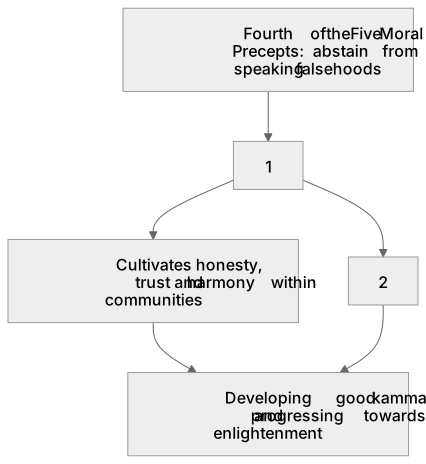
1Box 1
2Box 2
There is more to this lesson
The full lesson goes on to check your understanding and help you earn the marks. Create a free account to carry on, with your progress saved.
A week of Premium from your first lesson · Then the free plan continues · No card, no charge
Test your understanding of Buddhism - 3.1.1.2 Practices: do not speak falsehoods
Active recall beats re-reading. Take an instant quiz now to test what you’ve learned and lock it into long-term memory.
A week of Premium from your first lesson · Then the free plan continues · No card, no charge