AQA · GCSE · Religious Studies
Course version: 8062 · Version from Sept 2018
Buddhism - 3.1.1.2 Practices: do not misuse the senses
The precept 'do not misuse the senses' is the third of the Five Moral Precepts.
Checked against the AQA 8062 specification (opens in a new tab) on .
- Point 20 of 29
- 4 key terms
Study notes
From the checked teaching notes for this specification point.
The idea
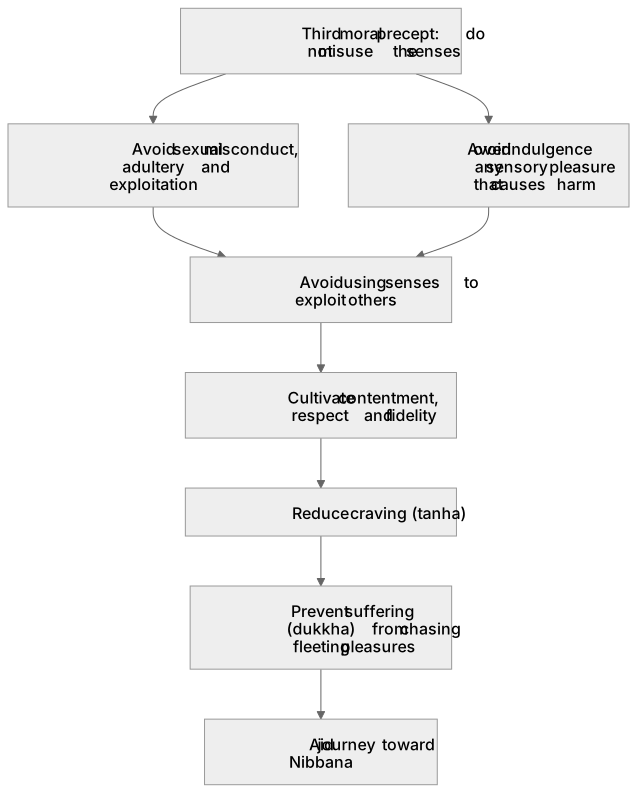
The precept 'do not misuse the senses' is the third of the Five Moral Precepts. It is often interpreted as avoiding sexual misconduct, but broadly encompasses refraining from any sensory overindulgence that causes harm. Buddhists are taught to avoid using their senses to exploit others or feed their own insatiable cravings. For example, this means avoiding adultery, sexual exploitation, or consuming media that promotes harmful desires. Instead, Buddhists cultivate contentment, respect, and fidelity. By controlling sensory desires, practitioners reduce attachment (tanha) and prevent the suffering (dukkha) that arises from chasing fleeting physical pleasures, aiding their journey toward Nibbana.
What earns the marks
- Identifies 'do not misuse the senses' as the third of the Five Moral Precepts.
- Explains that it involves avoiding sexual misconduct, adultery, and exploitation.
- Broadens the definition to include avoiding overindulgence in any sensory pleasure that leads to harm or craving.
- Links the observance of this precept to the reduction of craving (tanha) and the cultivation of contentment.
Common mistakes and how to put them right
Limiting the precept exclusively to sexual misconduct.
Put it right: Explain that while it primarily addresses sexual ethics, it also covers the broader misuse of any sensory pleasure.
Stating that Buddhism forbids all sensory pleasure.
Put it right: Clarify that Buddhism teaches the Middle Way, avoiding harmful overindulgence and attachment rather than demanding total sensory deprivation for laypeople.
Confusing this precept with the fifth precept about intoxicants.
Put it right: Ensure you distinguish between misusing the senses (third precept) and clouding the mind with drugs or alcohol (fifth precept).
Exam tips
- Connect this precept to the concept of the Middle Way, showing how Buddhists avoid extremes of indulgence.
- Use the concept of 'tanha' (craving) to explain why misusing the senses leads to suffering.
- Discuss how this precept promotes healthy, respectful relationships and protects individuals from emotional harm.
Try the lesson
The start of the Buddhism - 3.1.1.2 Practices: do not misuse the senses lesson, made from checked teaching notes for this specification point.
Have a go first
The third of the Five Moral Precepts in Buddhism instructs followers to avoid which of the following?
Listen
The precept 'do not misuse the senses' is the third of the Five Moral Precepts. It is often interpreted as avoiding sexual misconduct, but broadly encompasses refraining from any sensory overindulgence that causes harm. Buddhists are taught to avoid using their senses to exploit others or feed their own insatiable cravings. For example, this means avoiding adultery, sexual exploitation, or consuming media that promotes harmful desires. Instead, Buddhists cultivate contentment, respect, and fidelity. By controlling sensory desires, practitioners reduce attachment (tanha) and prevent the suffering (dukkha) that arises from chasing fleeting physical pleasures, aiding their journey toward Nibbana. A strong answer earns marks for these points. Identifies 'do not misuse the senses' as the third of the Five Moral Precepts. Explains that it involves avoiding sexual misconduct, adultery, and exploitation. Broadens the definition to include avoiding overindulgence in any sensory pleasure that leads to harm or craving. Links the observance of this precept to the reduction of craving (tanha) and the cultivation of contentment. A common slip: Limiting the precept exclusively to sexual misconduct. Instead, Explain that while it primarily addresses sexual ethics, it also covers the broader misuse of any sensory pleasure. Exam tip: Connect this precept to the concept of the Middle Way, showing how Buddhists avoid extremes of indulgence.
See it
Key words
Say what each word means before you turn the card.
The Five Moral Precepts
Try answering aloud or in your head before turning the card.
Craving (Tanha) and Suffering (Dukkha)
Try answering aloud or in your head before turning the card.
Sexual ethics and relationships
Try answering aloud or in your head before turning the card.
The Middle Way
Try answering aloud or in your head before turning the card.
See every definition
- The Five Moral Precepts
- The precept 'do not misuse the senses' is the third of these.
- Craving (Tanha) and Suffering (Dukkha)
- Controlling sensory desires reduces craving and prevents the suffering that arises from chasing fleeting physical pleasures.
- Sexual ethics and relationships
- The precept is often interpreted as avoiding sexual misconduct, adultery and exploitation, and promotes healthy, respectful relationships.
- The Middle Way
- Buddhism teaches avoiding harmful overindulgence and attachment rather than demanding total sensory deprivation for laypeople.
Label the diagram
Some boxes have lost their names. Pick the right name for each number.
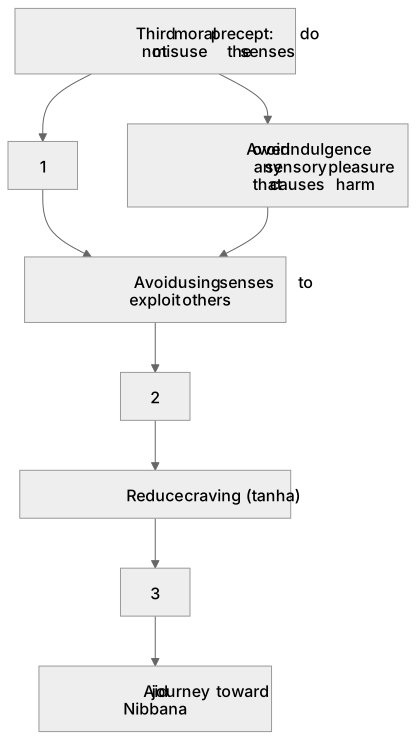
1Box 1
2Box 2
3Box 3
There is more to this lesson
The full lesson goes on to check your understanding and help you earn the marks. Create a free account to carry on, with your progress saved.
A week of Premium from your first lesson · Then the free plan continues · No card, no charge
Test your understanding of Buddhism - 3.1.1.2 Practices: do not misuse the senses
Active recall beats re-reading. Take an instant quiz now to test what you’ve learned and lock it into long-term memory.
A week of Premium from your first lesson · Then the free plan continues · No card, no charge