AQA · GCSE · Religious Studies
Course version: 8062 · Version from Sept 2018
Buddhism - 3.1.1.2 Practices: Ethical teaching:
In Buddhism, ethical teaching (sila) forms the foundation of spiritual practice and is essential for progressing towards enlightenment.
Checked against the AQA 8062 specification (opens in a new tab) on .
- Point 13 of 29
- 3 key terms
Study notes
From the checked teaching notes for this specification point.
The idea
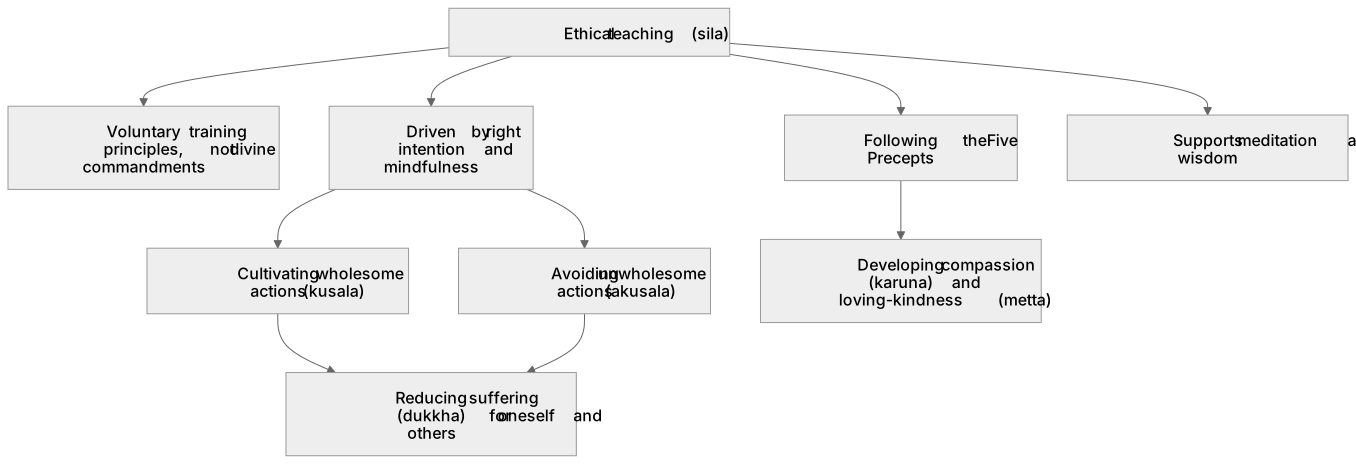
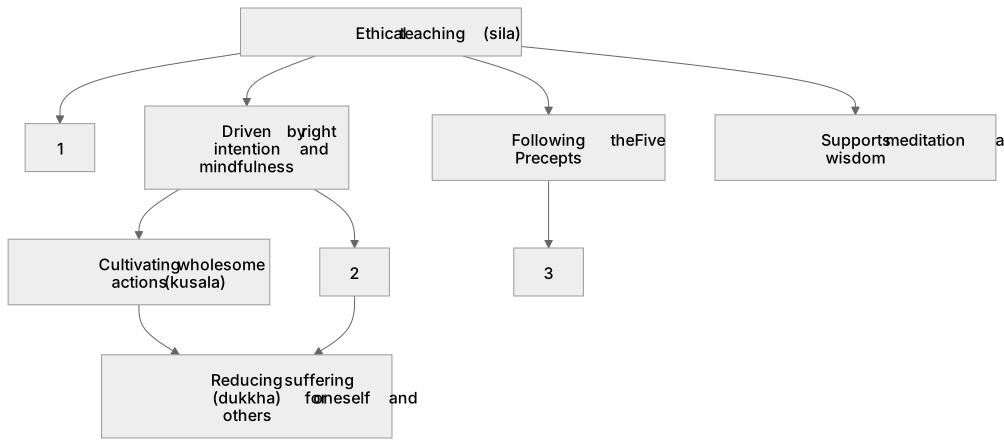
In Buddhism, ethical teaching (sila) forms the foundation of spiritual practice and is essential for progressing towards enlightenment. It is not a set of divine commandments, but rather a framework of training principles designed to reduce suffering (dukkha) for oneself and others. Ethical behaviour is driven by right intention and mindfulness, focusing on cultivating wholesome actions (kusala) and avoiding unwholesome ones (akusala). For example, a Buddhist applies ethical teaching by following the Five Precepts, such as refraining from taking life, which actively develops compassion (karuna) and loving-kindness (metta). This ethical foundation directly supports meditation and wisdom.
What earns the marks
- Define Buddhist ethics (sila) as voluntary principles of training rather than strict divine laws.
- Explain the connection between ethical behaviour and the reduction of suffering (dukkha).
- Identify the role of intention (cetana) in determining whether an action is ethically wholesome or unwholesome.
- Explain how ethical teachings form one of the three divisions of the Noble Eightfold Path, supporting meditation and wisdom.
Common mistakes and how to put them right
Describing Buddhist ethical teachings as commandments from a creator god.
Put it right: Explain that they are voluntary training precepts undertaken to aid personal spiritual development.
Assuming ethical teachings only apply to monks and nuns.
Put it right: Clarify that foundational ethical teachings, like the Five Precepts, apply to all lay Buddhists as well.
Viewing ethical actions purely in terms of outward behaviour.
Put it right: Emphasise that the underlying intention (cetana) is just as important as the physical action in Buddhist ethics.
Exam tips
- Always link Buddhist ethical teachings back to the ultimate goal of achieving enlightenment and escaping samsara.
- Use specific Pali terms like 'sila' (ethics) and 'kusala' (wholesome) to demonstrate precise subject knowledge.
- When evaluating ethical teachings, contrast how they might be applied differently by lay Buddhists compared to the monastic sangha.
Try the lesson
The start of the Buddhism - 3.1.1.2 Practices: Ethical teaching: lesson, made from checked teaching notes for this specification point.
Have a go first
What is the primary purpose of following ethical teachings (sila) in Buddhist practice?
Listen
In Buddhism, ethical teaching (sila) forms the foundation of spiritual practice and is essential for progressing towards enlightenment. It is not a set of divine commandments, but rather a framework of training principles designed to reduce suffering (dukkha) for oneself and others. Ethical behaviour is driven by right intention and mindfulness, focusing on cultivating wholesome actions (kusala) and avoiding unwholesome ones (akusala). For example, a Buddhist applies ethical teaching by following the Five Precepts, such as refraining from taking life, which actively develops compassion (karuna) and loving-kindness (metta). This ethical foundation directly supports meditation and wisdom. A strong answer earns marks for these points. Define Buddhist ethics (sila) as voluntary principles of training rather than strict divine laws. Explain the connection between ethical behaviour and the reduction of suffering (dukkha). Identify the role of intention (cetana) in determining whether an action is ethically wholesome or unwholesome. Explain how ethical teachings form one of the three divisions of the Noble Eightfold Path, supporting meditation and wisdom. A common slip: Describing Buddhist ethical teachings as commandments from a creator god. Instead, Explain that they are voluntary training precepts undertaken to aid personal spiritual development. Exam tip: Always link Buddhist ethical teachings back to the ultimate goal of achieving enlightenment and escaping samsara.
See it
Key words
Say what each word means before you turn the card.
Sila (Ethics)
Try answering aloud or in your head before turning the card.
Intention (Cetana)
Try answering aloud or in your head before turning the card.
Compassion (Karuna)
Try answering aloud or in your head before turning the card.
See every definition
- Sila (Ethics)
- Ethical teaching that forms the foundation of spiritual practice and is essential for progressing towards enlightenment.
- Intention (Cetana)
- The underlying intention that is just as important as the physical action in Buddhist ethics.
- Compassion (Karuna)
- Actively developed by following the Five Precepts, such as refraining from taking life.
Label the diagram
Some boxes have lost their names. Pick the right name for each number.
1Box 1
2Box 2
3Box 3
There is more to this lesson
The full lesson goes on to check your understanding and help you earn the marks. Create a free account to carry on, with your progress saved.
A week of Premium from your first lesson · Then the free plan continues · No card, no charge
Test your understanding of Buddhism - 3.1.1.2 Practices: Ethical teaching:
Active recall beats re-reading. Take an instant quiz now to test what you’ve learned and lock it into long-term memory.
A week of Premium from your first lesson · Then the free plan continues · No card, no charge