AQA · GCSE · Religious Studies
Course version: 8062 · Version from Sept 2018
Buddhism - 3.1.1.2 Practices: kamma (karma) and rebirth
Kamma (karma) is the Buddhist principle of cause and effect, where intentional actions (physical, verbal, or mental) produce corresponding consequences.
Checked against the AQA 8062 specification (opens in a new tab) on .
- Point 14 of 29
- 4 key terms
Study notes
From the checked teaching notes for this specification point.
The idea
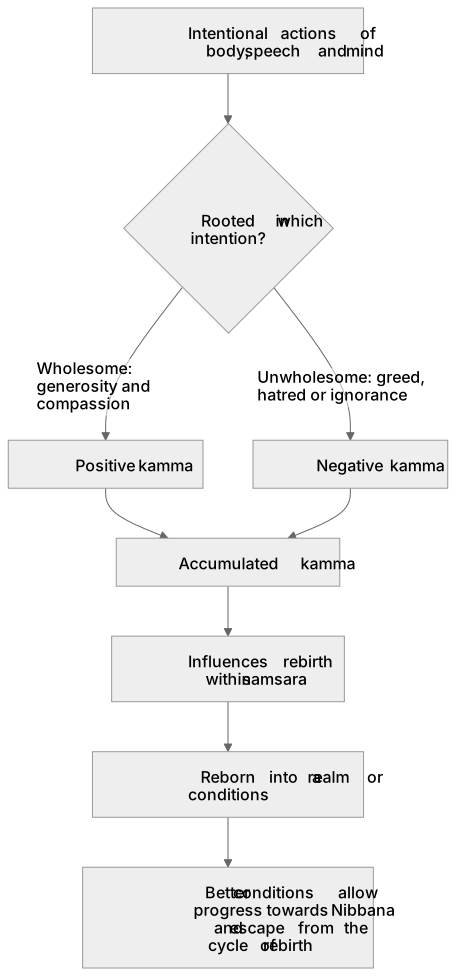
Kamma (karma) is the Buddhist principle of cause and effect, where intentional actions (physical, verbal, or mental) produce corresponding consequences. Wholesome actions rooted in generosity and compassion generate positive kamma, while unwholesome actions rooted in greed, hatred, or ignorance generate negative kamma. This accumulated kamma directly influences rebirth, the continuous cycle of being born, dying, and being born again (samsara).
For example: A person who consistently acts with cruelty may be reborn into a realm of suffering, whereas ethical behaviour leads to a favourable rebirth, providing better conditions for achieving enlightenment (Nibbana) and ultimately escaping the cycle of rebirth entirely.
What earns the marks
- Define kamma as intentional action that drives the cycle of cause and effect.
- Explain that kamma is generated by actions of body, speech, and mind, rooted in either wholesome or unwholesome intentions.
- Describe rebirth as the continuation of karmic energy into a new existence, rather than the transmigration of a permanent soul (anatta).
- Link the accumulation of kamma to the specific realm or conditions of a being's subsequent rebirth within samsara.
Common mistakes and how to put them right
Confusing rebirth with reincarnation by suggesting a permanent soul moves to a new body.
Put it right: Use the concept of anatta (no-self) to explain that it is karmic energy, not a soul, that continues.
Treating kamma as a system of divine reward and punishment.
Put it right: Explain kamma as a natural, impersonal law of cause and effect, like gravity.
Stating that kamma is just about physical actions.
Put it right: Emphasise that mental intentions and verbal actions also generate karmic consequences.
Exam tips
- Use the analogy of a candle lighting another candle to explain rebirth without a permanent soul.
- Connect the concept of kamma to the Three Poisons (greed, hatred, ignorance) when explaining what causes negative karmic consequences.
- In evaluation questions, discuss whether the desire for a favourable rebirth is a lesser goal compared to the ultimate goal of Nibbana.
Try the lesson
The start of the Buddhism - 3.1.1.2 Practices: kamma (karma) and rebirth lesson, made from checked teaching notes for this specification point.
Have a go first
In Buddhist teaching, what does the term 'kamma' (karma) literally translate to?
Listen
Kamma (karma) is the Buddhist principle of cause and effect, where intentional actions (physical, verbal, or mental) produce corresponding consequences. Wholesome actions rooted in generosity and compassion generate positive kamma, while unwholesome actions rooted in greed, hatred, or ignorance generate negative kamma. This accumulated kamma directly influences rebirth, the continuous cycle of being born, dying, and being born again (samsara). For example, a person who consistently acts with cruelty may be reborn into a realm of suffering, whereas ethical behaviour leads to a favourable rebirth, providing better conditions for achieving enlightenment (Nibbana) and ultimately escaping the cycle of rebirth entirely. A strong answer earns marks for these points. Define kamma as intentional action that drives the cycle of cause and effect. Explain that kamma is generated by actions of body, speech, and mind, rooted in either wholesome or unwholesome intentions. Describe rebirth as the continuation of karmic energy into a new existence, rather than the transmigration of a permanent soul (anatta). Link the accumulation of kamma to the specific realm or conditions of a being's subsequent rebirth within samsara. A common slip: Confusing rebirth with reincarnation by suggesting a permanent soul moves to a new body. Instead, Use the concept of anatta (no-self) to explain that it is karmic energy, not a soul, that continues. Exam tip: Use the analogy of a candle lighting another candle to explain rebirth without a permanent soul.
See it
Key words
Say what each word means before you turn the card.
Kamma (Karma)
Try answering aloud or in your head before turning the card.
Rebirth
Try answering aloud or in your head before turning the card.
Samsara
Try answering aloud or in your head before turning the card.
Anatta (No-self)
Try answering aloud or in your head before turning the card.
See every definition
- Kamma (Karma)
- The Buddhist principle of cause and effect, where intentional actions produce corresponding consequences.
- Rebirth
- The continuation of karmic energy into a new existence, rather than the transmigration of a permanent soul.
- Samsara
- The continuous cycle of being born, dying, and being born again.
- Anatta (No-self)
- The concept that it is karmic energy, not a soul, that continues.
There is more to this lesson
The full lesson goes on to check your understanding and help you earn the marks. Create a free account to carry on, with your progress saved.
A week of Premium from your first lesson · Then the free plan continues · No card, no charge
Test your understanding of Buddhism - 3.1.1.2 Practices: kamma (karma) and rebirth
Active recall beats re-reading. Take an instant quiz now to test what you’ve learned and lock it into long-term memory.
A week of Premium from your first lesson · Then the free plan continues · No card, no charge