AQA · GCSE · Religious Studies
Course version: 8062 · Version from Sept 2018
The practice and significance of different ceremonies and rituals…
Full specification wording
Buddhism - 3.1.1.2 Practices: The practice and significance of different ceremonies and rituals associated with death and mourning in Theravada communities and in Japan and Tibet.
Buddhist death rituals reflect the core belief in impermanence (anicca) and rebirth.
Checked against the AQA 8062 specification (opens in a new tab) on .
- Point 8 of 29
- 4 key terms
Study notes
From the checked teaching notes for this specification point.
The idea
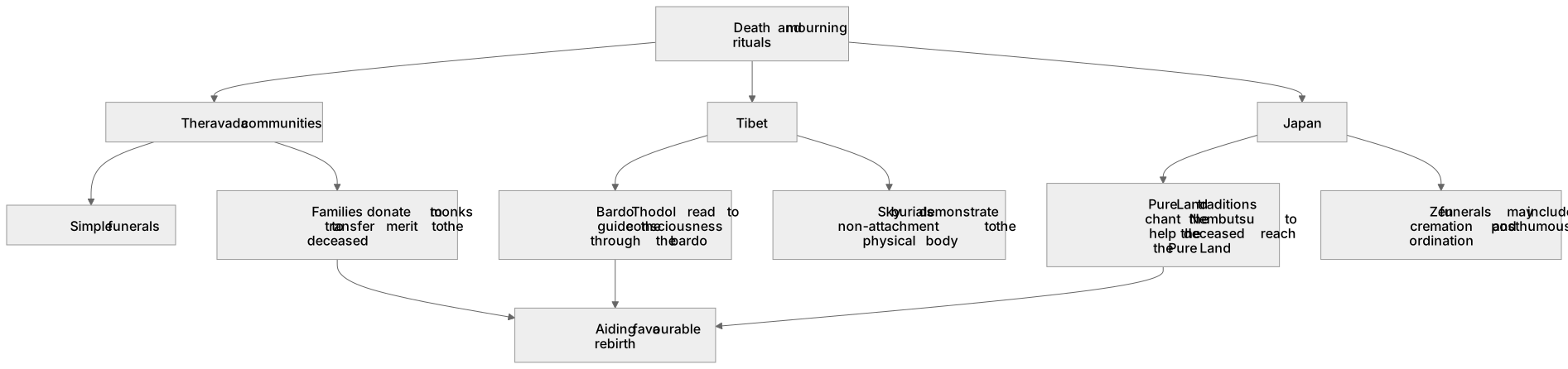
Buddhist death rituals reflect the core belief in impermanence (anicca) and rebirth. In Theravada communities, funerals are simple; families donate to monks to transfer merit to the deceased, aiding their favourable rebirth. In Tibet, the 'Bardo Thodol' (Tibetan Book of the Dead) is read to guide the consciousness through the bardo (intermediate state), and sky burials are traditionally practised to demonstrate non-attachment to the physical body. In Japan, Pure Land traditions often involve chanting the Nembutsu to help the deceased reach the Pure Land, while Zen funerals may include the cremation of the body and the posthumous ordination of the deceased. Across all traditions, these ceremonies provide comfort and reinforce key dharma teachings.
What earns the marks
- Theravada practices: transferring merit to the deceased through almsgiving and cloth donations to monks to ensure a favourable rebirth.
- Tibetan practices: reading the Tibetan Book of the Dead to guide the consciousness, and the tradition of sky burials to show impermanence and compassion.
- Japanese practices: chanting the Nembutsu (Pure Land) or posthumous ordination (Zen), followed by cremation and picking bones from the ashes.
- The shared significance of death rituals across traditions in demonstrating impermanence (anicca) and positively influencing the deceased's karmic transition.
Common mistakes and how to put them right
Stating that all Buddhists have sky burials.
Put it right: Specify that sky burials are unique to Tibetan Buddhism due to geographical and specific Vajrayana cultural factors.
Believing Buddhist funerals focus on mourning the end of existence.
Put it right: Emphasise that funerals focus on transition, rebirth, and transferring merit to aid the deceased in their next life.
Confusing the Tibetan Book of the Dead with Japanese Pure Land chanting.
Put it right: Clearly separate Tibetan bardo guidance from Japanese Nembutsu chanting aimed at rebirth in Amitabha's Pure Land.
Exam tips
- Compare and contrast the simplicity of Theravada merit-making with the elaborate rituals of Tibetan or Japanese funerals.
- Always link the specific funeral practice back to core Buddhist beliefs, such as anicca (impermanence), karma, or rebirth.
- Use the correct terminology for each tradition, such as 'bardo' for Tibet and 'Nembutsu' for Japan, to access higher marks.
Try the lesson
The start of the Buddhism - 3.1.1.2 Practices: The practice and significance of different ceremonies and rituals associated with death and mourning in Theravada communities and in Japan and Tibet. lesson, made from checked teaching notes for this specification point.
Have a go first
In Theravada Buddhist communities, what is a common practice during a funeral ceremony?
Listen
Buddhist death rituals reflect the core belief in impermanence (anicca) and rebirth. In Theravada communities, funerals are simple; families donate to monks to transfer merit to the deceased, aiding their favourable rebirth. In Tibet, the 'Bardo Thodol' (Tibetan Book of the Dead) is read to guide the consciousness through the bardo (intermediate state), and sky burials are traditionally practised to demonstrate non-attachment to the physical body. In Japan, Pure Land traditions often involve chanting the Nembutsu to help the deceased reach the Pure Land, while Zen funerals may include the cremation of the body and the posthumous ordination of the deceased. Across all traditions, these ceremonies provide comfort and reinforce key dharma teachings. A strong answer earns marks for these points. Theravada practices: transferring merit to the deceased through almsgiving and cloth donations to monks to ensure a favourable rebirth. Tibetan practices: reading the Tibetan Book of the Dead to guide the consciousness, and the tradition of sky burials to show impermanence and compassion. Japanese practices: chanting the Nembutsu (Pure Land) or posthumous ordination (Zen), followed by cremation and picking bones from the ashes. The shared significance of death rituals across traditions in demonstrating impermanence (anicca) and positively influencing the deceased's karmic transition. A common slip: Stating that all Buddhists have sky burials. Instead, Specify that sky burials are unique to Tibetan Buddhism due to geographical and specific Vajrayana cultural factors. Exam tip: Compare and contrast the simplicity of Theravada merit-making with the elaborate rituals of Tibetan or Japanese funerals.
See it
Key words
Say what each word means before you turn the card.
Impermanence (Anicca)
Try answering aloud or in your head before turning the card.
Rebirth and Karma
Try answering aloud or in your head before turning the card.
Compassion and Merit
Try answering aloud or in your head before turning the card.
Cultural variations in practice
Try answering aloud or in your head before turning the card.
See every definition
- Impermanence (Anicca)
- The core belief that death rituals reflect, shown in Tibetan sky burials demonstrating non-attachment to the physical body.
- Rebirth and Karma
- The belief that death rituals reflect, with merit transferred to the deceased to aid their favourable rebirth and karmic transition.
- Compassion and Merit
- Families donate to monks to transfer merit to the deceased, and sky burials show impermanence and compassion.
- Cultural variations in practice
- The different ceremonies and rituals associated with death and mourning in Theravada communities and in Japan and Tibet.
Label the diagram
Some boxes have lost their names. Pick the right name for each number.
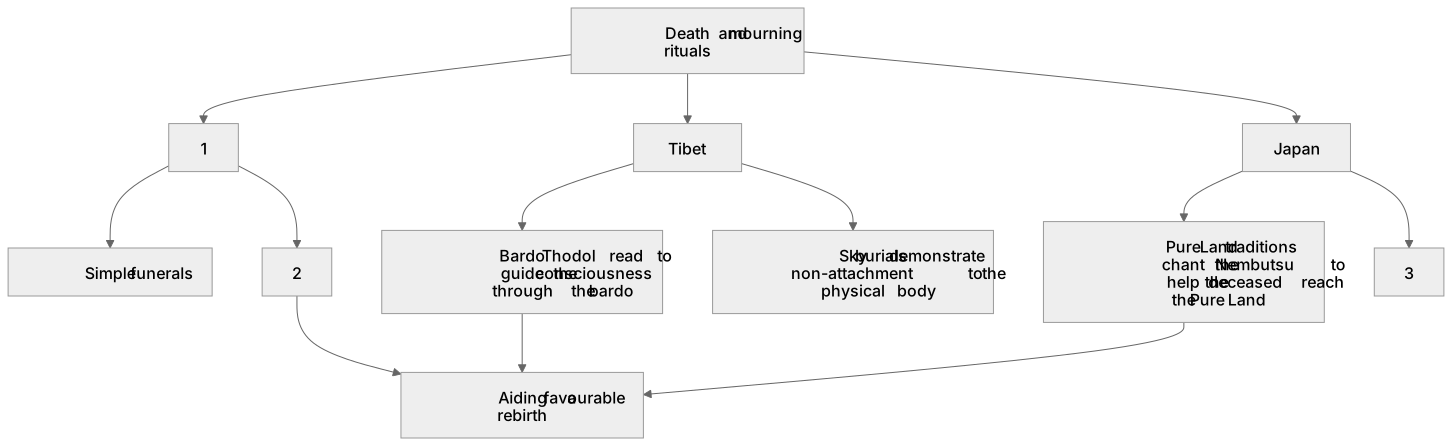
1Box 1
2Box 2
3Box 3
There is more to this lesson
The full lesson goes on to check your understanding and help you earn the marks. Create a free account to carry on, with your progress saved.
A week of Premium from your first lesson · Then the free plan continues · No card, no charge
Test your understanding of Buddhism - 3.1.1.2 Practices: The practice and significance of different ceremonies and rituals associated with death and mourning in Theravada communities and in Japan and Tibet.
Active recall beats re-reading. Take an instant quiz now to test what you’ve learned and lock it into long-term memory.
A week of Premium from your first lesson · Then the free plan continues · No card, no charge