AQA · GCSE · Religious Studies
Course version: 8062 · Version from Sept 2018
Buddhism - 3.1.1.2 Practices: the visualisation of Buddhas and Bodhisattvas.
Visualisation (deity yoga) is a profound meditation practice primarily found in Mahayana and Vajrayana Buddhism.
Checked against the AQA 8062 specification (opens in a new tab) on .
- Point 7 of 29
- 4 key terms
Study notes
From the checked teaching notes for this specification point.
The idea
Visualisation (deity yoga) is a profound meditation practice primarily found in Mahayana and Vajrayana Buddhism. Practitioners vividly imagine a Buddha or Bodhisattva in their mind, focusing on their intricate details, spiritual qualities, and associated mantras. For example, visualising Avalokiteshvara (the Bodhisattva of compassion) helps a Buddhist cultivate deep compassion within themselves. Practitioners often use physical aids like thangkas (detailed paintings) or mandalas to guide their mental imagery. The ultimate goal is not to worship the deity as an external god, but to merge with their enlightened qualities, realising that the practitioner possesses the same Buddha-nature and potential for awakening.
What earns the marks
- Definition of visualisation as mentally picturing a Buddha or Bodhisattva to cultivate their specific enlightened qualities.
- Use of physical aids such as thangkas (intricate paintings) or mandalas (geometric patterns) to help focus the mind during meditation.
- Examples of figures visualised, such as Amitabha Buddha (for Pure Land rebirth) or Avalokiteshvara (for developing compassion).
- The theological purpose of awakening one's own Buddha-nature by identifying with and internalising the enlightened being's attributes.
Common mistakes and how to put them right
Thinking Buddhists worship the visualised Buddha as a creator God.
Put it right: Understand that the visualised figure represents enlightened qualities the practitioner aims to develop within themselves.
Confusing visualisation with simple concentration meditation (samatha).
Put it right: Distinguish visualisation as a complex practice involving detailed imagery and the cultivation of specific spiritual attributes, often part of Vajrayana deity yoga.
Assuming all Buddhists practice visualisation.
Put it right: Specify that this practice is characteristic of Mahayana and Vajrayana (Tibetan) traditions, rather than Theravada Buddhism.
Exam tips
- Use specific examples of Bodhisattvas, such as Avalokiteshvara or Tara, to illustrate the qualities a practitioner seeks to develop.
- Explain the connection between visualisation and the concept of Buddha-nature when evaluating the effectiveness of this practice.
- Mention physical aids like thangkas and mandalas to demonstrate a practical understanding of how visualisation is performed.
Try the lesson
The start of the Buddhism - 3.1.1.2 Practices: the visualisation of Buddhas and Bodhisattvas. lesson, made from checked teaching notes for this specification point.
Have a go first
What is the primary purpose of visualising a Buddha or Bodhisattva during meditation?
Listen
Visualisation (deity yoga) is a profound meditation practice primarily found in Mahayana and Vajrayana Buddhism. Practitioners vividly imagine a Buddha or Bodhisattva in their mind, focusing on their intricate details, spiritual qualities, and associated mantras. For example, visualising Avalokiteshvara (the Bodhisattva of compassion) helps a Buddhist cultivate deep compassion within themselves. Practitioners often use physical aids like thangkas (detailed paintings) or mandalas to guide their mental imagery. The ultimate goal is not to worship the deity as an external god, but to merge with their enlightened qualities, realising that the practitioner possesses the same Buddha-nature and potential for awakening. A strong answer earns marks for these points. Definition of visualisation as mentally picturing a Buddha or Bodhisattva to cultivate their specific enlightened qualities. Use of physical aids such as thangkas (intricate paintings) or mandalas (geometric patterns) to help focus the mind during meditation. Examples of figures visualised, such as Amitabha Buddha (for Pure Land rebirth) or Avalokiteshvara (for developing compassion). The theological purpose of awakening one's own Buddha-nature by identifying with and internalising the enlightened being's attributes. A common slip: Thinking Buddhists worship the visualised Buddha as a creator God. Instead, Understand that the visualised figure represents enlightened qualities the practitioner aims to develop within themselves. Exam tip: Use specific examples of Bodhisattvas, such as Avalokiteshvara or Tara, to illustrate the qualities a practitioner seeks to develop.
See it
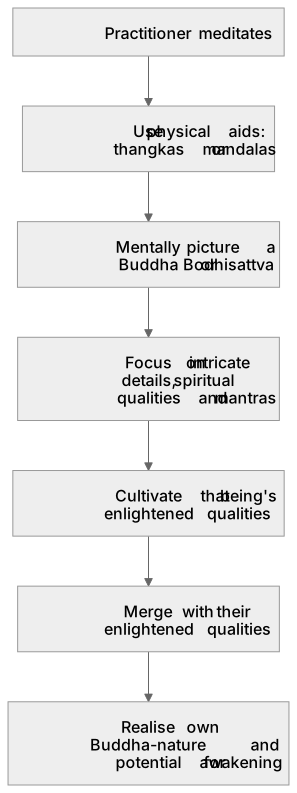
Put it in order
Put these steps in the order they happen.
- 1. Realise own Buddha-nature and potential for awakening
- 2. Merge with their enlightened qualities
- 3. Mentally picture a Buddha or Bodhisattva
- 4. Cultivate that being's enlightened qualities
- 5. Practitioner meditates
- 6. Use physical aids: thangkas or mandalas
- 7. Focus on intricate details, spiritual qualities and mantras
Key words
Say what each word means before you turn the card.
Visualisation
Try answering aloud or in your head before turning the card.
Mahayana and Vajrayana traditions
Try answering aloud or in your head before turning the card.
Buddha-nature
Try answering aloud or in your head before turning the card.
Spiritual development and compassion
Try answering aloud or in your head before turning the card.
See every definition
- Visualisation
- Mentally picturing a Buddha or Bodhisattva to cultivate their specific enlightened qualities.
- Mahayana and Vajrayana traditions
- Traditions in which visualisation is primarily found, rather than Theravada Buddhism.
- Buddha-nature
- The same potential for awakening that the practitioner possesses and realises by merging with the enlightened qualities.
- Spiritual development and compassion
- Cultivating deep compassion within themselves, for example by visualising Avalokiteshvara, the Bodhisattva of compassion.
Label the diagram
Some boxes have lost their names. Pick the right name for each number.
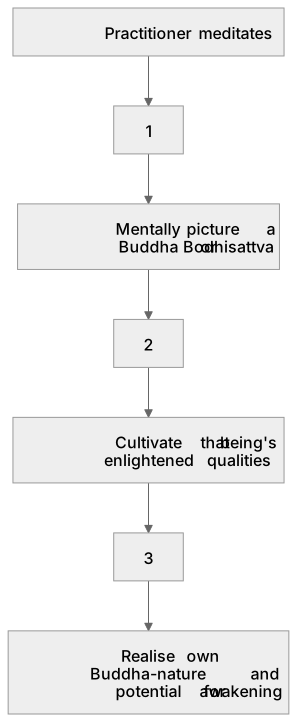
1Box 1
2Box 2
3Box 3
There is more to this lesson
The full lesson goes on to check your understanding and help you earn the marks. Create a free account to carry on, with your progress saved.
A week of Premium from your first lesson · Then the free plan continues · No card, no charge
Test your understanding of Buddhism - 3.1.1.2 Practices: the visualisation of Buddhas and Bodhisattvas.
Active recall beats re-reading. Take an instant quiz now to test what you’ve learned and lock it into long-term memory.
A week of Premium from your first lesson · Then the free plan continues · No card, no charge