AQA · GCSE · Religious Studies
Course version: 8062 · Version from Sept 2018
Wisdom, including how the individual develops these perfections within…
Full specification wording
Buddhism - 3.1.1.2 Practices: wisdom, including how the individual develops these perfections within themselves.
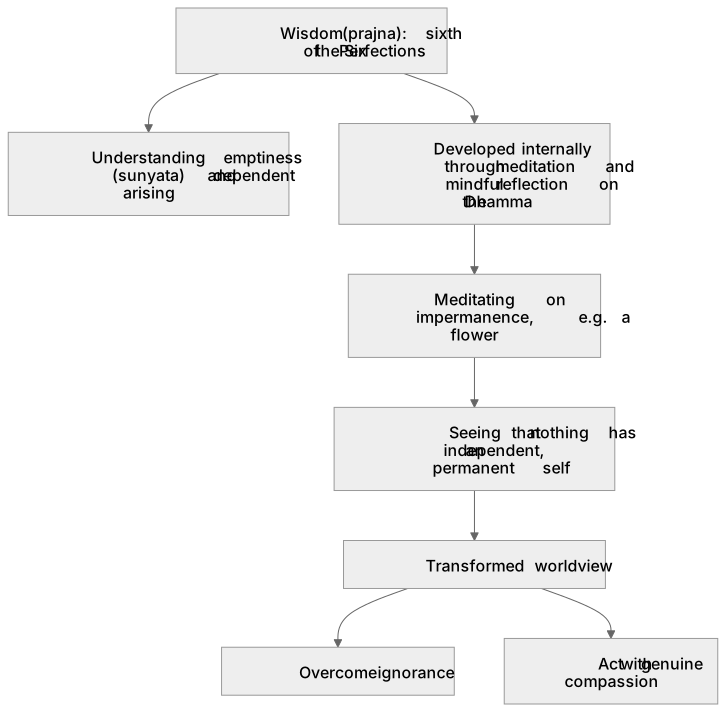
In Mahayana Buddhism, wisdom (prajna) is the sixth of the Six Perfections (Paramitas) and is essential for achieving enlightenment.
Checked against the AQA 8062 specification (opens in a new tab) on .
- Point 29 of 29
- 3 key terms
Study notes
From the checked teaching notes for this specification point.
The idea
In Mahayana Buddhism, wisdom (prajna) is the sixth of the Six Perfections (Paramitas) and is essential for achieving enlightenment. It involves a deep, experiential understanding of the true nature of reality, particularly the concepts of emptiness (sunyata) and dependent arising. A Buddhist develops this perfection within themselves not merely through academic study, but through dedicated meditation and mindful reflection on the Buddha's teachings (Dhamma). For example, by meditating on the impermanent nature of a flower, an individual cultivates the wisdom to see that nothing possesses an independent, permanent self. This internal development transforms their worldview, allowing them to overcome ignorance and act with genuine compassion.
What earns the marks
- Wisdom (prajna) is the culmination of the Six Perfections in Mahayana Buddhism, essential for attaining Buddhahood.
- Individuals develop this perfection internally through rigorous meditation and mindful application of the Dhamma in daily life.
- Developing wisdom allows a Buddhist to overcome ignorance (avidya), which is the root cause of suffering (dukkha).
Common mistakes and how to put them right
Confusing wisdom with general intelligence.
Put it right by explaining that Buddhist wisdom specifically refers to understanding the true nature of reality, such as impermanence and emptiness.
Assuming perfections are granted by a deity.
Put it right by emphasising that individuals must actively develop these perfections within themselves through personal effort and meditation.
Treating wisdom as entirely separate from the other perfections.
Put it right by noting that wisdom guides and completes the other five perfections, such as generosity and patience.
Exam tips
- Use the Sanskrit term 'prajna' alongside 'wisdom' to demonstrate precise subject vocabulary.
- Link the development of wisdom directly to specific practices, such as vipassana (insight) meditation.
- Explain how developing wisdom internally leads to external changes in a Buddhist's ethical behaviour and compassion.
Try the lesson
The start of the Buddhism - 3.1.1.2 Practices: wisdom, including how the individual develops these perfections within themselves. lesson, made from checked teaching notes for this specification point.
Have a go first
In Mahayana Buddhism, which practice is most directly associated with developing the perfection of wisdom (prajna)?
Listen
In Mahayana Buddhism, wisdom (prajna) is the sixth of the Six Perfections (Paramitas) and is essential for achieving enlightenment. It involves a deep, experiential understanding of the true nature of reality, particularly the concepts of emptiness (sunyata) and dependent arising. A Buddhist develops this perfection within themselves not merely through academic study, but through dedicated meditation and mindful reflection on the Buddha's teachings (Dhamma). For example, by meditating on the impermanent nature of a flower, an individual cultivates the wisdom to see that nothing possesses an independent, permanent self. This internal development transforms their worldview, allowing them to overcome ignorance and act with genuine compassion. A strong answer earns marks for these points. Wisdom (prajna) is the culmination of the Six Perfections in Mahayana Buddhism, essential for attaining Buddhahood. Individuals develop this perfection internally through rigorous meditation and mindful application of the Dhamma in daily life. Developing wisdom allows a Buddhist to overcome ignorance (avidya), which is the root cause of suffering (dukkha). A common slip: Confusing wisdom with general intelligence. Instead, explaining that Buddhist wisdom specifically refers to understanding the true nature of reality, such as impermanence and emptiness. Exam tip: Use the Sanskrit term 'prajna' alongside 'wisdom' to demonstrate precise subject vocabulary.
See it
Key words
Say what each word means before you turn the card.
The Six Perfections
Try answering aloud or in your head before turning the card.
Meditation
Try answering aloud or in your head before turning the card.
Emptiness (Sunyata)
Try answering aloud or in your head before turning the card.
See every definition
- The Six Perfections
- In Mahayana Buddhism, wisdom is the sixth of these, and wisdom guides and completes the other five.
- Meditation
- A dedicated practice through which a Buddhist develops wisdom within themselves, alongside mindful reflection on the Buddha's teachings.
- Emptiness (Sunyata)
- A core Buddhist concept concerning the true nature of reality, which wisdom requires a profound understanding of.
Label the diagram
Some boxes have lost their names. Pick the right name for each number.
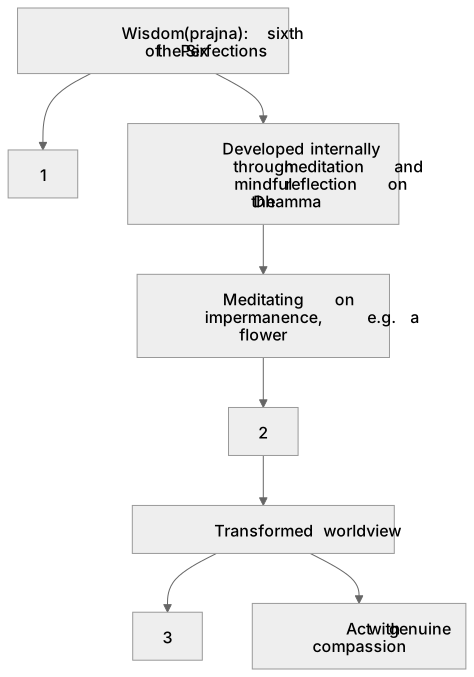
1Box 1
2Box 2
3Box 3
There is more to this lesson
The full lesson goes on to check your understanding and help you earn the marks. Create a free account to carry on, with your progress saved.
A week of Premium from your first lesson · Then the free plan continues · No card, no charge
Test your understanding of Buddhism - 3.1.1.2 Practices: wisdom, including how the individual develops these perfections within themselves.
Active recall beats re-reading. Take an instant quiz now to test what you’ve learned and lock it into long-term memory.
A week of Premium from your first lesson · Then the free plan continues · No card, no charge