AQA · GCSE · Religious Studies
Course version: 8062 · Version from Sept 2018
Buddhism - 3.1.1.2 Practices: meditation
In Buddhist practice, meditation is a central method for developing the mind and progressing towards enlightenment.
Checked against the AQA 8062 specification (opens in a new tab) on .
- Point 28 of 29
- 3 key terms
Study notes
From the checked teaching notes for this specification point.
The idea
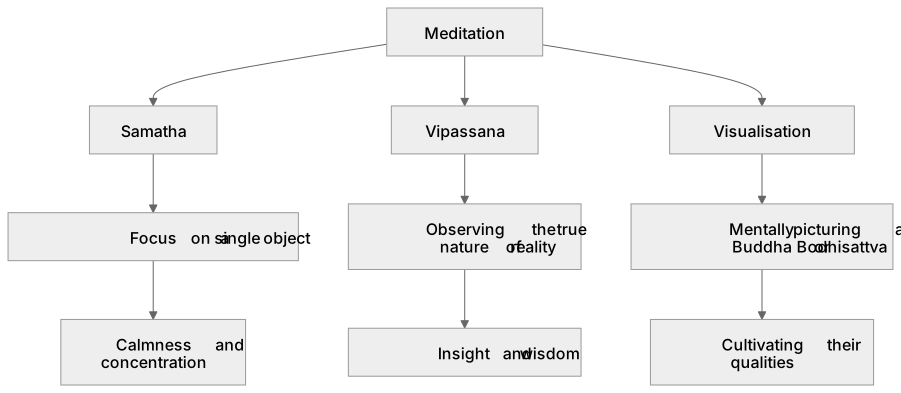
In Buddhist practice, meditation is a central method for developing the mind and progressing towards enlightenment. Samatha (calmness) meditation involves focusing on a single object, such as breathing or a kasina, to develop deep concentration and tranquility. Vipassana (insight) meditation involves observing the true nature of reality, such as the Three Marks of Existence, to gain wisdom. In Mahayana Buddhism, visualisation is also practised, where a practitioner mentally pictures a Buddha or Bodhisattva, such as Amitabha, to cultivate their qualities. Understanding the distinct aims and methods of these practices is essential.
What earns the marks
- Explain Samatha meditation as the practice of calming the mind and developing concentration, often using mindfulness of breathing.
- Describe Vipassana meditation as insight meditation aimed at understanding the true nature of reality, such as impermanence.
- Explain the practice of visualisation in Mahayana Buddhism, where practitioners mentally picture a Buddha or Bodhisattva to absorb their spiritual qualities.
- Contrast the aims of Samatha (tranquility and focus) with Vipassana (insight and wisdom).
Common mistakes and how to put them right
Confusing Samatha and Vipassana meditation.
Put it right: Samatha focuses on calmness and concentration, while Vipassana focuses on insight into the nature of reality.
Thinking visualisation is just imagining a peaceful scene.
Put it right: In Buddhism, visualisation specifically involves picturing a Buddha or Bodhisattva to cultivate their enlightened qualities.
Assuming all Buddhists meditate in the exact same way.
Put it right: Acknowledge that different traditions emphasise different practices, such as visualisation in Tibetan Buddhism.
Exam tips
- Use specific examples, such as focusing on a kasina for Samatha or visualising Amitabha Buddha, to support your explanations.
- When evaluating the importance of meditation, discuss how Samatha provides the calm foundation necessary for Vipassana insight.
Try the lesson
The start of the Buddhism - 3.1.1.2 Practices: meditation lesson, made from checked teaching notes for this specification point.
Have a go first
In the context of the Six Perfections, what is the primary focus of meditation (samadhi)?
Listen
In Buddhist practice, meditation is a central method for developing the mind and progressing towards enlightenment. Samatha (calmness) meditation involves focusing on a single object, such as breathing or a kasina, to develop deep concentration and tranquility. Vipassana (insight) meditation involves observing the true nature of reality, such as the Three Marks of Existence, to gain wisdom. In Mahayana Buddhism, visualisation is also practised, where a practitioner mentally pictures a Buddha or Bodhisattva, such as Amitabha, to cultivate their qualities. Understanding the distinct aims and methods of these practices is essential. A strong answer earns marks for these points. Explain Samatha meditation as the practice of calming the mind and developing concentration, often using mindfulness of breathing. Describe Vipassana meditation as insight meditation aimed at understanding the true nature of reality, such as impermanence. Explain the practice of visualisation in Mahayana Buddhism, where practitioners mentally picture a Buddha or Bodhisattva to absorb their spiritual qualities. Contrast the aims of Samatha (tranquility and focus) with Vipassana (insight and wisdom). A common slip: Confusing Samatha and Vipassana meditation. Instead, Samatha focuses on calmness and concentration, while Vipassana focuses on insight into the nature of reality. Exam tip: Use specific examples, such as focusing on a kasina for Samatha or visualising Amitabha Buddha, to support your explanations.
See it
Key words
Say what each word means before you turn the card.
Samatha (calmness)
Try answering aloud or in your head before turning the card.
Vipassana (insight)
Try answering aloud or in your head before turning the card.
Visualisation
Try answering aloud or in your head before turning the card.
See every definition
- Samatha (calmness)
- Meditation that involves focusing on a single object, such as breathing or a kasina, to develop deep concentration and tranquility.
- Vipassana (insight)
- Meditation that involves observing the true nature of reality, such as the Three Marks of Existence, to gain wisdom.
- Visualisation
- A practice in Mahayana Buddhism where a practitioner mentally pictures a Buddha or Bodhisattva, such as Amitabha, to cultivate their qualities.
Label the diagram
Some boxes have lost their names. Pick the right name for each number.
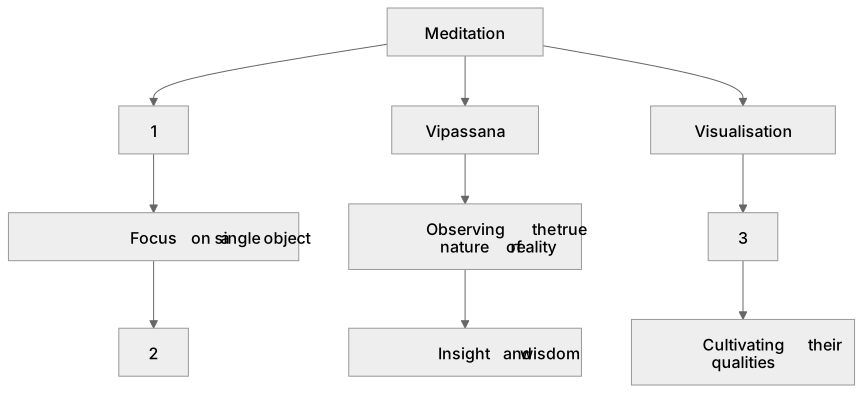
1Box 1
2Box 2
3Box 3
There is more to this lesson
The full lesson goes on to check your understanding and help you earn the marks. Create a free account to carry on, with your progress saved.
A week of Premium from your first lesson · Then the free plan continues · No card, no charge
Test your understanding of Buddhism - 3.1.1.2 Practices: meditation
Active recall beats re-reading. Take an instant quiz now to test what you’ve learned and lock it into long-term memory.
A week of Premium from your first lesson · Then the free plan continues · No card, no charge