AQA · GCSE · Religious Studies
Course version: 8062 · Version from Sept 2018
Buddhism - 3.1.1.2 Practices: Worship and festivals
Worship (puja) in Buddhism is fundamentally different from theistic religions; it is not about petitioning a creator god, but rather expressing deep gratitude and respect for the Buddha and his…
Checked against the AQA 8062 specification (opens in a new tab) on .
- Point 1 of 29
- 4 key terms
Study notes
From the checked teaching notes for this specification point.
The idea
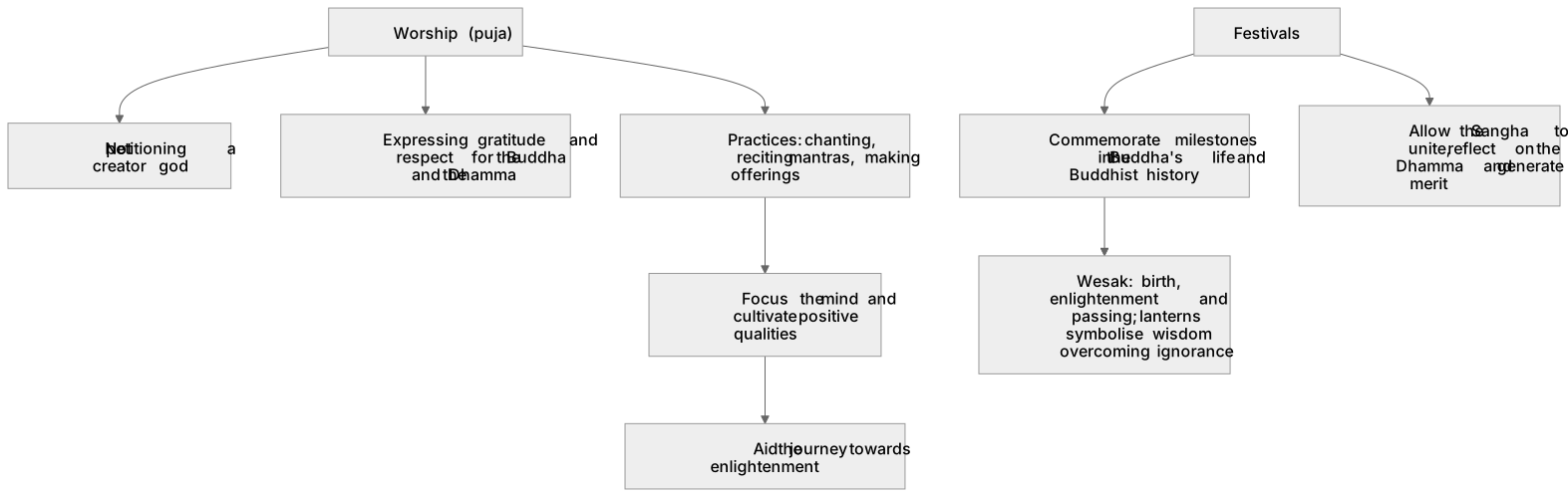
Worship (puja) in Buddhism is fundamentally different from theistic religions; it is not about petitioning a creator god, but rather expressing deep gratitude and respect for the Buddha and his teachings (Dhamma). Through practices such as chanting, reciting mantras, and making offerings, Buddhists focus their minds and cultivate positive qualities to aid their journey towards enlightenment. Festivals are vital communal events that commemorate significant milestones in the Buddha's life and the history of Buddhism. For example, Wesak celebrates the Buddha's birth, enlightenment, and passing, often involving the lighting of lanterns to symbolise wisdom overcoming ignorance. These occasions allow the Sangha to unite, reflect on the Dhamma, and generate merit.
What earns the marks
- Explain that Buddhist worship (puja) aims to cultivate wisdom and compassion rather than please a deity.
- Identify key worship practices such as chanting, mantra recitation, and meditation.
- Describe the purpose of festivals as opportunities to remember the Buddha's life and teachings.
- Explain how participating in worship and festivals helps Buddhists generate merit and strengthen the Sangha.
Common mistakes and how to put them right
Stating that Buddhists worship the Buddha as a god.
Put it right by explaining they show respect and gratitude to him as a supreme teacher.
Confusing the purpose of prayer.
Put it right by noting that mantras and chanting are for mental focus and cultivating virtues, not asking for favours.
Treating all Buddhist festivals as identical.
Put it right by distinguishing specific events like Wesak (birth and enlightenment) and Parinirvana Day (passing away).
Exam tips
- Always link the practice of worship to the ultimate Buddhist goal of achieving enlightenment or Nirvana.
- Use specific examples of festivals, such as Wesak, to illustrate how Buddhists celebrate as a community.
- Contrast Buddhist puja with theistic worship if evaluating the nature of religious devotion.
Try the lesson
The start of the Buddhism - 3.1.1.2 Practices: Worship and festivals lesson, made from checked teaching notes for this specification point.
Have a go first
What is the primary focus of the Buddhist festival of Wesak?
Listen
Worship (puja) in Buddhism is fundamentally different from theistic religions; it is not about petitioning a creator god, but rather expressing deep gratitude and respect for the Buddha and his teachings (Dhamma). Through practices such as chanting, reciting mantras, and making offerings, Buddhists focus their minds and cultivate positive qualities to aid their journey towards enlightenment. Festivals are vital communal events that commemorate significant milestones in the Buddha's life and the history of Buddhism. For example, Wesak celebrates the Buddha's birth, enlightenment, and passing, often involving the lighting of lanterns to symbolise wisdom overcoming ignorance. These occasions allow the Sangha to unite, reflect on the Dhamma, and generate merit. A strong answer earns marks for these points. Explain that Buddhist worship (puja) aims to cultivate wisdom and compassion rather than please a deity. Identify key worship practices such as chanting, mantra recitation, and meditation. Describe the purpose of festivals as opportunities to remember the Buddha's life and teachings. Explain how participating in worship and festivals helps Buddhists generate merit and strengthen the Sangha. A common slip: Stating that Buddhists worship the Buddha as a god. Instead, explaining they show respect and gratitude to him as a supreme teacher. Exam tip: Always link the practice of worship to the ultimate Buddhist goal of achieving enlightenment or Nirvana.
See it
Key words
Say what each word means before you turn the card.
Worship (puja)
Try answering aloud or in your head before turning the card.
Sangha
Try answering aloud or in your head before turning the card.
Enlightenment
Try answering aloud or in your head before turning the card.
Merit
Try answering aloud or in your head before turning the card.
See every definition
- Worship (puja)
- Expressing deep gratitude and respect for the Buddha and his teachings (Dhamma), rather than petitioning a creator god.
- Sangha
- The community that unites on festivals to reflect on the Dhamma and generate merit.
- Enlightenment
- The goal aided by focusing the mind and cultivating positive qualities through practices such as chanting, reciting mantras and making offerings.
- Merit
- Something generated by the Sangha when it unites on festivals.
Label the diagram
Some boxes have lost their names. Pick the right name for each number.
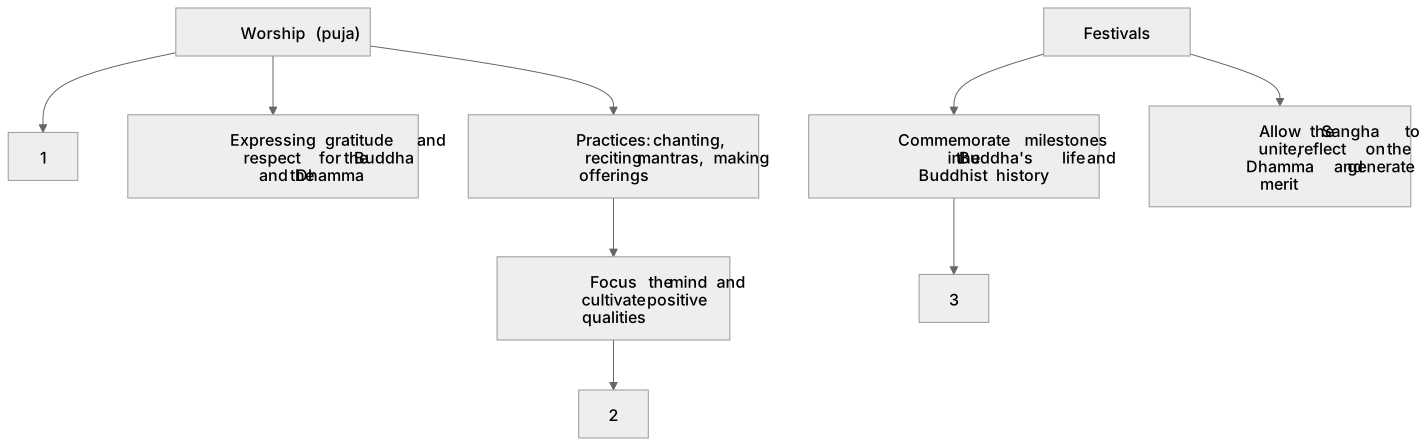
1Box 1
2Box 2
3Box 3
There is more to this lesson
The full lesson goes on to check your understanding and help you earn the marks. Create a free account to carry on, with your progress saved.
A week of Premium from your first lesson · Then the free plan continues · No card, no charge
Test your understanding of Buddhism - 3.1.1.2 Practices: Worship and festivals
Active recall beats re-reading. Take an instant quiz now to test what you’ve learned and lock it into long-term memory.
A week of Premium from your first lesson · Then the free plan continues · No card, no charge