AQA · GCSE · Religious Studies
Course version: 8062 · Version from Sept 2018
The nature, use and importance of Buddhist places of worship including…
Full specification wording
Buddhism - 3.1.1.2 Practices: The nature, use and importance of Buddhist places of worship including temples, shrines, monasteries (viharas), halls for meditation or learning (gompas) and their key features including Buddha rupa, artefacts and offerings.
Buddhist places of worship serve distinct purposes for the Sangha.
Checked against the AQA 8062 specification (opens in a new tab) on .
- Point 2 of 29
- 4 key terms
Study notes
From the checked teaching notes for this specification point.
The idea
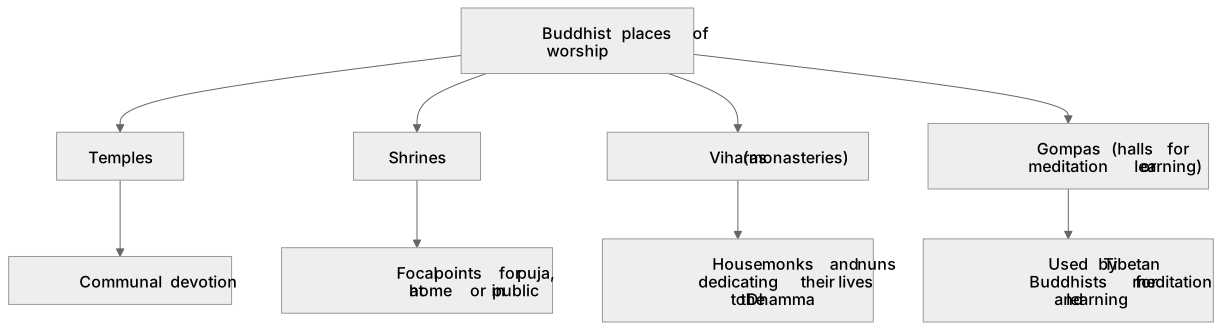
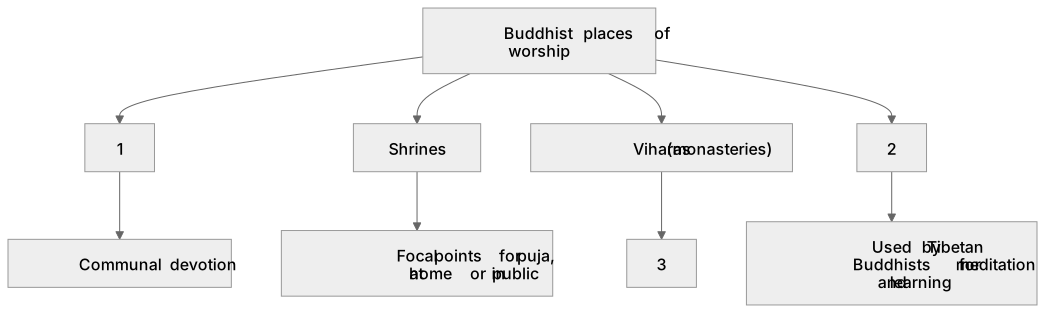
Buddhist places of worship serve distinct purposes for the Sangha. Temples are central hubs for communal devotion, while shrines provide focal points for puja, either at home or in public. Monasteries (viharas) house monks and nuns dedicating their lives to the Dhamma, and gompas are specific halls used by Tibetan Buddhists for meditation and learning. Key features include the Buddha rupa (statue), which acts as a visual aid for meditation and a reminder of the Buddha's qualities. Artefacts like singing bowls or prayer wheels aid focus. Offerings (such as light, flowers, and incense) are crucial; for instance, offering decaying flowers reminds practitioners of anicca (impermanence), reinforcing core teachings during worship.
What earns the marks
- Distinguish between the uses of temples (communal worship), viharas (monastic living), and gompas (learning and meditation).
- Explain the significance of the Buddha rupa as a focal point for inspiration and meditation, not an idol for worship.
- Describe how offerings symbolise Buddhist teachings, such as light representing wisdom and flowers representing impermanence.
- Evaluate the importance of having a dedicated place of worship versus the ability to practice Buddhism anywhere.
- Identify the role of shrines in both domestic and public settings for daily puja.
Common mistakes and how to put them right
Calling a Buddha rupa an idol that Buddhists pray to; correct by explaining it is a focal point representing enlightenment and the Buddha's qualities.
Confusing viharas and gompas.
Put it right by specifying that viharas are monasteries for living, while gompas are specifically halls for meditation and learning.
Assuming offerings are gifts to feed or please the Buddha.
Put it right by stating they are symbolic reminders of teachings like anicca (impermanence).
Exam tips
- Learn the specific terms 'vihara' and 'gompa' and use them accurately to demonstrate subject knowledge.
- When discussing offerings, always link the physical item (like a candle) to its symbolic meaning (the light of wisdom driving away ignorance).
- Be prepared to discuss whether a physical place of worship is necessary for a Buddhist, contrasting communal benefits with internal meditation.
Try the lesson
The start of the Buddhism - 3.1.1.2 Practices: The nature, use and importance of Buddhist places of worship including temples, shrines, monasteries (viharas), halls for meditation or learning (gompas) and their key features including Buddha rupa, artefacts and offerings. lesson, made from checked teaching notes for this specification point.
Have a go first
In the context of Buddhist places of worship, what is a 'vihara'?
Listen
Buddhist places of worship serve distinct purposes for the Sangha. Temples are central hubs for communal devotion, while shrines provide focal points for puja, either at home or in public. Monasteries (viharas) house monks and nuns dedicating their lives to the Dhamma, and gompas are specific halls used by Tibetan Buddhists for meditation and learning. Key features include the Buddha rupa (statue), which acts as a visual aid for meditation and a reminder of the Buddha's qualities. Artefacts like singing bowls or prayer wheels aid focus. Offerings (such as light, flowers, and incense) are crucial; for instance, offering decaying flowers reminds practitioners of anicca (impermanence), reinforcing core teachings during worship. A strong answer earns marks for these points. Distinguish between the uses of temples (communal worship), viharas (monastic living), and gompas (learning and meditation). Explain the significance of the Buddha rupa as a focal point for inspiration and meditation, not an idol for worship. Describe how offerings symbolise Buddhist teachings, such as light representing wisdom and flowers representing impermanence. Evaluate the importance of having a dedicated place of worship versus the ability to practice Buddhism anywhere. A common slip: Calling a Buddha rupa an idol that Buddhists pray to. Instead, explaining it is a focal point representing enlightenment and the Buddha's qualities. Exam tip: Learn the specific terms 'vihara' and 'gompa' and use them accurately to demonstrate subject knowledge.
See it
Key words
Say what each word means before you turn the card.
Viharas
Try answering aloud or in your head before turning the card.
Gompas
Try answering aloud or in your head before turning the card.
Buddha rupa
Try answering aloud or in your head before turning the card.
Anicca
Try answering aloud or in your head before turning the card.
See every definition
- Viharas
- Monasteries that house monks and nuns dedicating their lives to the Dhamma.
- Gompas
- Specific halls used by Tibetan Buddhists for meditation and learning.
- Buddha rupa
- A statue acting as a visual aid for meditation and a reminder of the Buddha's qualities.
- Anicca
- Impermanence, reinforced during worship by offerings such as decaying flowers.
Label the diagram
Some boxes have lost their names. Pick the right name for each number.
1Box 1
2Box 2
3Box 3
There is more to this lesson
The full lesson goes on to check your understanding and help you earn the marks. Create a free account to carry on, with your progress saved.
A week of Premium from your first lesson · Then the free plan continues · No card, no charge
Test your understanding of Buddhism - 3.1.1.2 Practices: The nature, use and importance of Buddhist places of worship including temples, shrines, monasteries (viharas), halls for meditation or learning (gompas) and their key features including Buddha rupa, artefacts and offerings.
Active recall beats re-reading. Take an instant quiz now to test what you’ve learned and lock it into long-term memory.
A week of Premium from your first lesson · Then the free plan continues · No card, no charge