AQA · GCSE · Religious Studies
Course version: 8062 · Version from Sept 2018
Component 1: The study of religions: beliefs, teachings: Hinduism
The study of Hinduism focuses on its core beliefs and teachings, providing a foundation for understanding Hindu worldview and practice.
Checked against the AQA 8062 specification (opens in a new tab) on .
- Point 4 of 7
- 4 key terms
Study notes
From the checked teaching notes for this specification point.
The idea
The study of Hinduism focuses on its core beliefs and teachings, providing a foundation for understanding Hindu worldview and practice. Central to this is the concept of Brahman, the ultimate reality or supreme spirit, which is understood in various ways, including through the Trimurti: Brahma (creator), Vishnu (preserver), and Shiva (destroyer). Key teachings also include the cycle of birth, death, and rebirth known as samsara, which is driven by karma (the law of cause and effect). The ultimate goal of Hindu life is moksha, the liberation from samsara and the union of the Atman with Brahman. Understanding these interconnected concepts is essential for evaluating Hindu perspectives on life, duty (dharma), and the universe.
What earns the marks
- Accurately define Brahman as the ultimate reality and explain its relationship with the Atman.
- Identify the roles of the Trimurti (Brahma, Vishnu, Shiva) in the continuous cycle of creation, preservation, and destruction.
- Explain the concepts of karma and samsara, detailing how actions influence future rebirths.
- Describe moksha as the ultimate spiritual goal, representing liberation from the cycle of samsara.
Common mistakes and how to put them right
Confusing Brahma (the creator deity) with Brahman (the ultimate reality).
Put it right: Ensure you clearly distinguish between the supreme spirit and the specific manifestation.
Treating karma merely as 'bad luck'.
Put it right by explaining karma as a universal law of cause and effect where both good and bad actions have consequences.
Assuming all Hindus worship the same deities in the same way.
Put it right: Acknowledge the diversity within Hinduism, such as Vaishnavism and Shaivism.
Exam tips
- Use specific Sanskrit terms like Atman, Moksha, and Dharma to demonstrate precise subject knowledge.
- When evaluating a statement about Hindu beliefs, contrast different Hindu traditions (e.g., dualist versus non-dualist views of Brahman) to access higher marks.
- Link the concept of karma directly to the cycle of samsara when explaining why Hindus strive to perform good actions.
Try the lesson
The start of the Component 1: The study of religions: beliefs, teachings: Hinduism lesson, made from checked teaching notes for this specification point.
Have a go first
Which of the following deities is known as the Preserver within the Hindu Trimurti?
Listen
The study of Hinduism focuses on its core beliefs and teachings, providing a foundation for understanding Hindu worldview and practice. Central to this is the concept of Brahman, the ultimate reality or supreme spirit, which is understood in various ways, including through the Trimurti: Brahma (creator), Vishnu (preserver), and Shiva (destroyer). Key teachings also include the cycle of birth, death, and rebirth known as samsara, which is driven by karma (the law of cause and effect). The ultimate goal of Hindu life is moksha, the liberation from samsara and the union of the Atman with Brahman. Understanding these interconnected concepts is essential for evaluating Hindu perspectives on life, duty (dharma), and the universe. A strong answer earns marks for these points. Accurately define Brahman as the ultimate reality and explain its relationship with the Atman. Identify the roles of the Trimurti (Brahma, Vishnu, Shiva) in the continuous cycle of creation, preservation, and destruction. Explain the concepts of karma and samsara, detailing how actions influence future rebirths. Describe moksha as the ultimate spiritual goal, representing liberation from the cycle of samsara. A common slip: Treating karma merely as 'bad luck'. Instead, explaining karma as a universal law of cause and effect where both good and bad actions have consequences. Exam tip: Use specific Sanskrit terms like Atman, Moksha, and Dharma to demonstrate precise subject knowledge.
See it
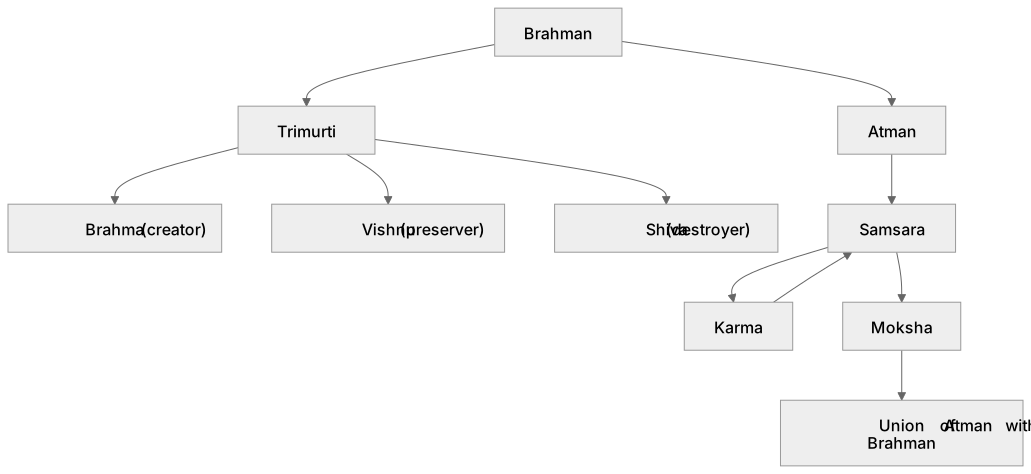
Key words
Say what each word means before you turn the card.
Brahman
Try answering aloud or in your head before turning the card.
Atman
Try answering aloud or in your head before turning the card.
Samsara
Try answering aloud or in your head before turning the card.
Moksha
Try answering aloud or in your head before turning the card.
See every definition
- Brahman
- The ultimate reality or supreme spirit, which is understood in various ways, including through the Trimurti.
- Atman
- The eternal self or soul, whose relationship with Brahman students must explore.
- Samsara
- The cycle of birth, death, and rebirth, which is driven by karma.
- Moksha
- The liberation from samsara and the union of the Atman with Brahman, the ultimate goal of Hindu life.
Label the diagram
Some boxes have lost their names. Pick the right name for each number.
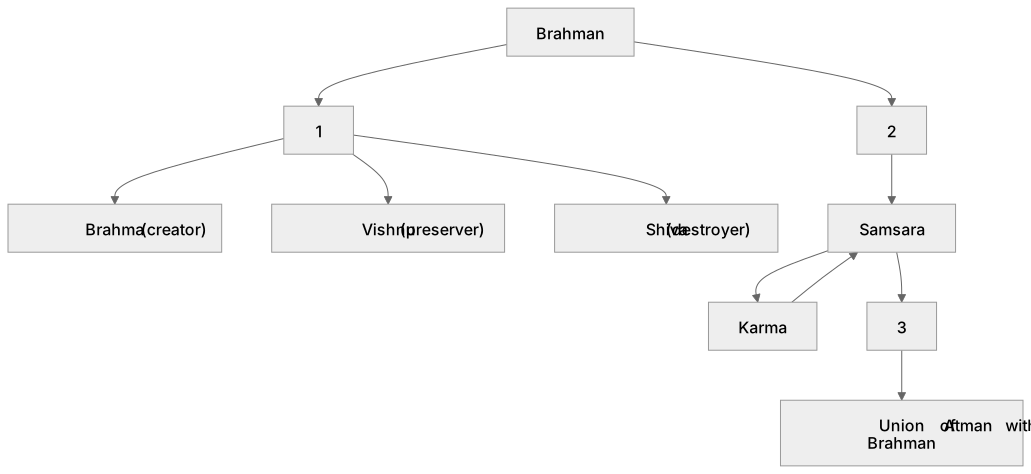
1Box 1
2Box 2
3Box 3
There is more to this lesson
The full lesson goes on to check your understanding and help you earn the marks. Create a free account to carry on, with your progress saved.
A week of Premium from your first lesson · Then the free plan continues · No card, no charge
Test your understanding of Component 1: The study of religions: beliefs, teachings: Hinduism
Active recall beats re-reading. Take an instant quiz now to test what you’ve learned and lock it into long-term memory.
A week of Premium from your first lesson · Then the free plan continues · No card, no charge