AQA · GCSE · Religious Studies
Course version: 8062 · Version from Sept 2018
Component 1: The study of religions: beliefs, teachings: Judaism
The study of Judaism focuses on its foundational beliefs and teachings, primarily the concept of the Almighty as One, Creator, Law-Giver, and Judge.
Checked against the AQA 8062 specification (opens in a new tab) on .
- Point 6 of 7
- 4 key terms
Study notes
From the checked teaching notes for this specification point.
The idea
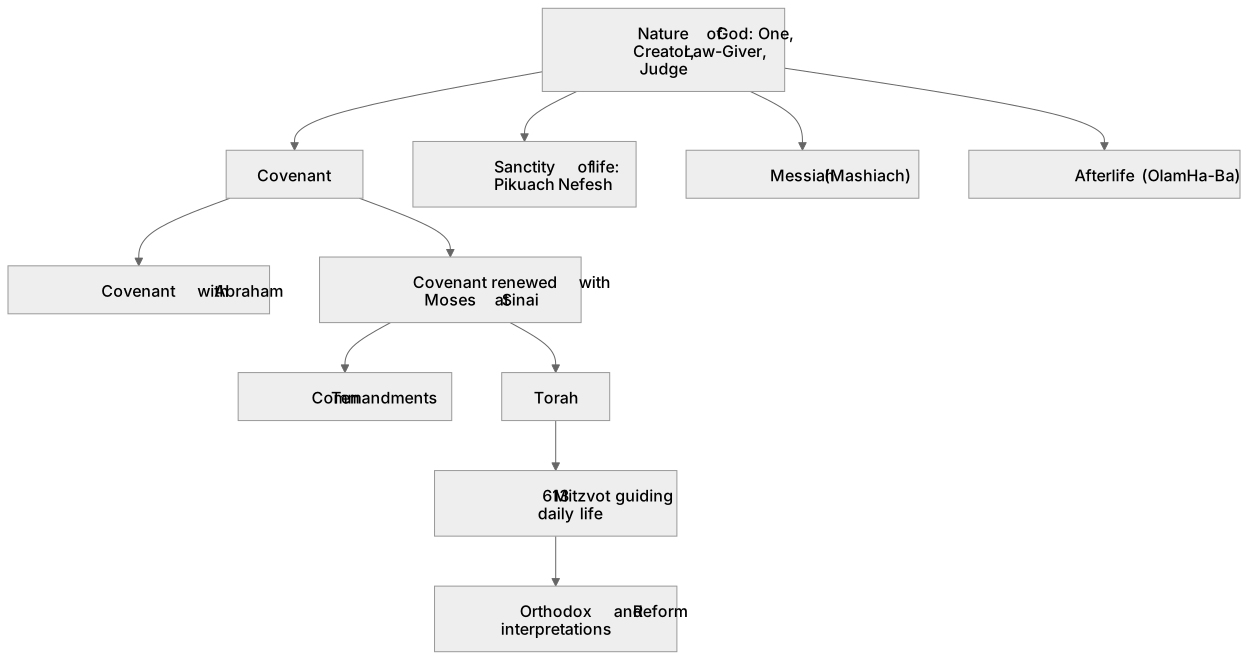
The study of Judaism focuses on its foundational beliefs and teachings, primarily the concept of the Almighty as One, Creator, Law-Giver, and Judge. A central pillar is the Covenant, established with Abraham and renewed with Moses at Sinai, which binds the Jewish people to God through the Torah. Key teachings also encompass beliefs about the sanctity of life (Pikuach Nefesh), the nature of the Messiah (Mashiach), and diverse views on the afterlife (Olam Ha-Ba). Understanding these concepts requires analysing sacred texts like the Tenakh and Talmud.
What earns the marks
- Accurate definition of the nature of God as omnipresent, omnipotent, and indivisible.
- Explanation of the Covenant's significance, distinguishing between the Abrahamic and Mosaic covenants.
- Clear distinction between Orthodox and Reform views regarding the strictness of the Mitzvot and the nature of the Messiah.
- Application of Pikuach Nefesh (saving a life) to modern ethical scenarios and medical decisions.
Common mistakes and how to put them right
Confusing the Abrahamic covenant with the Mosaic covenant.
Put it right: Abraham's covenant involves the promised land and circumcision, while Moses' involves the Torah and Ten Commandments.
Assuming all Jews hold identical beliefs about the afterlife.
Put it right: Acknowledge that views on Olam Ha-Ba vary widely, with some focusing strictly on the present life.
Using the term 'Old Testament' instead of 'Tenakh'.
Put it right: Use 'Tenakh' to accurately reflect the Jewish sacred text without Christian theological implications.
Exam tips
- Always specify whether a belief or practice is more closely associated with Orthodox or Reform Judaism to demonstrate depth of knowledge.
- Use specific Hebrew terms like Shema, Mitzvot, and Pikuach Nefesh, but ensure you can define them clearly in English.
- When evaluating a statement, contrast the focus on a future Messianic Age (Reform) with the belief in a personal, historical Messiah (Orthodox).
Try the lesson
The start of the Component 1: The study of religions: beliefs, teachings: Judaism lesson, made from checked teaching notes for this specification point.
Have a go first
Which of the following best describes the core Jewish belief expressed in the Shema?
Listen
The study of Judaism focuses on its foundational beliefs and teachings, primarily the concept of the Almighty as One, Creator, Law-Giver, and Judge. A central pillar is the Covenant, established with Abraham and renewed with Moses at Sinai, which binds the Jewish people to God through the Torah. Key teachings also encompass beliefs about the sanctity of life (Pikuach Nefesh), the nature of the Messiah (Mashiach), and diverse views on the afterlife (Olam Ha-Ba). Understanding these concepts requires analysing sacred texts like the Tenakh and Talmud. A strong answer earns marks for these points. Accurate definition of the nature of God as omnipresent, omnipotent, and indivisible. Explanation of the Covenant's significance, distinguishing between the Abrahamic and Mosaic covenants. Clear distinction between Orthodox and Reform views regarding the strictness of the Mitzvot and the nature of the Messiah. Application of Pikuach Nefesh (saving a life) to modern ethical scenarios and medical decisions. A common slip: Confusing the Abrahamic covenant with the Mosaic covenant. Instead, Abraham's covenant involves the promised land and circumcision, while Moses' involves the Torah and Ten Commandments. Exam tip: Always specify whether a belief or practice is more closely associated with Orthodox or Reform Judaism to demonstrate depth of knowledge.
See it
Key words
Say what each word means before you turn the card.
Nature of God
Try answering aloud or in your head before turning the card.
The Covenant
Try answering aloud or in your head before turning the card.
Mitzvot and Free Will
Try answering aloud or in your head before turning the card.
Sanctity of Life
Try answering aloud or in your head before turning the card.
See every definition
- Nature of God
- The Almighty is understood as One, Creator, Law-Giver and Judge, and as omnipresent, omnipotent and indivisible.
- The Covenant
- A central pillar established with Abraham and renewed with Moses at Sinai, binding the Jewish people to God through the Torah.
- Mitzvot and Free Will
- The 613 duties that guide daily life, with Orthodox and Reform interpretations differing over their strictness.
- Sanctity of Life
- Belief about the sanctity of life, known as Pikuach Nefesh, which concerns saving a life and applies to modern ethical scenarios and medical decisions.
Label the diagram
Some boxes have lost their names. Pick the right name for each number.
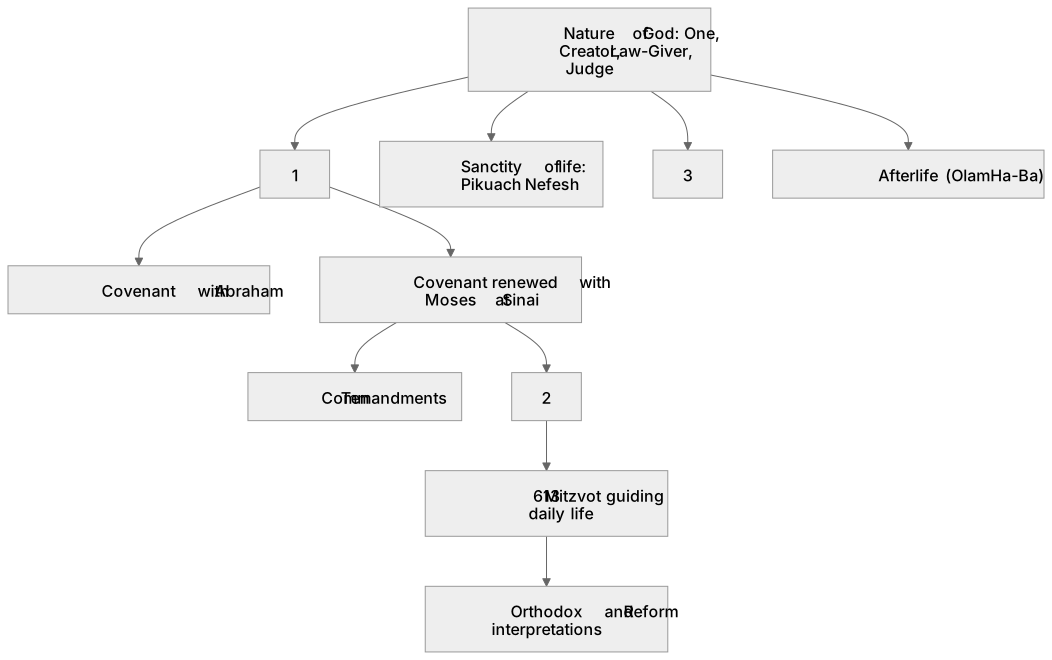
1Box 1
2Box 2
3Box 3
There is more to this lesson
The full lesson goes on to check your understanding and help you earn the marks. Create a free account to carry on, with your progress saved.
A week of Premium from your first lesson · Then the free plan continues · No card, no charge
Test your understanding of Component 1: The study of religions: beliefs, teachings: Judaism
Active recall beats re-reading. Take an instant quiz now to test what you’ve learned and lock it into long-term memory.
A week of Premium from your first lesson · Then the free plan continues · No card, no charge