AQA · GCSE · Religious Studies
Sikhism
Dive into Sikhism, a vibrant and profound religious tradition founded in 15th-century Punjab. This guide covers everything from the foundational Mool Mantra and the pursuit of mukti to the practical expressions of equality through langar and sewa, perfectly tailored for GCSE Religious Studies success.
- 6 min read
- 3 worked examples
- 1 practice question
- 6 key terms
Study Notes
Overview
Sikhism is the world's fifth-largest religion, founded in the Punjab region of India in the late 15th century by Guru Nanak. For GCSE Religious Studies candidates, studying Sikhism offers a profound look at a faith that deeply intertwines spiritual devotion with active social justice. Examiners expect you to demonstrate a clear understanding of core Sikh beliefs—such as the oneness of God (Waheguru), the cycle of rebirth (samsara), and the ultimate goal of liberation (mukti)—and how these beliefs are practically expressed in the daily lives of Sikhs in Great Britain today. Key areas of focus include the teachings of the Guru Granth Sahib, the role of the gurdwara, the importance of the Khalsa, and the fundamental principle of equality demonstrated through practices like sewa (selfless service) and langar (the free kitchen).

The Nature of God and the Mool Mantra
The foundation of Sikh theology is the Mool Mantra, the opening verse of the Guru Granth Sahib composed by Guru Nanak. It is the most important statement of Sikh belief.
Key Beliefs in the Mool Mantra:
- Ik Onkar: There is only one God.
- Satnam: Truth is His name.
- Karta Purakh: He is the Creator.
- Nirbhau & Nirvair: Without fear and without hate.
- Akal Moorat: Immortal, without form.
- Ajuni: Beyond birth and death.
- Saibhang: Self-existent.
- Gur Prasad: Realised by the grace of the true Guru.
Why it matters for exams: You must be able to explain these terms to demonstrate an understanding of God as Nirankar (formless) and omnipresent (everywhere). Examiners reward candidates who link the Mool Mantra to the Sikh belief that God cannot be fully understood by humans but is known through divine grace (nadar).
Human Life, Karma, and Mukti
Sikhs believe that human life is a precious opportunity. It is the only form of life in which a soul can achieve mukti (spiritual liberation).
The Cycle of Samsara: Like Hindus and Buddhists, Sikhs believe in reincarnation. The soul is reborn into different bodies based on karma (the accumulated sum of one's good and bad actions).
The Goal of Mukti: Mukti is the release from the cycle of samsara. It is the state where the soul merges back with Waheguru, like a drop of water returning to the ocean.
Barriers to Mukti: The main barrier is haumai (ego or self-centredness). Haumai leads humans to focus on worldly illusions (maya) rather than God. Haumai gives rise to the five vices: kaam (lust), krodh (anger), lobh (greed), moh (attachment), and ahankar (pride).
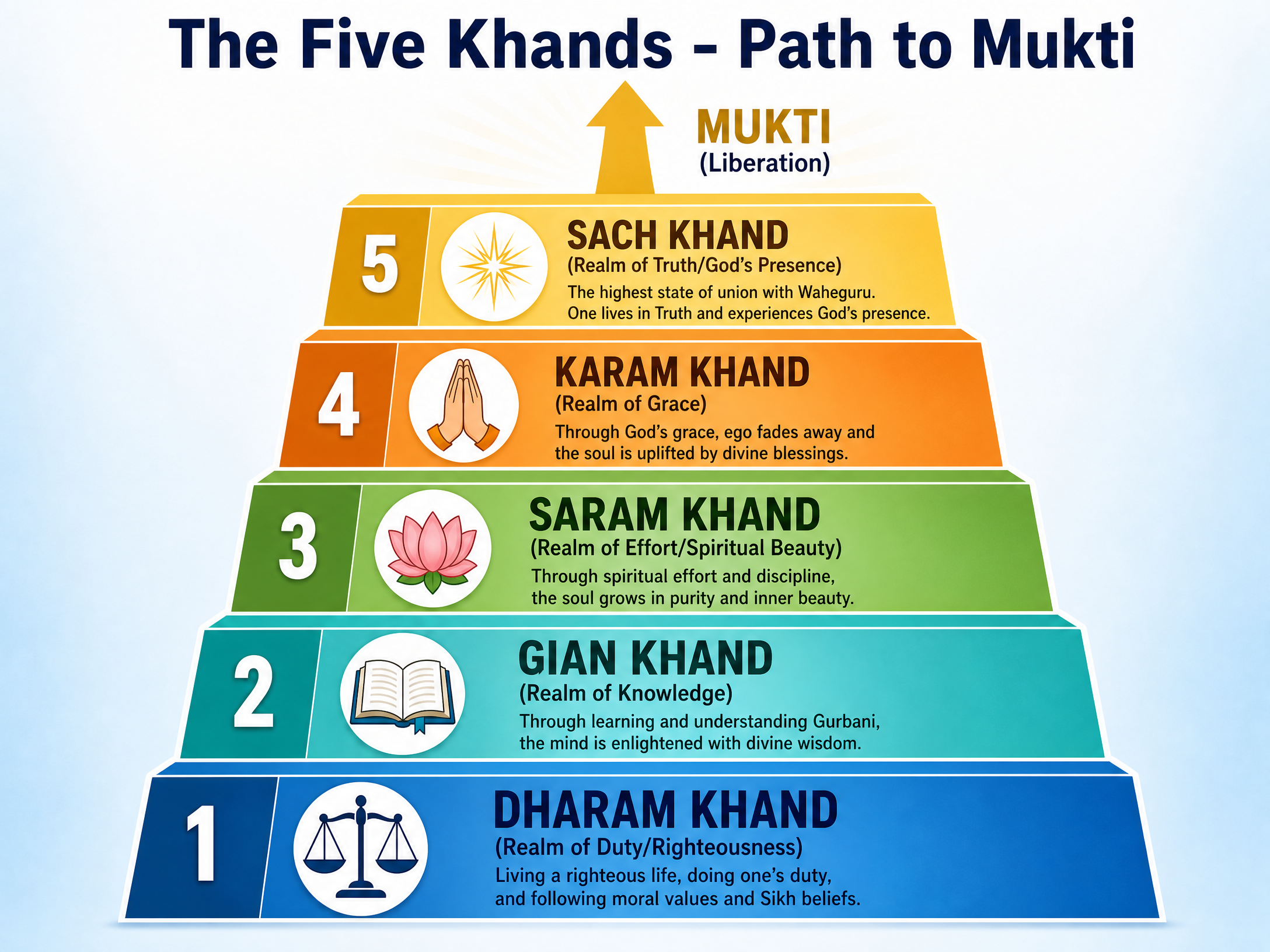
The Five Khands (Stages of Liberation)
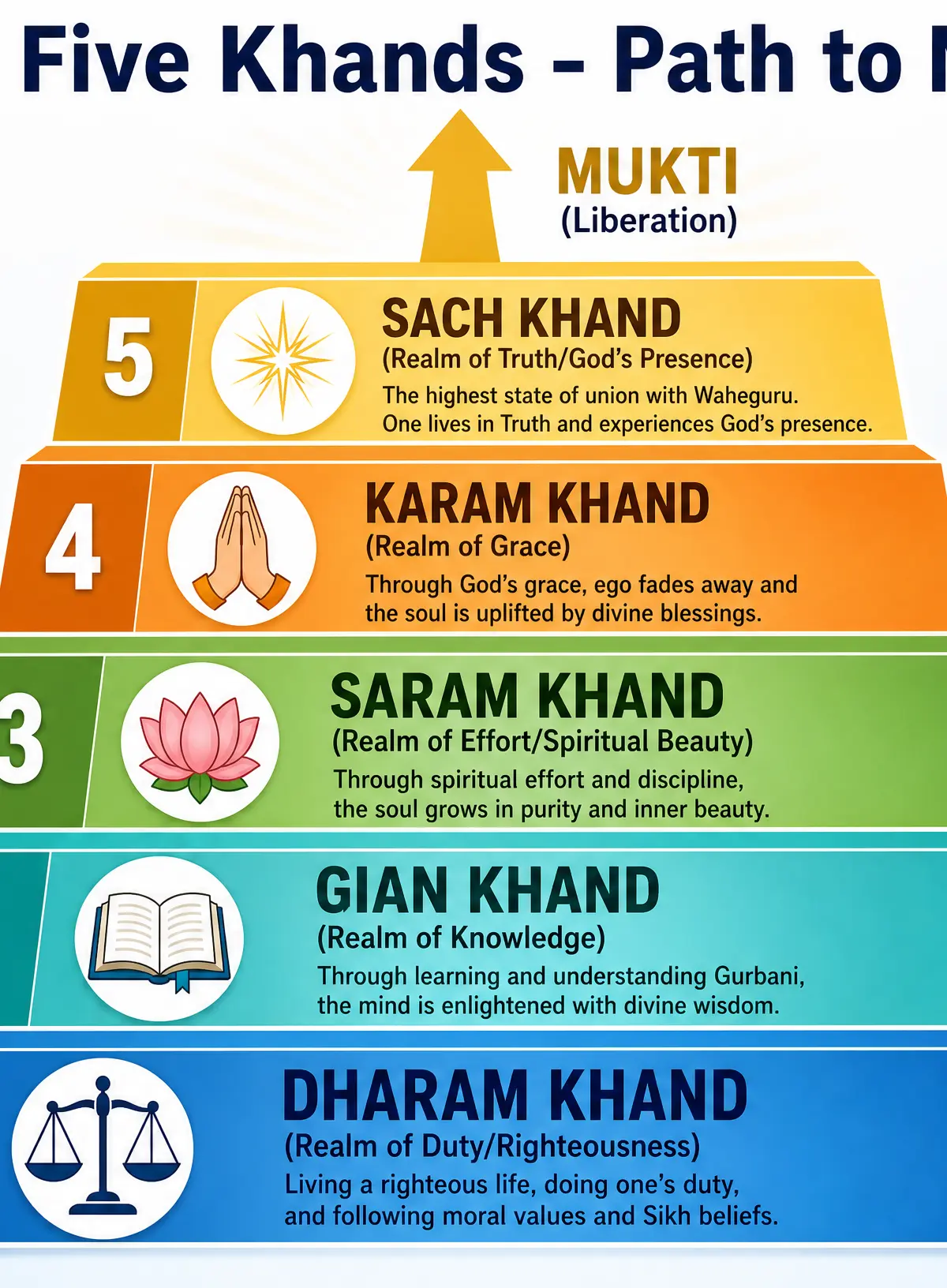
The journey to mukti is described in the Japji Sahib as passing through five spiritual stages or realms (khands):
- Dharam Khand (Realm of Duty): Living righteously.
- Gian Khand (Realm of Knowledge): Gaining spiritual wisdom.
- Saram Khand (Realm of Effort): Developing spiritual discipline.
- Karam Khand (Realm of Grace): Receiving God's blessing; ego fades.
- Sach Khand (Realm of Truth): Complete union with God.
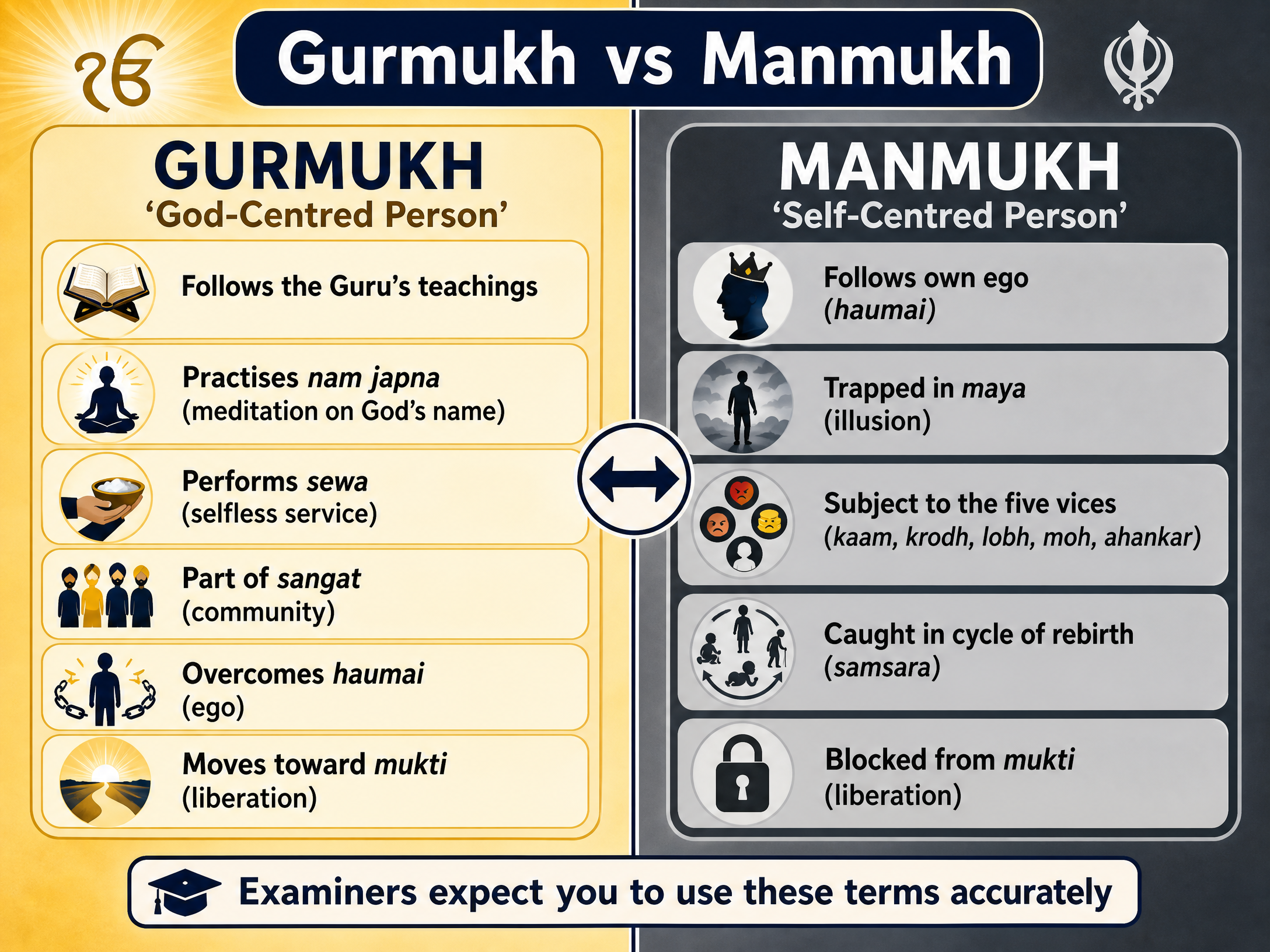
Gurmukh vs Manmukh
Examiners frequently ask candidates to contrast these two ways of living.
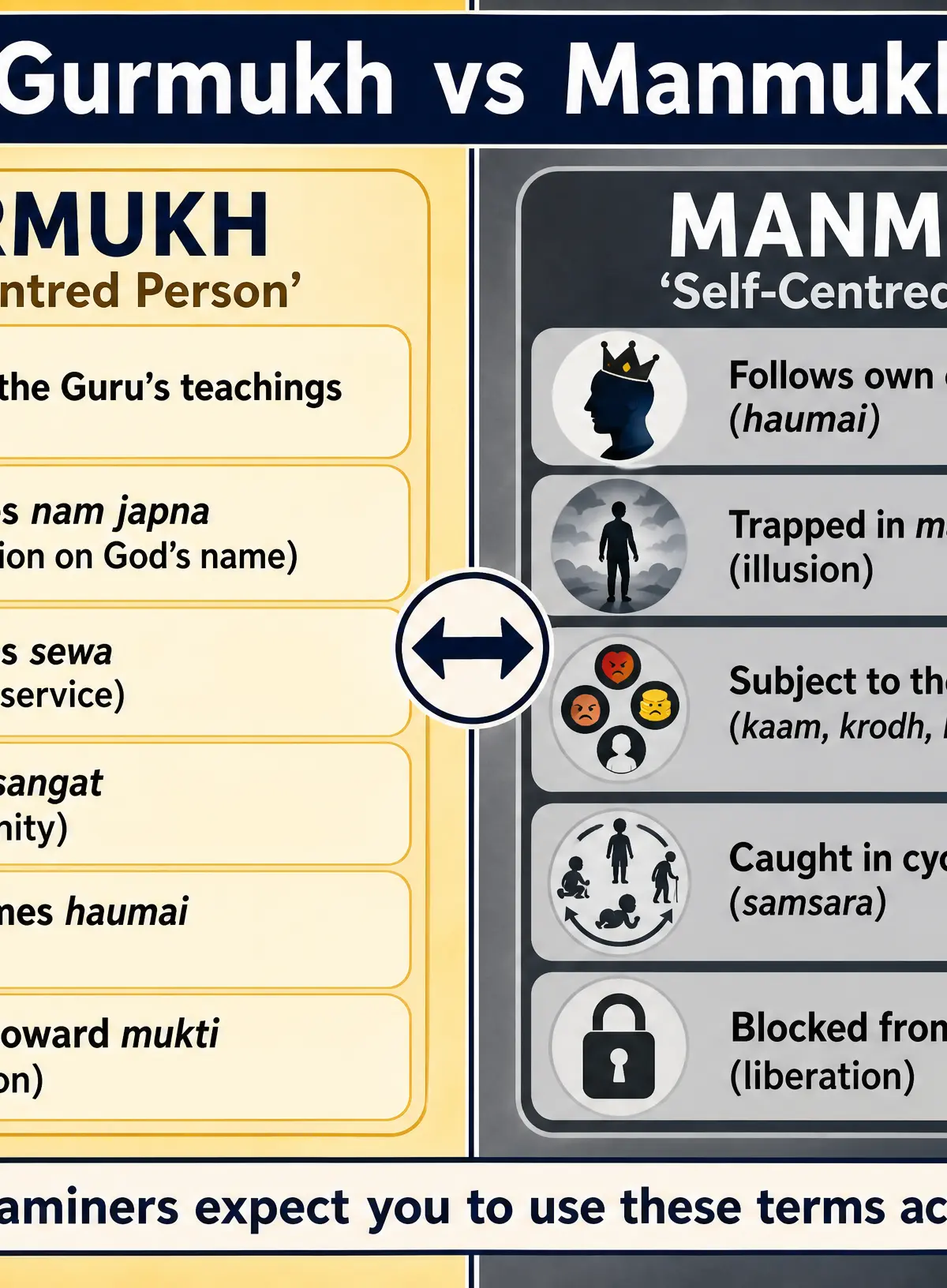
- Gurmukh: A God-centred person. They follow the Guru's teachings, practise nam japna (meditating on God's name), perform sewa, and overcome haumai. They are on the path to mukti.
- Manmukh: A self-centred person. They are controlled by haumai and the five vices, trapped in maya, and caught in the cycle of rebirth.
Equality and Sewa
Equality is the beating heart of Sikhism. Guru Nanak rejected the caste system, teaching that all humans are equal before God.
Gender Equality: Women are spiritually equal to men. They can lead worship, read from the Guru Granth Sahib, and join the Khalsa. Initiated women take the name Kaur (Princess), and men take the name Singh (Lion), stripping away caste-identifying surnames.
Sewa (Selfless Service): Serving others without expecting anything in return. It overcomes ego and brings one closer to God. There are three types:
- Tan Sewa: Physical service (e.g., cleaning the gurdwara).
- Man Sewa: Mental service (e.g., teaching, studying the Guru Granth Sahib).
- Dhan Sewa: Material service (e.g., donating 10% of income, called dasvandh, to charity).
The Gurdwara and Worship
The gurdwara ('door to the Guru') is the Sikh place of worship and community gathering.
Key Features:
- Takht: The raised throne where the Guru Granth Sahib rests.
- Palki: The canopy above the scripture, showing respect.
- Langar: The free community kitchen. Everyone sits on the floor together (pangat) to eat a vegetarian meal, demonstrating absolute equality and putting sewa into practice.
Worship Practices:
- Nam Japna: Meditating on God's name.
- Akhand Path: A continuous 48-hour reading of the entire Guru Granth Sahib, often held before festivals (Gurpurbs).
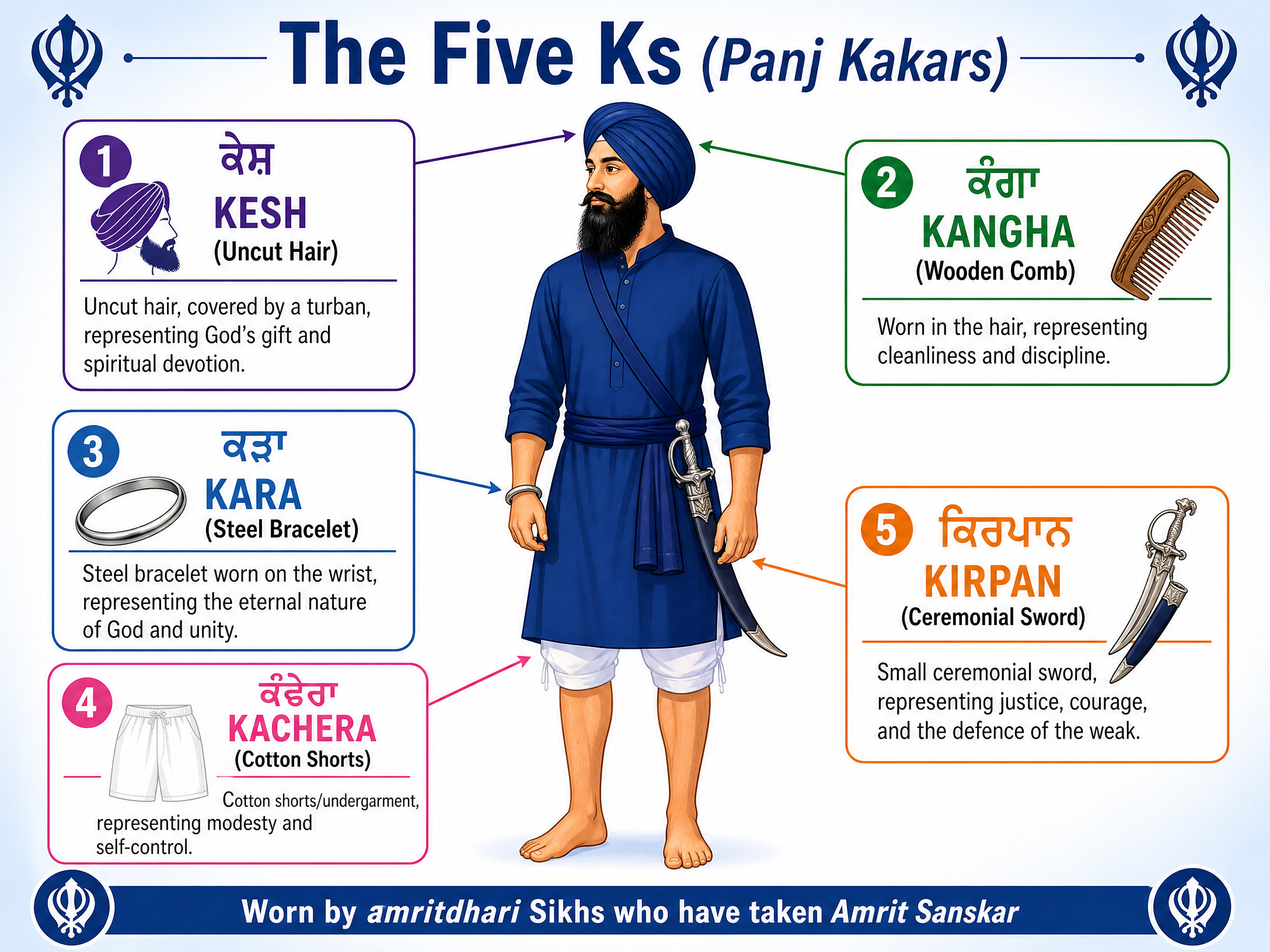
The Khalsa and the Five Ks
In 1699, Guru Gobind Singh created the Khalsa (the community of pure/initiated Sikhs) at the festival of Vaisakhi.
Amrit Sanskar: The initiation ceremony where Sikhs drink amrit (sweetened water stirred with a double-edged sword).
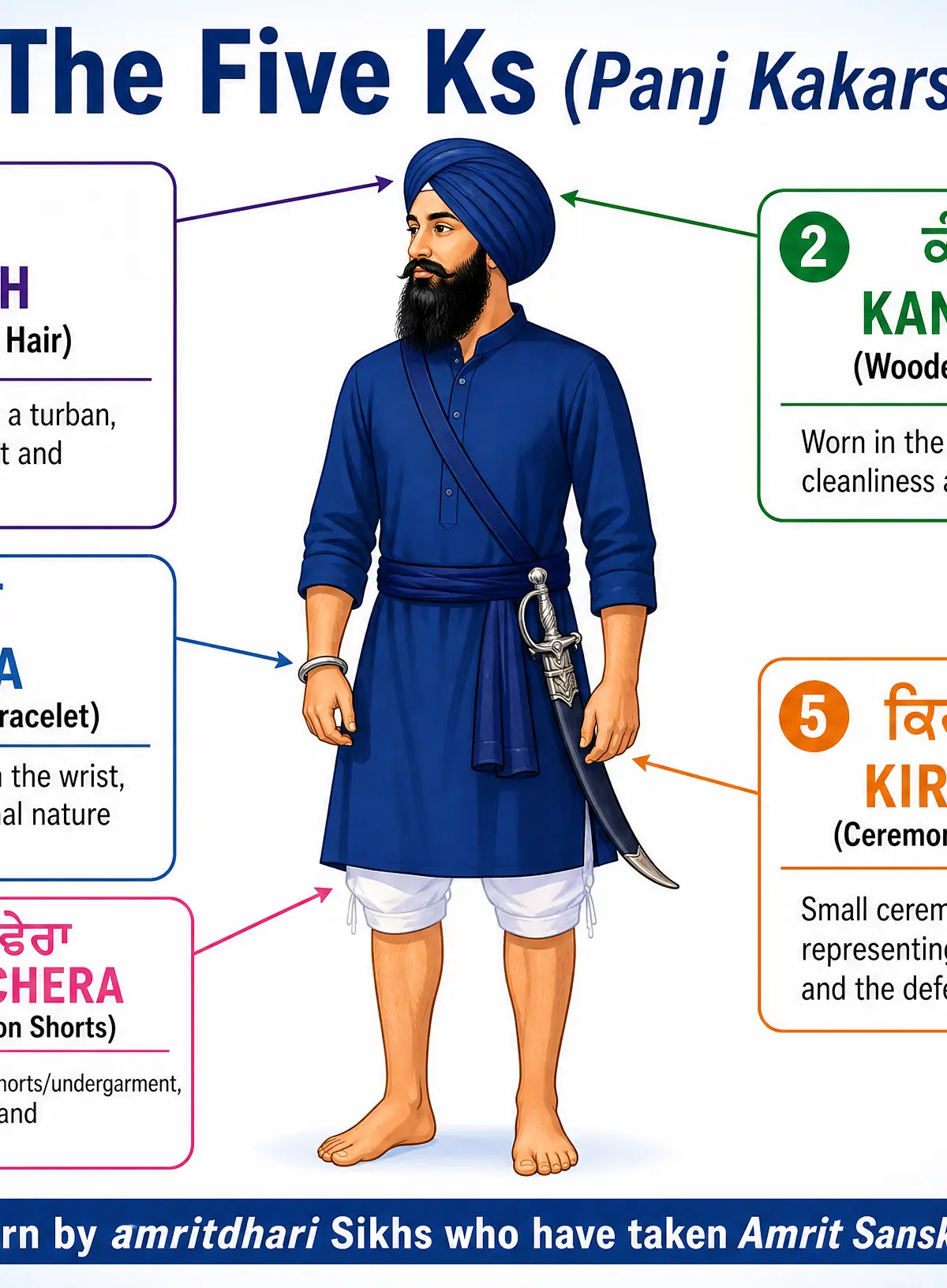
- Amritdhari Sikhs: Have taken initiation and wear the Five Ks.
- Sahajdhari Sikhs: Follow Sikhism but have not taken initiation.
The Panj Kakars (Five Ks):
- Kesh: Uncut hair (covered by a turban) - accepting God's creation.
- Kangha: Wooden comb - cleanliness and discipline.
- Kara: Steel bracelet - God has no beginning or end; unity.
- Kachera: Cotton shorts - modesty and moral restraint.
- Kirpan: Small sword - defending the weak and fighting injustice.
Festivals in Great Britain
- Vaisakhi: Celebrates the founding of the Khalsa and the Sikh New Year. In the UK, it is marked by vibrant Nagar Kirtans (street processions) in places like Southall and Birmingham.
- Divali: For Sikhs, this is Bandi Chhor Divas (Day of Liberation), celebrating the release of Guru Hargobind from prison. Gurdwaras are illuminated with lights.
- Gurpurbs: Anniversaries of the births or deaths of the Gurus, celebrated with an akhand path.
Visual Resources
3 diagrams and illustrations
Interactive Diagrams
1 interactive diagram to visualise key concepts
Conceptual Flow Outline
The contrasting paths of the Manmukh and the Gurmukh.
Worked Examples
3 worked examples — open one to explore the question and available guidance.
Practice Questions
Test your understanding — click to reveal model answers
Describe the features of the gurdwara that show respect for the Guru Granth Sahib. (5 marks)
Hint: Think about where the book is placed, what covers it, and how worshippers behave.