AQA · GCSE · Religious Studies
Course version: 8062 · Version from Sept 2018
Key Beliefs: anatta (no fixed self)
Anatta is the Buddhist teaching that there is no fixed, permanent self or soul, serving as one of the Three Marks of Existence.
Checked against the AQA 8062 specification (opens in a new tab) on .
- Point 6 of 24
- 4 key terms
Study notes
From the checked teaching notes for this specification point.
The idea
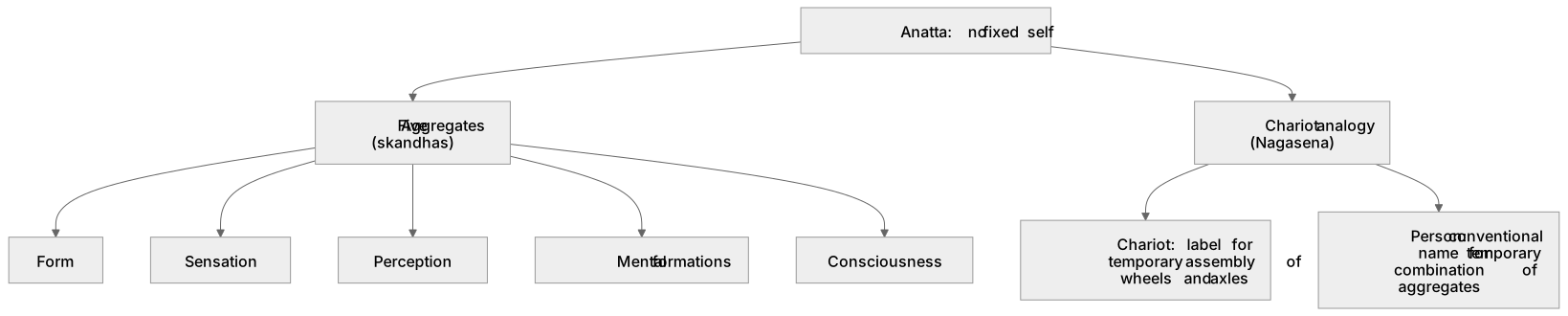
Anatta is the Buddhist teaching that there is no fixed, permanent self or soul, serving as one of the Three Marks of Existence. It proposes that human beings are composed of five constantly changing elements known as the Five Aggregates, or skandhas: form, sensation, perception, mental formations, and consciousness. A classic method used to explain this is the analogy of the chariot, taught by the monk Nagasena. Just as a chariot is merely a convenient label for a temporary assembly of wheels and axles, a person is simply a conventional name for the temporary combination of the aggregates. Realising anatta helps Buddhists overcome selfishness and the illusion of ego, which are root causes of suffering and keep people trapped in samsara.
What earns the marks
- Definition of anatta as the absence of a permanent, unchanging self or soul.
- Identification of anatta as one of the Three Marks of Existence.
- Explanation of the Five Aggregates (skandhas) as the temporary components that make up a person.
- Reference to the chariot analogy used by Nagasena to illustrate how the self is just a conventional label for assembled parts.
Common mistakes and how to put them right
Claiming that Buddhists believe in a soul that reincarnates.
Put it right: State that Buddhists believe in rebirth, where karmic energy continues, but there is no permanent soul (anatta) that moves from one body to another.
Confusing anatta with anicca.
Put it right: Clearly distinguish anatta as the lack of a fixed self, whereas anicca is the broader concept of universal impermanence.
Thinking anatta means humans do not exist at all.
Put it right: Explain that humans do exist, but only as a temporary combination of the Five Aggregates, not as a permanent entity.
Exam tips
- Use the chariot analogy to clearly demonstrate your understanding of how parts make up the illusion of a whole self.
- Connect anatta to the concept of rebirth by explaining how karmic energy transfers without a permanent soul.
- Mention the Five Aggregates (skandhas) when explaining what actually constitutes a human being in Buddhist thought.
Try the lesson
The start of the Key Beliefs: anatta (no fixed self) lesson, made from checked teaching notes for this specification point.
Have a go first
What is the meaning of the Buddhist teaching of anatta?
Listen
Anatta is the Buddhist teaching that there is no fixed, permanent self or soul, serving as one of the Three Marks of Existence. It proposes that human beings are composed of five constantly changing elements known as the Five Aggregates, or skandhas: form, sensation, perception, mental formations, and consciousness. A classic method used to explain this is the analogy of the chariot, taught by the monk Nagasena. Just as a chariot is merely a convenient label for a temporary assembly of wheels and axles, a person is simply a conventional name for the temporary combination of the aggregates. Realising anatta helps Buddhists overcome selfishness and the illusion of ego, which are root causes of suffering and keep people trapped in samsara. A strong answer earns marks for these points. Definition of anatta as the absence of a permanent, unchanging self or soul. Identification of anatta as one of the Three Marks of Existence. Explanation of the Five Aggregates (skandhas) as the temporary components that make up a person. Reference to the chariot analogy used by Nagasena to illustrate how the self is just a conventional label for assembled parts. A common slip: Claiming that Buddhists believe in a soul that reincarnates. Instead, State that Buddhists believe in rebirth, where karmic energy continues, but there is no permanent soul (anatta) that moves from one body to another. Exam tip: Use the chariot analogy to clearly demonstrate your understanding of how parts make up the illusion of a whole self.
See it
Key words
Say what each word means before you turn the card.
The Three Marks of Existence
Try answering aloud or in your head before turning the card.
The Five Aggregates (Skandhas)
Try answering aloud or in your head before turning the card.
Rebirth
Try answering aloud or in your head before turning the card.
Illusion of Ego
Try answering aloud or in your head before turning the card.
See every definition
- The Three Marks of Existence
- One of these is anatta, the teaching that there is no fixed, permanent self or soul.
- The Five Aggregates (Skandhas)
- The five constantly changing elements of form, sensation, perception, mental formations and consciousness that make up human beings.
- Rebirth
- Karmic energy continues, but there is no permanent soul that moves from one body to another.
- Illusion of Ego
- Realising anatta helps Buddhists overcome selfishness and this, which is a root cause of suffering.
Label the diagram
Some boxes have lost their names. Pick the right name for each number.
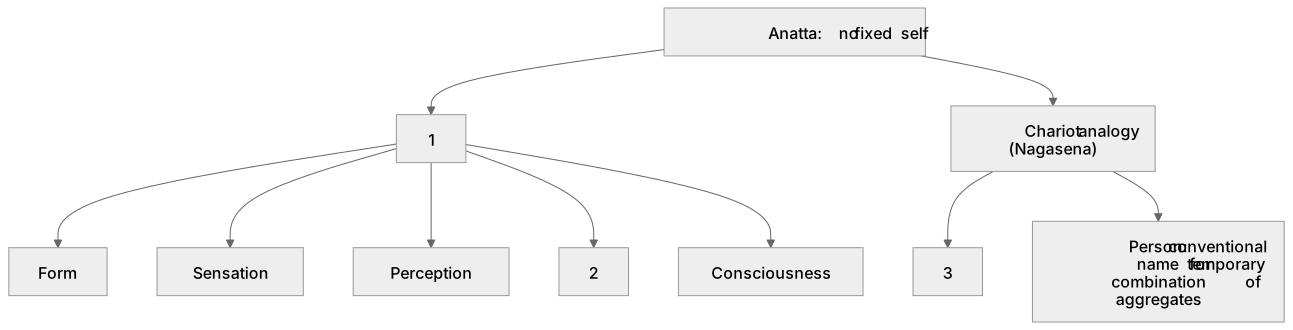
1Box 1
2Box 2
3Box 3
There is more to this lesson
The full lesson goes on to check your understanding and help you earn the marks. Create a free account to carry on, with your progress saved.
A week of Premium from your first lesson · Then the free plan continues · No card, no charge
Test your understanding of Key Beliefs: anatta (no fixed self)
Active recall beats re-reading. Take an instant quiz now to test what you’ve learned and lock it into long-term memory.
A week of Premium from your first lesson · Then the free plan continues · No card, no charge