AQA · GCSE · Religious Studies
Course version: 8062 · Version from Sept 2018
Key Beliefs: anicca (impermanence)
Anicca is the fundamental Buddhist concept of impermanence, forming one of the Three Marks of Existence.
Checked against the AQA 8062 specification (opens in a new tab) on .
- Point 5 of 24
- 2 key terms
Study notes
From the checked teaching notes for this specification point.
The idea
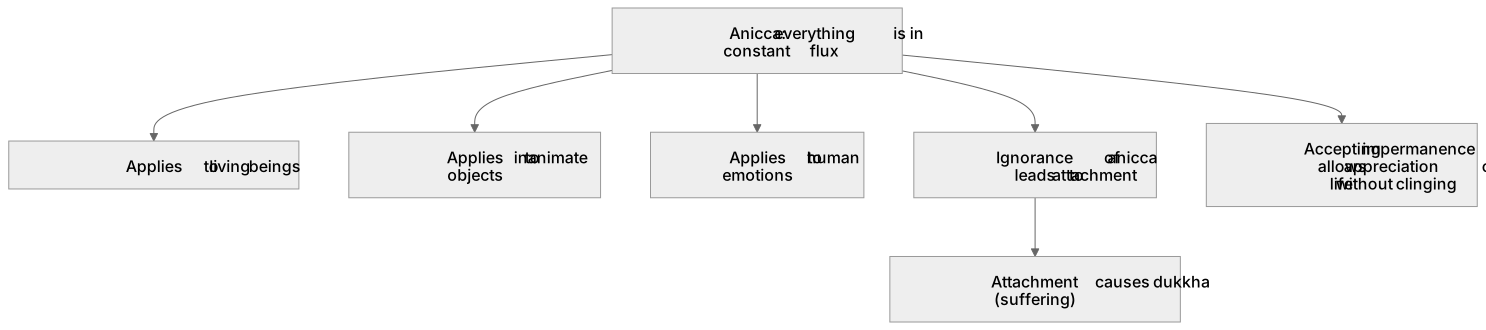
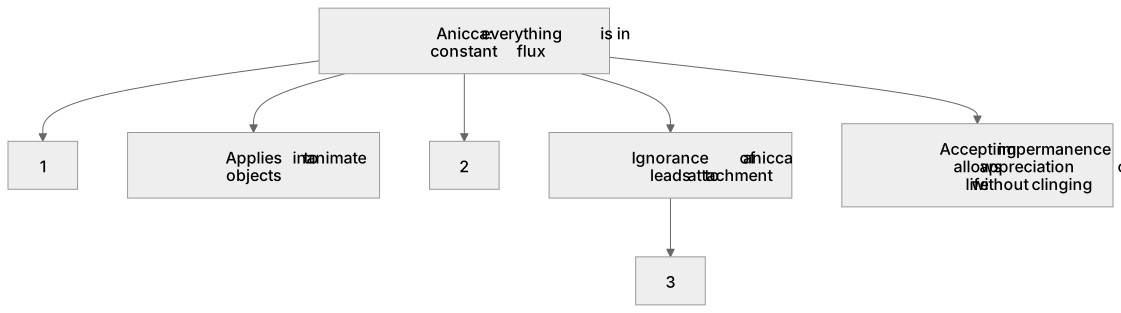
Anicca is the fundamental Buddhist concept of impermanence, forming one of the Three Marks of Existence. It teaches that everything in the physical and mental universe is in a constant state of flux; nothing remains unchanged forever. This principle applies to living beings, inanimate objects, and human emotions. For example, a beautiful flower will eventually wither, just as human joy or sorrow will pass. The story of Kisa Gotami, who sought a cure for her dead son, illustrates anicca by showing that death and change touch every family. Understanding anicca is essential because ignorance of this truth leads to attachment, which causes dukkha (suffering). Accepting impermanence allows Buddhists to appreciate life without clinging to it.
What earns the marks
- Definition of anicca as impermanence or the idea that everything constantly changes.
- Identification of anicca as one of the Three Marks of Existence.
- Explanation of the link between anicca and dukkha, noting that suffering arises from clinging to impermanent things.
- Application of anicca to physical objects, living beings, and mental states.
Common mistakes and how to put them right
Believing anicca only applies to physical death.
Put it right: Understand that anicca applies to all things, including emotions, thoughts, and inanimate objects.
Confusing anicca with anatta.
Put it right: Ensure anicca is defined as the impermanence of all things, while anatta specifically refers to the lack of a fixed, independent self or soul.
Stating that anicca is a purely negative or pessimistic belief.
Put it right: Explain that anicca is a realistic observation of nature that can bring comfort, as it means suffering and difficult times will also pass.
Exam tips
- Use the story of Kisa Gotami and the mustard seed to illustrate the universal nature of anicca in your longer answers.
- Always link anicca to dukkha by explaining how attachment to changing things causes suffering.
- When asked to explain Buddhist beliefs about the world, explicitly name anicca as one of the Three Marks of Existence.
Try the lesson
The start of the Key Beliefs: anicca (impermanence) lesson, made from checked teaching notes for this specification point.
Have a go first
Which of the following best describes the Buddhist concept of anicca?
Listen
Anicca is the fundamental Buddhist concept of impermanence, forming one of the Three Marks of Existence. It teaches that everything in the physical and mental universe is in a constant state of flux; nothing remains unchanged forever. This principle applies to living beings, inanimate objects, and human emotions. For example, a beautiful flower will eventually wither, just as human joy or sorrow will pass. The story of Kisa Gotami, who sought a cure for her dead son, illustrates anicca by showing that death and change touch every family. Understanding anicca is essential because ignorance of this truth leads to attachment, which causes dukkha (suffering). Accepting impermanence allows Buddhists to appreciate life without clinging to it. A strong answer earns marks for these points. Definition of anicca as impermanence or the idea that everything constantly changes. Identification of anicca as one of the Three Marks of Existence. Explanation of the link between anicca and dukkha, noting that suffering arises from clinging to impermanent things. Application of anicca to physical objects, living beings, and mental states. A common slip: Believing anicca only applies to physical death. Instead, Understand that anicca applies to all things, including emotions, thoughts, and inanimate objects. Exam tip: Use the story of Kisa Gotami and the mustard seed to illustrate the universal nature of anicca in your longer answers.
See it
Key words
Say what each word means before you turn the card.
The Three Marks of Existence
Try answering aloud or in your head before turning the card.
Dukkha (Suffering)
Try answering aloud or in your head before turning the card.
See every definition
- The Three Marks of Existence
- The fundamental Buddhist concept of impermanence forms one of these, and anicca is named as one of them.
- Dukkha (Suffering)
- Ignorance of anicca leads to attachment, which causes this suffering.
Label the diagram
Some boxes have lost their names. Pick the right name for each number.
1Box 1
2Box 2
3Box 3
There is more to this lesson
The full lesson goes on to check your understanding and help you earn the marks. Create a free account to carry on, with your progress saved.
A week of Premium from your first lesson · Then the free plan continues · No card, no charge
Test your understanding of Key Beliefs: anicca (impermanence)
Active recall beats re-reading. Take an instant quiz now to test what you’ve learned and lock it into long-term memory.
A week of Premium from your first lesson · Then the free plan continues · No card, no charge