AQA · GCSE · Religious Studies
Course version: 8062 · Version from Sept 2018
Key Beliefs: Human destiny:
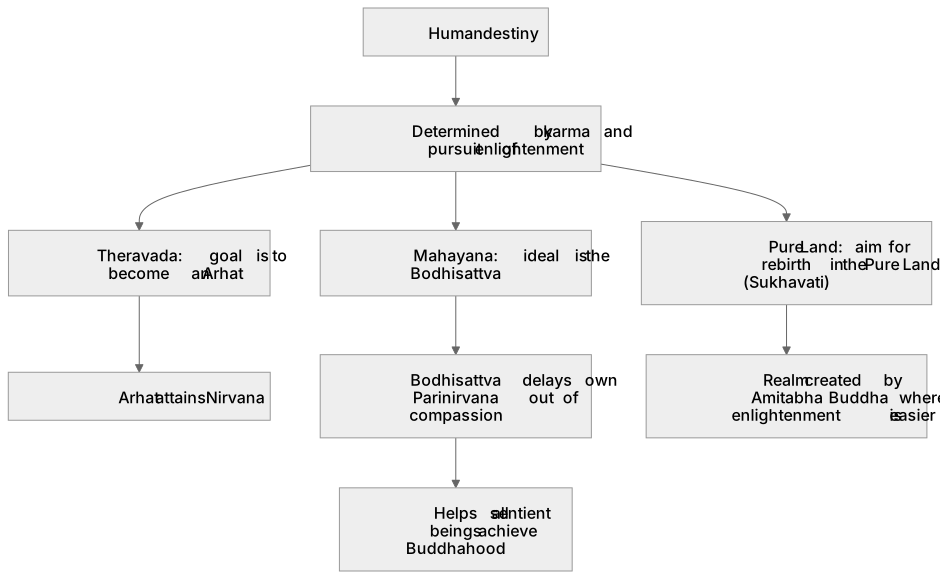
In Buddhism, human destiny is determined by a person's actions (karma) and their pursuit of enlightenment.
Checked against the AQA 8062 specification (opens in a new tab) on .
- Point 11 of 24
- 3 key terms
Study notes
From the checked teaching notes for this specification point.
The idea
In Buddhism, human destiny is determined by a person's actions (karma) and their pursuit of enlightenment. The ultimate goal is to break free from samsara. Different traditions offer distinct paths and goals for human destiny. In Theravada Buddhism, the goal is to become an Arhat, a perfected person who has attained Nirvana. In Mahayana Buddhism, the ideal is the Bodhisattva, who delays their own Parinirvana out of compassion to help all sentient beings achieve Buddhahood. Additionally, Pure Land Buddhists aim for rebirth in the Pure Land (Sukhavati), a realm created by Amitabha Buddha where attaining enlightenment is much easier. Understanding these distinct concepts of human destiny is essential for evaluating Buddhist practices.
What earns the marks
- Explain the Theravada goal of becoming an Arhat, a perfected person who has overcome the main sources of suffering to attain Nirvana.
- Describe the Mahayana ideal of the Bodhisattva, who remains in the cycle of samsara out of compassion to help others achieve enlightenment.
- Outline the concept of Buddhahood as the ultimate state of awakening and human destiny in Mahayana traditions.
- Explain the Pure Land Buddhist goal of rebirth in the Pure Land (Sukhavati), where Amitabha Buddha helps beings attain enlightenment.
Common mistakes and how to put them right
Confusing the goals of Arhat and Bodhisattva.
Put it right: An Arhat focuses on their own liberation (Theravada), while a Bodhisattva seeks to help all beings achieve enlightenment (Mahayana).
Assuming Nirvana is a physical place after death.
Put it right: Describe Nirvana as a state of enlightenment and liberation from suffering, whereas the Pure Land is a realm where enlightenment is easier to attain.
Believing human destiny is controlled by a creator God.
Put it right: Explain that destiny is shaped by an individual's own karma and choices, leading towards Buddhahood or rebirth in the Pure Land.
Exam tips
- Always specify which Buddhist tradition you are referring to when discussing human destiny (e.g., Theravada for Arhat, Mahayana for Bodhisattva).
- Use the concepts of Arhat, Bodhisattva, Buddhahood, and Pure Land to show diverse Buddhist views on human destiny in evaluation questions.
Try the lesson
The start of the Key Beliefs: Human destiny: lesson, made from checked teaching notes for this specification point.
Have a go first
In Buddhism, what is considered the ultimate human destiny or goal?
Listen
In Buddhism, human destiny is determined by a person's actions (karma) and their pursuit of enlightenment. The ultimate goal is to break free from samsara. Different traditions offer distinct paths and goals for human destiny. In Theravada Buddhism, the goal is to become an Arhat, a perfected person who has attained Nirvana. In Mahayana Buddhism, the ideal is the Bodhisattva, who delays their own Parinirvana out of compassion to help all sentient beings achieve Buddhahood. Additionally, Pure Land Buddhists aim for rebirth in the Pure Land (Sukhavati), a realm created by Amitabha Buddha where attaining enlightenment is much easier. Understanding these distinct concepts of human destiny is essential for evaluating Buddhist practices. A strong answer earns marks for these points. Explain the Theravada goal of becoming an Arhat, a perfected person who has overcome the main sources of suffering to attain Nirvana. Describe the Mahayana ideal of the Bodhisattva, who remains in the cycle of samsara out of compassion to help others achieve enlightenment. Outline the concept of Buddhahood as the ultimate state of awakening and human destiny in Mahayana traditions. Explain the Pure Land Buddhist goal of rebirth in the Pure Land (Sukhavati), where Amitabha Buddha helps beings attain enlightenment. A common slip: Confusing the goals of Arhat and Bodhisattva. Instead, an Arhat focuses on their own liberation (Theravada), while a Bodhisattva seeks to help all beings achieve enlightenment (Mahayana). Exam tip: Always specify which Buddhist tradition you are referring to when discussing human destiny (e.g., Theravada for Arhat, Mahayana for Bodhisattva).
See it
Key words
Say what each word means before you turn the card.
Human destiny
Try answering aloud or in your head before turning the card.
Arhat and Bodhisattva
Try answering aloud or in your head before turning the card.
Buddhahood and Pure Land
Try answering aloud or in your head before turning the card.
See every definition
- Human destiny
- Determined by a person's actions (karma) and their pursuit of enlightenment, with the ultimate goal of breaking free from samsara.
- Arhat and Bodhisattva
- In Theravada the goal is a perfected person who has attained Nirvana; in Mahayana the ideal delays their own Parinirvana out of compassion to help all sentient beings achieve Buddhahood.
- Buddhahood and Pure Land
- The ultimate state of awakening, and a realm created by Amitabha Buddha where attaining enlightenment is much easier.
Label the diagram
Some boxes have lost their names. Pick the right name for each number.
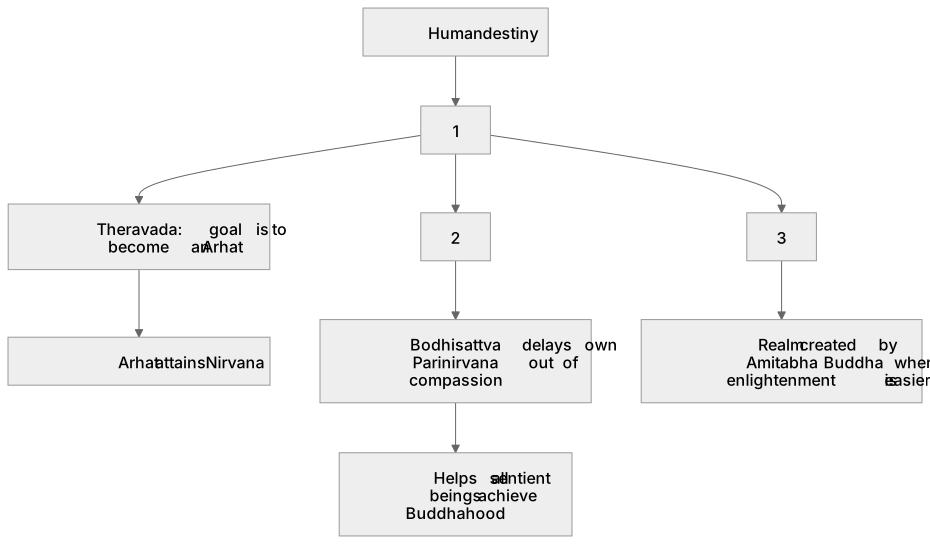
1Box 1
2Box 2
3Box 3
There is more to this lesson
The full lesson goes on to check your understanding and help you earn the marks. Create a free account to carry on, with your progress saved.
A week of Premium from your first lesson · Then the free plan continues · No card, no charge
Test your understanding of Key Beliefs: Human destiny:
Active recall beats re-reading. Take an instant quiz now to test what you’ve learned and lock it into long-term memory.
A week of Premium from your first lesson · Then the free plan continues · No card, no charge