AQA · GCSE · Religious Studies
Course version: 8062 · Version from Sept 2018
Different ideals in Theravada and Mahayana traditions: Arhat (a ‘perfected…
Full specification wording
Key Beliefs: different ideals in Theravada and Mahayana traditions: Arhat (a ‘perfected person’) and Bodhisattva ideals
Theravada and Mahayana traditions offer different ideals for human destiny.
Checked against the AQA 8062 specification (opens in a new tab) on .
- Point 12 of 24
- 4 key terms
Study notes
From the checked teaching notes for this specification point.
The idea
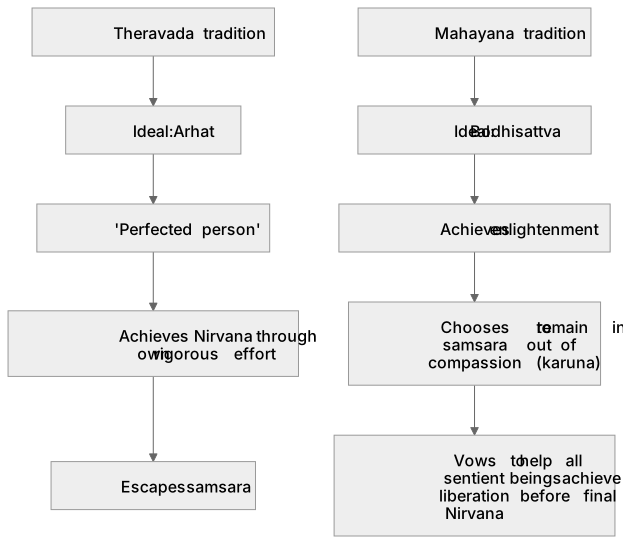
Theravada and Mahayana traditions offer different ideals for human destiny. In Theravada Buddhism, the ideal is the Arhat, a 'perfected person' who has overcome the three poisons and achieved Nirvana through their own rigorous effort, escaping samsara. They focus on personal enlightenment, following the Buddha's original teachings. Conversely, Mahayana Buddhism promotes the Bodhisattva ideal. A Bodhisattva achieves enlightenment but deliberately chooses to remain in the cycle of samsara out of supreme compassion (karuna) to help all other sentient beings achieve liberation. They take a vow to delay their own final Nirvana until everyone else is saved, embodying the six perfections.
What earns the marks
- An Arhat is a 'perfected person' in Theravada Buddhism who has achieved Nirvana and will not be reborn.
- The Arhat path emphasises personal spiritual effort, strict monastic discipline, and overcoming the three poisons.
- A Bodhisattva is the Mahayana ideal of an enlightened being who chooses to remain in samsara out of compassion.
- Bodhisattvas take a vow to help all sentient beings achieve enlightenment before entering final Nirvana themselves.
- The Bodhisattva path focuses on developing the six perfections (paramitas), particularly compassion (karuna) and wisdom (prajna).
Common mistakes and how to put them right
Stating that Theravada Buddhists do not care about others.
Put it right: Clarify that while the Arhat focuses on personal enlightenment, they still develop loving-kindness; they simply believe one must save oneself before helping others.
Confusing the definitions of Arhat and Bodhisattva.
Put it right: 'Arhat' means 'perfected person' (Theravada) who leaves samsara, while 'Bodhisattva' (Mahayana) stays in samsara to help others.
Claiming Bodhisattvas have not reached enlightenment.
Put it right: Explain that Bodhisattvas are fully enlightened but choose to delay Parinirvana (final Nirvana after death) out of compassion.
Exam tips
- Use the exact translation 'perfected person' when defining an Arhat to secure knowledge marks.
- Highlight the role of compassion (karuna) as the driving force behind the Bodhisattva's vow to remain in samsara.
- When evaluating which ideal is 'better', contrast the Arhat's focus on personal liberation with the Bodhisattva's universal compassion.
Try the lesson
The start of the Key Beliefs: different ideals in Theravada and Mahayana traditions: Arhat (a ‘perfected person’) and Bodhisattva ideals lesson, made from checked teaching notes for this specification point.
Have a go first
In Theravada Buddhism, what is an Arhat?
Listen
Theravada and Mahayana traditions offer different ideals for human destiny. In Theravada Buddhism, the ideal is the Arhat, a 'perfected person' who has overcome the three poisons and achieved Nirvana through their own rigorous effort, escaping samsara. They focus on personal enlightenment, following the Buddha's original teachings. Conversely, Mahayana Buddhism promotes the Bodhisattva ideal. A Bodhisattva achieves enlightenment but deliberately chooses to remain in the cycle of samsara out of supreme compassion (karuna) to help all other sentient beings achieve liberation. They take a vow to delay their own final Nirvana until everyone else is saved, embodying the six perfections. A strong answer earns marks for these points. An Arhat is a 'perfected person' in Theravada Buddhism who has achieved Nirvana and will not be reborn. The Arhat path emphasises personal spiritual effort, strict monastic discipline, and overcoming the three poisons. A Bodhisattva is the Mahayana ideal of an enlightened being who chooses to remain in samsara out of compassion. Bodhisattvas take a vow to help all sentient beings achieve enlightenment before entering final Nirvana themselves. A common slip: Stating that Theravada Buddhists do not care about others. Instead, Clarify that while the Arhat focuses on personal enlightenment, they still develop loving-kindness; they simply believe one must save oneself before helping others. Exam tip: Use the exact translation 'perfected person' when defining an Arhat to secure knowledge marks.
See it
Key words
Say what each word means before you turn the card.
Arhat
Try answering aloud or in your head before turning the card.
Bodhisattva
Try answering aloud or in your head before turning the card.
Compassion (Karuna)
Try answering aloud or in your head before turning the card.
Spiritual Ideals
Try answering aloud or in your head before turning the card.
See every definition
- Arhat
- A 'perfected person' in Theravada Buddhism who has overcome the three poisons and achieved Nirvana through their own rigorous effort, escaping samsara.
- Bodhisattva
- The Mahayana ideal of an enlightened being who chooses to remain in the cycle of samsara out of supreme compassion (karuna) to help all other sentient beings achieve liberation.
- Compassion (Karuna)
- The supreme compassion that drives a Bodhisattva to remain in samsara and take a vow to help all other sentient beings achieve liberation.
- Spiritual Ideals
- The different ideals for human destiny offered by the Theravada and Mahayana traditions: the Arhat and the Bodhisattva.
Label the diagram
Some boxes have lost their names. Pick the right name for each number.
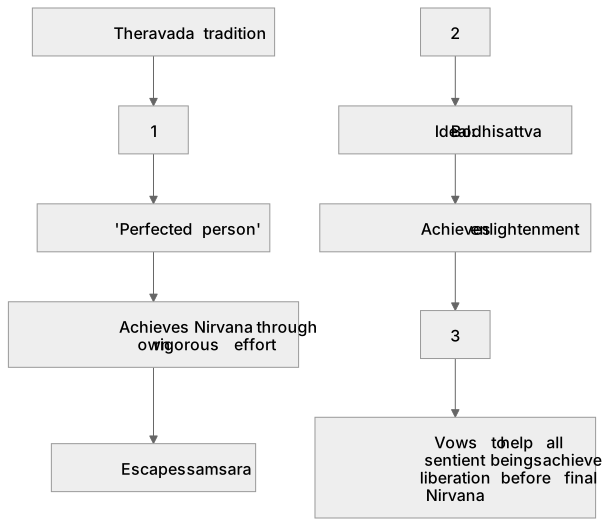
1Box 1
2Box 2
3Box 3
There is more to this lesson
The full lesson goes on to check your understanding and help you earn the marks. Create a free account to carry on, with your progress saved.
A week of Premium from your first lesson · Then the free plan continues · No card, no charge
Test your understanding of Key Beliefs: different ideals in Theravada and Mahayana traditions: Arhat (a ‘perfected person’) and Bodhisattva ideals
Active recall beats re-reading. Take an instant quiz now to test what you’ve learned and lock it into long-term memory.
A week of Premium from your first lesson · Then the free plan continues · No card, no charge