AQA · GCSE · Religious Studies
Course version: 8062 · Version from Sept 2018
Key Beliefs: the Buddha’s Enlightenment.
Siddhartha Gautama achieved Enlightenment after meditating under the Bodhi tree in Bodh Gaya.
Checked against the AQA 8062 specification (opens in a new tab) on .
- Point 19 of 24
- 3 key terms
Study notes
From the checked teaching notes for this specification point.
The idea
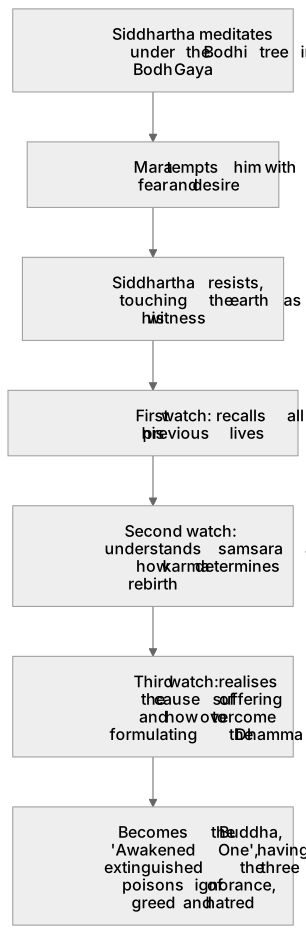
Siddhartha Gautama achieved Enlightenment after meditating under the Bodhi tree in Bodh Gaya. During his meditation, he was tempted by the demon Mara, who tried to distract him with fear and desire. Siddhartha resisted, touching the earth as his witness. His Enlightenment occurred over three 'watches' of the night. First, he recalled all his previous lives. Second, he understood the cycle of samsara, seeing how karma determines rebirth. Third, he realised the cause of suffering and how to overcome it, formulating the Dhamma. At this point, he became the Buddha, meaning the 'Awakened One', having extinguished the three poisons of ignorance, greed, and hatred.
What earns the marks
- Identify the location of the Buddha's Enlightenment as the Bodhi tree in Bodh Gaya.
- Explain the role of Mara in attempting to prevent Siddhartha from achieving Enlightenment through temptation and fear.
- Describe the Three Watches of the Night: recalling past lives, understanding karma and rebirth, and discovering the end of suffering.
- Define the term 'Buddha' as the 'Awakened One' or 'Enlightened One'.
Common mistakes and how to put them right
Confusing Enlightenment with asceticism.
Put it right: Enlightenment was achieved through the Middle Way, after Siddhartha rejected extreme asceticism.
Stating Mara is a physical devil.
Put it right: Mara represents psychological forces of greed, hatred, and delusion (the three poisons) rather than a literal Christian-style devil.
Forgetting the specific events of the Three Watches.
Put it right: Ensure you can list the realisation of past lives, the mechanics of karma and samsara, and the cessation of suffering in chronological order.
Exam tips
- Use the story of Mara to explain how Buddhists view the internal struggle against the three poisons.
- Link the Buddha's Enlightenment directly to the discovery of the Middle Way and the Four Noble Truths.
- When evaluating the importance of Enlightenment, contrast it with his earlier life of luxury and asceticism to show why it is the ultimate goal.
Try the lesson
The start of the Key Beliefs: the Buddha’s Enlightenment. lesson, made from checked teaching notes for this specification point.
Have a go first
According to Buddhist tradition, which figure attempted to stop Siddhartha Gautama from achieving enlightenment by sending distractions and temptations?
Listen
Siddhartha Gautama achieved Enlightenment after meditating under the Bodhi tree in Bodh Gaya. During his meditation, he was tempted by the demon Mara, who tried to distract him with fear and desire. Siddhartha resisted, touching the earth as his witness. His Enlightenment occurred over three 'watches' of the night. First, he recalled all his previous lives. Second, he understood the cycle of samsara, seeing how karma determines rebirth. Third, he realised the cause of suffering and how to overcome it, formulating the Dhamma. At this point, he became the Buddha, meaning the 'Awakened One', having extinguished the three poisons of ignorance, greed, and hatred. A strong answer earns marks for these points. Identify the location of the Buddha's Enlightenment as the Bodhi tree in Bodh Gaya. Explain the role of Mara in attempting to prevent Siddhartha from achieving Enlightenment through temptation and fear. Describe the Three Watches of the Night: recalling past lives, understanding karma and rebirth, and discovering the end of suffering. Define the term 'Buddha' as the 'Awakened One' or 'Enlightened One'. A common slip: Confusing Enlightenment with asceticism. Instead, Enlightenment was achieved through the Middle Way, after Siddhartha rejected extreme asceticism. Exam tip: Use the story of Mara to explain how Buddhists view the internal struggle against the three poisons.
See it
Put it in order
Put these steps in the order they happen.
- 1. Becomes the Buddha, the 'Awakened One', having extinguished the three poisons of ignorance, greed and hatred
- 2. Third watch: realises the cause of suffering and how to overcome it, formulating the Dhamma
- 3. Siddhartha resists, touching the earth as his witness
- 4. Second watch: understands samsara and how karma determines rebirth
- 5. Siddhartha meditates under the Bodhi tree in Bodh Gaya
- 6. Mara tempts him with fear and desire
- 7. First watch: recalls all his previous lives
Key words
Say what each word means before you turn the card.
The Middle Way
Try answering aloud or in your head before turning the card.
Karma and Samsara
Try answering aloud or in your head before turning the card.
Overcoming temptation (Mara)
Try answering aloud or in your head before turning the card.
See every definition
- The Middle Way
- The path through which Enlightenment was achieved, after Siddhartha rejected extreme asceticism.
- Karma and Samsara
- The cycle of samsara, seeing how karma determines rebirth, understood during the second watch of the night.
- Overcoming temptation (Mara)
- The demon who tried to distract Siddhartha with fear and desire during his meditation, and who represents psychological forces of greed, hatred, and delusion.
Label the diagram
Some boxes have lost their names. Pick the right name for each number.
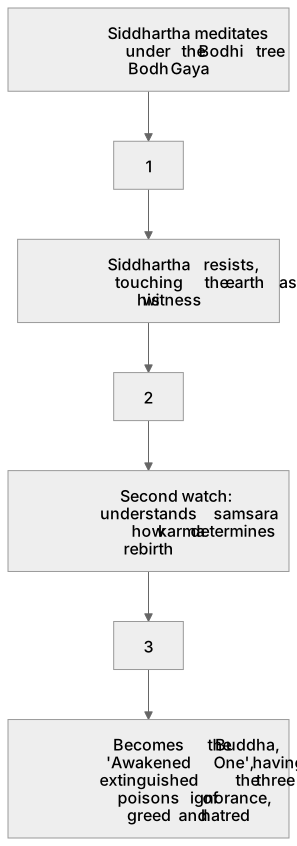
1Box 1
2Box 2
3Box 3
There is more to this lesson
The full lesson goes on to check your understanding and help you earn the marks. Create a free account to carry on, with your progress saved.
A week of Premium from your first lesson · Then the free plan continues · No card, no charge
Test your understanding of Key Beliefs: the Buddha’s Enlightenment.
Active recall beats re-reading. Take an instant quiz now to test what you’ve learned and lock it into long-term memory.
A week of Premium from your first lesson · Then the free plan continues · No card, no charge