AQA · GCSE · Religious Studies
Course version: 8062 · Version from Sept 2018
Key Beliefs: The Buddha’s life and its significance:
Siddhartha Gautama’s life serves as the foundational narrative of Buddhism, demonstrating that enlightenment is attainable by a human being.
Checked against the AQA 8062 specification (opens in a new tab) on .
- Point 15 of 24
- 3 key terms
Study notes
From the checked teaching notes for this specification point.
The idea
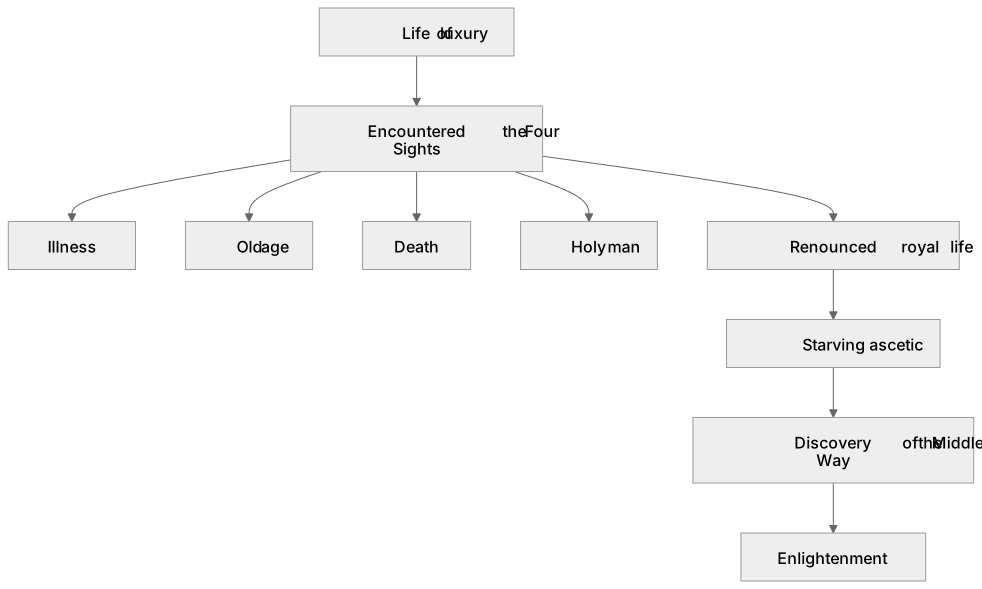
Siddhartha Gautama’s life serves as the foundational narrative of Buddhism, demonstrating that enlightenment is attainable by a human being. Born into a life of luxury, he was shielded from worldly suffering until he encountered the Four Sights: illness, old age, death, and a holy man. These profound experiences shattered his sheltered existence and inspired him to seek an end to suffering. He renounced his royal life to become a starving ascetic, but eventually realised that neither extreme indulgence nor severe deprivation leads to the cessation of suffering. This led to his discovery of the Middle Way and his subsequent Enlightenment. The significance of his life lies in providing a practical, replicable path. His experiences directly shaped the Dhamma, showing Buddhists that through personal effort they can break the cycle of samsara and achieve Nibbana.
What earns the marks
- Identify Siddhartha Gautama as a historical human figure whose life experiences directly shaped core Buddhist teachings.
- Describe the impact of the Four Sights (illness, old age, death, and a holy man) in prompting his departure from a life of luxury.
- Explain how his transition from extreme luxury to severe asceticism led to the discovery of the Middle Way.
- Evaluate the significance of his enlightenment as proof that human beings possess the potential to achieve Nibbana.
Common mistakes and how to put them right
Stating that the Buddha was a god.
Put it right by explaining he was a human being who achieved enlightenment through his own effort.
Claiming the Buddha invented suffering.
Put it right by stating he recognised suffering as a universal truth through the Four Sights and discovered a method to overcome it.
Listing only three of the Four Sights.
Put it right by ensuring all four (illness, old age, death, holy man) are memorised and cited.
Exam tips
- Use the Four Sights as concrete examples of dukkha (suffering) and anicca (impermanence) when explaining the catalyst for the Buddha's spiritual journey.
- Link the concept of the Middle Way directly to his rejection of both his luxurious upbringing and his later ascetic practices.
Try the lesson
The start of the Key Beliefs: The Buddha’s life and its significance: lesson, made from checked teaching notes for this specification point.
Have a go first
What is the primary significance of the Buddha's life story for Buddhists today?
Listen
Siddhartha Gautama’s life serves as the foundational narrative of Buddhism, demonstrating that enlightenment is attainable by a human being. Born into a life of luxury, he was shielded from worldly suffering until he encountered the Four Sights: illness, old age, death, and a holy man. These profound experiences shattered his sheltered existence and inspired him to seek an end to suffering. He renounced his royal life to become a starving ascetic, but eventually realised that neither extreme indulgence nor severe deprivation leads to the cessation of suffering. This led to his discovery of the Middle Way and his subsequent Enlightenment. The significance of his life lies in providing a practical, replicable path. His experiences directly shaped the Dhamma, showing Buddhists that through personal effort they can break the cycle of samsara and achieve Nibbana. A strong answer earns marks for these points. Identify Siddhartha Gautama as a historical human figure whose life experiences directly shaped core Buddhist teachings. Describe the impact of the Four Sights (illness, old age, death, and a holy man) in prompting his departure from a life of luxury. Explain how his transition from extreme luxury to severe asceticism led to the discovery of the Middle Way. Evaluate the significance of his enlightenment as proof that human beings possess the potential to achieve Nibbana. A common slip: Stating that the Buddha was a god. Instead, explaining he was a human being who achieved enlightenment through his own effort. Exam tip: Use the Four Sights as concrete examples of dukkha (suffering) and anicca (impermanence) when explaining the catalyst for the Buddha's spiritual journey.
See it
Key words
Say what each word means before you turn the card.
The Four Sights
Try answering aloud or in your head before turning the card.
The Middle Way
Try answering aloud or in your head before turning the card.
Enlightenment (Nibbana)
Try answering aloud or in your head before turning the card.
See every definition
- The Four Sights
- Illness, old age, death, and a holy man, encountered by Siddhartha Gautama and shattering his sheltered existence.
- The Middle Way
- The discovery that neither extreme indulgence nor severe deprivation leads to the cessation of suffering.
- Enlightenment (Nibbana)
- A state attainable by a human being, achieved by the Buddha and open to Buddhists through personal effort.
Label the diagram
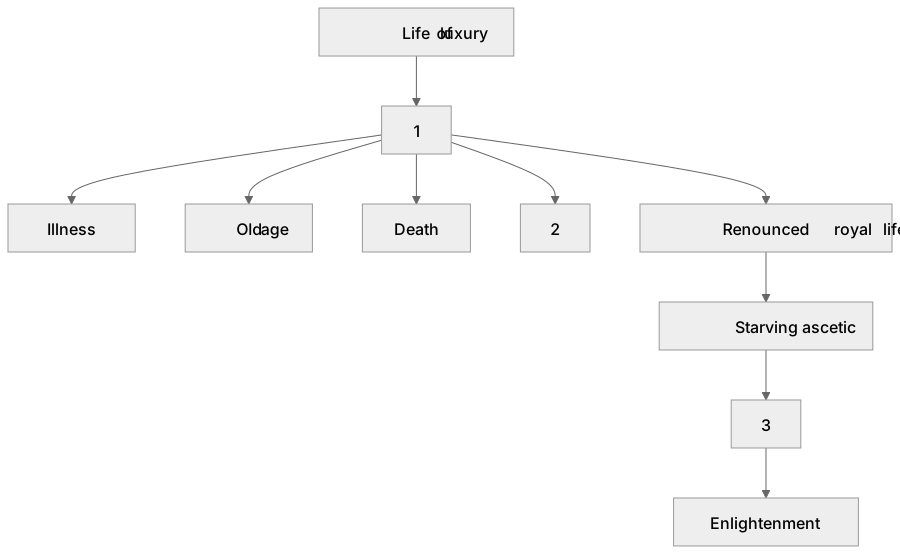
Some boxes have lost their names. Pick the right name for each number.
1Box 1
2Box 2
3Box 3
There is more to this lesson
The full lesson goes on to check your understanding and help you earn the marks. Create a free account to carry on, with your progress saved.
A week of Premium from your first lesson · Then the free plan continues · No card, no charge
Test your understanding of Key Beliefs: The Buddha’s life and its significance:
Active recall beats re-reading. Take an instant quiz now to test what you’ve learned and lock it into long-term memory.
A week of Premium from your first lesson · Then the free plan continues · No card, no charge