AQA · GCSE · Religious Studies
Course version: 8062 · Version from Sept 2018
Key Beliefs: The Buddha and the Four Noble Truths
Siddhartha Gautama's journey to becoming the Buddha began with his birth and a life of luxury, shielded from suffering.
Checked against the AQA 8062 specification (opens in a new tab) on .
- Point 14 of 24
- 4 key terms
Study notes
From the checked teaching notes for this specification point.
The idea
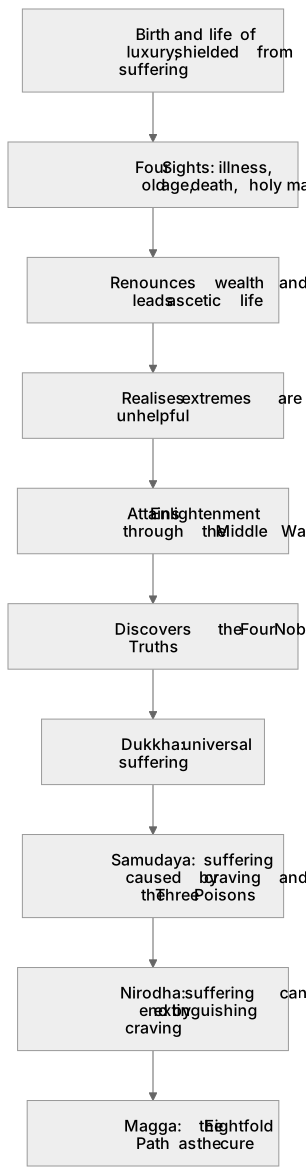
Siddhartha Gautama's journey to becoming the Buddha began with his birth and a life of luxury, shielded from suffering. This changed when he encountered the Four Sights: illness, old age, death, and a holy man. These sights prompted him to renounce his wealth and lead an ascetic life. Realising extremes were unhelpful, he attained Enlightenment through the Middle Way. This awakening led to his discovery of the Four Noble Truths, which act as a medical diagnosis for the human condition. The first truth, Dukkha, acknowledges universal suffering. Samudaya identifies its root cause as craving and the Three Poisons. Nirodha offers hope that suffering can end by extinguishing craving. Finally, Magga prescribes the cure: the Eightfold Path. The Buddha is revered as the supreme physician who diagnosed suffering and provided the practical treatment.
What earns the marks
- Outline the Buddha's early life, including his birth, life of luxury, and the transformative impact of the Four Sights (illness, old age, death, holy man).
- Describe the Buddha's ascetic life and his subsequent Enlightenment, which led to the realisation of the Four Noble Truths.
- Explain Dukkha (suffering) and Samudaya (the truth that suffering is caused by craving and the Three Poisons).
- Explain Nirodha (the cessation of suffering) and Magga (the Eightfold Path as the practical method to end suffering).
Common mistakes and how to put them right
Translating Dukkha only as physical pain.
Put it right: Broaden the definition of Dukkha to include emotional dissatisfaction, frustration, and the general unsatisfactoriness of life.
Stating that the Buddha created the Four Noble Truths.
Put it right: Explain that the Buddha discovered or realised these universal truths during his enlightenment, rather than inventing them.
Omitting the Four Sights when discussing the Buddha's realisation of suffering.
Put it right: Include illness, old age, death, and the holy man as the catalyst for his departure from a life of luxury.
Exam tips
- Use the analogy of the Buddha as a physician diagnosing an illness to explain how the Four Noble Truths work together.
- Link the Four Sights directly to the First Noble Truth (Dukkha) to show how the Buddha's life experiences shaped his teachings.
Try the lesson
The start of the Key Beliefs: The Buddha and the Four Noble Truths lesson, made from checked teaching notes for this specification point.
Have a go first
What did the Buddha identify as the First Noble Truth (Dukkha) in his teachings?
Listen
Siddhartha Gautama's journey to becoming the Buddha began with his birth and a life of luxury, shielded from suffering. This changed when he encountered the Four Sights: illness, old age, death, and a holy man. These sights prompted him to renounce his wealth and lead an ascetic life. Realising extremes were unhelpful, he attained Enlightenment through the Middle Way. This awakening led to his discovery of the Four Noble Truths, which act as a medical diagnosis for the human condition. The first truth, Dukkha, acknowledges universal suffering. Samudaya identifies its root cause as craving and the Three Poisons. Nirodha offers hope that suffering can end by extinguishing craving. Finally, Magga prescribes the cure: the Eightfold Path. The Buddha is revered as the supreme physician who diagnosed suffering and provided the practical treatment. A strong answer earns marks for these points. Outline the Buddha's early life, including his birth, life of luxury, and the transformative impact of the Four Sights (illness, old age, death, holy man). Describe the Buddha's ascetic life and his subsequent Enlightenment, which led to the realisation of the Four Noble Truths. Explain Dukkha (suffering) and Samudaya (the truth that suffering is caused by craving and the Three Poisons). Explain Nirodha (the cessation of suffering) and Magga (the Eightfold Path as the practical method to end suffering). A common slip: Translating Dukkha only as physical pain. Instead, Broaden the definition of Dukkha to include emotional dissatisfaction, frustration, and the general unsatisfactoriness of life. Exam tip: Use the analogy of the Buddha as a physician diagnosing an illness to explain how the Four Noble Truths work together.
See it
Key words
Say what each word means before you turn the card.
Suffering (Dukkha)
Try answering aloud or in your head before turning the card.
Samudaya
Try answering aloud or in your head before turning the card.
Nirodha
Try answering aloud or in your head before turning the card.
Magga
Try answering aloud or in your head before turning the card.
See every definition
- Suffering (Dukkha)
- The first truth, which acknowledges universal suffering and includes emotional dissatisfaction, frustration and the general unsatisfactoriness of life.
- Samudaya
- The truth that identifies the root cause of suffering as craving and the Three Poisons.
- Nirodha
- The truth offering hope that suffering can end by extinguishing craving.
- Magga
- The truth that prescribes the cure for suffering: the Eightfold Path.
Label the diagram
Some boxes have lost their names. Pick the right name for each number.
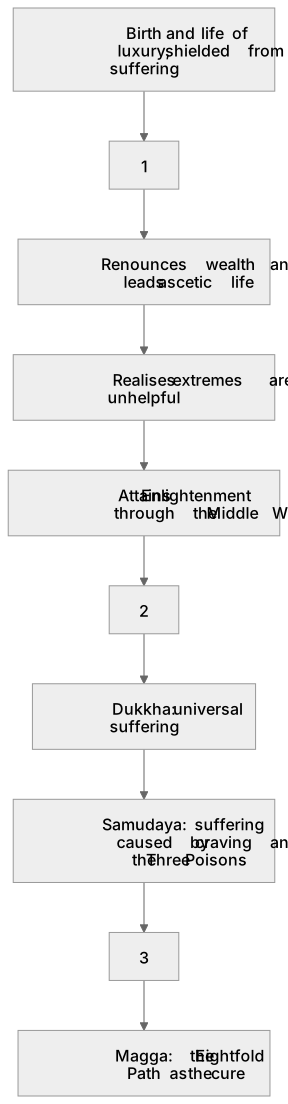
1Box 1
2Box 2
3Box 3
There is more to this lesson
The full lesson goes on to check your understanding and help you earn the marks. Create a free account to carry on, with your progress saved.
A week of Premium from your first lesson · Then the free plan continues · No card, no charge
Test your understanding of Key Beliefs: The Buddha and the Four Noble Truths
Active recall beats re-reading. Take an instant quiz now to test what you’ve learned and lock it into long-term memory.
A week of Premium from your first lesson · Then the free plan continues · No card, no charge