AQA · GCSE · Religious Studies
Course version: 8062 · Version from Sept 2018
Key Beliefs: The concept of dependent arising (paticcasamupada).
Dependent arising (paticcasamupada) is the fundamental Buddhist belief that everything exists in a state of constant interconnectedness.
Checked against the AQA 8062 specification (opens in a new tab) on .
- Point 3 of 24
- 4 key terms
Study notes
From the checked teaching notes for this specification point.
The idea
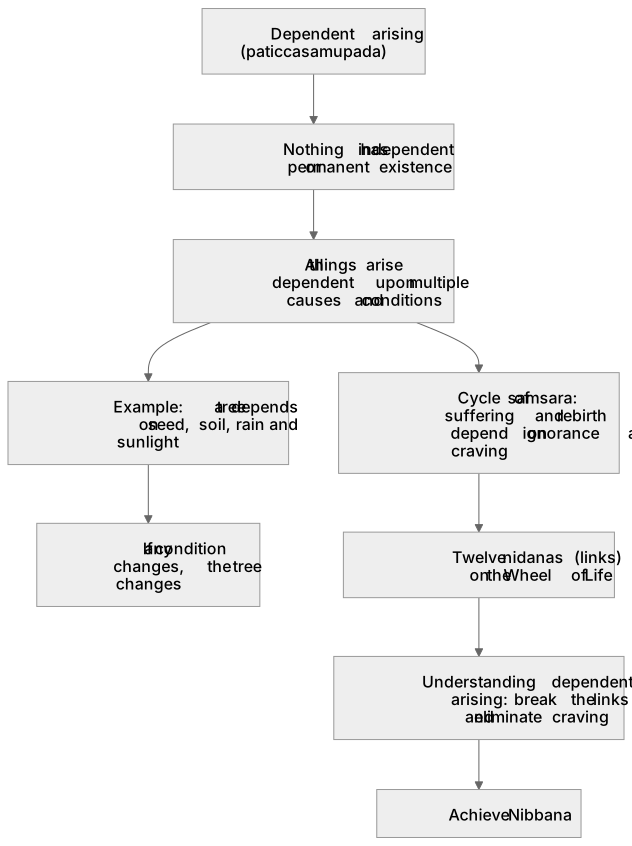
Dependent arising (paticcasamupada) is the fundamental Buddhist belief that everything exists in a state of constant interconnectedness. Nothing has independent or permanent existence; instead, all things arise and continue to exist dependent upon multiple causes and conditions. For example, a tree only exists because of the seed, soil, rain, and sunlight. If any of these conditions change, the tree changes. In human life, this principle explains the cycle of samsara: suffering and rebirth arise depending on ignorance and craving, often illustrated by the twelve nidanas (links) on the Tibetan Wheel of Life. By understanding dependent arising, Buddhists aim to break these links, eliminate craving, and ultimately achieve Nibbana.
What earns the marks
- Definition of dependent arising as the principle that all things depend on causes and conditions.
- Explanation that nothing exists independently or permanently, linking to the concepts of anatta and anicca.
- Application to the cycle of samsara, where rebirth and suffering depend on ignorance and craving.
- Reference to the twelve nidanas (links) which illustrate this continuous process on the Wheel of Life.
- The ultimate goal of breaking the cycle of dependent arising to achieve Nibbana.
Common mistakes and how to put them right
Confusing dependent arising with karma.
Put it right: Karma is specifically about intentional actions having consequences, whereas dependent arising is the broader universal principle of interconnectedness.
Thinking dependent arising only applies to physical objects.
Put it right: It applies to everything, including physical objects, human emotions, suffering, and the cycle of rebirth.
Spelling paticcasamupada incorrectly and avoiding the term.
Put it right: Learn the spelling or confidently use the English translation 'dependent arising' as both are credited equally.
Exam tips
- Use the analogy of a tree or a wave to clearly illustrate how things rely on external conditions to exist.
- Link dependent arising to the Three Marks of Existence, particularly anicca (impermanence) and anatta (no fixed self).
- When evaluating its importance, argue that understanding this concept is essential for achieving enlightenment because it reveals the root causes of suffering.
Try the lesson
The start of the Key Beliefs: The concept of dependent arising (paticcasamupada). lesson, made from checked teaching notes for this specification point.
Have a go first
What is the fundamental belief expressed by the Buddhist concept of dependent arising (paticcasamupada)?
Listen
Dependent arising (paticcasamupada) is the fundamental Buddhist belief that everything exists in a state of constant interconnectedness. Nothing has independent or permanent existence; instead, all things arise and continue to exist dependent upon multiple causes and conditions. For example, a tree only exists because of the seed, soil, rain, and sunlight. If any of these conditions change, the tree changes. In human life, this principle explains the cycle of samsara: suffering and rebirth arise depending on ignorance and craving, often illustrated by the twelve nidanas (links) on the Tibetan Wheel of Life. By understanding dependent arising, Buddhists aim to break these links, eliminate craving, and ultimately achieve Nibbana. A strong answer earns marks for these points. Definition of dependent arising as the principle that all things depend on causes and conditions. Explanation that nothing exists independently or permanently, linking to the concepts of anatta and anicca. Application to the cycle of samsara, where rebirth and suffering depend on ignorance and craving. Reference to the twelve nidanas (links) which illustrate this continuous process on the Wheel of Life. A common slip: Confusing dependent arising with karma. Instead, Karma is specifically about intentional actions having consequences, whereas dependent arising is the broader universal principle of interconnectedness. Exam tip: Use the analogy of a tree or a wave to clearly illustrate how things rely on external conditions to exist.
See it
Key words
Say what each word means before you turn the card.
Interconnectedness
Try answering aloud or in your head before turning the card.
Samsara
Try answering aloud or in your head before turning the card.
Causes and conditions
Try answering aloud or in your head before turning the card.
Enlightenment
Try answering aloud or in your head before turning the card.
See every definition
- Interconnectedness
- The state in which everything exists, since all things arise and continue to exist dependent upon multiple causes and conditions.
- Samsara
- The cycle of suffering and rebirth, which arises depending on ignorance and craving.
- Causes and conditions
- The multiple factors upon which all things depend in order to arise and continue to exist.
- Enlightenment
- The goal achieved by understanding dependent arising, breaking the links, eliminating craving and ultimately achieving Nibbana.
Label the diagram
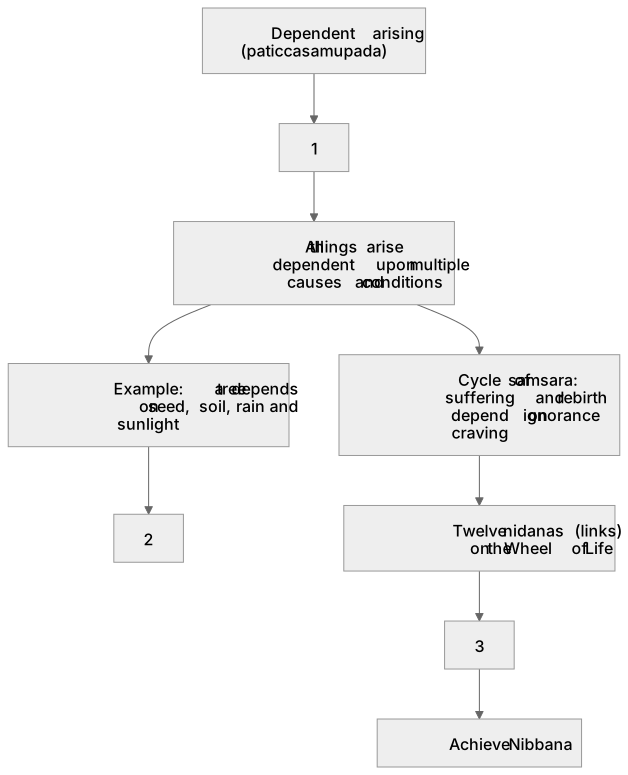
Some boxes have lost their names. Pick the right name for each number.
1Box 1
2Box 2
3Box 3
There is more to this lesson
The full lesson goes on to check your understanding and help you earn the marks. Create a free account to carry on, with your progress saved.
A week of Premium from your first lesson · Then the free plan continues · No card, no charge
Test your understanding of Key Beliefs: The concept of dependent arising (paticcasamupada).
Active recall beats re-reading. Take an instant quiz now to test what you’ve learned and lock it into long-term memory.
A week of Premium from your first lesson · Then the free plan continues · No card, no charge