AQA · GCSE · Religious Studies
Course version: 8062 · Version from Sept 2018
Key Beliefs: the Four Sights: illness, old age, death, holy man (Jataka 075)
The Four Sights mark a pivotal moment in Siddhartha Gautama's life, prompting his departure from a sheltered palace.
Checked against the AQA 8062 specification (opens in a new tab) on .
- Point 17 of 24
- 4 key terms
Study notes
From the checked teaching notes for this specification point.
The idea
The Four Sights mark a pivotal moment in Siddhartha Gautama's life, prompting his departure from a sheltered palace. As referenced in Jataka 075, Siddhartha ventured outside and encountered four profound realities. First, he saw an old man, revealing the inevitability of ageing. Second, he witnessed an ill person, demonstrating physical suffering. Third, he observed a corpse, exposing the inescapable reality of death. These three sights introduced him to the universal problem of suffering (dukkha). Finally, he saw a holy man who appeared peaceful despite having no possessions. This fourth sight inspired Siddhartha to renounce his royal life and seek a spiritual solution to human suffering, setting him on the path to enlightenment.
What earns the marks
- Identify the Four Sights encountered by Siddhartha: old age, illness, death, and a holy man.
- Explain how the first three sights (illness, old age, death) introduced Siddhartha to the reality of dukkha (suffering).
- Describe the impact of the fourth sight (the holy man) as the catalyst for Siddhartha's renunciation of his royal life.
- Reference Jataka 075 to support explanations of Siddhartha's encounters and his subsequent realisation about the nature of existence.
Common mistakes and how to put them right
Stating that Siddhartha had never seen anyone before leaving the palace.
Put it right: Clarify that he had never seen suffering, illness, old age, or death due to his father's extreme sheltering, not that he was entirely isolated from all people.
Confusing the holy man with the Buddha.
Put it right: Explain that the holy man was an ascetic seeking truth, which inspired Siddhartha to become an ascetic himself before eventually becoming the Buddha.
Omitting the specific reference to Jataka 075 when asked for a textual source.
Put it right: Memorise Jataka 075 as the specific scriptural reference for the story of the Four Sights.
Exam tips
- Use the Four Sights to explain the origins of the Buddhist concept of dukkha (suffering) in essay questions.
- When evaluating Siddhartha's decision to leave the palace, contrast the suffering seen in the first three sights with the peace of the fourth sight.
- Explicitly mention Jataka 075 when providing evidence for Siddhartha's early life and realisations.
Try the lesson
The start of the Key Beliefs: the Four Sights: illness, old age, death, holy man (Jataka 075) lesson, made from checked teaching notes for this specification point.
Have a go first
Which of the following correctly identifies the Four Sights seen by Siddhartha Gautama according to Buddhist tradition?
Listen
The Four Sights mark a pivotal moment in Siddhartha Gautama's life, prompting his departure from a sheltered palace. As referenced in Jataka 075, Siddhartha ventured outside and encountered four profound realities. First, he saw an old man, revealing the inevitability of ageing. Second, he witnessed an ill person, demonstrating physical suffering. Third, he observed a corpse, exposing the inescapable reality of death. These three sights introduced him to the universal problem of suffering (dukkha). Finally, he saw a holy man who appeared peaceful despite having no possessions. This fourth sight inspired Siddhartha to renounce his royal life and seek a spiritual solution to human suffering, setting him on the path to enlightenment. A strong answer earns marks for these points. Identify the Four Sights encountered by Siddhartha: old age, illness, death, and a holy man. Explain how the first three sights (illness, old age, death) introduced Siddhartha to the reality of dukkha (suffering). Describe the impact of the fourth sight (the holy man) as the catalyst for Siddhartha's renunciation of his royal life. Reference Jataka 075 to support explanations of Siddhartha's encounters and his subsequent realisation about the nature of existence. A common slip: Stating that Siddhartha had never seen anyone before leaving the palace. Instead, Clarify that he had never seen suffering, illness, old age, or death due to his father's extreme sheltering, not that he was entirely isolated from all people. Exam tip: Use the Four Sights to explain the origins of the Buddhist concept of dukkha (suffering) in essay questions.
See it
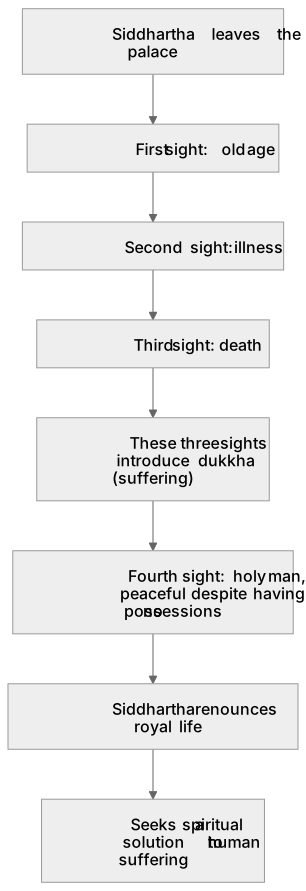
Put it in order
Put these steps in the order they happen.
- 1. These three sights introduce dukkha (suffering)
- 2. Seeks a spiritual solution to human suffering
- 3. Fourth sight: holy man, peaceful despite having no possessions
- 4. Siddhartha leaves the palace
- 5. First sight: old age
- 6. Siddhartha renounces his royal life
- 7. Second sight: illness
- 8. Third sight: death
Key words
Say what each word means before you turn the card.
Dukkha (Suffering)
Try answering aloud or in your head before turning the card.
Renunciation
Try answering aloud or in your head before turning the card.
Holy man
Try answering aloud or in your head before turning the card.
Jataka 075
Try answering aloud or in your head before turning the card.
See every definition
- Dukkha (Suffering)
- The universal problem of suffering introduced to Siddhartha by the first three sights.
- Renunciation
- What Siddhartha was inspired to do with his royal life after seeing the holy man, so as to seek a spiritual solution to human suffering.
- Holy man
- The fourth sight, who appeared peaceful despite having no possessions.
- Jataka 075
- The scriptural reference for the story of the Four Sights.
Label the diagram
Some boxes have lost their names. Pick the right name for each number.
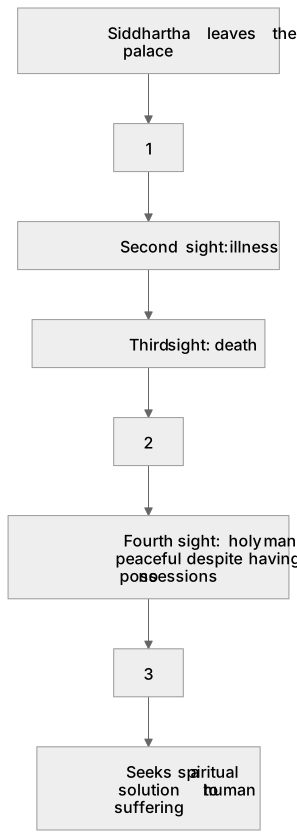
1Box 1
2Box 2
3Box 3
There is more to this lesson
The full lesson goes on to check your understanding and help you earn the marks. Create a free account to carry on, with your progress saved.
A week of Premium from your first lesson · Then the free plan continues · No card, no charge
Test your understanding of Key Beliefs: the Four Sights: illness, old age, death, holy man (Jataka 075)
Active recall beats re-reading. Take an instant quiz now to test what you’ve learned and lock it into long-term memory.
A week of Premium from your first lesson · Then the free plan continues · No card, no charge