Pearson Edexcel · GCSE · Religious Studies
Aims of Punishment
This study guide provides a comprehensive analysis of the four aims of punishment for Edexcel GCSE Religious Studies. It is designed to help students master the key concepts, religious teachings, and exam techniques required to achieve top marks."
- 16 min read
- 3 worked examples
- 5 practice questions
Study Notes
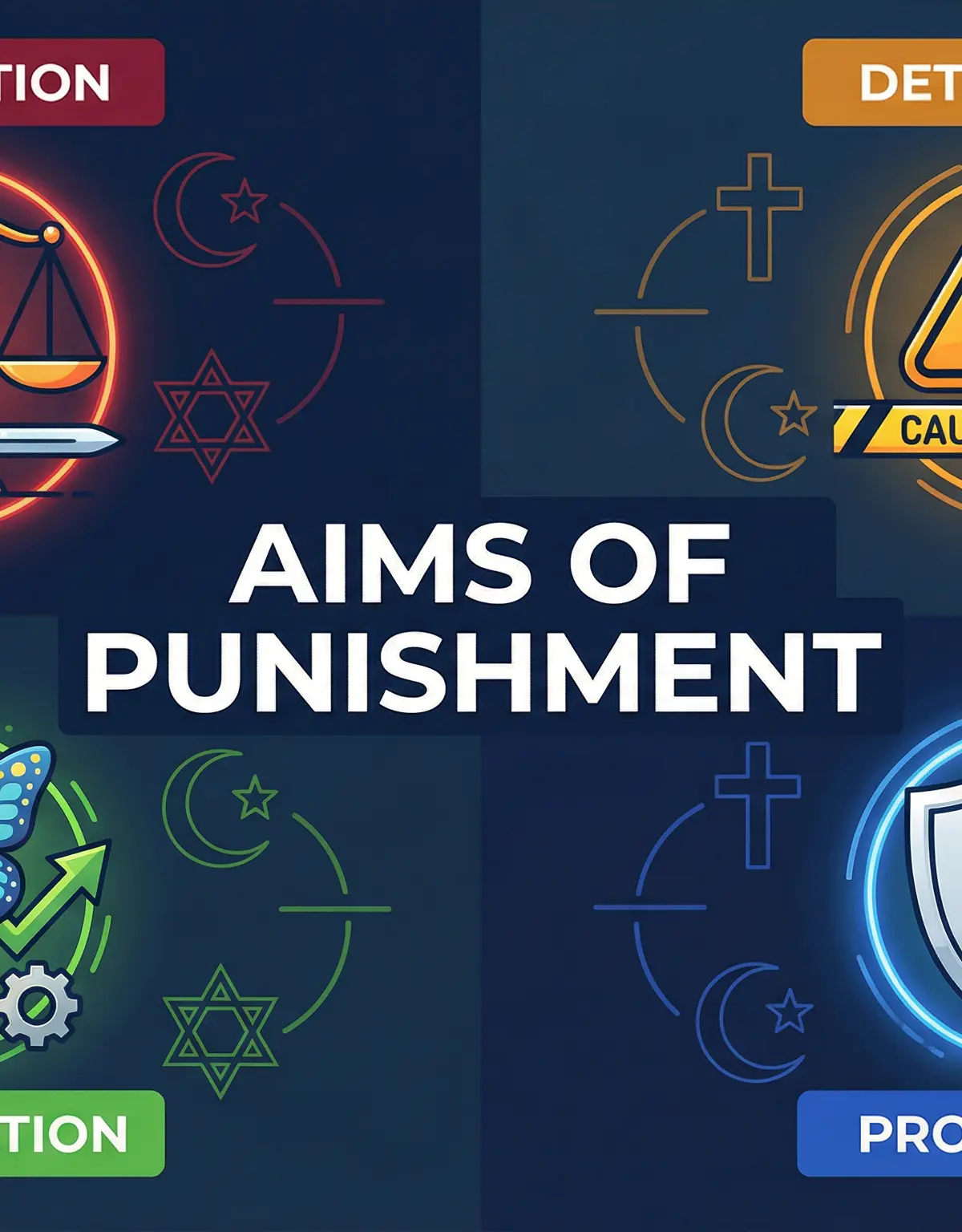
Overview
This study guide covers the four principal aims of punishment as required by the Edexcel GCSE Religious Studies specification: Retribution, Deterrence, Reformation, and Protection. Understanding these concepts is fundamental to the Crime and Punishment topic. Examiners expect candidates to not only define each aim with precision but also to evaluate their effectiveness and moral standing from Christian and other religious perspectives, consistently referencing Sources of Wisdom and Authority (SoA). This guide will break down each aim, explore the relevant religious teachings, highlight common mistakes, and provide a clear framework for constructing high-level exam answers. A key skill is distinguishing between similar concepts, such as retribution and revenge, or deterrence and protection. Mastery of this topic is demonstrated by a candidate's ability to build a reasoned argument, supported by specific textual evidence, and to evaluate the complex interplay between these different, and sometimes conflicting, purposes of punishment in contemporary society.
The Four Aims of Punishment
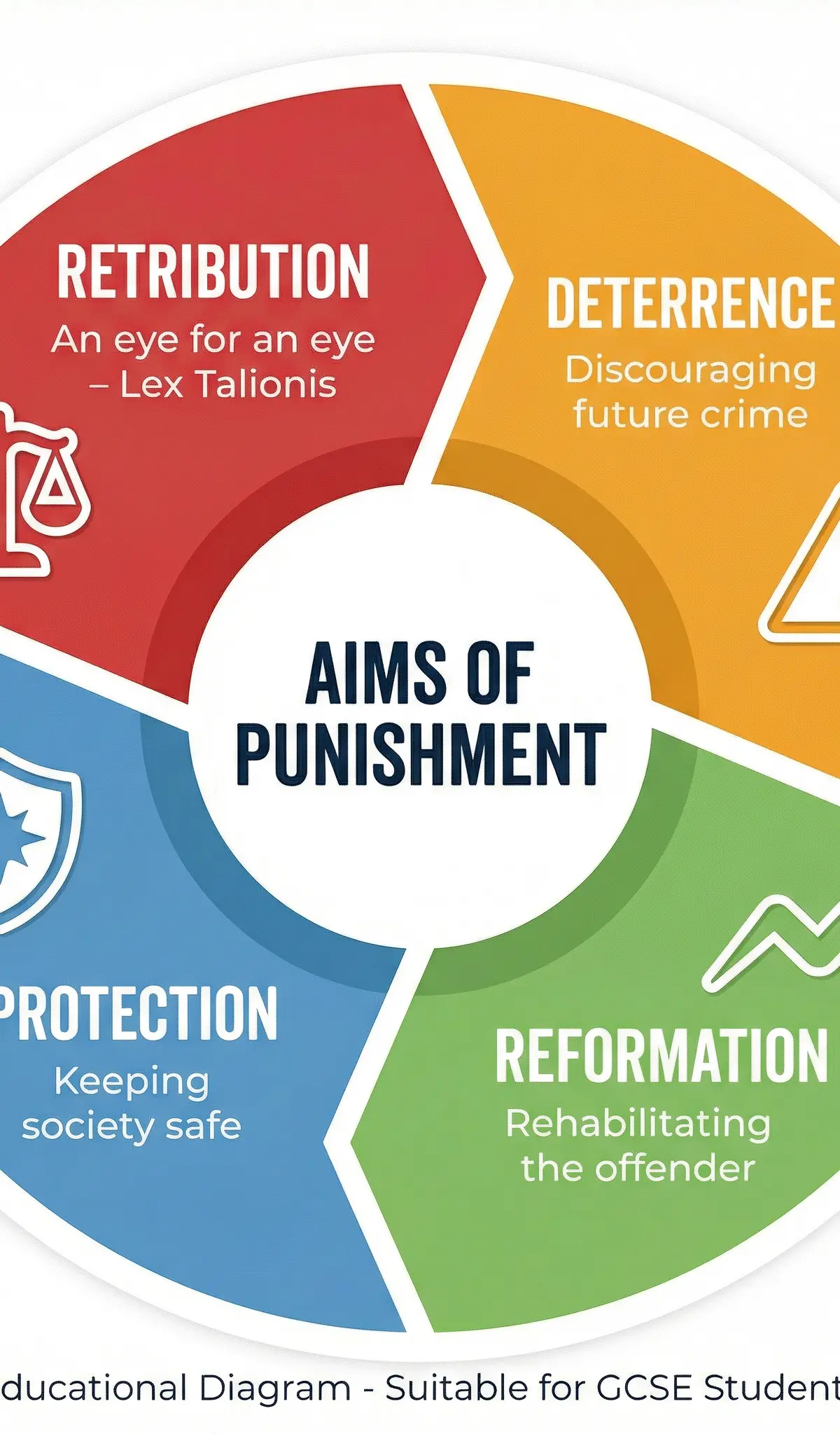
Retribution
What it is: The idea that punishment should be proportional to the crime committed. It is a backward-looking aim, focused on ensuring the offender gets their 'just deserts'. This is about justice, not revenge. The punishment fits the crime.
Why it matters: This is the oldest aim of punishment. Examiners will credit candidates who can explain the principle of proportionality. A key Source of Wisdom and Authority is the concept of Lex Talionis (the law of retaliation) from Exodus 21:24: "an eye for an eye, a tooth for a tooth". This is often misinterpreted as a call for vengeance, but its original purpose was to limit punishment and ensure it was not excessive.
Specific Knowledge: Candidates must know the term Lex Talionis and be able to reference Exodus 21. They should also be able to contrast this with Jesus' teaching in Matthew 5:38-39, where he appears to reject this principle: "You have heard that it was said, ‘Eye for eye, and tooth for tooth.’ But I tell you, do not resist an evil person."
Deterrence
What it is: The aim of discouraging crime through the fear of punishment. There are two forms: specific deterrence (punishing an individual to stop them reoffending) and general deterrence (punishing an individual to warn society at large).
Why it matters: This is a forward-looking, utilitarian argument for punishment. It justifies punishment based on its supposed good consequences (reducing crime). Examiners look for candidates who can distinguish it clearly from protection. For example, a long prison sentence might deter others (general deterrence) and the offender (specific deterrence), but its primary function in keeping the offender off the streets is protection.
Specific Knowledge: In Islam, the severe Hudud punishments (e.g., amputation for theft) are often justified on the grounds of their strong deterrent effect on the community. A good evaluation will note the debate around whether such punishments are appropriate in the modern world.
Reformation
What it is: The aim of changing or rehabilitating the offender so they can become a law-abiding member of society. This is a forward-looking, offender-focused aim.
Why it matters: This aim is strongly supported by many religious believers, particularly Christians, who believe in the possibility of redemption and forgiveness. It aligns with the idea that every human has value and can change for the better. It is the most optimistic aim of punishment.
Specific Knowledge: The key Christian teaching is the belief in forgiveness and the sanctity of life. The Parable of the Prodigal Son (Luke 15) is a perfect example of forgiveness and second chances. Another crucial text is Matthew 25:36, where Jesus says, "I was in prison and you came to visit me," which implies a duty of care towards prisoners. Charities like the Prison Fellowship are practical examples of this aim in action.
Protection
What it is: The aim of keeping society safe from dangerous offenders by physically removing them. This is the primary justification for imprisonment and, for some, capital punishment.
Why it matters: This is a pragmatic, society-focused aim. It raises difficult questions about how to balance the rights of the individual offender against the safety of the community. The tension between Protection and Reformation is a key area for evaluation. If an offender is reformed, is it right to keep them in prison for protection?
Specific Knowledge: The debate around capital punishment is central here. While some may argue it is the ultimate form of protection, most Christians and many other religious believers argue it violates the sanctity of life. The Catholic Church, for example, has declared the death penalty "inadmissible".
Key Concepts & Distinctions

Retributive vs. Restorative Justice
Examiners award high credit to candidates who can distinguish between these two models of justice.
| Feature | Retributive Justice | Restorative Justice |
|---|---|---|
| Focus | Past offence | Future harmony |
| Goal | Proportional punishment | Repairing harm |
| Key Question | What does the offender deserve? | What do the victims and community need? |
| Religious Link | Exodus 21 (Lex Talionis) | Luke 15 (Prodigal Son) |
| ", | ||
| "podcast_script": "Welcome to the GCSE Religious Studies Revision Podcast. I'm your host, and today we are diving deep into one of the most important topics on the Edexcel specification: the Aims of Punishment. Whether you're revising for the first time or doing a final check before your exam, this episode is going to give you everything you need — the key concepts, the religious teachings, the exam technique, and a quick-fire quiz at the end. So let's get started. |
First, a quick overview of why this topic matters. The Aims of Punishment sits within the Crime and Punishment section of your Edexcel GCSE Religious Studies course. Examiners love this topic because it requires you to do two things simultaneously: demonstrate precise knowledge of what each aim actually means, and evaluate those aims through religious and ethical lenses. The assessment is split equally — fifty percent AO1, which is knowledge and understanding, and fifty percent AO2, which is evaluation and analysis. So you cannot just describe — you must also argue. Keep that in mind throughout everything we cover today.
Now let's get into the core concepts. There are four main aims of punishment, and I want you to remember them using the acronym R-D-R-P: Retribution, Deterrence, Reformation, and Protection. Think of it as: "Really Determined Religious People." A bit silly, but it works. Let's go through each one in detail.
Starting with Retribution. Retribution is the idea that punishment is deserved — that criminals should get what they have coming to them as a consequence of their actions. This is a backward-looking aim, meaning it focuses on what has already happened, not on preventing future crime. The key phrase here is "just deserts." The offender deserves to suffer because they chose to commit a crime. Now, here is the critical distinction that trips up so many candidates: retribution is NOT the same as revenge. Revenge is personal, emotional, and often disproportionate. Retribution is proportional — the punishment must fit the crime. Examiners will not award full marks if you conflate these two concepts.
The most important Source of Wisdom and Authority for retribution is the concept of Lex Talionis, which comes from Exodus chapter 21. The Latin phrase means "the law of retaliation," and the famous line is: "an eye for an eye, a tooth for a tooth." This principle establishes proportionality — you cannot take two eyes for one eye. It is actually a limiting principle, designed to prevent excessive punishment. Christians and Jewish scholars have debated this text extensively. Some argue it supports retributive punishment; others, particularly in the New Testament tradition, argue that Jesus overturned it in Matthew chapter 5, where he says "You have heard it said, an eye for an eye... but I say to you, do not resist an evil person." This is a brilliant tension to explore in your evaluation questions.
Moving on to Deterrence. Deterrence is the aim of discouraging people from committing crime. There are two types, and you should know both. General deterrence aims to discourage the wider public — if people see that crime leads to harsh punishment, they will think twice before offending. Specific deterrence aims to prevent the individual offender from reoffending — the punishment is unpleasant enough that they will not want to experience it again. The key idea here is that punishment sends a message. It is forward-looking, unlike retribution.
A common mistake — and I cannot stress this enough — is confusing deterrence with protection. They are different. Deterrence works through fear and the threat of consequences. Protection works by physically preventing the offender from being able to harm society. A person in prison is protected from society not because they are scared, but because they are physically removed. Different aims, different mechanisms. Learn that distinction.
From a religious perspective, deterrence has some support. In Islam, the concept of Hudud punishments — fixed punishments prescribed in the Quran for serious crimes — are partly justified on deterrent grounds. The severity of the punishment, such as amputation for theft, is intended to discourage others. However, many Muslims today argue that these punishments should only be applied in a perfectly just Islamic society, which does not currently exist. This is a nuanced point that will impress examiners in your evaluation answers.
Now let's talk about Reformation. This is arguably the most theologically rich of the four aims, and it is the one most closely aligned with Christian teaching. Reformation — sometimes called rehabilitation — is the idea that the purpose of punishment is to change the offender, to help them become a better person so they can reintegrate into society. It is forward-looking and offender-focused.
The theological basis for reformation is rooted in the Christian belief in the sanctity of human life and the possibility of redemption. Every person, no matter what they have done, retains their God-given dignity and the capacity for change. This connects to the concept of agape — unconditional love — which Christians believe should be extended even to criminals. The Parable of the Prodigal Son in Luke chapter 15 is a powerful Source of Wisdom and Authority here. The son squanders his inheritance, behaves terribly, but the father — representing God — welcomes him back with open arms. The message is that repentance and reformation are always possible.
Another key text is Matthew chapter 25, the Parable of the Sheep and Goats. Jesus says: "I was in prison and you came to visit me." This teaching suggests that Christians have a duty to care for prisoners and support their reformation, rather than simply punishing them. The Prison Fellowship, a Christian charity founded by Chuck Colson in 1976, is a real-world example of this principle in action. Mentioning specific organisations in your answers can earn you additional marks.
In Islam, the concept of Tawbah — sincere repentance — is central. Allah is described in the Quran as Al-Tawwab, the Ever-Accepting of Repentance. This suggests that reformation and spiritual renewal are always possible, and punishment should ideally create the conditions for this to happen.
Finally, let's cover Protection. Protection is the aim of keeping society safe from dangerous individuals. It is achieved by physically removing the offender from society — through imprisonment, or in extreme cases, through capital punishment. Protection is forward-looking and society-focused. The key question is: how long must someone be removed to adequately protect society?
This is where the tension between protection and reformation becomes really interesting for exam purposes. If someone is genuinely reformed — if they have changed and pose no further risk — is it still justified to keep them imprisoned for the sake of protection? Most religious traditions would say no. But if someone is dangerous and unrepentant, protection of innocent people may take priority. This tension is at the heart of debates about life sentences and capital punishment.
From a Christian perspective, the sanctity of life argument is crucial. If every human life is sacred — created in the image of God, or Imago Dei — then even the most dangerous criminal retains their right to life. This is why most mainstream Christian denominations, including the Catholic Church under Pope Francis, oppose capital punishment. The Catechism of the Catholic Church, updated in 2018, states that the death penalty is "inadmissible" because it attacks the dignity of the person.
In contrast, some Protestant traditions have historically supported capital punishment based on Genesis chapter 9, verse 6: "Whoever sheds human blood, by humans shall their blood be shed; for in the image of God has God made mankind." This text has been used to argue that capital punishment is actually a recognition of human dignity — the ultimate crime deserves the ultimate punishment.
Now let's move into exam tips and common mistakes. This is where you can really gain or lose marks.
The first and most critical tip: in your "c" questions — the five-mark "Explain two ways" questions — you must include a specific Source of Wisdom and Authority in your second developed point. If you do not, the mark scheme caps you at two out of five. This is the single most common reason candidates lose marks on this topic. Do not just say "Christians believe in reformation." Say: "Christians believe in reformation, as shown in the Parable of the Prodigal Son in Luke 15, where the father's welcome of his wayward son demonstrates that repentance and renewal are always possible."
Second tip: for your twelve-mark evaluation questions, use the FARM structure. F stands for Arguments For. A stands for Arguments Against. R stands for Religious teachings. M stands for Main conclusion. This ensures you cover both sides, integrate religious sources, and reach a clear judgement — all of which are required for the top mark band.
Third tip: allocate your time carefully. The twelve-mark question should take you twelve to fifteen minutes. Do not spend more than three minutes on the three-mark definition questions. Time management is an exam skill in itself.
Fourth tip: avoid narrative. Examiners do not want to hear about prison conditions or a description of what happens in court. They want ethical analysis. Ask yourself: "Am I explaining the purpose and justification of this punishment, or am I just describing it?" If it is the latter, rewrite it.
Fifth tip: know the difference between the four aims cold. Practice writing one-sentence definitions for each without looking at your notes. If you can do that fluently, you are in a strong position.
Now for our quick-fire recall quiz. I will ask five questions. Pause the podcast after each one and try to answer before I give you the answer.
Question one: What is the Latin term for "an eye for an eye," and where does it appear in the Bible? Pause now. The answer is Lex Talionis, found in Exodus chapter 21.
Question two: What is the key difference between deterrence and protection? Pause now. Deterrence works through fear and the threat of consequences; protection works by physically removing the offender from society.
Question three: Name one Christian parable that supports the aim of reformation, and state where it appears in the Bible? Pause now. The Parable of the Prodigal Son, Luke chapter 15. Or the Parable of the Sheep and Goats, Matthew chapter 25.
Question four: What does the acronym FARM stand for in exam technique? Pause now. Arguments For, Arguments Against, Religious teachings, Main conclusion.
Question five: What is the maximum mark you can achieve on a five-mark "c" question if you fail to include a Source of Wisdom and Authority? Pause now. Two marks out of five.
How did you do? If you got all five, you are in great shape. If you missed any, go back and review that section.
Let's wrap up with a quick summary of everything we have covered today. The four aims of punishment are Retribution, Deterrence, Reformation, and Protection — remember them with R-D-R-P, or "Really Determined Religious People." Retribution is proportional justice, not revenge — rooted in Lex Talionis from Exodus 21. Deterrence discourages crime through fear of consequences — do not confuse it with protection. Reformation aims to change the offender — supported by the Parable of the Prodigal Son and the concept of Tawbah in Islam. Protection keeps society safe by removing dangerous individuals — this creates a tension with reformation in debates about capital punishment. In your exams, always include a specific Source of Wisdom and Authority in your five-mark answers, use the FARM structure for twelve-mark evaluations, and keep your definitions precise and distinct.
You have got this. Good luck in your exams, and thank you so much for listening. Keep revising, keep practising, and remember — every mark counts. See you in the next episode."
Worked Examples
3 worked examples — open one to explore the question and available guidance.
Practice Questions
Try the question, then reveal an answer plan or example response
Explain two reasons why a religious person might support the aim of deterrence. (5 marks)
Hint: Think about the purpose of law in religion and how different traditions view the role of punishment in society. Remember to include a Source of Wisdom!
\u0027Reformation is the only aim of punishment that a true Christian can support.\u0027 Evaluate this statement. (12 marks)",
"marks": 12
Explain two ways in which a religious community works to reform offenders. (5 marks)
Hint: Think about specific, real-world examples of organisations or programmes. Name them!
Explain two religious beliefs about retribution. (5 marks)
Hint: Contrast an Old Testament view with a New Testament view.
Explain two contrasting aims of punishment. (4 marks)
Hint: Pick two aims that have a clear tension, like Retribution and Reformation, and explain what each one is.
Watch or listen (optional)
Test your understanding of Aims of Punishment
Active recall beats re-reading. Take an instant quiz now to test what you’ve learned and lock it into long-term memory.
7 days Premium · Then the free plan continues · No card, no charge