WJEC · GCSE · Religious Studies
Sources of Authority (e.g., sacred texts, religious leaders)
This guide explores the crucial topic of 'Sources of Authority' for WJEC GCSE Religious Studies, examining how sacred texts, religious leaders, and conscience guide believers. Mastering this is key to unlocking top marks by understanding the foundations of religious decision-making.
- 7 min read
- 3 worked examples
- 5 practice questions
- 6 key terms
Study Notes

Overview
Welcome to your guide on Sources of Wisdom and Authority, a compulsory theme in the WJEC GCSE Religious Studies specification. This topic is fundamental because it explores the very foundation of religious belief and practice: where do believers get their rules, guidance, and inspiration from? Examiners expect candidates to demonstrate a nuanced understanding of the hierarchy of authority in both Christianity and Islam. You must be able to explain the role of sacred texts, religious leaders, tradition, and individual conscience. More importantly, for AO2, you need to evaluate how these sources are applied to modern ethical dilemmas, weighing their reliability and relevance. Success requires moving beyond simple descriptions to a critical analysis, using specific citations from sources of wisdom to support your arguments. This guide will equip you with the specific knowledge and exam techniques needed to tackle this challenging but rewarding topic.
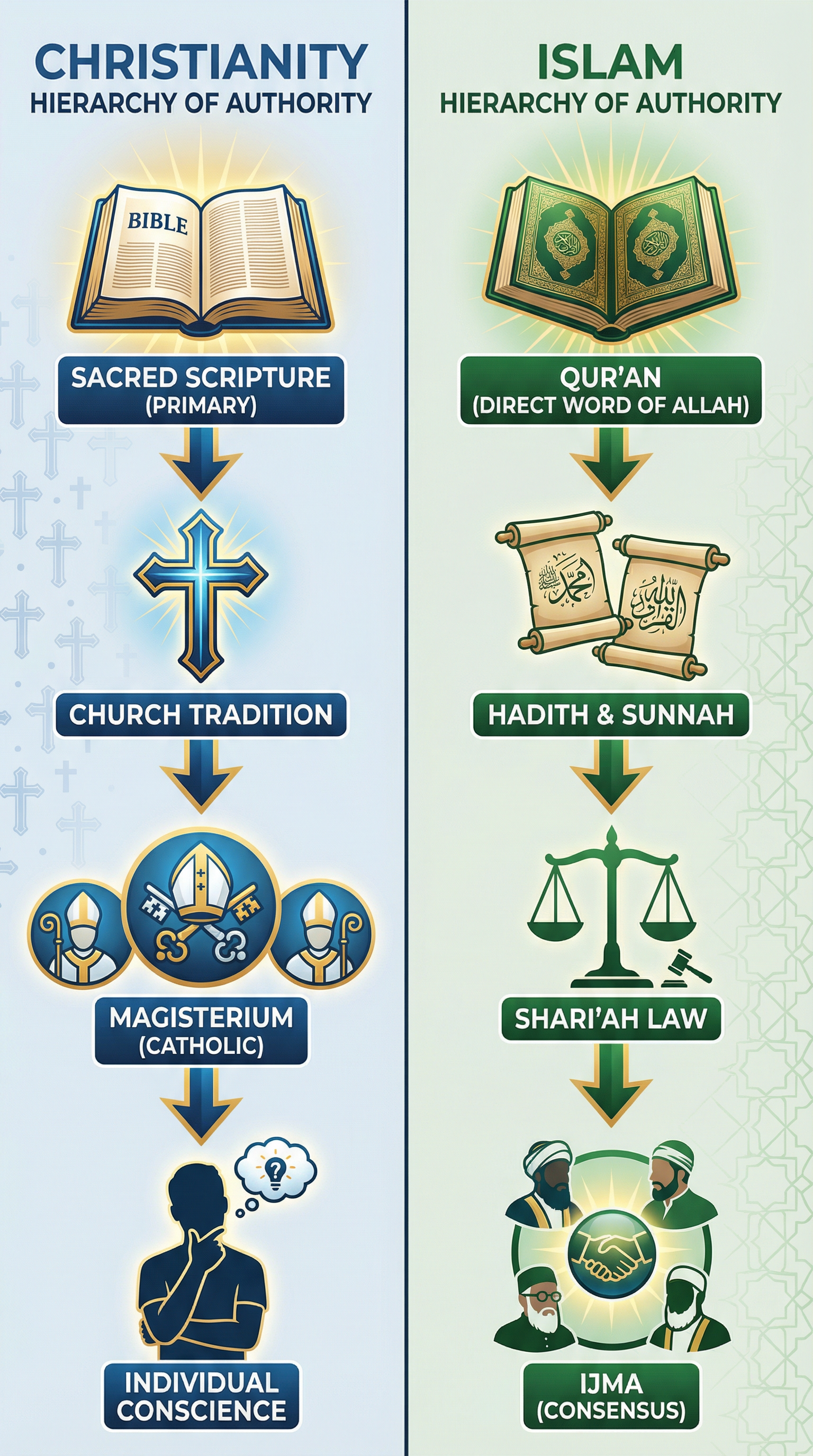
Key Sources of Authority in Christianity
The Bible (Sacred Scripture)
What it is: The primary source of authority for all Christians, consisting of the Old and New Testaments. It contains laws, prophecies, poems, history, and the teachings and life of Jesus Christ.
Why it matters: It is considered the word of God. However, interpretations vary. Literalists (or Fundamentalists) believe it is the direct, inerrant word of God and should be followed exactly. Liberals (or Conservatives) believe it is inspired by God but written by humans, and therefore requires interpretation in a modern context. For example, a literalist might reject evolution based on the Genesis creation story, while a liberal might see the story as a symbolic account of God's creative power.
Specific Knowledge: Candidates should be able to cite specific texts. For example, the Decalogue (Exodus 20) provides foundational moral laws, while the Sermon on the Mount (Matthew 5-7) contains Jesus' key ethical teachings, like the Beatitudes.
Church Tradition & The Magisterium
What it is: The teachings and practices passed down through generations. For the Catholic Church, this is a vital source of authority, embodied in the Magisterium – the teaching authority of the Pope and bishops. Protestants, particularly those following the principle of Sola Scriptura (Scripture Alone), place far less emphasis on tradition.
Why it matters: The Magisterium provides guidance on new issues not directly addressed in the Bible, such as IVF or genetic engineering. The Pope can make infallible statements ex cathedra (from the chair of St. Peter) on matters of faith and morals. This is a key difference between Catholic and Protestant authority.
Specific Knowledge: Know the role of the Pope as the head of the Catholic Church and successor to St. Peter. Understand that the Archbishop of Canterbury is the symbolic head of the Anglican Communion but does not hold the same authority as the Pope.
Individual Conscience
What it is: The inner sense of right and wrong. Many Christians believe it is the voice of God within them.
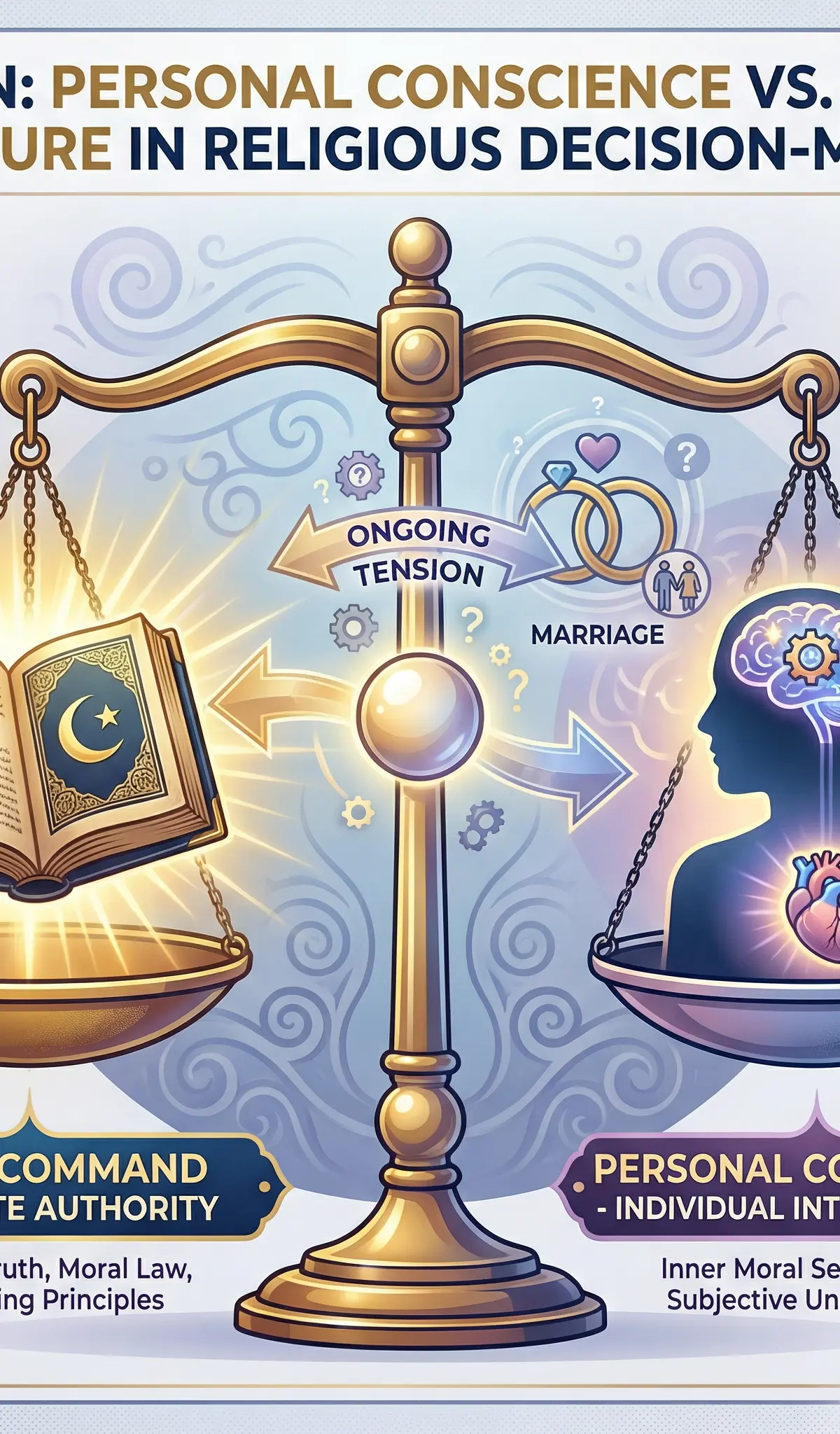
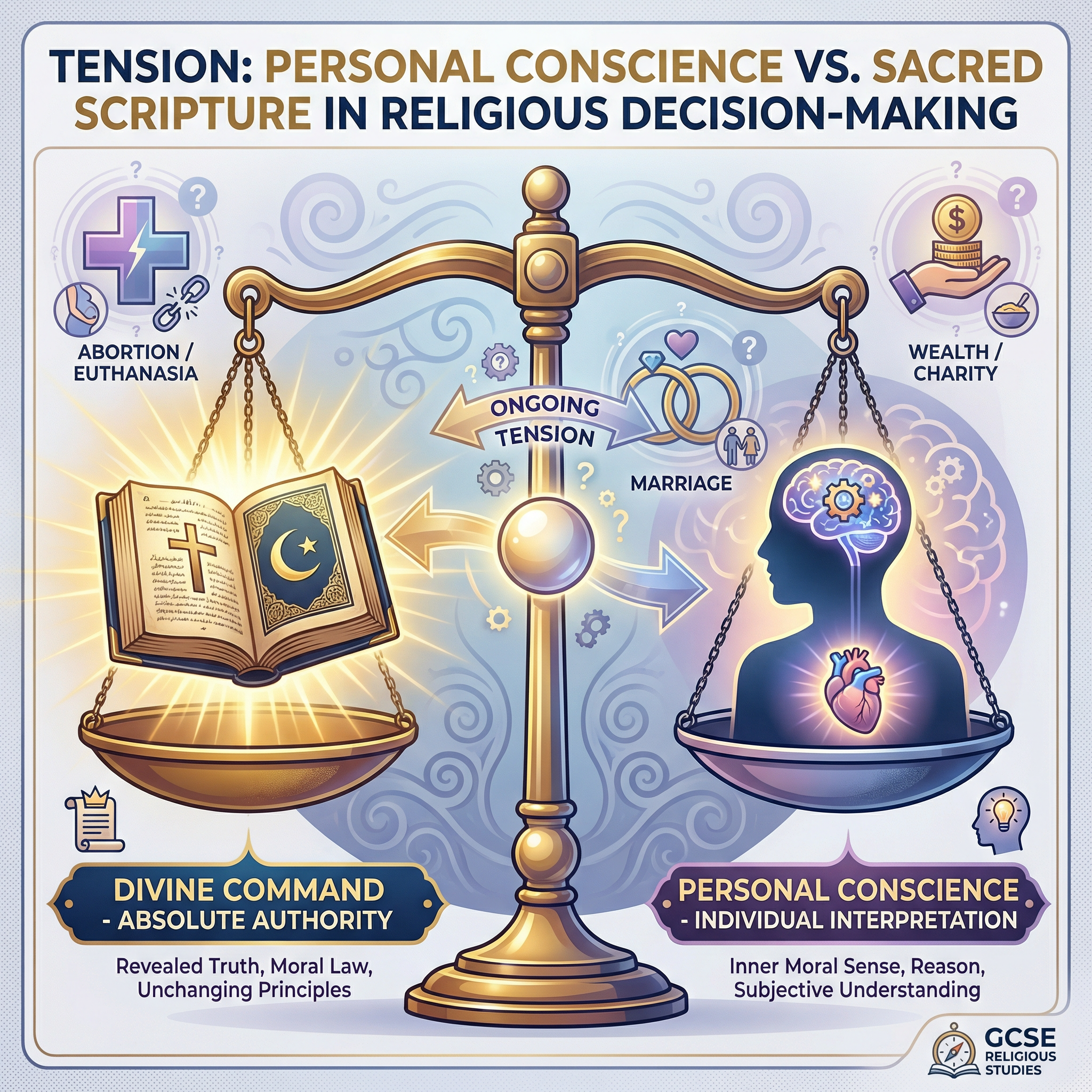
Why it matters: Theologians like St. Thomas Aquinas taught that a believer must always follow their conscience, but it must be an informed conscience, shaped by scripture and church teaching. It is not just a feeling. This creates a potential tension: what happens when an individual's conscience conflicts with a teaching from the Bible or the Church? This is a key area for AO2 evaluation.
Key Sources of Authority in Islam
The Qur'an
What it is: The direct and final word of Allah, revealed to the Prophet Muhammad. It is the highest source of authority in Islam.
Why it matters: Unlike the Bible, Muslims do not believe the Qur'an was written by humans inspired by God; they believe it is the literal, unchanged word of God Himself, revealed in Arabic. This gives it absolute authority. It is the foundation of all Islamic law and belief.
Specific Knowledge: Candidates must cite the Qur'an. A versatile quote is "Allah is well acquainted with what you do" (Qur'an 2:237), which can be applied to many ethical topics. Another is "There is no compulsion in religion" (Qur'an 2:256).
The Sunnah and Hadith
What it is: The Sunnah is the 'way of the Prophet' – his actions and example. The Hadith are the recorded sayings of the Prophet Muhammad. They are the second most important source of authority.
Why it matters: They provide practical guidance on how to apply the teachings of the Qur'an. For example, the Qur'an commands Muslims to pray (Salat), but the Hadith explain how to pray. Scholars have graded Hadith based on their reliability (authenticity of the chain of narrators).
Specific Knowledge: Know the names of the two most authentic Hadith collections: Sahih al-Bukhari and Sahih Muslim.
Shari'ah Law and Ijma
What it is: Shari'ah is the legal framework derived from the Qur'an and Sunnah. Ijma is the consensus of Islamic scholars on a point of law. If a consensus is reached, it becomes a binding ruling.
Why it matters: Shari'ah provides a comprehensive code for living. Ijma allows for interpretation and application of Islamic principles to new situations, showing that the law is not static. This demonstrates the importance of scholarly community in Islamic authority.
Second-Order Concepts
Causation
Why do believers turn to these sources? The primary cause is the belief in divine revelation – that God has communicated His will to humanity. Secondary causes include the need for moral guidance, community cohesion, and a framework for understanding life's biggest questions.
Consequence
The consequence of having these sources is a clear framework for living. However, it can also lead to conflict, both within a religion (e.g., literal vs. liberal interpretation) and between individuals and the institution (e.g., conscience vs. church teaching).
Change & Continuity
The core sacred texts (Bible, Qur'an) represent continuity – they are unchanging. However, the interpretation and application of these texts represent change. Church tradition, the Magisterium, and Ijma are all mechanisms through which religious authority adapts over time.
Significance
The significance of this topic lies in its real-world impact. Sources of authority dictate how believers vote, what they eat, how they marry, and their stance on critical ethical issues like abortion and euthanasia. Understanding this is key to understanding religion itself.
Source Skills
When presented with a source (e.g., a quote from the Bible or a religious leader), you must analyse its provenance. Ask yourself: Who said it? When? What is their position of authority? Is this a source all believers in that religion would accept? For example, a quote from the Pope is highly authoritative for Catholics, but not for Protestants. A quote from the Qur'an is universally authoritative for all Muslims.
Visual Resources
2 diagrams and illustrations
Interactive Diagrams
2 interactive diagrams to visualise key concepts
Conceptual Flow Outline
Flowchart of Christian Sources of Authority
Conceptual Flow Outline
Hierarchy of Islamic Sources of Authority
Worked Examples
3 worked examples — open one to explore the question and available guidance.
Practice Questions
Test your understanding — click to reveal model answers
Describe the role of the Sunnah in Islam. (2 marks)
Hint: Think about what the Prophet's example adds to the Qur'an.
Explain two reasons why Christians have different views about the authority of the Bible. (5 marks)
Hint: Think about literal vs. liberal interpretations.
Explain how sources of authority are used by Muslims when making moral decisions. (8 marks)
Hint: Use the PERC structure and follow the hierarchy of sources.
"(d) 'For a religious person, their conscience is the most important source of authority.' Discuss. (15 marks)
Hint: You must include arguments for and against, with SoWAs on both sides. Consider both Christian and Muslim perspectives if you can.
Explain two ways sources of authority in Christianity can cause disagreement. (5 marks)
Hint: Think about the Pope and different ways of reading the Bible.