Study Notes
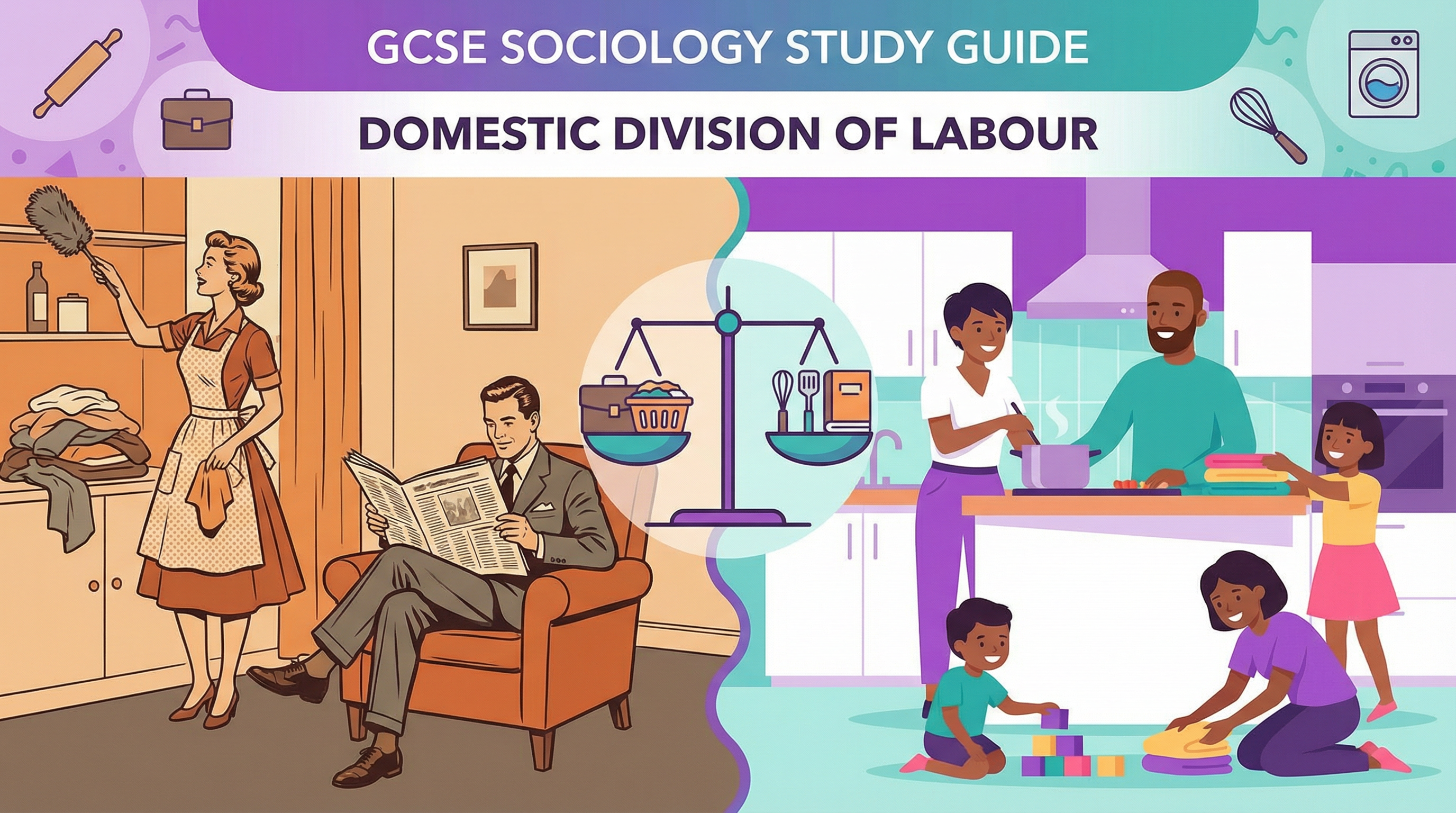
Overview
This study guide explores the domestic division of labour, a core topic in the AQA GCSE Sociology ‘Families’ unit. Candidates are expected to analyse how domestic tasks, childcare, and power are distributed within the family. The central debate pits the Functionalist 'March of Progress' view, which sees families as becoming more equal, against Feminist critiques that highlight the persistence of patriarchy and the 'dual burden' on women. Examiners expect a detailed understanding of the transition from segregated to joint conjugal roles, a critical evaluation of the 'symmetrical family' thesis, and familiarity with contemporary concepts like the 'triple shift' and the commercialisation of housework. Success in this area requires not just knowing the key studies, but being able to juxtapose them to form a coherent argument, particularly in higher-mark questions. This guide will provide the specific knowledge, analytical frameworks, and exam techniques required to achieve top marks.
Key Concepts & Developments
The Shift from Segregated to Joint Conjugal Roles
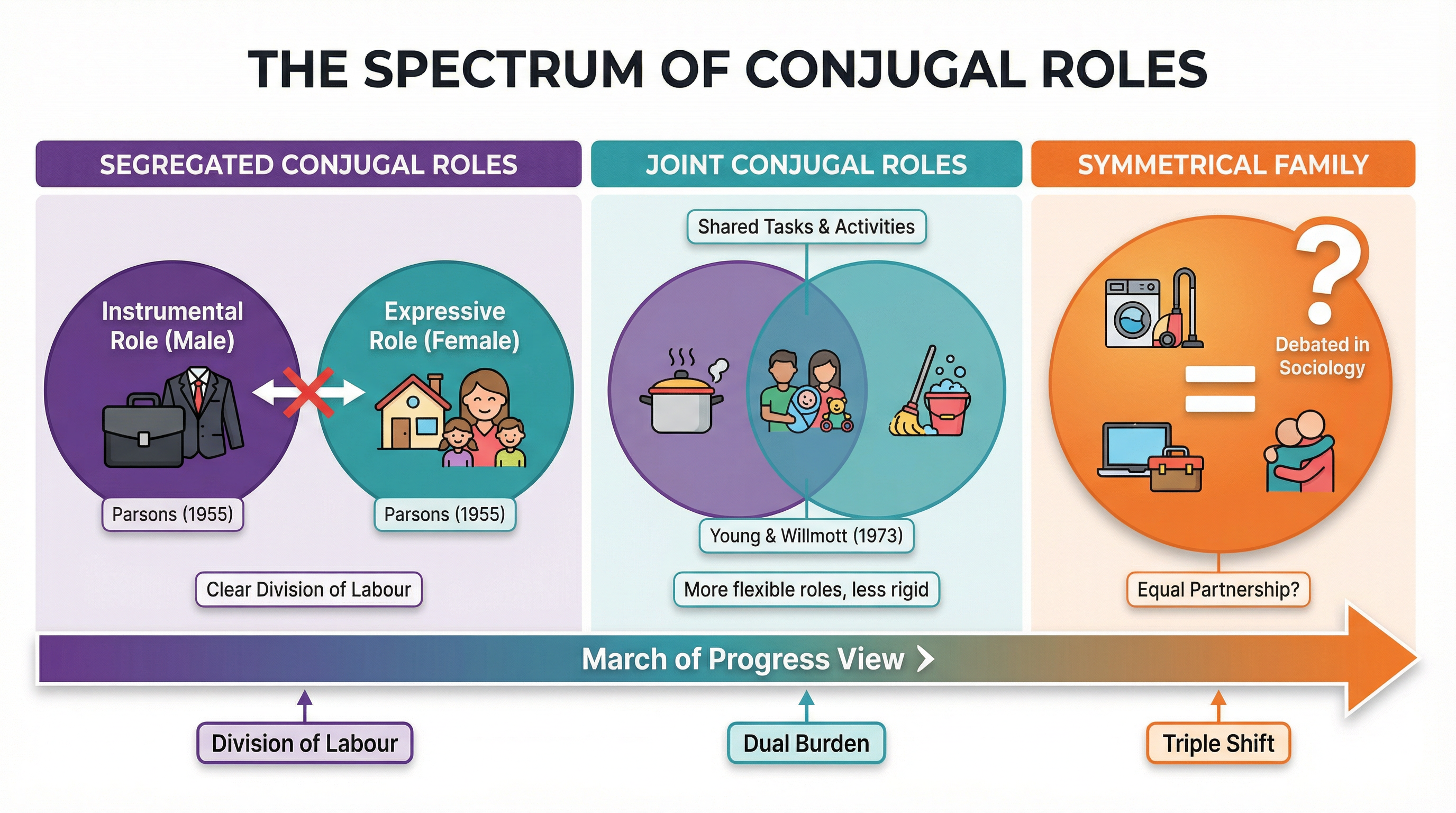
What happened: Sociologists observed a historical shift in how partners organise their roles. Initially, the dominant model was segregated conjugal roles, where men and women had completely separate responsibilities. The man was the breadwinner (instrumental role), and the woman was the homemaker (expressive role). Over time, particularly in the latter half of the 20th century, there was a move towards joint conjugal roles, where partners share tasks and leisure time more flexibly.
Why it matters: This is the foundational concept for the entire topic. Understanding this shift is essential for explaining the 'March of Progress' view and its subsequent critiques. Examiners will credit candidates who can clearly define and contrast these two types of roles.
Specific Knowledge: Talcott Parsons (1955) on instrumental/expressive roles; Elizabeth Bott (1957) on segregated/joint conjugal roles.
The 'Symmetrical Family' and the 'March of Progress'
What happened: Michael Young and Peter Willmott (1973) proposed the idea of the symmetrical family. Based on their research in London, they argued that the family was progressing towards a state of symmetry, where the roles of husbands and wives, though not identical, were becoming more similar and balanced. This included women working more, men helping more with housework and childcare, and couples spending more leisure time together. This optimistic perspective is known as the 'March of Progress' view.
Why it matters: This is the central argument for the idea that family life is improving and becoming more egalitarian. It forms one side of the key debate you must evaluate. Marks are awarded for explaining why this change occurred (e.g., geographical mobility, new technology, higher living standards).
Specific Knowledge: Young & Willmott, 'The Symmetrical Family' (1973); Key features: shared decision-making, shared chores, shared leisure time.
The Feminist Critique: Dual Burden and Triple Shift
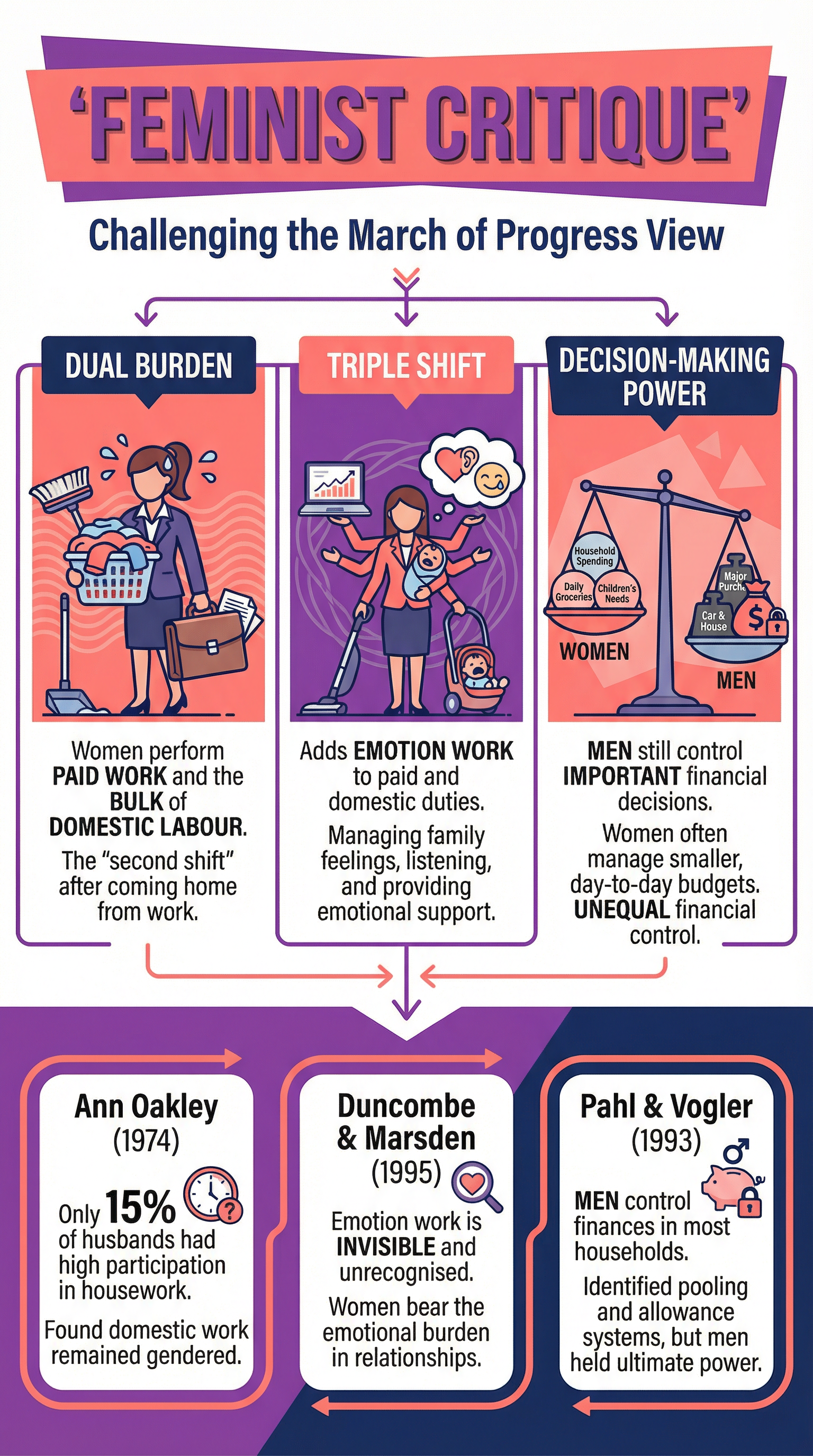
What happened: Feminist sociologists launched a powerful critique of the 'March of Progress' view. Ann Oakley (1974) argued that Young & Willmott's claims were exaggerated and that their research methodology was flawed. Her own research found that women still did the vast majority of housework, and men's 'help' was often minimal and selective. This led to the concept of the dual burden, where women are responsible for both paid work and unpaid domestic work. Later, Duncombe and Marsden (1995) added the triple shift, arguing women also perform 'emotion work'—managing the family's emotional life.
Why it matters: This provides the essential counter-argument to the Functionalist view. High-level responses must use Feminist critiques to evaluate the symmetrical family thesis. It demonstrates a more nuanced understanding of inequality, showing that it persists even when women enter paid employment.
Specific Knowledge: Ann Oakley (1974) - found only 15% of husbands had high participation in housework. Duncombe & Marsden (1995) - emotion work. Jean Duncombe and Dennis Marsden, 'Women's Work' (1995).
Key Individuals
Young & Willmott
Role: Functionalist Sociologists, proponents of the 'March of Progress' view.
Key Actions: Conducted large-scale social surveys in London from the 1950s to the 1970s. Published 'The Symmetrical Family' (1973).
Impact: Their work established the dominant optimistic narrative of family life becoming more egalitarian. Their concept of the 'symmetrical family' is a cornerstone of the syllabus and the primary theory that Feminist sociologists sought to critique.
Ann Oakley
Role: Feminist Sociologist, leading critic of the 'March of Progress' view.
Key Actions: Conducted in-depth interviews with 40 housewives for her book 'The Sociology of Housework' (1974). Critiqued Young & Willmott's methodology, arguing their measures for 'help' were too generous.
Impact: Oakley's research provided the first major sociological challenge to the symmetrical family thesis. Her work shifted the focus from simply what tasks were done to who was responsible for them, and introduced a more critical, feminist perspective into the study of housework.
Second-Order Concepts
Causation
Why did the division of labour change?
- Long-term causes: Rise of feminism, increased educational opportunities for women, decline in heavy industry jobs for men.
- Short-term causes: Availability of contraception allowing women to plan families and careers, commercialisation of housework (ready meals, washing machines), increased female participation in the workforce.
Consequence
What were the effects of these changes?
- Immediate effects: Women entering paid work led to the 'dual burden'. Increased negotiation and potential conflict over domestic tasks.
- Long-term effects: A shift in social norms and expectations around gender roles. The rise of the 'new man' ideal. Ongoing debate about whether true equality has been achieved.
Change & Continuity
- What changed: More women are in full-time employment. Men are more involved in childcare than in the 1950s. The idea of segregated roles is no longer the dominant social norm.
- What stayed the same: Women still do the majority of housework. Women are more likely to take time off work for childcare. Key financial decisions are often still dominated by men. Gendered patterns in chores persist (e.g., men do DIY, women do laundry).
Significance
Why does this topic matter?
- It reveals the persistence of gender inequality in one of the most private areas of life.
- It connects personal family experiences to wider social and economic structures.
- It is a classic example of a sociological debate between two major perspectives (Functionalism and Feminism), which is a key skill for examiners to test.
Source Skills
When presented with an Item (a short text or data snippet) on the domestic division of labour, your first task is to identify the sociological perspective it aligns with. Does it sound optimistic and talk about sharing? It's likely reflecting the 'March of Progress' view. Does it highlight inequality, stress, or unfairness? It's probably reflecting a Feminist critique. In your answer, you must explicitly reference the Item (e.g., "As Item A suggests, women often face a 'dual burden'...") to secure AO2 application marks. Use the Item as a springboard to introduce the sociological concepts, studies, and evaluations you have learned.