Study Notes

Overview
This guide explores ethnic inequality within the Social Stratification module of the Edexcel GCSE Sociology specification. It focuses on the disparities in life chances—specifically in education, crime and employment, and health—that different ethnic groups experience in the UK. Examiners expect candidates to not only describe these inequalities using statistical evidence but also to critically evaluate the sociological explanations behind them. This involves contrasting structural theories (like Marxism and Weberianism) with cultural theories (like Functionalism), and applying key concepts such as institutional racism, the ethnocentric curriculum, and the dual labour market. A strong understanding of relevant sociological studies and the ability to use precise terminology are essential for achieving high marks.
Key Areas of Inequality
Education
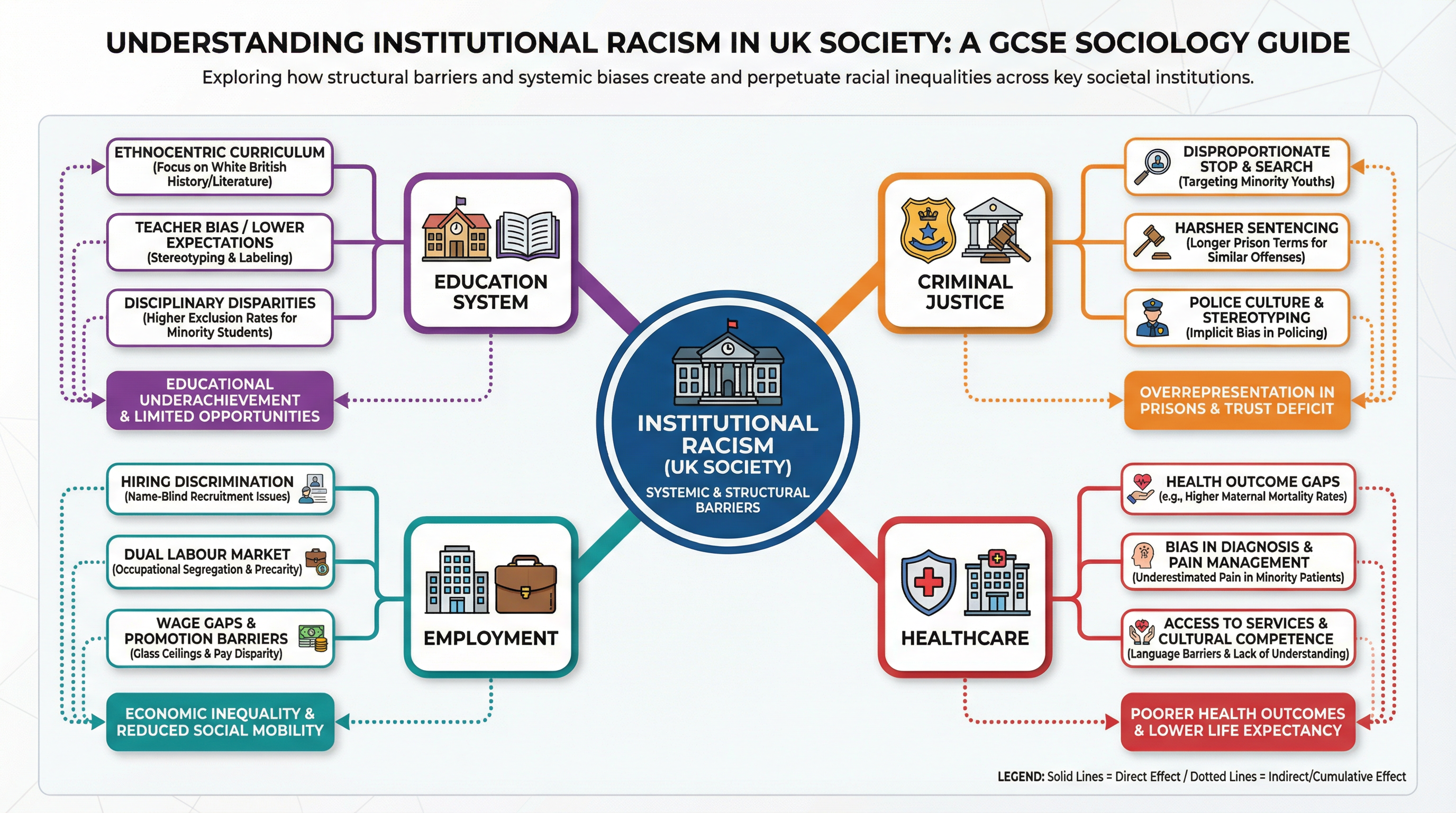
What happens: There are significant differences in educational achievement among ethnic groups. While Chinese and Indian pupils often have the highest attainment levels, Black Caribbean, Pakistani, and Bangladeshi pupils have historically faced underachievement. For example, Black Caribbean pupils are more likely to be permanently excluded from school than their White counterparts.
Why it matters: Examiners will credit candidates who can explain these trends using both internal and external factors. This includes discussing cultural factors like parental attitudes (e.g., Driver and Ballard) versus structural factors like institutional racism within the education system (e.g., Gillborn and Youdell).
Specific Knowledge: Ethnocentric curriculum, teacher labelling, anti-school subcultures (Sewell), cultural capital.

Crime and Criminal Justice
What happened: Statistics consistently show that some ethnic minority groups, particularly Black people, are over-represented at every stage of the criminal justice system. This includes higher rates of stop and search, arrest, prosecution, and imprisonment compared to the White majority.
Why it matters: This is a key area for AO3 (analysis and evaluation). Candidates must be able to critically assess the validity of crime statistics, contrasting official statistics with victim surveys and self-report studies. Explanations must be rooted in sociological theory, such as the Neo-Marxist concept of moral panics (Stuart Hall) or Left Realist explanations focusing on relative deprivation and marginalisation (Lea and Young).
Specific Knowledge: Macpherson Report (1999), institutional racism, stop and search statistics, moral panic, labelling theory.
Employment and Income
What happened: Ethnic minorities are more likely to be unemployed, and those in work are often concentrated in low-paid, insecure jobs. This is sometimes explained by the dual labour market theory. There is also a significant ethnic pay gap, even among professionals with similar qualifications.
Why it matters: This section requires an understanding of how discrimination in the workplace and structural economic factors create and perpetuate inequality. Candidates should be able to apply Weberian concepts of status and party alongside Marxist ideas of a reserve army of labour.
Specific Knowledge: Dual labour market, concrete ceiling, Equality Act 2010, unemployment rates for different ethnic groups.
Sociological Perspectives
Functionalism
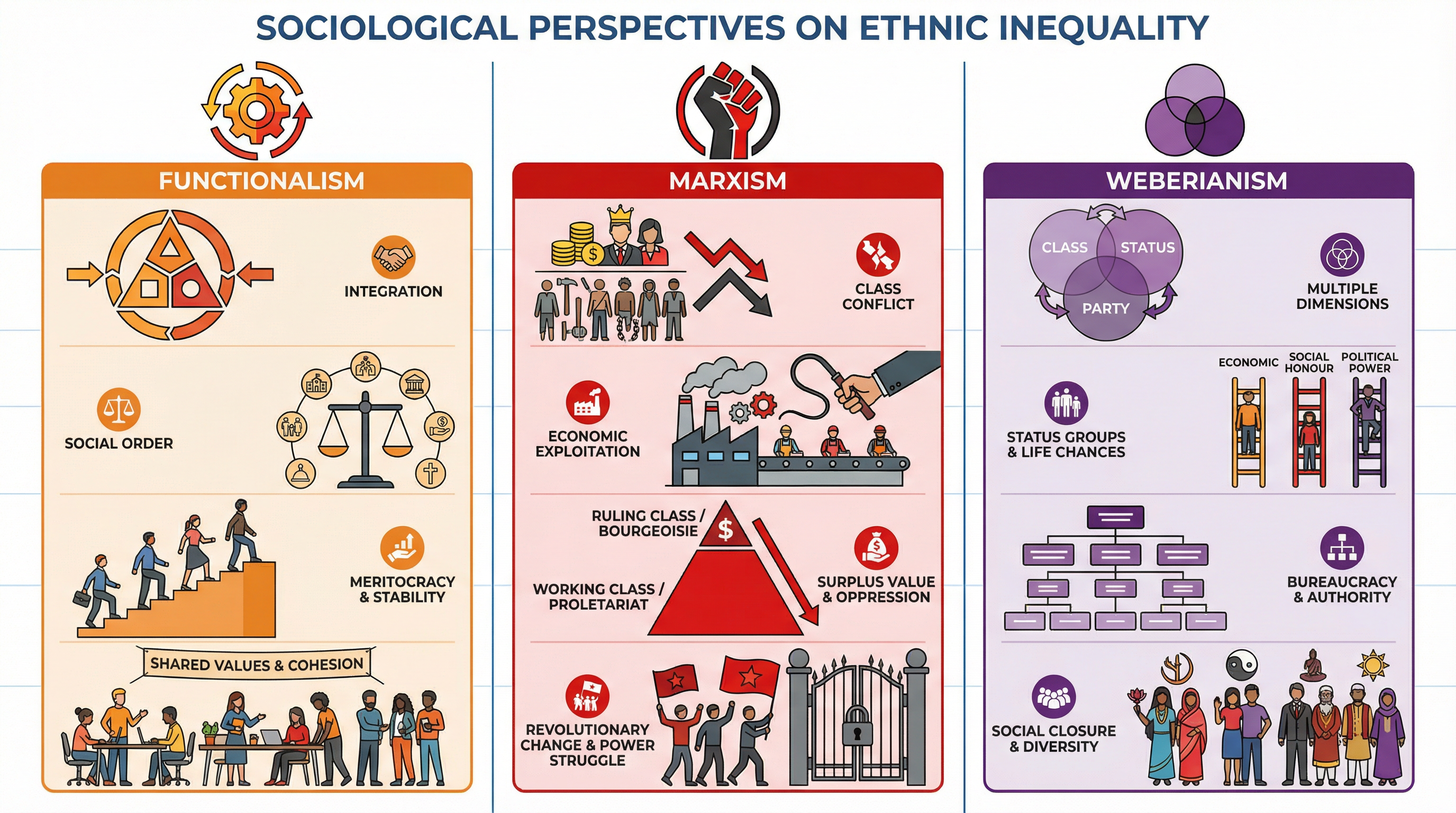
View: Functionalists argue that for society to function smoothly, immigrants and minority groups must assimilate into the mainstream culture. They might suggest that ethnic inequality is a temporary phase that will reduce as groups adopt the norms and values of the host society.
Criticism: This view is widely criticised for blaming minorities for their own disadvantage and ignoring the role of racism and structural barriers.
Marxism
View: Marxists see ethnic inequality as a product of capitalism. The ruling class uses racism as a tool to divide the proletariat, preventing them from uniting and overthrowing the system. Ethnic minorities often form a 'reserve army of labour', which can be hired and fired as needed, depressing wages for the entire working class.
Criticism: This perspective can be seen as economically deterministic, reducing all inequality to class and sometimes failing to explain racism that isn't directly linked to profit.
Weberianism
View: Weberians argue that class is not the only source of inequality. They introduce the concepts of status (social honour or prestige) and party (political power). Ethnic minorities can lack status and form a separate, marginalised status group. The dual labour market theory is a key Weberian concept used to explain employment disparities.
Criticism: While offering a more multi-dimensional view than Marxism, Weberianism can be complex to apply and may under-emphasise the deep-rooted nature of racism.