Study Notes

Overview
This guide provides a comprehensive analysis of UK government education policies since 1944, a cornerstone of the Edexcel GCSE Sociology specification. Examiners expect candidates to demonstrate detailed knowledge of key policies and to critically evaluate their impact on differential educational achievement. You will need to understand the shift from the selective Tripartite System to the Comprehensive ideal, and the subsequent introduction of marketisation, which fundamentally reshaped the educational landscape. This involves not just describing policies, but applying sociological theories (Functionalism, Marxism) and concepts (meritocracy, parentocracy, cultural capital) to analyse their intended and unintended consequences. High-level responses will move beyond simple descriptions to a sustained evaluation of how these policies have either promoted or hindered equality of opportunity. This guide will equip you with the specific knowledge, terminology, and analytical skills required to achieve this.
Key Events & Developments
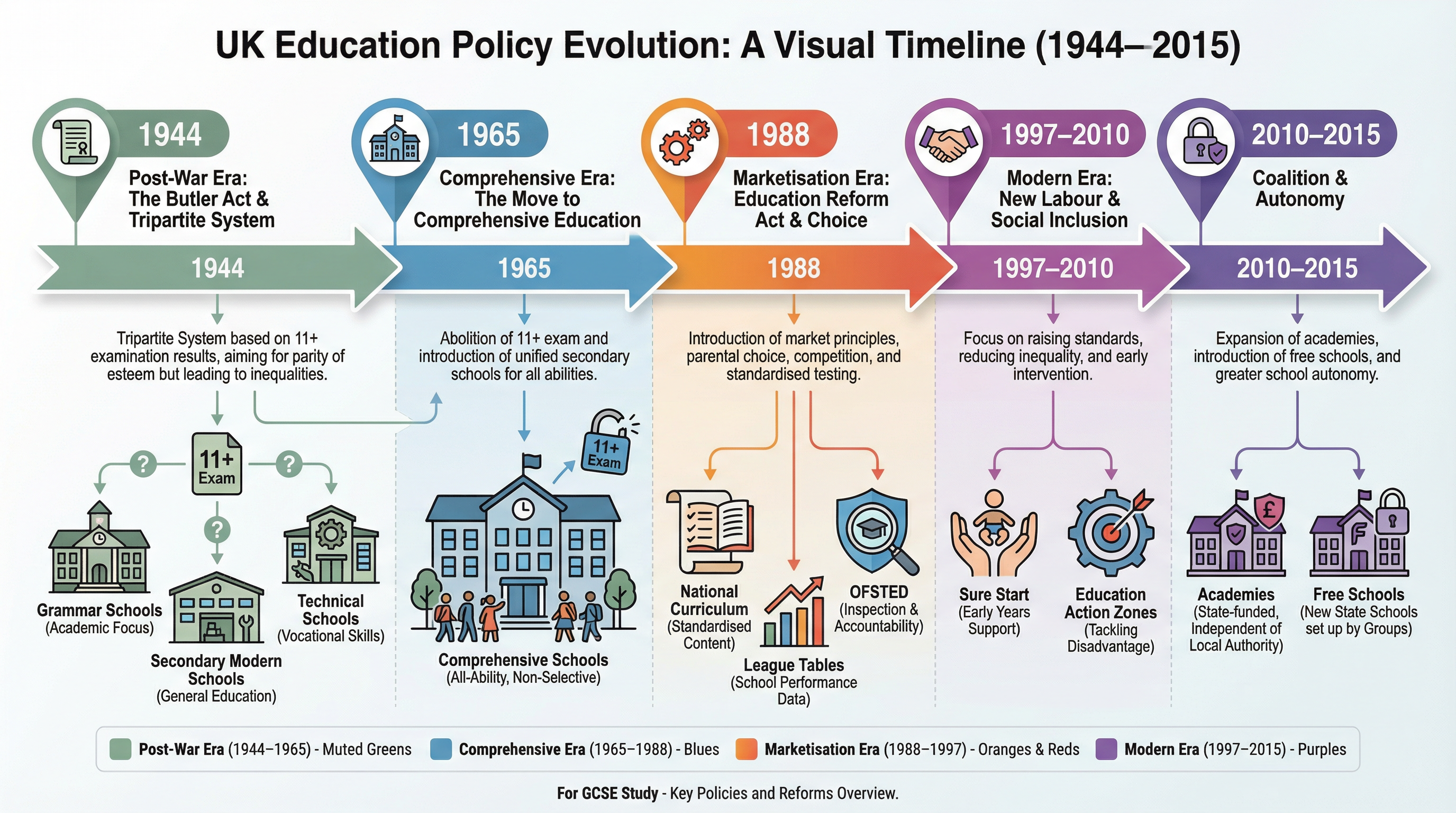
The 1944 Butler Education Act & The Tripartite System
Date(s): 1944
What happened: This landmark act introduced free secondary education for all pupils in England and Wales. It established the Tripartite System, which allocated children to one of three types of school based on their performance in the 11+ examination.
Why it matters: This was the first major attempt to create a 'meritocratic' system, aiming for 'parity of esteem' between schools. However, it is widely criticised for reproducing class inequality, as the 11+ was biased towards the middle classes. Functionalists saw it as effective role allocation, while Marxists argued it cemented class divisions at an early age.
Specific Knowledge: The three school types were Grammar Schools (for academic pupils, approx. 20%), Secondary Modern Schools (for the majority, offering a general education, approx. 75%), and Technical Schools (intended for vocational skills, but very few were ever built).\
The Move to Comprehensive Schooling
Date(s): From 1965 onwards (Circular 10/65)
What happened: The Labour government issued Circular 10/65, requesting Local Education Authorities (LEAs) to reorganise their schools along comprehensive lines, abolishing the 11+ exam and the Tripartite System.
Why it matters: This was a major policy shift aimed at promoting social integration and equality of opportunity by having all children from a local area attend the same school. However, the persistence of streaming and setting within schools, as well as catchment area inequalities, meant that class-based differences in achievement continued.
Specific Knowledge: By 1979, around 80% of secondary school pupils were in comprehensive schools. Sociologists like Julienne Ford (1969) found that comprehensive schooling did little to reduce class-based inequalities.
The 1988 Education Reform Act (ERA)
Date(s): 1988
What happened: Introduced by the Conservative government under Margaret Thatcher, this was the most significant education reform since 1944. It introduced the principles of marketisation, parentocracy, and competition into the education system.
Why it matters: The ERA fundamentally changed the relationship between schools, parents, and the state. It created an 'education market' where schools had to compete for 'customers' (students). This led to a focus on exam results and public image, which critics argue has had negative consequences for educational equality.

Specific Knowledge: Key policies of the ERA include: The National Curriculum, OFSTED (Office for Standards in Education), League Tables, Formula Funding (funding per pupil), and Open Enrolment.
New Labour Policies (1997-2010)
Date(s): 1997-2010
What happened: The New Labour government, under Tony Blair and Gordon Brown, continued many of the marketisation policies of the Conservatives but combined them with a focus on tackling social inequality.
Why it matters: New Labour's approach was a 'third way', blending market principles with social justice initiatives. They aimed to raise standards for all while providing targeted support for the most disadvantaged. This led to a complex landscape of both increased competition and increased intervention.
Specific Knowledge: Key policies include: Sure Start (early years centres), Education Action Zones (EAZs) (extra funding for deprived areas), the expansion of Specialist Schools, and the introduction of the Pupil Premium (though fully implemented by the Coalition). Their mantra was 'Education, Education, Education'.
The Coalition & Conservative Policies (2010-Present)
Date(s): 2010 onwards
What happened: The Conservative-Liberal Democrat Coalition government, and subsequent Conservative governments, accelerated the move away from local authority control towards a more autonomous and fragmented system.
Why it matters: These policies have intensified marketisation and created a more diverse but also more unequal school system. The focus has been on structural reform, giving schools unprecedented freedom from central control.
Specific Knowledge: Key policies include the rapid expansion of Academies (state-funded schools independent of LEA control), the introduction of Free Schools (new schools set up by parents, teachers, or charities), and reforms to the National Curriculum and examinations.
Key Individuals
R.A. Butler
Role: Conservative politician, President of the Board of Education.
Key Actions: Oversaw the creation of the 1944 Education Act.
Impact: His name is synonymous with the post-war settlement in education that created the Tripartite System and established the principle of free secondary education for all.
Margaret Thatcher
Role: Conservative Prime Minister (1979-1990).
Key Actions: Drove the 1988 Education Reform Act, championing marketisation and parental choice.
Impact: Fundamentally altered the UK education system, introducing competition and consumerist principles that continue to dominate policy today.
David Blunkett
Role: Labour Secretary of State for Education and Employment (1997-2001).
Key Actions: Implemented New Labour's early policies, including Education Action Zones and a focus on literacy and numeracy.
Impact: Embodied the 'third way' approach, balancing marketisation with a drive to tackle social exclusion and raise standards in deprived areas.
Michael Gove
Role: Conservative Secretary of State for Education (2010-2014).
Key Actions: Dramatically accelerated the Academies programme, introduced Free Schools, and reformed the National Curriculum to be more knowledge-rich and traditional.
Impact: His reforms created a more fragmented and autonomous school system, significantly reducing the role of Local Education Authorities.
Second-Order Concepts
Causation
The drive for educational reform is caused by a combination of factors. Economic factors are key; governments want a well-skilled workforce to compete globally. Political ideology is another major driver; the Conservative focus on market principles contrasts with the Labour focus on social justice. Social factors, such as concerns about inequality and social mobility, also trigger policy changes.
Consequence
The consequences of these policies are profound and contested. Marketisation, for example, has led to some schools improving their results but has also been linked to increased segregation between schools. The expansion of academies has given headteachers more freedom but has raised concerns about accountability and the fair treatment of pupils.
Change & Continuity
While the structure of the school system has changed dramatically (from Tripartite to Comprehensive to Academies), there is significant continuity in the outcomes. Class-based inequalities in educational achievement have proven remarkably persistent throughout all policy eras. The gap between the highest and lowest achievers remains a central problem.
Significance
Education policy is significant because it is a primary tool through which the state attempts to shape society. It reflects changing ideas about fairness, merit, and the role of the individual. For sociologists, it is a critical field for studying the relationship between government action and social inequality.
Source Skills
When presented with a source on education policy (e.g., a speech by a politician, a school league table, a critical cartoon), candidates must apply a systematic analysis. First, analyse the content: what does the source explicitly say or show about a policy? Second, evaluate the provenance: who created it, when, and for what purpose? This helps you assess its reliability and perspective. For example, a government document will present a policy in a positive light, whereas a teacher's union report might be highly critical. Finally, consider its limitations: what does it not tell you? A single source provides only one perspective.