Study Notes

Overview
Welcome to the sociological study of Identity. This topic is fundamental to understanding how we become who we are. For the Edexcel GCSE exam, candidates are expected to move beyond biological explanations and analyse identity as a social construct. This means examining the process of socialisation, where we learn the norms, values, and roles of our culture. You will need to apply key sociological perspectives—Functionalism, Marxism, and Feminism—to explain how different agencies of socialisation, such as the family and the media, influence our personal and social identities. Examiners award high marks for demonstrating a clear understanding of the 'nature versus nurture' debate, using specific sociological terminology, and evaluating the different theoretical viewpoints. This guide will equip you with the core knowledge, analytical skills, and exam techniques needed to achieve top marks.
The Process of Socialisation
Socialisation is the lifelong process through which individuals learn the culture of their society. Examiners expect you to distinguish between two key phases.
Primary Socialisation
Agent: The Family
What happens: This occurs in the early years of life (approx. 0-5 years). The family teaches children the basic norms and values of society. This is where we first learn language, manners, and fundamental beliefs. It is a crucial stage in forming our core identity.
Why it matters: Functionalists see this as essential for creating social cohesion. However, feminists like Ann Oakley argue this is where gender role socialisation begins, with parents channelling children towards gender-specific toys and activities (e.g., boys given cars, girls given dolls), a process she termed canalisation.
Secondary Socialisation
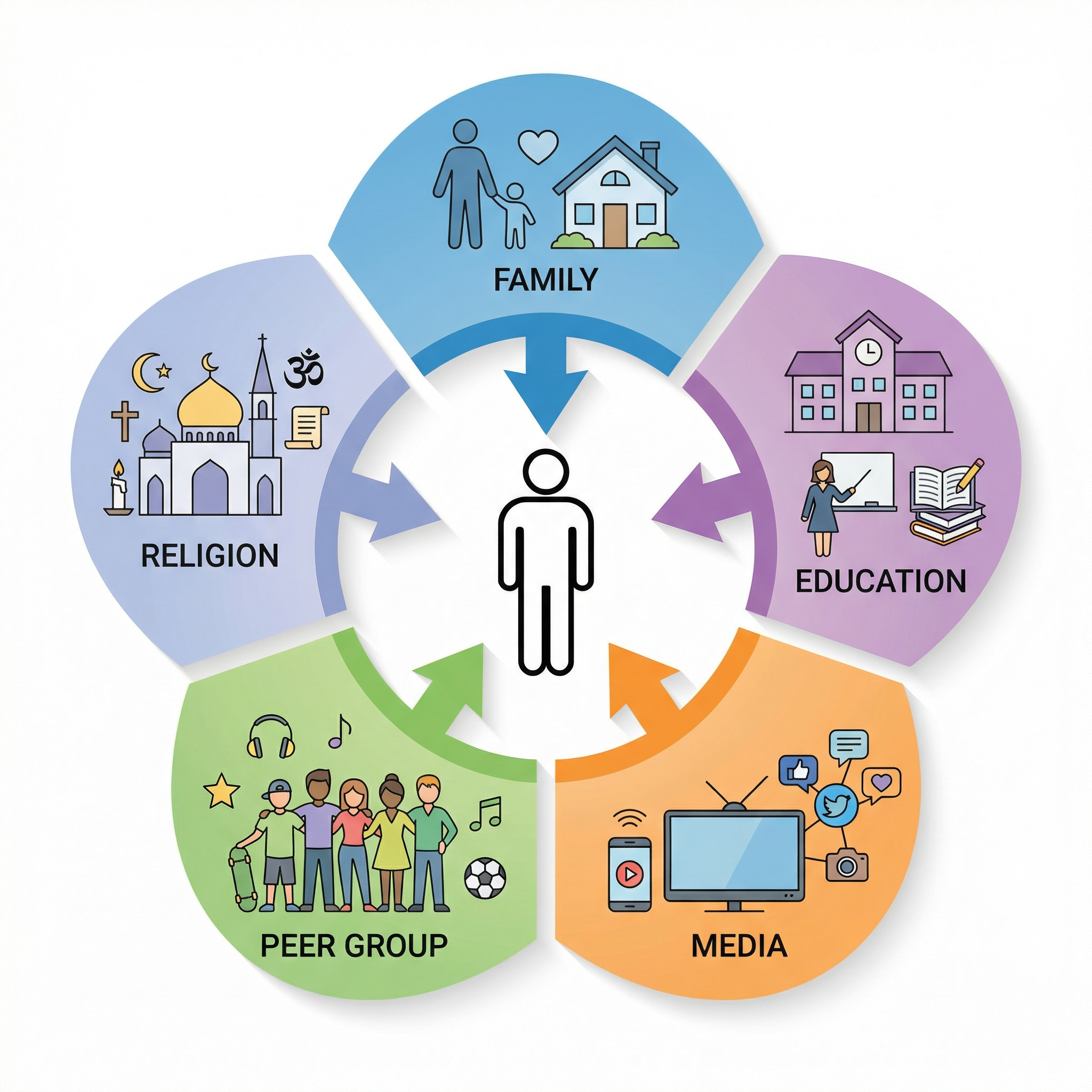
Agents: Education, Media, Peer Groups, Religion, Workplace
What happens: This process continues outside the home and throughout our lives. Each agent contributes to shaping our identity:
- Education: Teaches not only the formal curriculum but also a 'hidden curriculum' of values like punctuality, obedience, and competition.
- Media: Represents certain identities and lifestyles as desirable, often through stereotyping. It provides powerful role models that can influence our aspirations and behaviour.
- Peer Group: Particularly influential during adolescence, peers can pressure individuals to conform to group norms through fear of exclusion.
- Religion: Provides a set of moral values and a collective identity for believers.
Nature vs. Nurture Debate
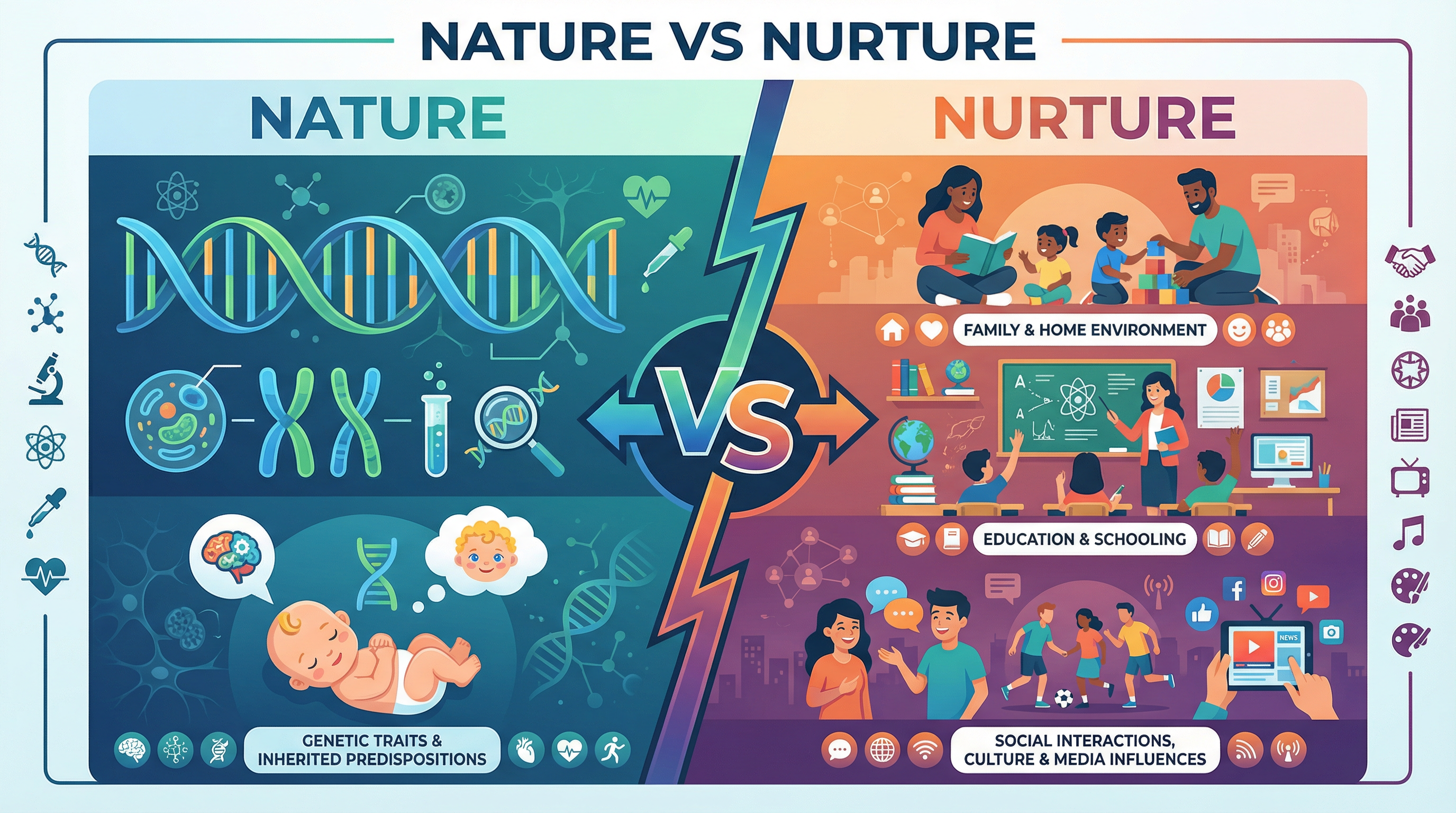
This is a central debate in sociology and crucial for high marks. You must be able to contrast these two explanations of human behaviour.
- Nature: The argument that our behaviour and identity are determined by our biology, genetics, and instincts. For example, some sociologists might argue that men are 'naturally' more aggressive.
- Nurture: The sociological view that our identity is shaped by our social environment and experiences—through the process of socialisation. The existence of feral children (children raised with little or no human contact) is often used as evidence for the nurture argument, as these children do not develop 'human' behaviours like language without social interaction.
Sociological Theories of Identity
Functionalism
- Key Thinker: Talcott Parsons
- Core Idea: Socialisation is a positive process that creates a value consensus (shared agreement on norms and values). This integrates individuals into society, ensuring social stability and order. Each agent of socialisation performs a function to maintain this harmony.
- Evaluation: Critics, particularly from conflict perspectives, argue that this view is too optimistic and ignores power inequalities. It assumes everyone is socialised into a single, shared culture, overlooking the diversity of modern societies.
Marxism
- Key Idea: Socialisation is a tool of the bourgeoisie (ruling class) to maintain capitalism. The agents of socialisation transmit a ruling class ideology that teaches the proletariat (working class) to accept their own exploitation. For example, the education system prepares workers to be obedient and hardworking, creating a false consciousness where they don't question the inequalities of the system.
- Evaluation: This view is powerful for explaining social class inequality but can be seen as too deterministic. It assumes individuals passively accept ruling class ideology without any resistance.
Feminism
- Key Thinker: Ann Oakley
- Core Idea: Socialisation reinforces patriarchy (male dominance). The family, media, and other agents create and police gender identities, socialising girls into a subordinate 'expressive' role (caring, emotional) and boys into a dominant 'instrumental' role (breadwinner, competitive). This happens through processes like canalisation (channelling interests) and manipulation (encouraging or discouraging gendered behaviour).
- Evaluation: Feminism has been hugely influential in revealing how gender identity is constructed. However, some critics argue it can overlook other sources of inequality like class and ethnicity, and that gender roles are becoming less fixed in contemporary society.
Social Control
Social control refers to the methods used by society to ensure people conform to its norms and values. You must be able to distinguish between its two forms.
- Formal Social Control: Based on official, written rules and laws. Enforced by official state agencies like the police, the courts, and the prison system. Breaking formal rules leads to legal punishment.
- Informal Social Control: Based on unwritten social rules and expectations. Enforced by agents of socialisation like the family and peer groups through sanctions such as disapproval, ridicule, or social exclusion.
{{asset:social_control.png