Study Notes
Overview
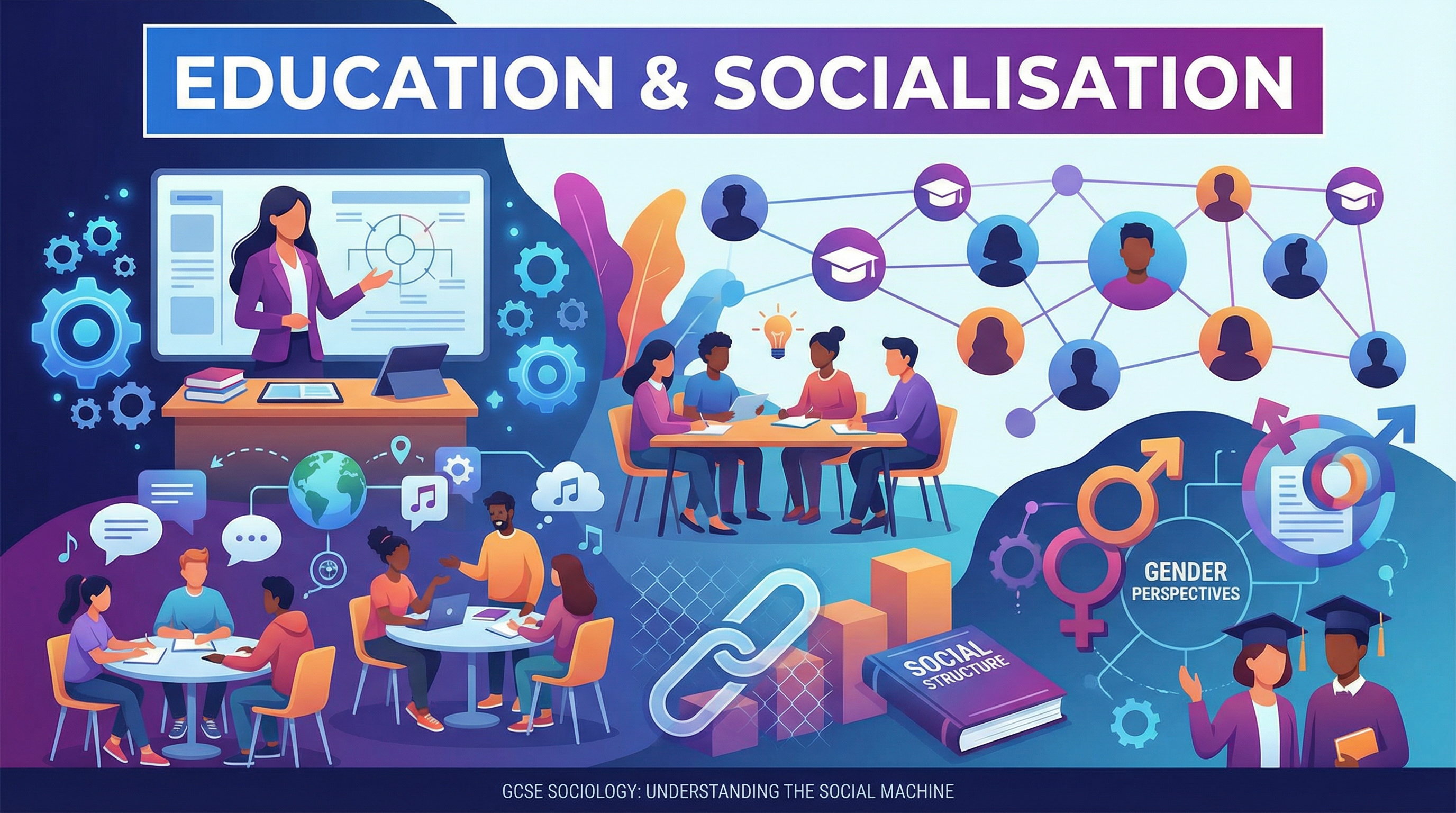
Welcome to your AQA GCSE Sociology guide on the role of education in socialisation. This topic is fundamental to understanding how society shapes individuals. Examiners expect candidates to go beyond simply describing school life and to analyse education as a powerful agent of secondary socialisation. This means you must understand how schools, both overtly and covertly, prepare you for your role in society. We will explore the Functionalist perspective, which sees education as a positive force for social cohesion and meritocracy, before critically evaluating this with the conflict perspectives of Marxism and Feminism. You will learn key concepts like the hidden curriculum, universalistic standards, and the correspondence principle, and be able to apply them to exam questions with confidence. This guide will equip you with the theories, studies, and exam techniques needed to analyse, critique, and evaluate the role of education in contemporary Britain.
Key Sociological Perspectives
Functionalism: Education as a Social Machine
Core Idea: Functionalists see society as a complex system whose parts work together to promote solidarity and stability. For them, education is a vital organ in the social body.
Key Functions:
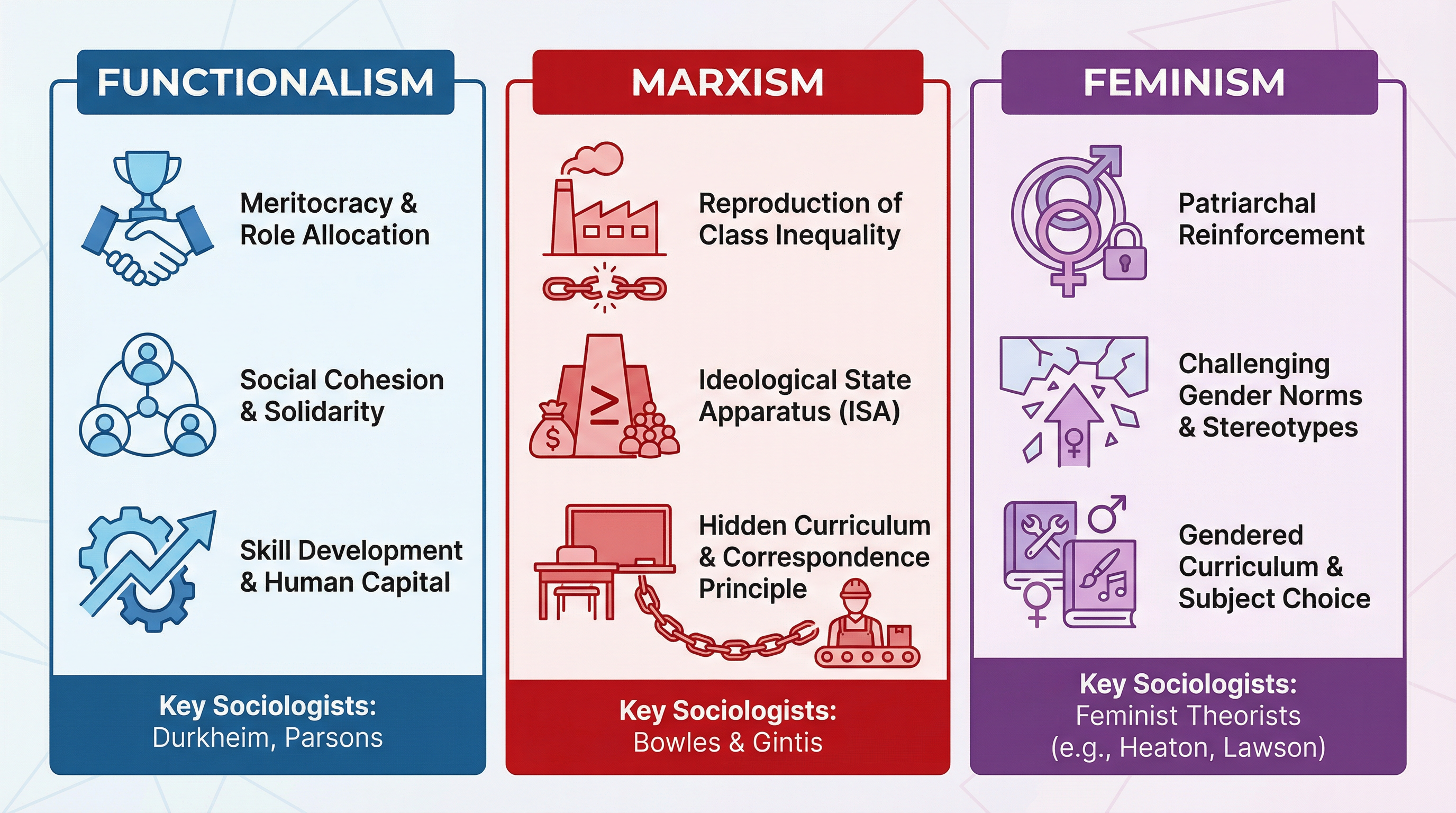
- Creating Social Solidarity: Émile Durkheim argued that without social solidarity, society would fall apart. Schools create this by transmitting a shared culture, heritage, and norms. School assemblies, history lessons, and team sports all bind individuals together, creating a sense of community.
- Teaching Specialist Skills: Durkheim also noted that modern industrial economies require a specialised division of labour. Education equips individuals with the diverse skills and knowledge necessary for them to play their part in the economy.
- Promoting Meritocracy (Talcott Parsons): Parsons argued that schools act as a bridge between the family and wider society. In the family, a child is judged by particularistic standards (i.e., they are loved for who they are). In society and at work, they are judged by universalistic standards (i.e., the same rules and exams apply to everyone). Parsons believed this system was meritocratic – everyone has an equal opportunity to succeed based on their ability and effort, and education allocates people to the most appropriate jobs.
Marxism: Reproducing Inequality
Core Idea: Marxists argue that education is not a neutral institution; it is part of the 'superstructure' and serves the interests of the ruling class (the bourgeoisie) by maintaining and reproducing class inequality.
Key Concepts:
- The Correspondence Principle (Bowles & Gintis): In their study 'Schooling in Capitalist America', Bowles and Gintis argued that school mirrors the world of work. This 'correspondence' prepares working-class pupils for their future as exploited workers. For example, accepting hierarchy (headteacher/boss), being motivated by external rewards (grades/pay), and the fragmentation of knowledge (subjects/tasks on a production line) all correspond.
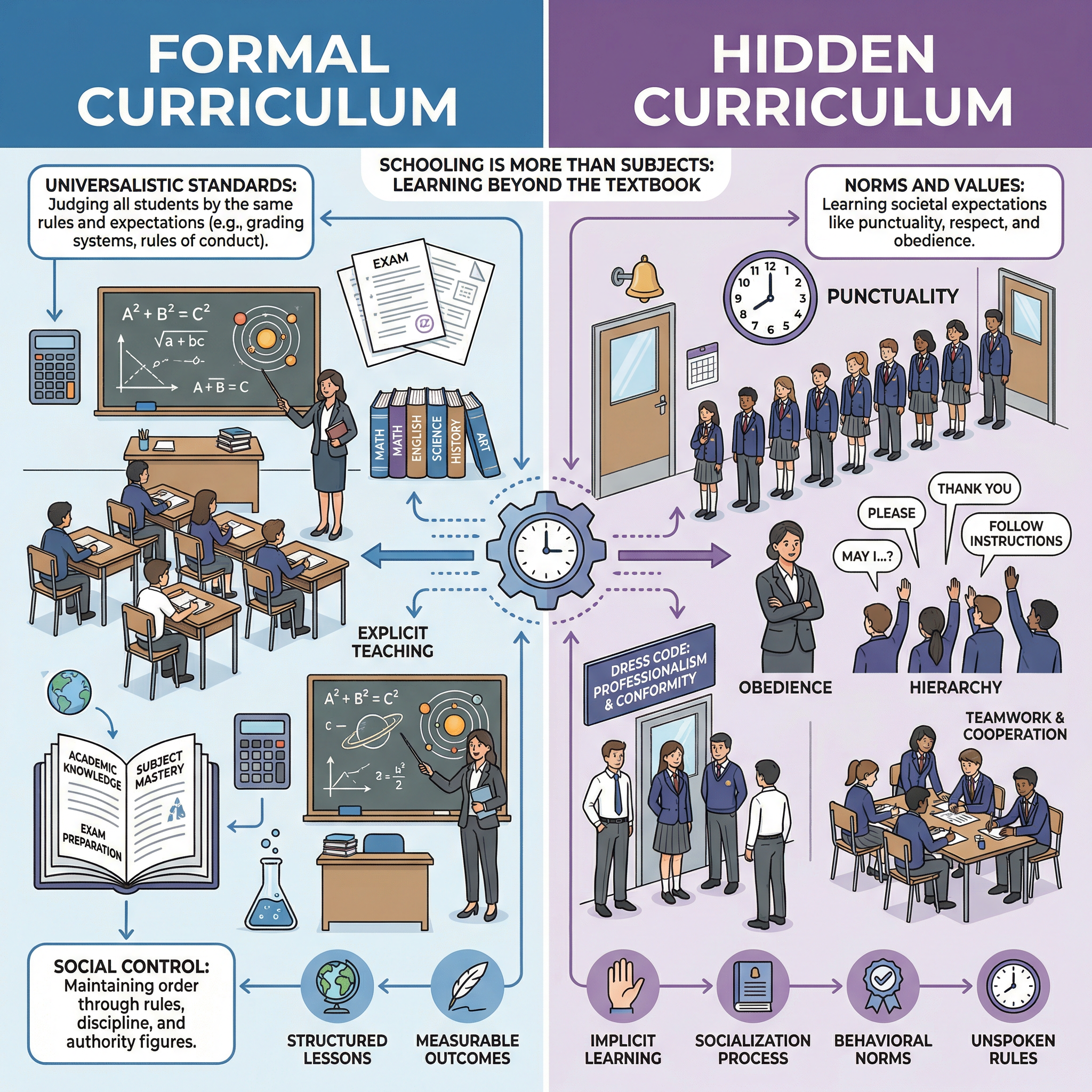
- The Hidden Curriculum: This is a central concept. While the formal curriculum is the subjects you are taught, the hidden curriculum refers to the unwritten rules, values, and norms you learn at school. Marxists argue this hidden curriculum teaches conformity, obedience, and acceptance of inequality, creating a docile and compliant workforce.
- The Myth of Meritocracy: Marxists argue that meritocracy is a myth. It's an ideology that makes it seem like failure is the fault of the individual, not the system. This legitimises class inequality, preventing the working class from questioning their subordinate position.
Feminism: Reinforcing Patriarchy
Core Idea: Feminists argue that the education system reinforces patriarchy (male dominance) and traditional gender roles, disadvantaging girls and women.
Key Mechanisms:
- Gendered Subject Choices: Despite girls outperforming boys, there are still clear gender patterns in subject choices. Girls tend to choose subjects like English, Sociology, and Art, while boys dominate in Physics, Engineering, and IT. This channels them into different career paths, with 'female' jobs often having lower status and pay.
- The Hidden Curriculum & Gender Roles: The hidden curriculum also reinforces gender stereotypes. Teachers may have different expectations for boys and girls (e.g., praising girls for being neat and quiet, but boys for being assertive). Textbooks and learning materials have historically stereotyped gender roles, although this is changing.
- Policing of Gender: Sociologists like Sue Lees have shown how schools control girls' behaviour more than boys', particularly around sexuality. Double standards are often applied, reinforcing patriarchal control.
The Hidden Curriculum vs. The Formal Curriculum
It is vital for the exam that you can distinguish between these two concepts.
| Feature | Formal Curriculum | Hidden Curriculum |
|---|---|---|
| What it is | The official subjects and content taught in lessons (e.g., Maths, English, Science). | The unwritten rules, norms, values, and routines learned at school. |
| How it's taught | Explicitly, through timetabled lessons, textbooks, and exams. | Implicitly, through the organisation of the school, teacher expectations, and social interactions. |
| Examples | Learning about Shakespeare, Pythagoras' Theorem, the Tudors. | Learning to be punctual, to queue, to respect authority, to compete with others. |
| Sociological View | Functionalists see it as teaching necessary skills. | Marxists and Feminists see it as a form of social control that teaches conformity and reinforces inequality. |