Causes of Poverty
This study guide tackles the complex sociological debate on the causes of poverty, a cornerstone of the OCR GCSE Social Inequality paper. It unpacks the critical distinction between structural and cultural explanations, equipping candidates with the theoretical knowledge and analytical skills needed to secure top marks.
Study Notes
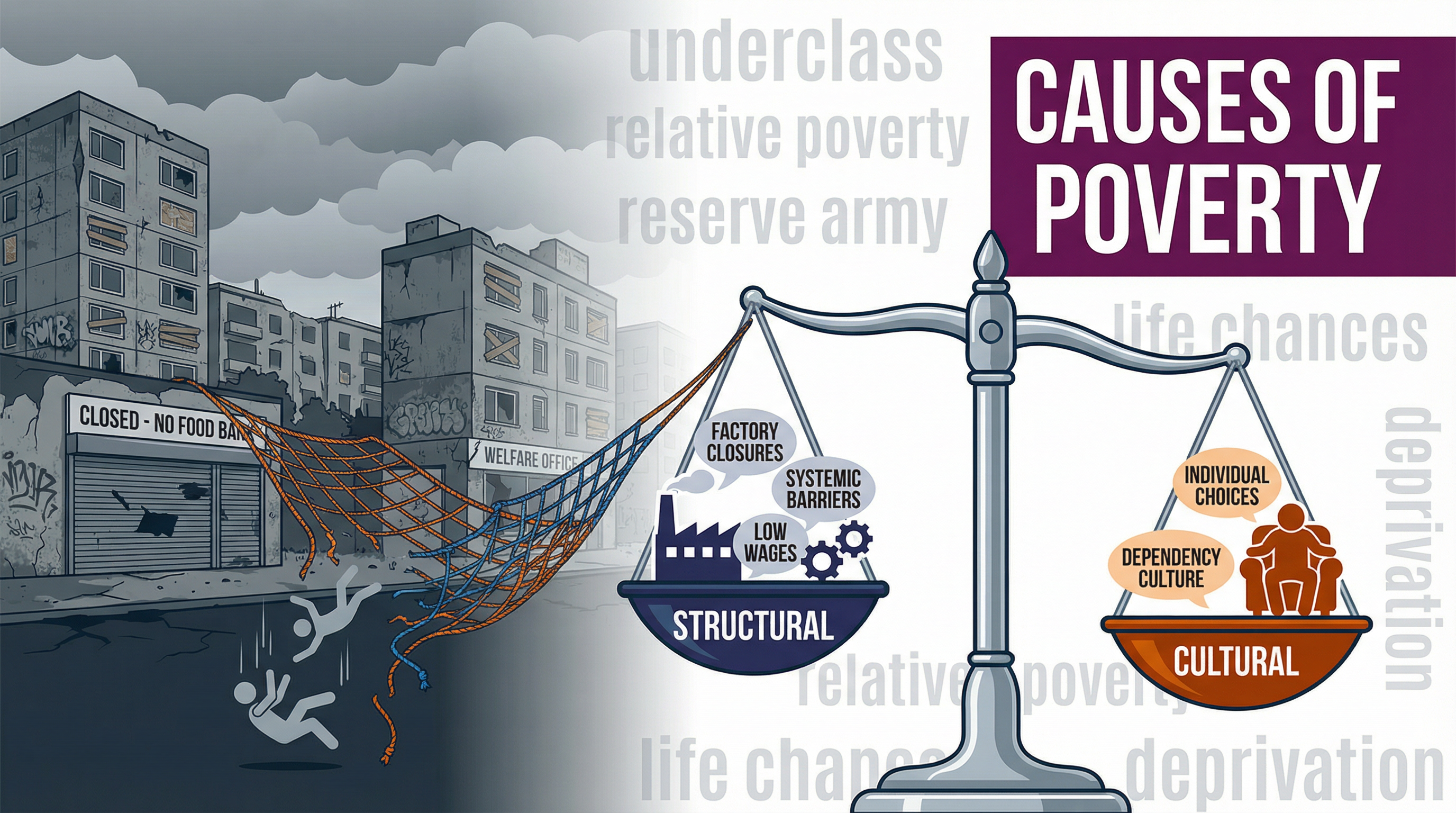
Overview
Understanding the causes of poverty is a fundamental requirement of the OCR GCSE Sociology specification (Component 02: Social Inequality). This is not simply about knowing facts; it is about engaging with a core sociological debate. Examiners are looking for candidates who can clearly differentiate between structural and cultural explanations, apply the work of key thinkers with precision, and critically evaluate the strengths and weaknesses of each perspective. This guide will provide the detailed knowledge and exam technique required to analyse why poverty persists in contemporary Britain. You will learn to distinguish between absolute and relative poverty, contrast the New Right view with Marxist and Weberian analyses, and apply concepts like the 'cycle of deprivation' and the 'poverty trap'. By mastering this topic, you will develop the analytical skills (AO3) that are essential for achieving the highest grades.
Key Concepts: Defining and Measuring Poverty
Absolute vs. Relative Poverty
What is it?: This is the most basic distinction you must make. Absolute poverty refers to a lack of basic resources needed for physical survival (food, shelter, warmth). It is measured against a fixed 'poverty line', a concept pioneered by Seebohm Rowntree in his studies of York (1899, 1936). Relative poverty, in contrast, is measured in relation to the living standards of the majority in a given society. It means being excluded from the normal activities, customs, and diet that most people take for granted. The key thinker here is Peter Townsend (1979), who developed a 'deprivation index' to measure the extent to which people lacked access to common social necessities.
Why it matters: Examiners expect you to define these terms accurately. Using Townsend to explain relative poverty immediately signals to the examiner that you have specific sociological knowledge (AO1). For top marks, you must explain that relative poverty is a more sociological concept because it highlights social exclusion, not just a lack of income.
The Great Debate: Structural vs. Cultural Explanations
This is the heart of the topic. Are people poor because of their own choices and values, or because of the way society is organised?
Cultural Explanations (Blaming the Individual)
What is it?: These theories locate the cause of poverty within the norms, values, and lifestyles of poor people themselves.
Key Thinkers & Theories:
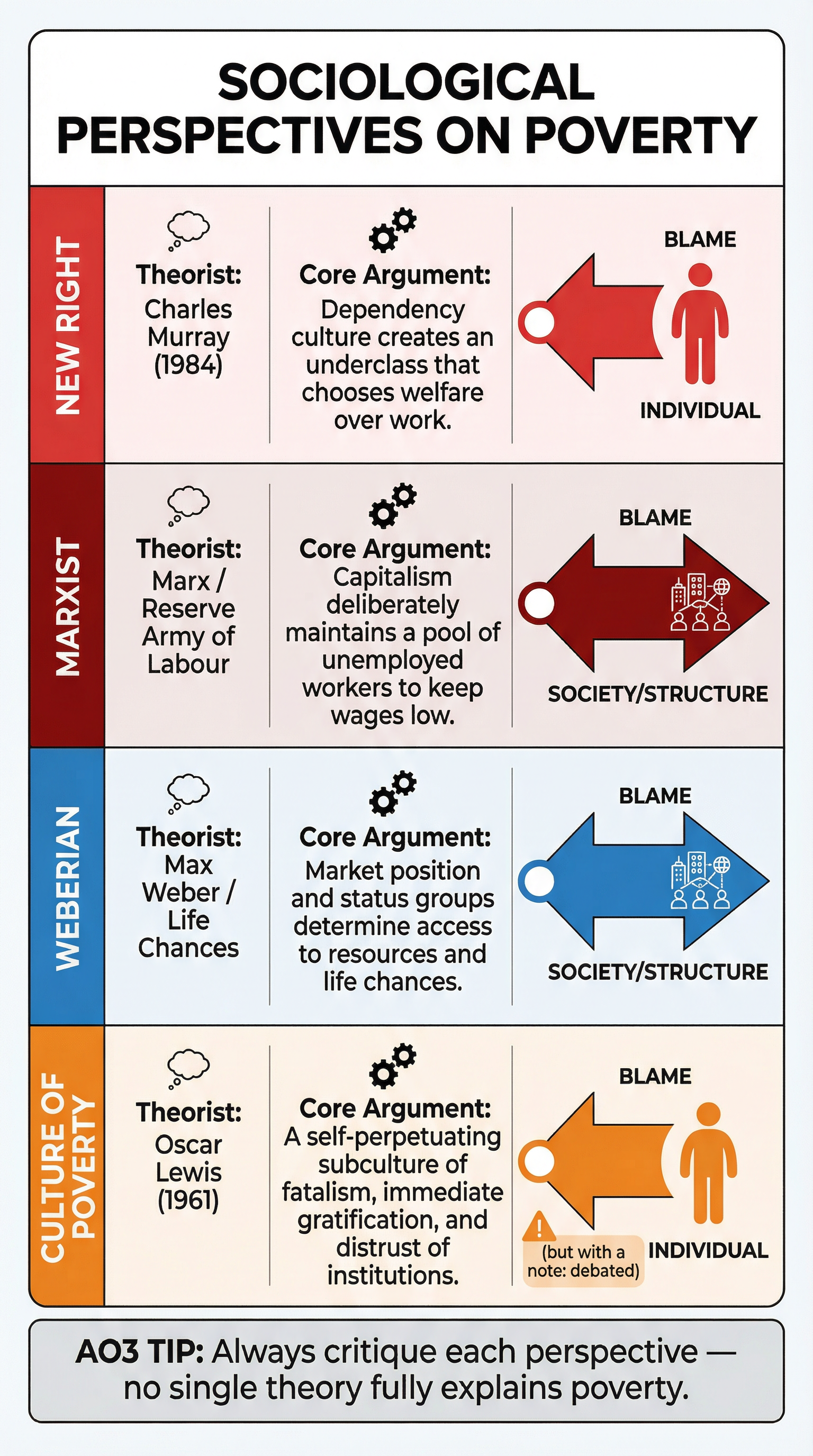
- Charles Murray (New Right, 1984): Argued that a welfare-dependent 'underclass' has emerged with its own distinct culture, characterised by a lack of interest in employment, high rates of lone parenthood, and criminality. He claimed a generous welfare state creates a 'dependency culture', removing the incentive to work.
- Oscar Lewis (Culture of Poverty, 1961): Identified a 'culture of poverty' among the poor, a subculture with values like fatalism (a belief that one cannot change one's situation) and immediate gratification (seeking pleasure now rather than planning for the future). He argued this culture is passed down through generations via socialisation.
Why it matters: These theories are highly controversial. While they are a required part of the specification, you must treat them as a perspective, not as fact. High-level AO3 analysis involves criticising these views for 'blaming the victim' and ignoring the structural constraints that people face.
Structural Explanations (Blaming Society)
What is it?: These theories argue that poverty is caused by the economic and social structure of society.
Key Thinkers & Theories:
- Marxism (Reserve Army of Labour): Argues that capitalism requires a 'reserve army of labour' (a pool of unemployed workers) to keep wages low and maintain profit. Poverty is therefore a built-in, necessary feature of the capitalist system.
- Weberianism (Life Chances): Max Weber argued that an individual's 'life chances' (their opportunities for income, health, and education) are determined by their 'market position'. Those with few skills or qualifications have a weak market position and are therefore more likely to be in poverty. This helps explain why certain groups (e.g., women, ethnic minorities) are at higher risk.
- The Poverty Trap: This is a structural issue where the tax and benefits system creates a disincentive to work. For example, if taking a low-paid job means losing more in state benefits (like housing benefit), a person can be financially worse off. This is a flaw in the system, not a sign of individual laziness.
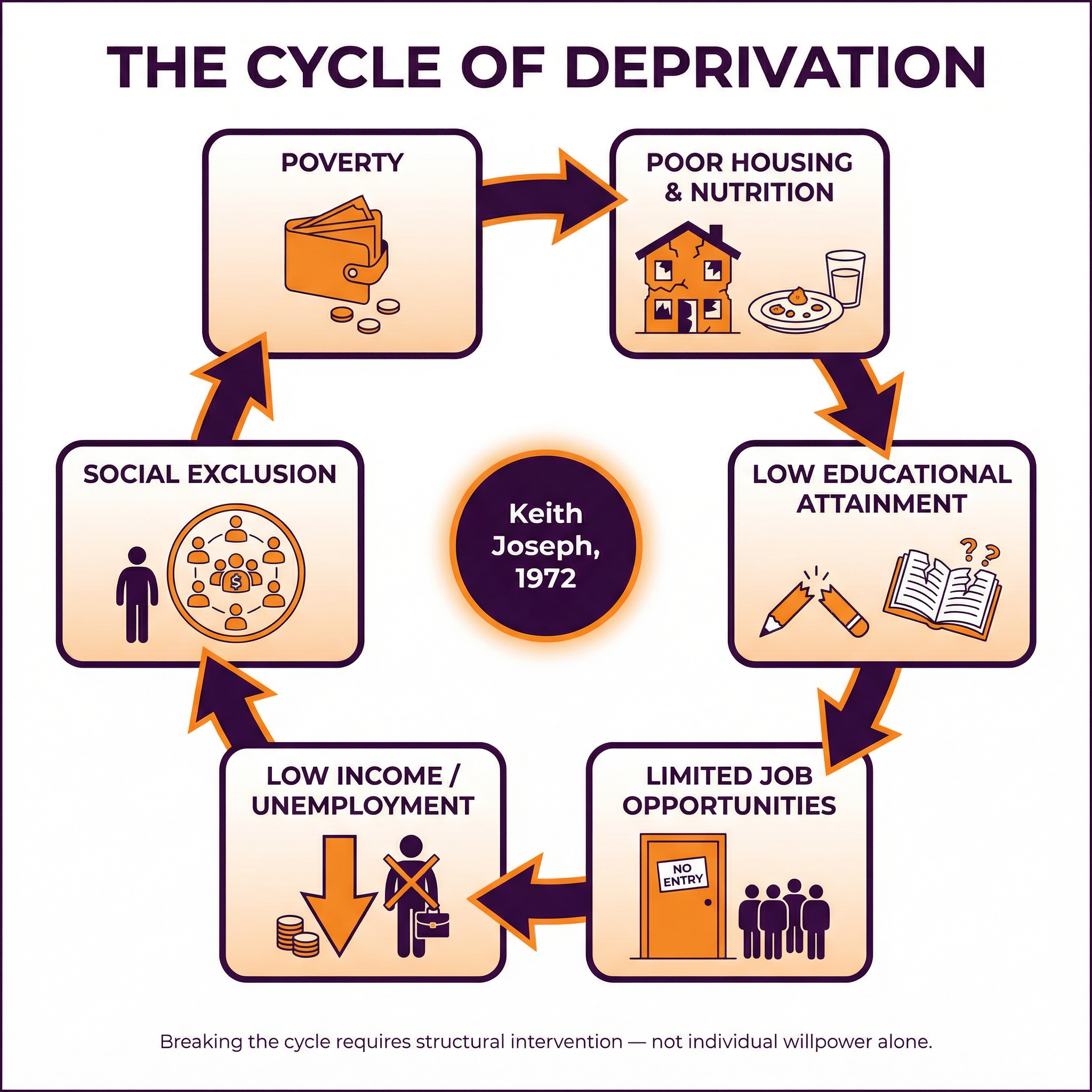
- The Cycle of Deprivation: Associated with Sir Keith Joseph (1972), this concept describes how poverty can be transmitted from one generation to the next. It links factors like poor housing, poor health, low educational attainment, and limited job opportunities in a self-reinforcing cycle.
Visual Resources
2 diagrams and illustrations
Interactive Diagrams
1 interactive diagram to visualise key concepts
Conceptual Flow Outline
A simplified flowchart illustrating the key stages of the Cycle of Deprivation.
Worked Examples
3 detailed examples with solutions and examiner commentary
Practice Questions
Test your understanding — click to reveal model answers
Explain what sociologists mean by relative poverty. (6 marks)
Hint: Think about who defined it, how it's measured, and why it's about more than just money.
Describe two cultural factors that some sociologists blame for causing poverty. (4 marks)
Hint: Think about the New Right and Culture of Poverty theories.
Outline and evaluate the Marxist explanation of poverty. (12 marks)
Hint: Explain the 'reserve army of labour' and then consider its strengths and weaknesses.
Explain the difference between the 'poverty trap' and the 'cycle of deprivation'. (6 marks)
Hint: One is about the benefits system, the other is about intergenerational transmission.
To what extent have government policies successfully reduced poverty in the UK? (12 marks)
Hint: Think about policies like the Minimum Wage, Tax Credits, and Universal Credit. Argue for and against their success.