OCR · GCSE · Sociology
Defining Crime and Deviance
Crime and deviance sit at the very heart of OCR GCSE Sociology, asking us to question who decides what is 'wrong' and why. Far from being fixed, objective categories, these concepts are socially constructed — shaped by time, place, and culture — which means what is criminal or deviant in one context may be perfectly normal in another. Mastering this topic unlocks not only strong marks in Component 02 but also a deeper understanding of power, control, and social order that runs through the entire specification.
- 8 min read
- 3 worked examples
- 5 practice questions
- 9 key terms
Check what you remember
Read the wording for your board, then hide it and explain Crime in your own words. Rough notes are fine. This is a self-check, with no mark or grade.
Reference: OCR
An act that breaks the formal, codified laws of a society and is subject to official sanctions imposed by agents of formal social control such as the police and courts.
Study Notes
Overview

This topic forms a cornerstone of OCR GCSE Sociology Component 02 (J204). Candidates are required to demonstrate a precise understanding of two related but distinct concepts — crime and deviance — and to apply the sociological argument that both are socially constructed. Examiners expect candidates to move beyond simple definitions and engage with the idea of relativity: the principle that what counts as criminal or deviant changes across time, place, and culture. This topic also introduces the mechanisms by which society enforces its rules, namely formal and informal social control, and connects to broader theoretical debates between Functionalism and Marxism about why norms and laws exist in the first place. Candidates who achieve the highest marks will integrate named sociological examples, apply theoretical perspectives, and construct well-reasoned arguments rather than simply listing facts.
Key Concepts
Crime vs. Deviance: The Core Distinction
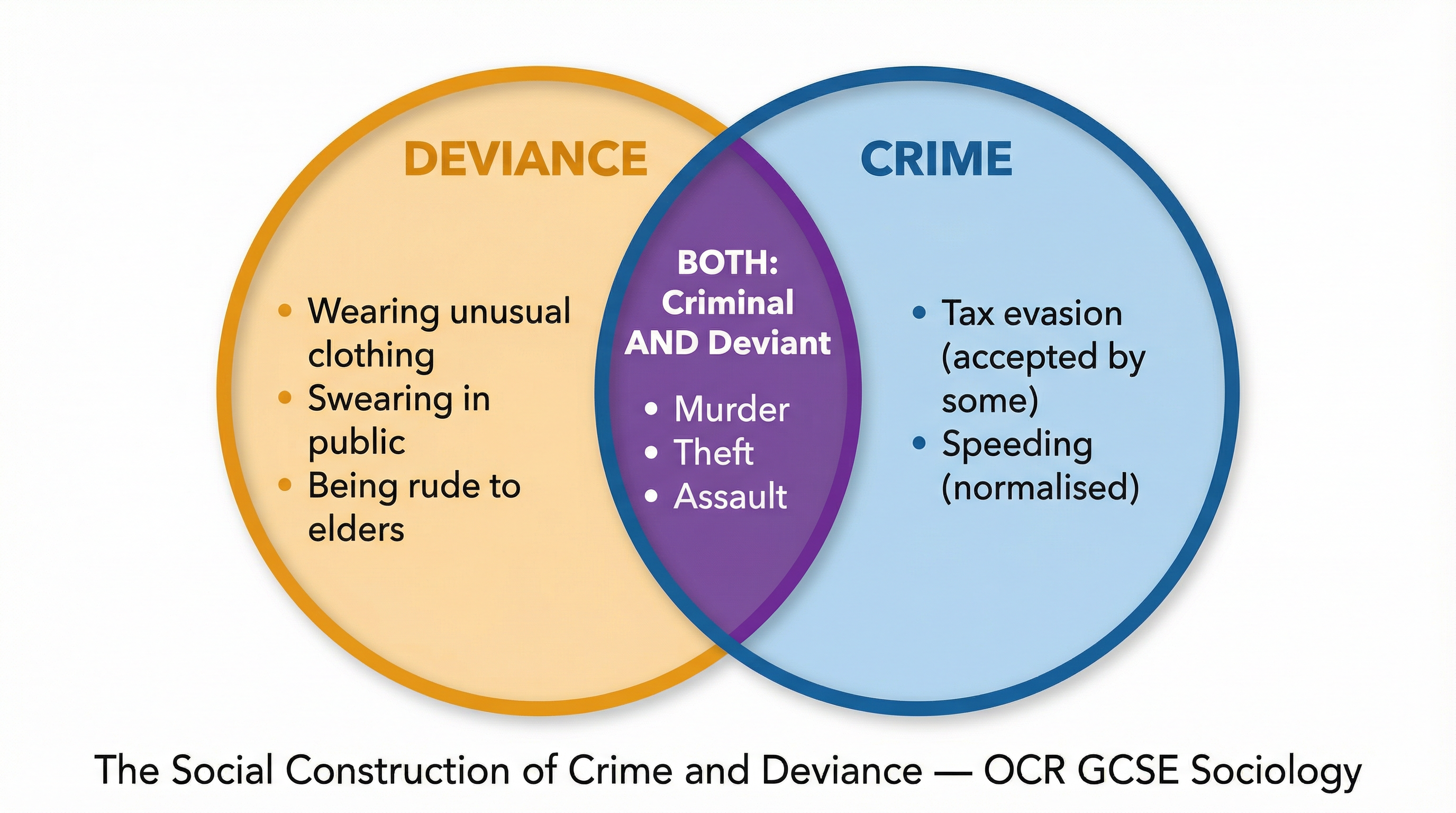
What it is: The most fundamental distinction in this topic is between crime and deviance. A crime is an act that violates the formal, codified laws of a society — laws created and enforced by the state through institutions such as Parliament, the police, and the courts. Deviance, by contrast, is a much broader concept: it refers to any act, belief, or appearance that violates the informal norms and values of a social group. All crimes are technically deviant (they break a rule), but not all deviant acts are crimes.
Why it matters: Examiners specifically award marks for candidates who acknowledge the overlap and distinction rather than treating the terms as synonyms. The classic Venn diagram approach — acts that are only deviant, only criminal, or both — is a highly effective way to demonstrate this understanding.
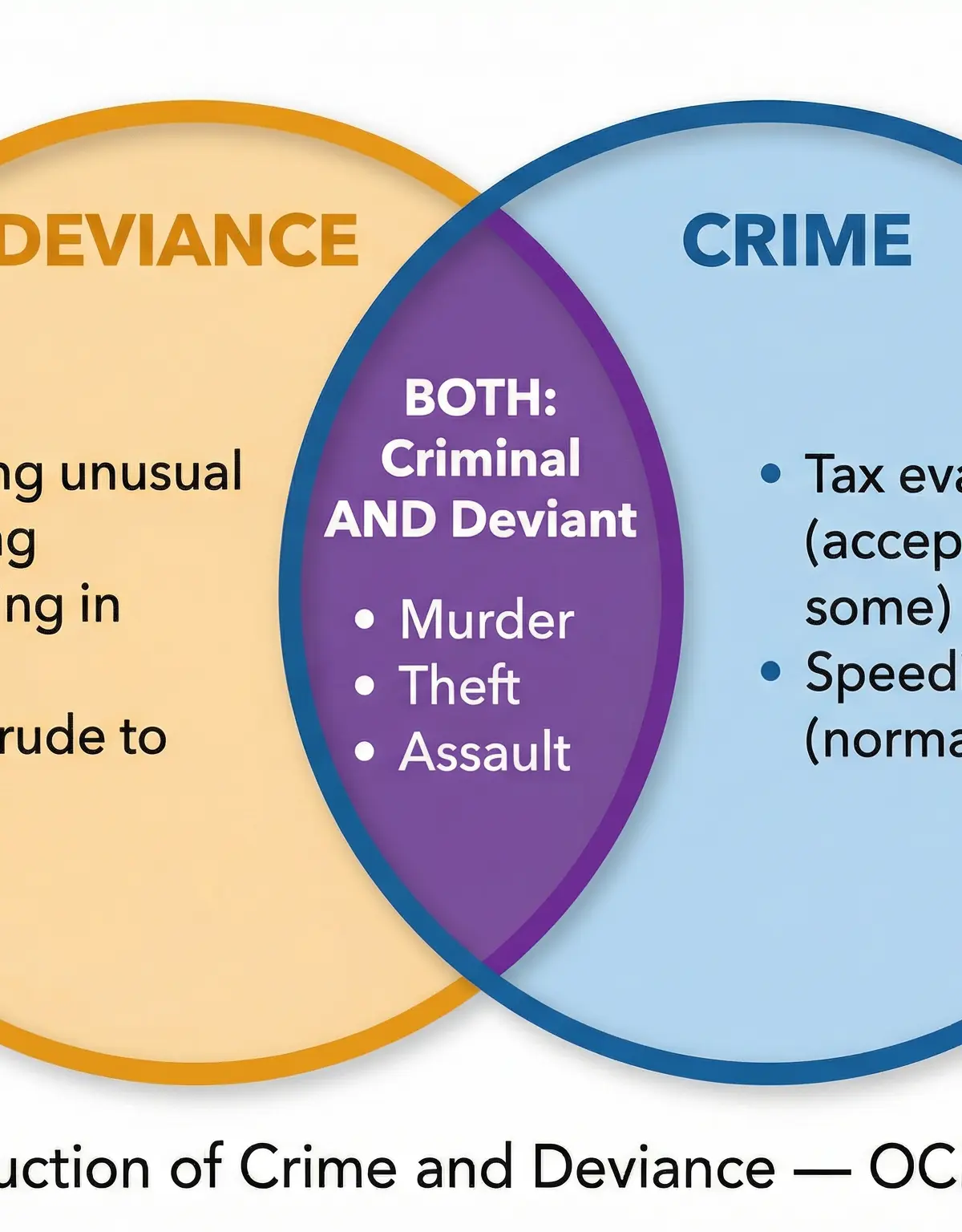
Specific Knowledge: A useful example of an act that is criminal but not widely considered deviant is speeding on a motorway. Studies suggest the majority of UK drivers exceed the speed limit at some point, meaning it has become normalised behaviour despite being illegal. Conversely, wearing a Halloween costume to a formal business meeting would be considered deviant but is not a crime.
The Social Construction of Crime and Deviance
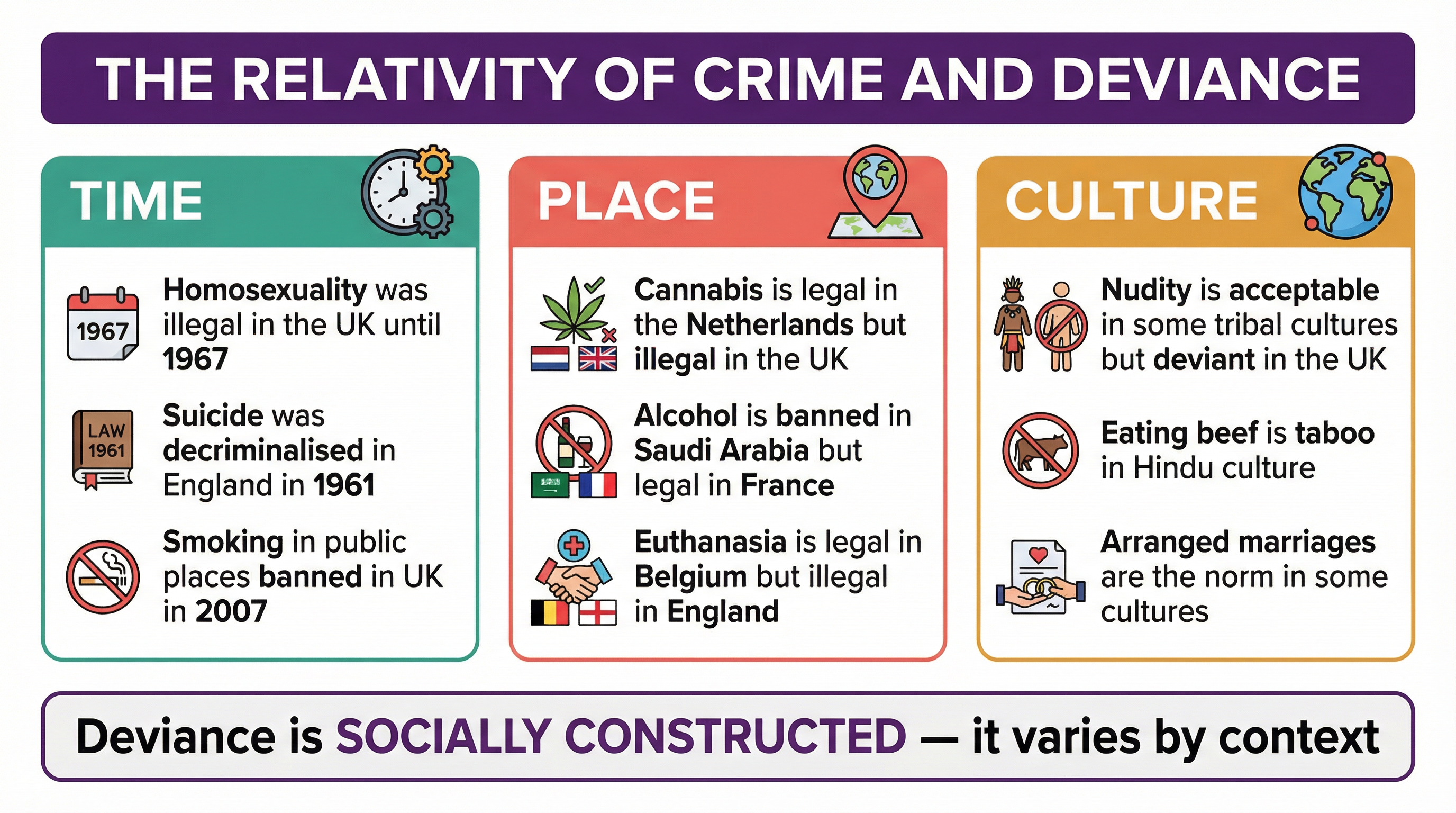
What it is: Sociologists argue that crime and deviance are not natural, objective categories but are socially constructed — meaning they are created by human societies and therefore vary across different contexts. The key framework for demonstrating this is Time, Place, and Culture (TPC).
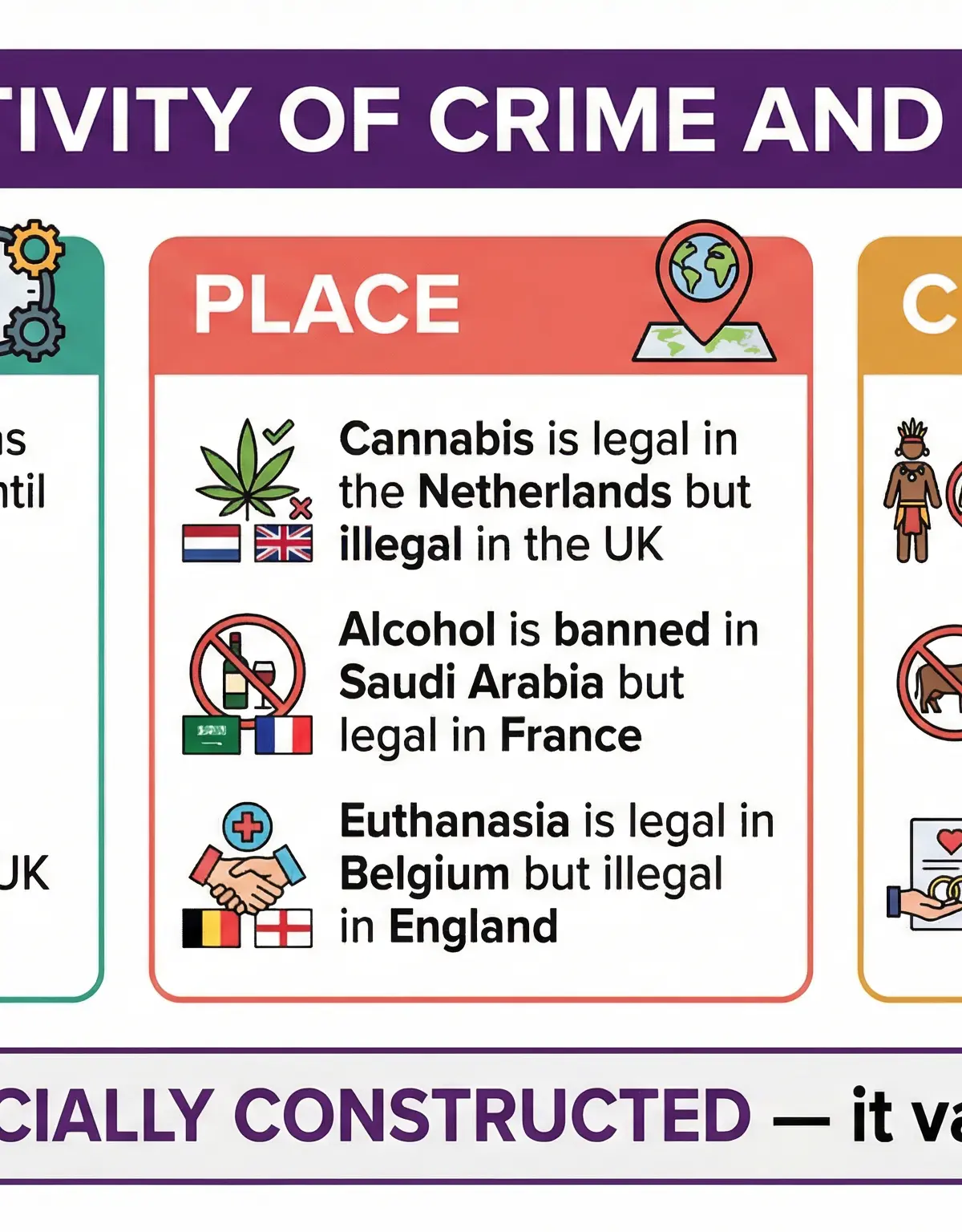
Time: Laws and norms change over time within the same society. Homosexuality was a criminal offence in England and Wales until the Sexual Offences Act 1967. Before this date, men could be imprisoned for same-sex relationships; today, same-sex marriage is legally recognised. Similarly, suicide was decriminalised in England and Wales under the Suicide Act 1961, and smoking in enclosed public spaces became illegal in England in 2007 under the Health Act. These examples show that the legal and moral status of acts can shift dramatically within a single society over time.
Place: The same act can be legal in one country and illegal in another. Cannabis is decriminalised or legal for recreational use in the Netherlands and several US states, yet remains a Class B drug in the UK. Alcohol is a legal and socially normalised substance in the UK and France, but is prohibited in Saudi Arabia under Islamic law. Euthanasia is legal in Belgium and the Netherlands but illegal in England and Wales.
Culture: Cultural norms determine what is considered deviant even within the same legal framework. Nudity is considered normal and non-deviant in some tribal communities and certain European nudist beaches, yet would be considered highly deviant (and potentially criminal) in most UK public spaces. Arranged marriages are a respected cultural norm in many South Asian communities but may be viewed with suspicion in Western secular cultures.
Formal and Informal Social Control
What it is: Society maintains order through social control — the mechanisms by which individuals are encouraged to conform to norms and laws. These mechanisms are divided into two types.
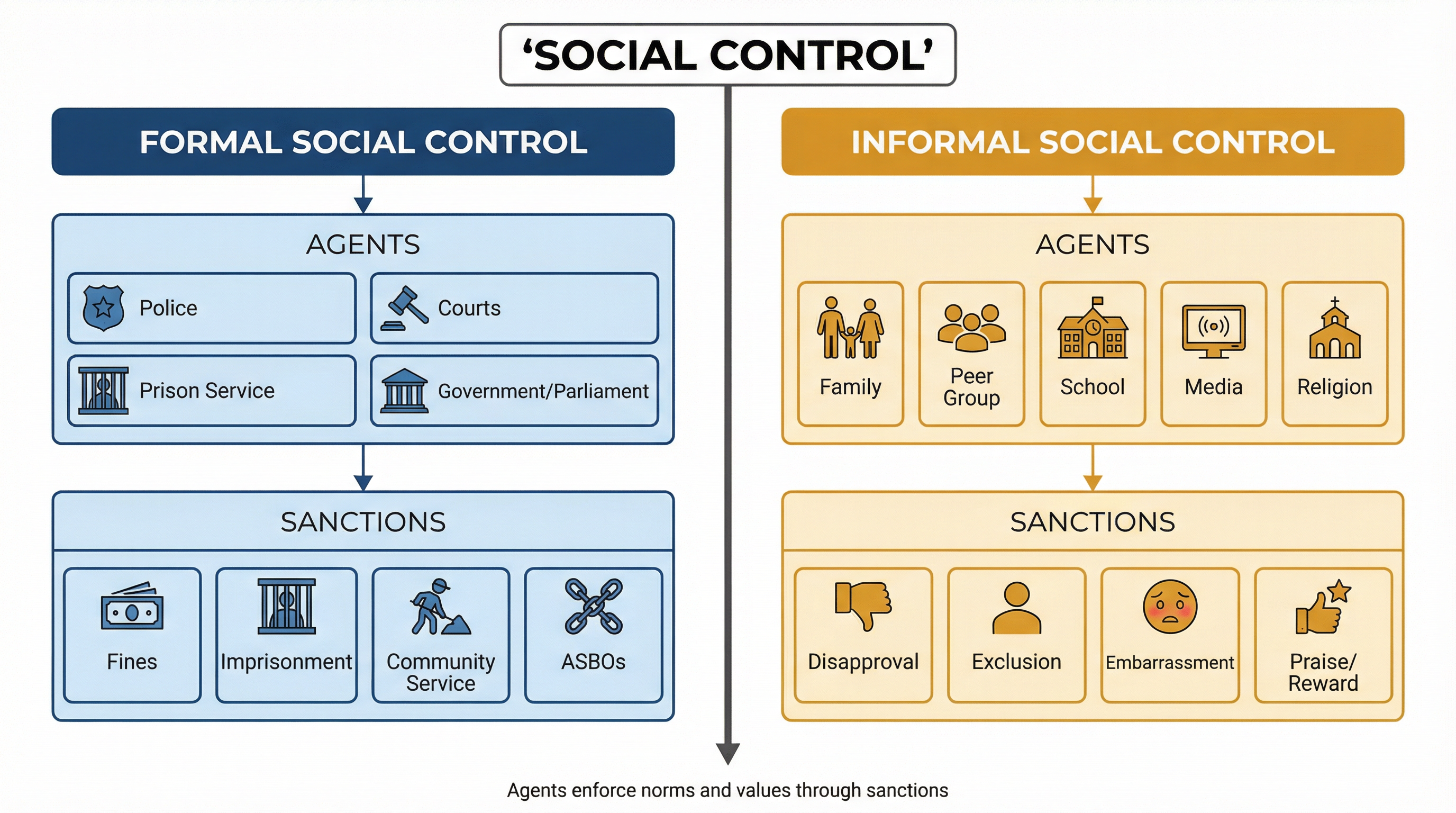
Formal social control is exercised by official institutions with legal authority. The key agents of formal control include the police, the courts, the prison service, and Parliament (which creates the laws). The sanctions they apply include fines, imprisonment, community service, and Anti-Social Behaviour Orders (ASBOs).
Informal social control is exercised by everyday social institutions through social pressure rather than legal force. Key agents include the family, peer groups, schools, the media, and religious institutions. The sanctions they apply include disapproval, exclusion, embarrassment, ridicule, and praise or reward for conformity.
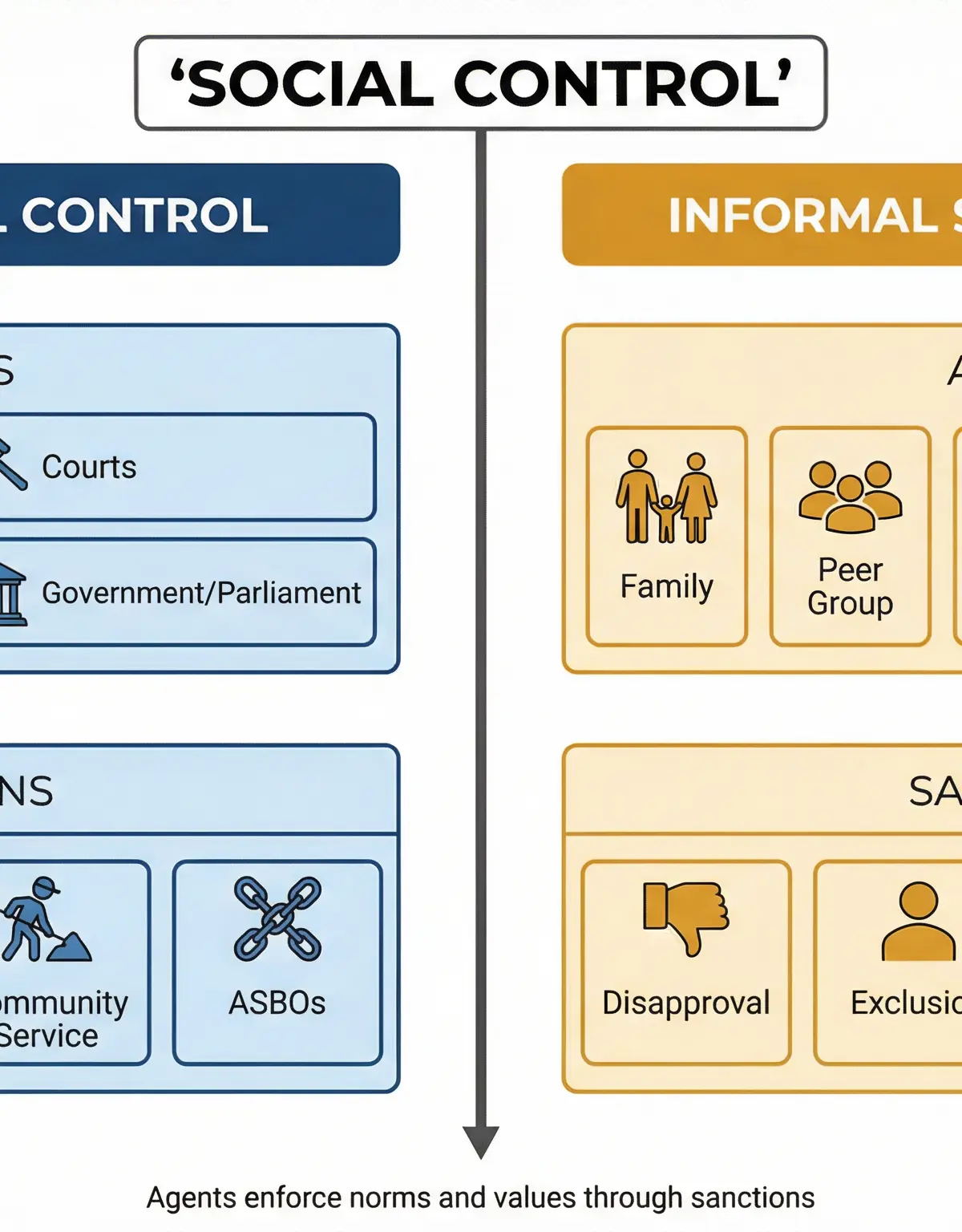
Critical Distinction for Examiners: Candidates frequently lose marks by confusing the agent (the institution doing the controlling) with the sanction (the punishment or reward used). For example, prison is a sanction, not an agent. The agent is the criminal justice system or the courts. This is one of the most commonly penalised errors in mark schemes.
Theoretical Perspectives
Functionalism
Functionalists such as Émile Durkheim argue that deviance serves a positive function in society. By defining and punishing deviant behaviour, society reinforces its shared norms and values, strengthening social cohesion. Durkheim also argued that a certain level of crime is inevitable and even necessary — it marks the boundaries of acceptable behaviour and can drive social change. For example, the suffragette movement was considered deviant and criminal at the time, yet it led to significant social progress.
Marxism
Marxists such as Karl Marx and later William Chambliss argue that laws and definitions of deviance are not neutral but reflect the interests of the ruling class (the bourgeoisie). Laws protect property and wealth — the things the powerful own — while the behaviours of the working class are more likely to be criminalised. This perspective challenges the idea that the law is fair or equally applied, arguing instead that the definition of crime is a tool of social control used by the powerful to maintain their dominance.
Named Example Bank
| Example | Category | Key Detail |
|---|---|---|
| Sexual Offences Act 1967 | Time relativity | Decriminalised homosexuality in England and Wales |
| Suicide Act 1961 | Time relativity | Decriminalised suicide in England and Wales |
| Health Act 2006 | Time relativity | Banned smoking in enclosed public places in England |
| Cannabis laws (Netherlands vs UK) | Place relativity | Legal/decriminalised in Netherlands; Class B drug in UK |
| Alcohol prohibition (Saudi Arabia) | Place relativity | Banned under Islamic law; legal in UK and France |
| Émile Durkheim | Functionalism | Argued deviance is inevitable and functional for society |
| Karl Marx / William Chambliss | Marxism | Laws protect ruling class interests; crime is socially constructed by the powerful |
| Speeding on motorways | Crime but not deviant | Normalised behaviour despite being illegal |
| Suffragette movement | Deviance driving change | Considered criminal at the time; led to women's suffrage |
| Nudity norms | Cultural relativity | Acceptable in some cultures/contexts; deviant in others |
Visual Resources
3 diagrams and illustrations
Interactive Diagrams
3 interactive diagrams to visualise key concepts
Conceptual Flow Outline
Formal vs Informal Social Control: Agents and Sanctions
Conceptual Flow Outline
Decision tree: Classifying acts as criminal and/or deviant
Conceptual Flow Outline
The Time, Place, Culture framework for the relativity of deviance
Worked Examples
3 worked examples — open one to explore the question and available guidance.
Practice Questions
Try the question, then reveal an answer plan or example response
Define what sociologists mean by 'social control'. (2 marks)
Hint: Think about the mechanisms society uses to encourage people to follow rules and norms. Include both formal and informal types.
Explain why sociologists argue that crime is socially constructed. (4 marks)
Hint: Use the TPC framework — Time, Place, Culture. Give at least two specific, named examples with dates or countries.
Describe two agents of informal social control. (4 marks)
Hint: Name two agents (not sanctions). For each, explain how they exercise control and give an example of a sanction they might use.
Explain the difference between a crime and a deviant act. (4 marks)
Hint: Think about the Venn diagram. Use examples of acts that are only deviant, only criminal, and both. Examiners want to see you acknowledge the overlap.
Discuss how far sociologists would agree that formal social control is more effective than informal social control in maintaining social order. (12 marks)
Hint: Define both types of control first. Then argue FOR formal being more effective (legal sanctions, universal application). Then argue AGAINST (informal is constant and internalised). Use sociological theory (Functionalism, Marxism). Reach a clear conclusion.
Exam technique
How to turn what you know into marks
How to approach the question
Always read the command word first. 'Define' requires a clear, concise definition with an example. 'Explain' requires a developed point with evidence and explanation of HOW/WHY. 'Discuss' requires a balanced argument with evidence on both sides and a clear conclusion. Never just list facts — always explain their significance.
How to structure your answer
- Essay questions
- Introduction with clear position → Paragraph 1 (evidence FOR) → Paragraph 2 (more evidence FOR, different dimension) → Paragraph 3 (theoretical support) → Paragraph 4 (counter-argument) → Conclusion (weigh evidence, reach a clear judgement)
- Source questions
- Content (what does the source actually say?) → Provenance (who created it, when, and why?) → Usefulness (what does it help us understand?) → Limitations (what does it NOT tell us, or what bias might exist?)
- Explain questions
- PEEL structure: Point (make your sociological claim) → Evidence (specific named example, date, or statistic) → Explanation (explain HOW the evidence supports your point) → Link (connect back to the question or to your next point). Each PEEL paragraph = 2 marks.
Timing
Approximately 1 minute per mark. A 2-mark question should take no more than 2 minutes. A 12-mark 'Discuss' question should take 12–15 minutes including 2 minutes of planning. Do not over-write on low-tariff questions at the expense of the 12-marker.
Common pitfalls
- Using 'crime' and 'deviance' interchangeably — always acknowledge the distinction and overlap
- Asserting that an act is universally deviant without acknowledging the social constructionist argument
- Confusing the agent of social control (e.g., the police) with the sanction (e.g., a fine or imprisonment)
- Writing a 12-mark answer that only presents one side of the argument — you must include a counter-argument
- Failing to reach a conclusion in 'Discuss' or 'How far do you agree' questions — the conclusion is where Level 4 marks are often secured
- Providing vague examples like 'some countries have different laws' without naming specific countries, acts, or dates
What the command words want
- Define
- Give a clear, precise sociological definition in one or two sentences. Always follow with a concrete example. 1–2 marks.
- Discuss
- Balanced argument required. Present evidence on both sides. Integrate sociological theory. Reach a clear, reasoned conclusion. 12 marks.
- Explain
- Use PEEL structure. Provide specific evidence (named examples, dates, statistics). Explain the mechanism — HOW or WHY. 4–6 marks.
- Describe
- Identify and develop two or more features of the concept. Use specific sociological language. 2–4 marks.
- How far do you agree
- Same as Discuss — balanced argument with a clear judgement. Avoid sitting on the fence; commit to a position supported by evidence.
Watch or listen (optional)
Test your understanding of Defining Crime and Deviance
Active recall beats re-reading. Take an instant quiz now to test what you’ve learned and lock it into long-term memory.
7 days Premium · Then the free plan continues · No card, no charge