OCR · GCSE · Sociology
Divorce
This study guide provides a comprehensive analysis of changing divorce patterns in the UK for OCR GCSE Sociology. It explores the pivotal legal changes, shifting social attitudes, and key sociological theories necessary to achieve top marks, making a complex topic accessible and memorable."
- 7 min read
- 3 worked examples
- 5 practice questions
Study Notes
Overview
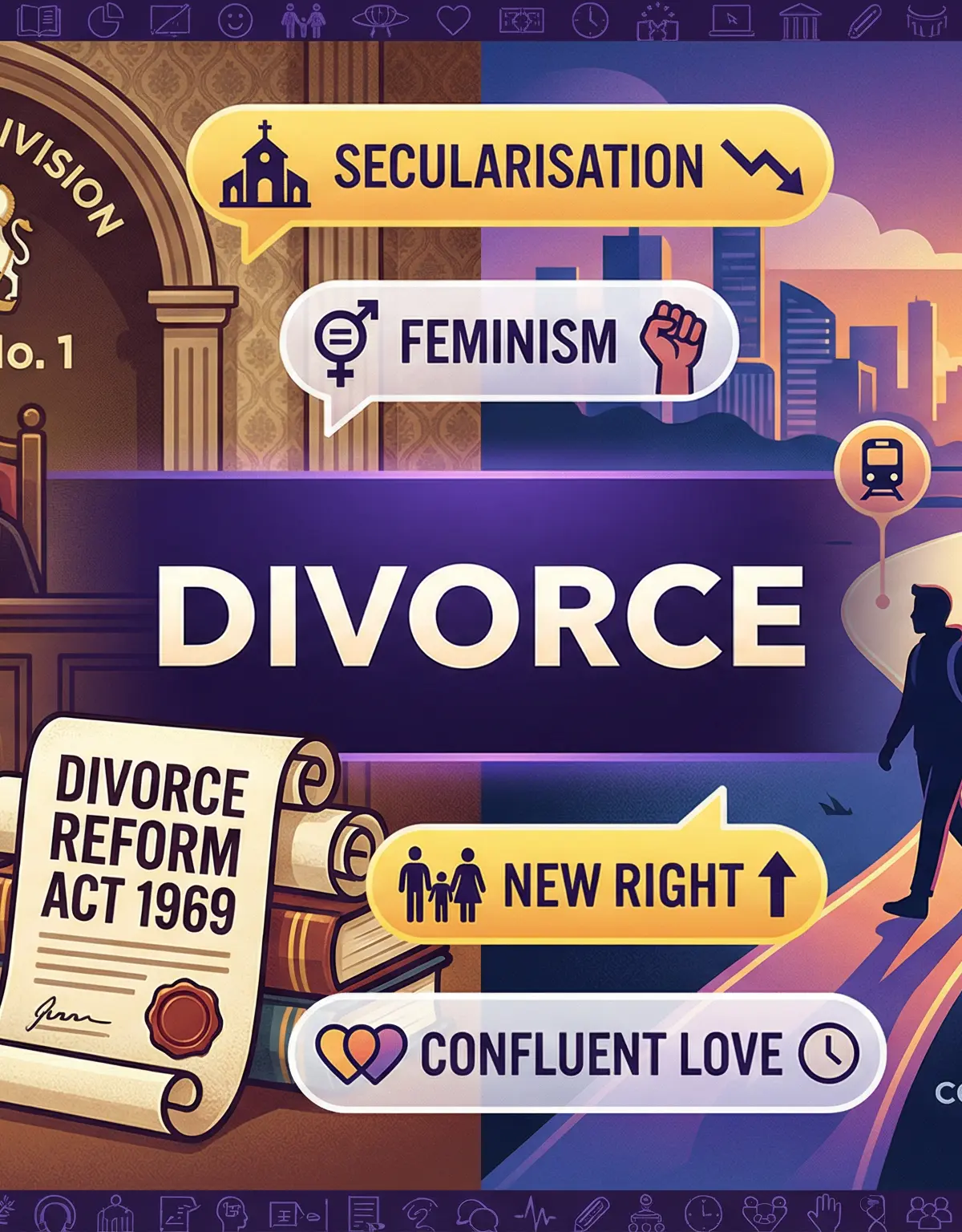
This guide explores the significant shifts in UK divorce patterns since the mid-20th century, a core topic in the OCR GCSE Sociology specification. For sociologists, divorce trends are a powerful lens through which to view wider social change, including secularisation, evolving gender roles, and changing cultural values. Examiners expect candidates to move beyond common-sense explanations, using precise sociological terminology and theoretical perspectives to analyse these trends. A strong answer will demonstrate detailed knowledge of the Divorce Reform Act 1969, explain the reasons for the subsequent rise and recent fall in divorce rates, and critically evaluate the contrasting views of Functionalist, Feminist, and New Right thinkers. This guide provides the specific knowledge, analytical frameworks, and exam techniques required to secure high marks.
Key Events & Developments
The Divorce Reform Act 1969
Date(s): Passed 1969, came into effect 1st January 1971.
What happened: This was the most significant piece of divorce legislation in the 20th century. It introduced the principle of 'irretrievable breakdown' as the sole ground for divorce. This removed the need to prove a 'matrimonial offence' (like adultery or cruelty), which was the basis of the old law. Couples could now divorce after two years of separation if both consented, or after five years if one partner objected.
Why it matters: The Act made divorce significantly easier and cheaper to obtain. It led to an immediate and dramatic spike in the divorce rate; the number of divorces more than doubled between 1970 and 1972. For the exam, this is the primary causal factor for the post-1970 rise in divorce. It represents a major shift in the legal framework governing marriage.
Specific Knowledge: Candidates must know the date of the Act (1969) and the year it came into force (1971). Quoting the term 'irretrievable breakdown' will gain credit.
The Peak and Subsequent Decline of Divorce
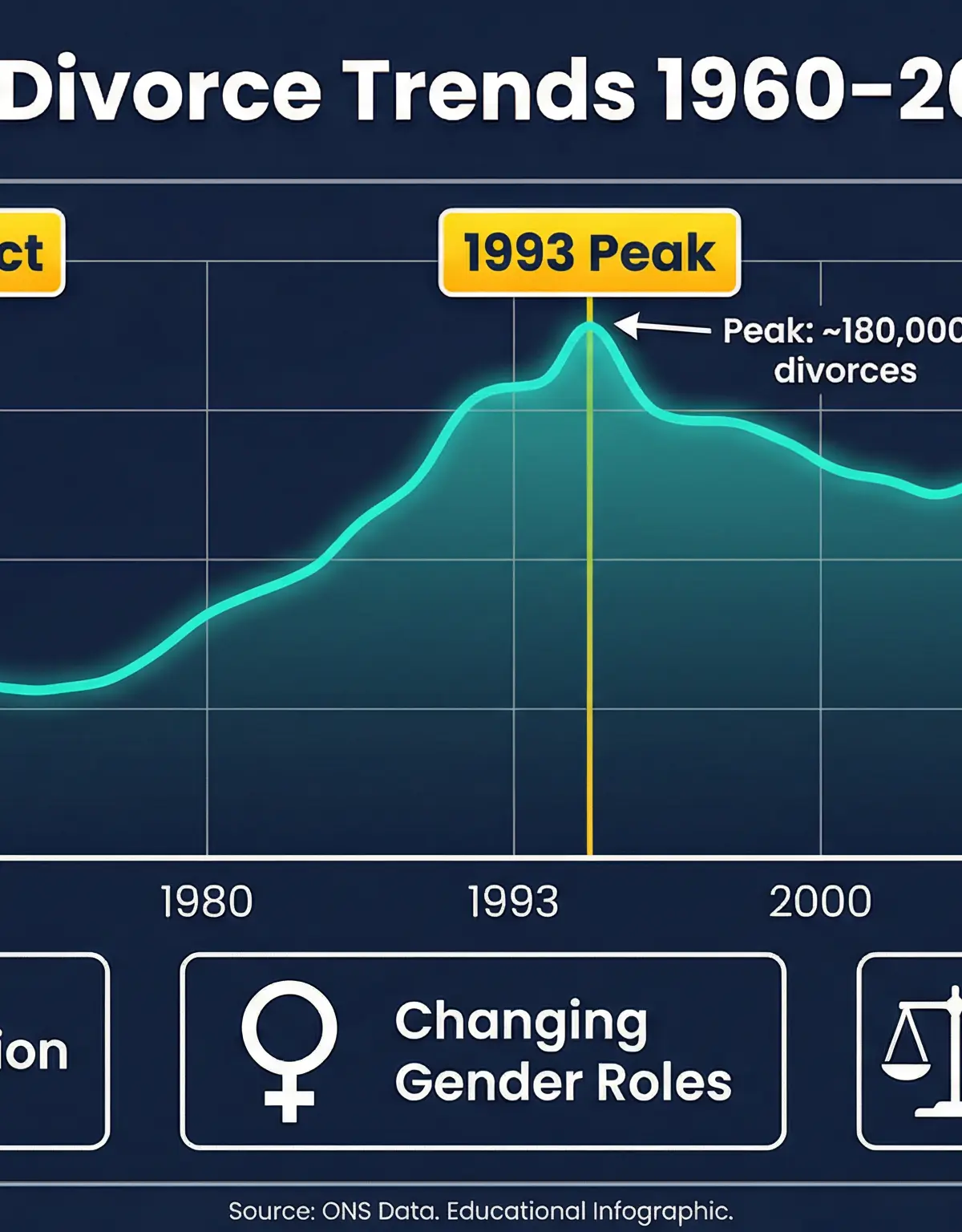
Date(s): Peak c.1993; Decline from mid-1990s to present.
What happened: After the 1969 Act, divorce rates continued to climb, peaking in 1993 with over 180,000 divorces. Since then, the rate has generally declined. This is not because marriages have become more stable, but primarily because fewer people are getting married. The rise of cohabitation as a socially acceptable alternative to marriage means the pool of married couples (and thus potential divorces) is smaller.
Why it matters: This demonstrates a crucial analytical point that examiners look for. Candidates must avoid the simplistic conclusion that marriage is now 'stronger'. The decline shows how changing family forms (like cohabitation) impact divorce statistics. It requires candidates to show they can interpret statistical trends with sociological insight.
Specific Knowledge: Know that the peak was in the early 1990s. The key reason for the decline is the rise in cohabitation and later age of marriage.
Key Sociological Explanations
Secularisation
What it is: The process by which religion loses its social and cultural significance. As society becomes more secular, the moral and religious objections to divorce weaken. Marriage is less likely to be seen as a sacred, lifelong spiritual union and more as a personal contract that can be terminated.
Impact: Reduced social stigma associated with divorce. Individuals are less likely to be deterred from ending an unhappy marriage by religious beliefs or pressure from religious communities.
Changing Gender Roles & Female Emancipation
What it is: From the 1960s, women gained greater access to education and paid employment, leading to increased financial independence. This reduced their economic dependency on their husbands, making divorce a more viable option. Feminist sociologists see this as a key factor in explaining why women initiate the majority (around two-thirds) of divorces.
Impact: Women are no longer trapped in unhappy or abusive marriages due to financial necessity. Rising expectations of marriage, particularly among women, mean they are less willing to accept a patriarchal or unfulfilling relationship. This is a story of female empowerment.
Changing Expectations of Marriage
What it is: Sociologists like Anthony Giddens argue that relationships are now judged by a standard of 'confluent love' or as a 'pure relationship'. This means individuals expect deep emotional and personal fulfilment from marriage, and the relationship is sustained only as long as it delivers this satisfaction to both partners. The traditional idea of marriage as a duty or a practical necessity has been replaced by a quest for romantic and emotional compatibility.
Impact: When marriages fail to live up to these high expectations, couples are more likely to see divorce as a logical and acceptable step. This contrasts with previous generations who may have had lower expectations and tolerated 'empty shell marriages'.
Second-Order Concepts
Causation
Long-term causes: Secularisation, the rise of feminism and changing gender roles, growing individualism.
Short-term trigger: The Divorce Reform Act 1969 was the immediate legal catalyst that unlocked the pent-up demand for divorce.
Combined factors: The Act did not cause the rise in divorce alone; it operated within a social context of changing attitudes and economic shifts that made divorce both more desirable and more possible.
Consequence
For the family: Increased family diversity, with a rise in lone-parent families (over 90% of which are female-headed) and reconstituted or 'step-families'.
For individuals: For some, divorce is a source of stress and financial hardship. For others (particularly women, according to feminists), it is a liberating escape from patriarchal control.
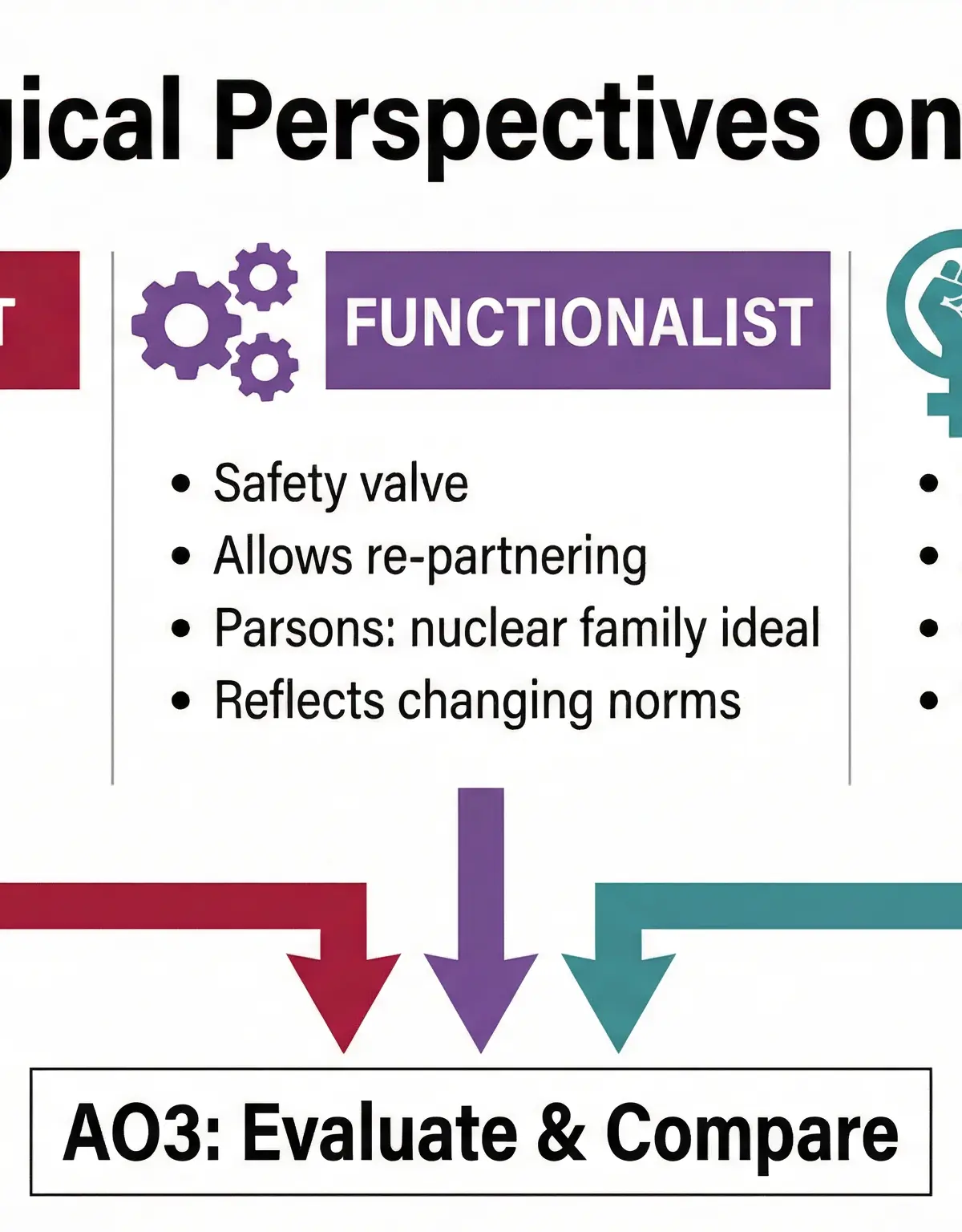
For society: The New Right argues it leads to 'family breakdown' and creates a welfare-dependent 'underclass'. Feminists see it as a sign of social progress and female empowerment.
Change & Continuity
Change: Massive increase in the divorce rate post-1971; significant reduction in the stigma attached to divorce; marriage is no longer always seen as a lifelong institution.
Continuity: Most people still get married, and the high rate of remarriage suggests a continued belief in the ideal of marriage, even if the first one fails. The nuclear family ideal remains powerful.
Significance
Divorce trends are significant because they are a key indicator of wider social change. They reveal shifts in the power dynamics between men and women, the declining influence of religion, and the rise of individualism. Understanding divorce is fundamental to understanding the changing nature of the family in modern Britain.
Source Skills
When presented with a source on divorce (e.g., a table of statistics, a quote from a sociologist, a newspaper article), candidates must apply the Content-Provenance-Limitations framework.
Content: What does the source explicitly show or say? (e.g., 'Source A shows that the number of divorces peaked in 1993.')
Provenance: Who created this source, when, and why? How does this affect its usefulness? (e.g., 'As Source A is from the Office for National Statistics, it is likely to be highly reliable for showing trends, but it doesn't explain the reasons behind them.')
Limitations: What does the source not tell you? What is its purpose or potential bias? (e.g., 'The source is limited because it only provides raw numbers and doesn't reveal the social class or ethnic differences in divorce patterns.')
Judgement: Overall, how useful is the source for the specific enquiry in the question?"
Worked Examples
3 worked examples — open one to explore the question and available guidance.
Practice Questions
Try the question, then reveal an answer plan or example response
Describe two social (non-legal) reasons for the increase in divorce since 1900. (8 marks)
Hint: Think about changes in social attitudes and the economy. Do not use the Divorce Reform Act as one of your points.
Explain why the divorce rate has fallen since the mid-1990s. (8 marks)
Hint: Focus on changes in marriage patterns rather than assuming marriages are happier.
Discuss the view that the main reason for the rise in divorce is the changing position of women in society. (12 marks)
Hint: This is an essay question. Argue for the feminist viewpoint, but also bring in other factors like legal changes and secularisation to create a balanced argument.
Describe what sociologists mean by an 'empty shell marriage'. (4 marks)
Hint: Give a clear definition and then a sentence of context.
Evaluate the New Right view of divorce. (12 marks)
Hint: Start by explaining the New Right view clearly. Then, use the Feminist perspective as your main source of criticism and evaluation.
Watch or listen (optional)
Test your understanding of Divorce
Active recall beats re-reading. Take an instant quiz now to test what you’ve learned and lock it into long-term memory.
7 days Premium · Then the free plan continues · No card, no charge