OCR · GCSE · Sociology
Ethical Considerations
Ethical Considerations in sociological research are governed by the British Sociological Association (BSA) guidelines, which protect participants from harm while shaping methodological choices. Mastering this topic is essential for OCR GCSE Sociology, as it underpins all research methods questions and requires candidates to evaluate the tension between ethical practice and data validity.
- 8 min read
- 4 worked examples
- 6 practice questions
- 10 key terms
Check what you remember
Read the wording for your board, then hide it and explain Informed Consent in your own words. Rough notes are fine. This is a self-check, with no mark or grade.
Reference: OCR
The principle that participants must be given sufficient information about a study to make an informed decision about whether to participate, including the purpose, procedures, risks, and their right to withdraw.
Study Notes
Overview
This guide focuses on the critical topic of Ethical Considerations in sociological research, a cornerstone of the OCR GCSE Sociology specification. Examiners expect candidates to demonstrate a robust understanding of the British Sociological Association (BSA) guidelines, not just as a list to be memorized, but as a framework to be applied and evaluated. This topic is fundamental because it governs how sociologists interact with the people they study, ensuring that the pursuit of knowledge does not come at the cost of human dignity and well-being. A strong grasp of ethics is essential for scoring highly on research methods questions, particularly those requiring evaluation of the strengths and limitations of different methodological choices. Candidates who can articulate the tension between ethical purity and the quest for valid data will distinguish themselves and access the higher mark bands. This guide will equip you with the precise terminology, analytical frameworks, and exam techniques needed to excel.
Key Concepts & Principles
The British Sociological Association (BSA) Guidelines
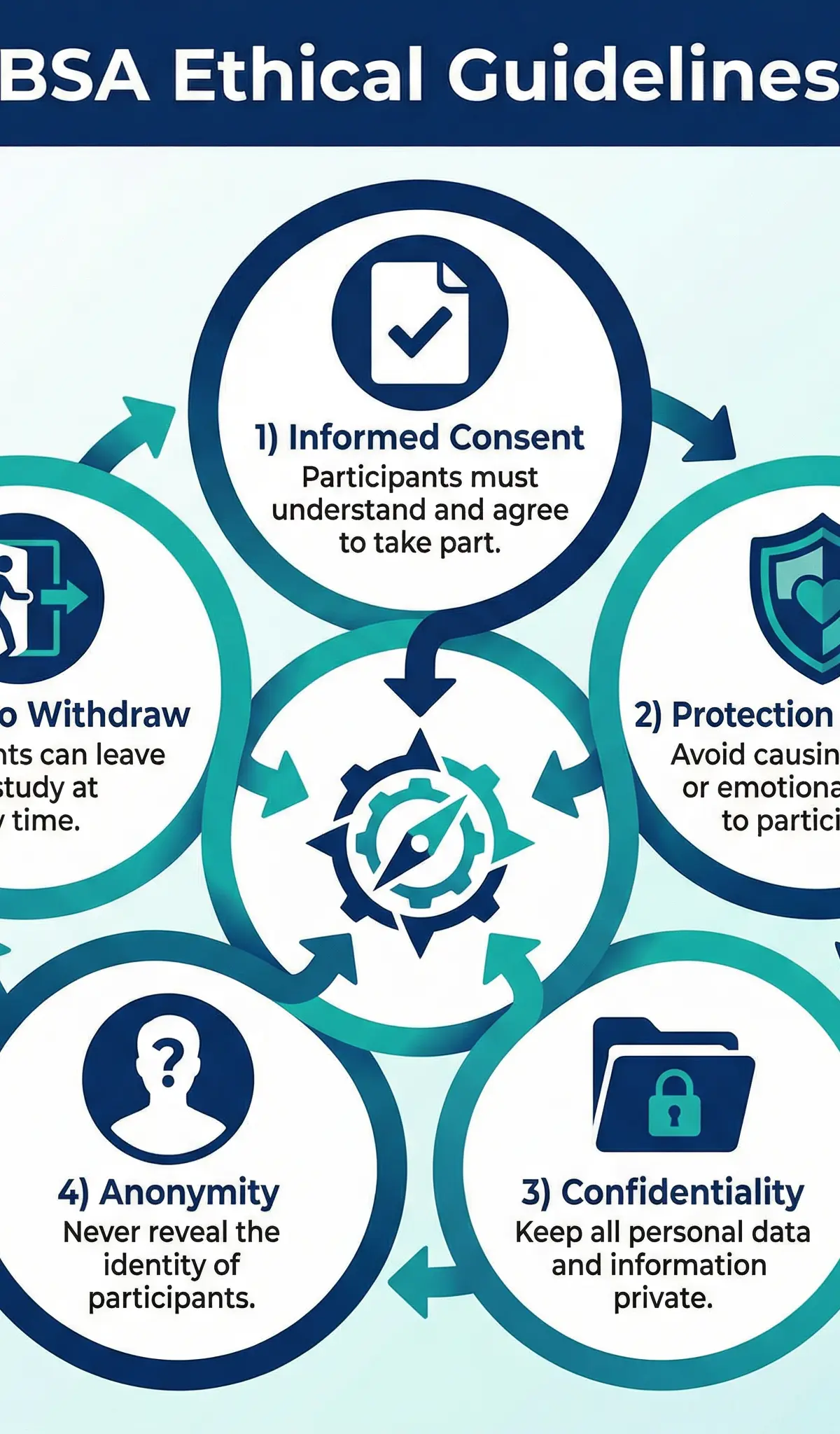
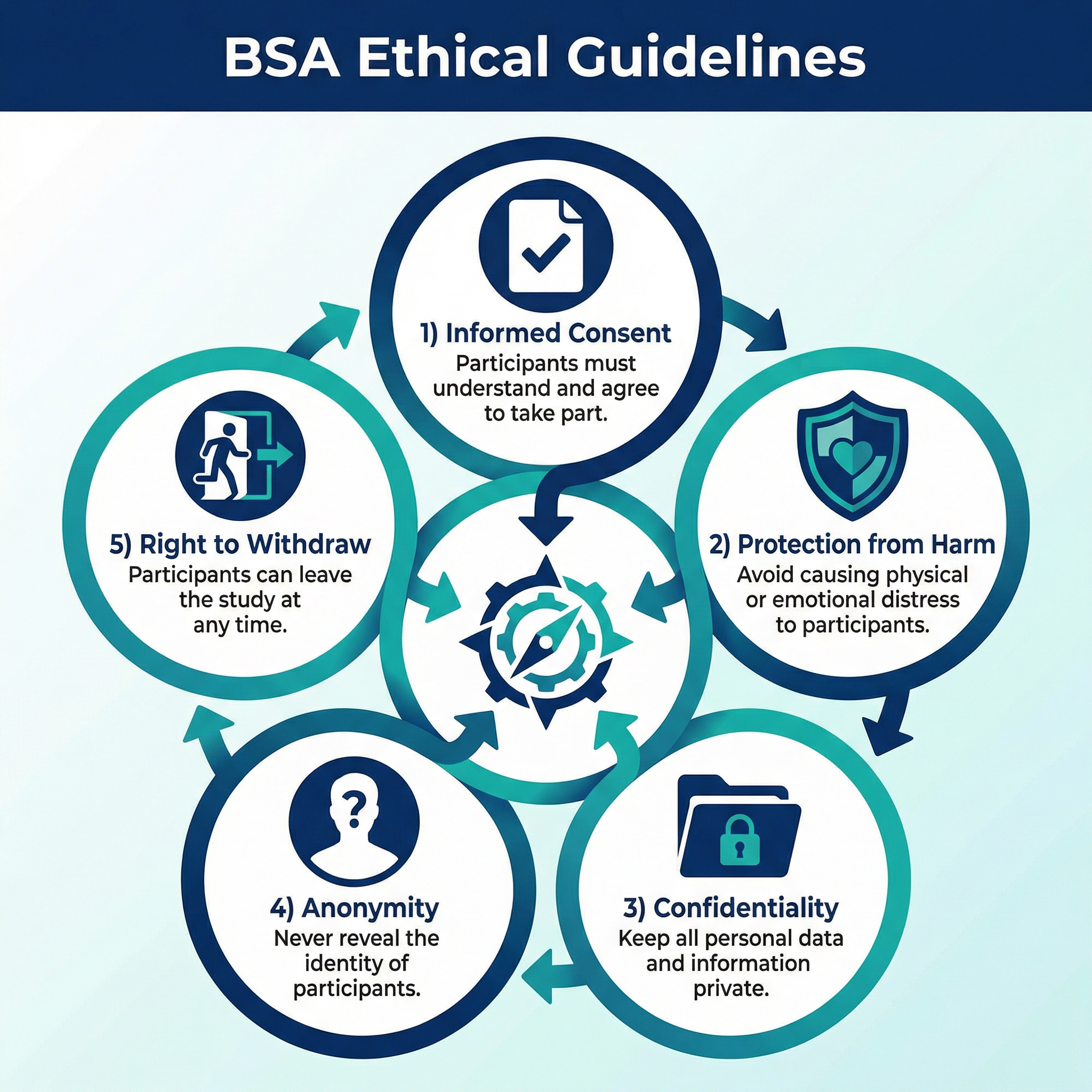
The BSA provides the ethical framework that all sociologists in the UK are expected to follow. For your exam, you must refer to these guidelines by name. The five core principles are:
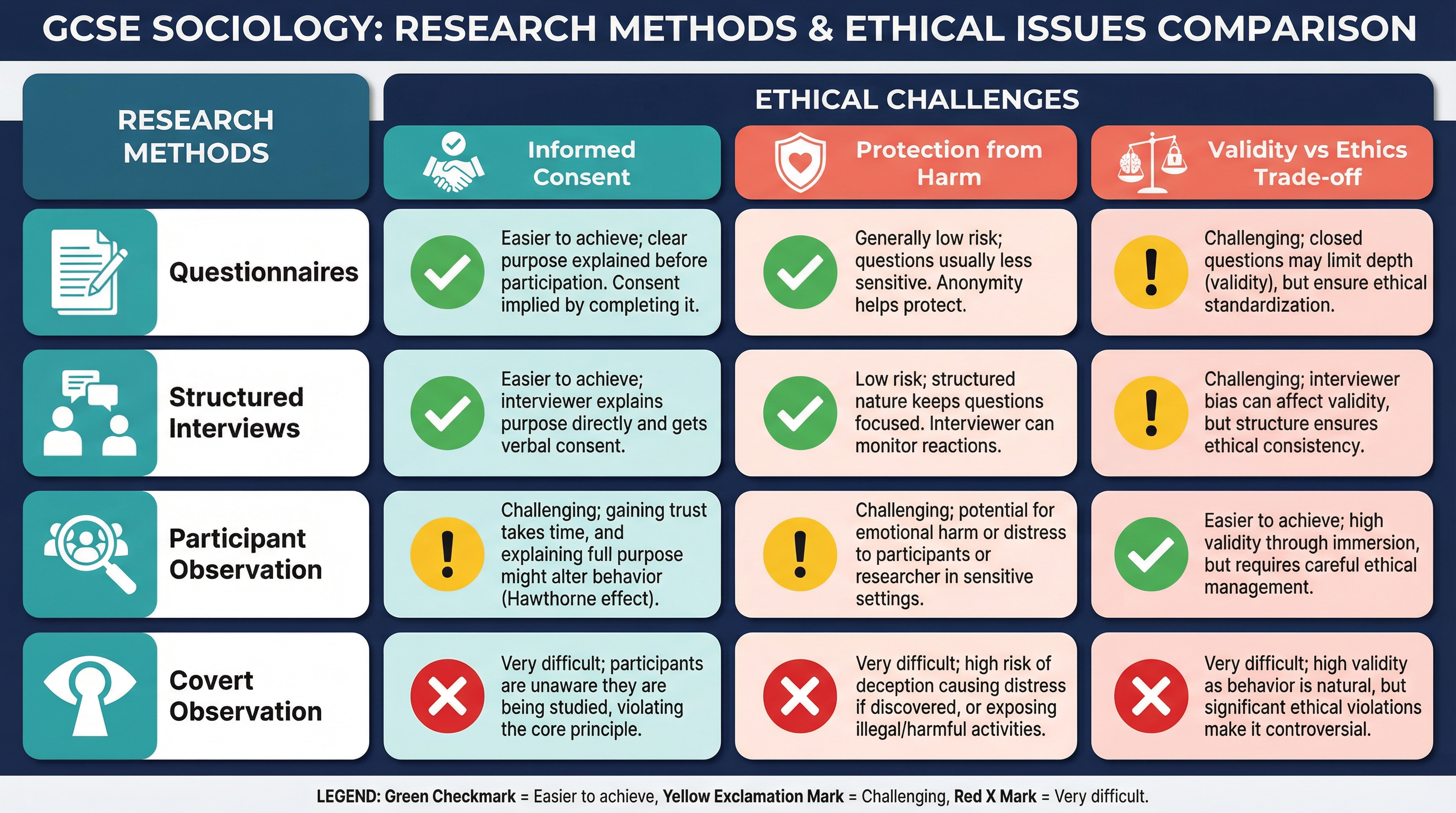
Informed Consent: This is the principle that participants should be given sufficient information about a study to make an informed decision about whether to participate. This includes the purpose of the research, the procedures involved, any potential risks and benefits, and their right to withdraw. It is not enough to simply ask for permission; the consent must be informed. Credit is given for using this precise term. In practice, informed consent is straightforward with methods such as questionnaires and structured interviews, where the researcher explains the study and the participant agrees. However, in covert observation, where participants are unaware they are being studied, informed consent is impossible to obtain, making the method ethically controversial.
Confidentiality and Anonymity: These two terms are often confused, but they are distinct. Confidentiality means that the researcher knows the identity of the participants but protects their privacy by not disclosing their information. The researcher might use pseudonyms in published work to protect identities. Anonymity is a stronger guarantee of privacy, where the researcher does not know the identity of the participants, making it impossible to link data to an individual. For example, an online survey with no identifying questions is anonymous. In your exam, confusing these two terms will cost you marks, so ensure you understand the difference.
Protection from Harm: Researchers have a duty to protect participants from physical, psychological, and emotional harm. This includes preventing stress, embarrassment, or any other negative consequences that might arise from participation. For instance, researching domestic violence survivors could cause psychological distress if sensitive questions trigger traumatic memories. This principle also extends to protecting the researcher from harm, particularly in sensitive or dangerous research settings such as gang research or participant observation in high-risk environments.
Right to Withdraw: Participants have the right to leave a study at any time, without giving a reason and without penalty. They also have the right to request that their data be destroyed. This must be made clear to participants at the start of the research. However, this principle presents practical challenges. In long-term participant observation studies, a participant withdrawing halfway through could result in the loss of months of data. In covert observation, participants cannot exercise this right because they do not know they are being studied.
Deception: Deception involves misleading or lying to participants about the nature of the research. The BSA guidelines state that deception should be avoided unless it is absolutely necessary for the validity of the research and is justified by the potential scientific value of the study. Even then, participants should be fully debriefed after the study. Deception is ethically problematic because it violates the principle of informed consent and can cause psychological harm if participants feel manipulated.
The Ethics vs. Validity Trade-Off
A central dilemma in sociological research is the trade-off between adhering to ethical guidelines and collecting valid data. Often, the more ethically sound a research method is, the less valid the data it produces, and vice versa. This tension is a key area for evaluation in 12-mark questions. For example:
Covert Observation: This method, where the researcher does not reveal their true identity, can produce highly valid data as it allows the researcher to observe natural behavior without the Hawthorne Effect (where participants alter their behavior because they know they are being observed). However, it is ethically problematic as it involves deception and a lack of informed consent. Candidates might write: "While covert observation would yield more valid data by avoiding the Hawthorne Effect, it directly violates the BSA principle of informed consent, making it ethically unacceptable despite its methodological advantages."
Structured Interviews: These are ethically sound as participants give informed consent and are fully aware they are being studied. However, the structured nature of the interview may limit the depth and validity of the data, and the presence of the interviewer may lead to social desirability bias (where participants give answers they think are socially acceptable rather than truthful).
Questionnaires: These are generally low-risk ethically, as consent is implied by completing the questionnaire and anonymity is easy to achieve. However, closed questions may limit the depth of data (reducing validity), though they ensure ethical standardization.
Candidates who can evaluate this trade-off, using specific examples of research methods, will be awarded higher marks.
Vulnerable Groups
The BSA guidelines place a special emphasis on protecting vulnerable groups. These are groups of people who may be at a higher risk of harm or may not be able to give full informed consent. Examples include:
- Children and young people (under 18)
- People with learning disabilities or mental health problems
- Victims of crime
- People in powerless positions (e.g., prisoners, employees)
When researching these groups, sociologists must take extra steps to ensure their protection and well-being. For instance, when researching children, parental consent is required in addition to the child's assent. If a source in your exam mentions researching children, immediately flag this as requiring enhanced ethical protection—this is an easy mark to pick up.
Ethical Issues and Research Methods
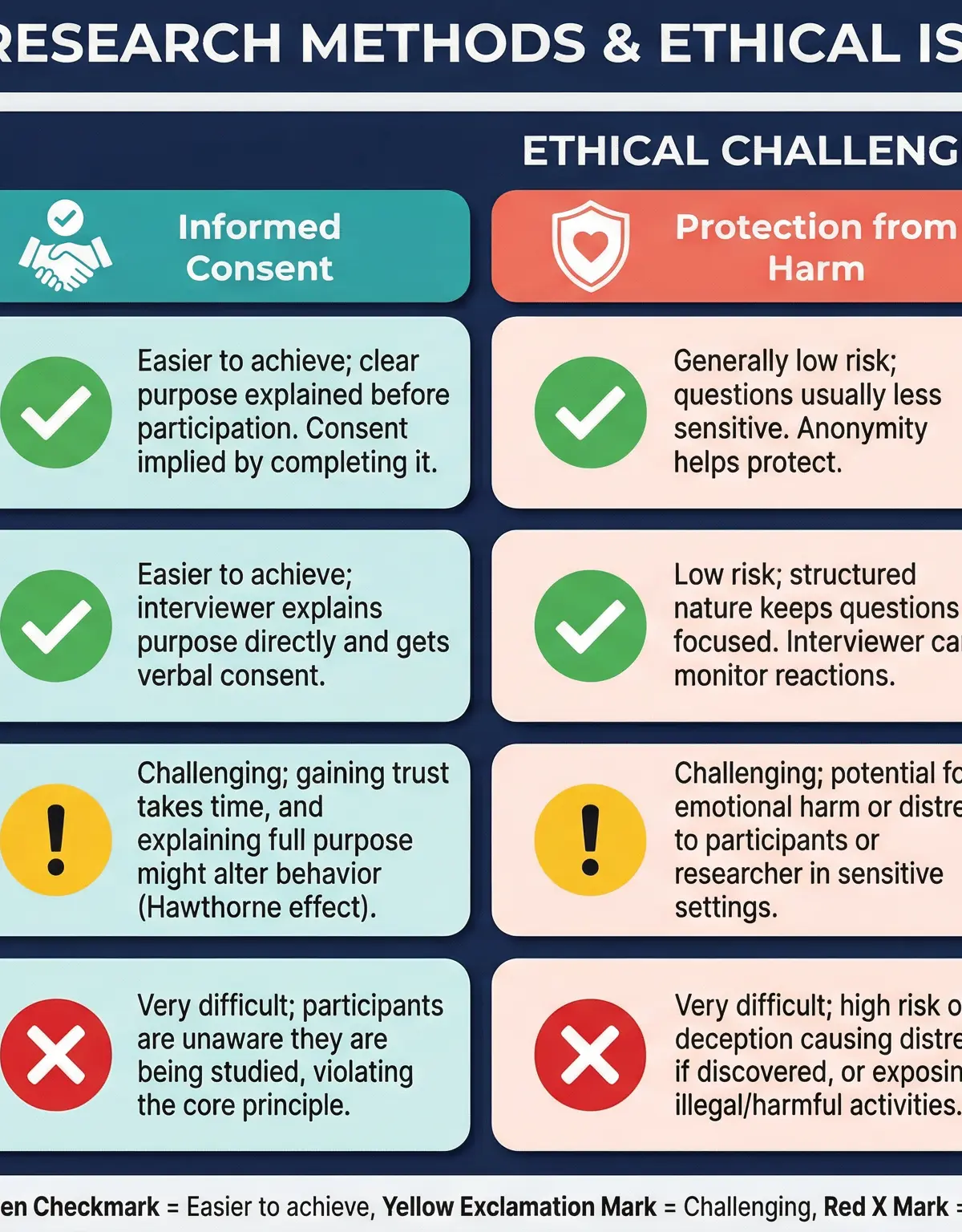
Different research methods present different ethical challenges. Understanding these is crucial for exam success:
| Research Method | Ethical Strengths | Ethical Challenges |
|---|---|---|
| Questionnaires | Easy to obtain informed consent; anonymity protects participants | Risk of sensitive questions causing distress; low response rates may indicate ethical concerns |
| Structured Interviews | Clear informed consent; researcher can monitor participant well-being | Potential for interviewer bias; social desirability bias may compromise validity |
| Unstructured Interviews | Rich, valid data; participants can express themselves freely | Risk of psychological harm from discussing sensitive topics; difficult to maintain anonymity |
| Participant Observation | High validity through immersion in natural settings | Difficult to obtain informed consent without altering behavior; risk of harm to researcher and participants |
| Covert Observation | Avoids Hawthorne Effect; natural behavior observed | Violates informed consent; deception; participants cannot withdraw |
| Experiments | Controlled conditions; clear consent procedures | Risk of psychological harm; deception often used; artificial setting reduces validity |
Listen to the 10-minute podcast: This audio guide covers the BSA principles, the ethics vs. validity trade-off, and exam strategies in a conversational, engaging format. Perfect for revision on the go!
Visual Resources
2 diagrams and illustrations
Interactive Diagrams
2 interactive diagrams to visualise key concepts
Conceptual Flow Outline
Overview of BSA Ethical Principles and Their Application
Conceptual Flow Outline
The Ethics vs. Validity Trade-off in Research Design
Worked Examples
4 worked examples — open one to explore the question and available guidance.
Practice Questions
Try the question, then reveal an answer plan or example response
Identify one reason why sociologists must obtain informed consent from research participants. (2 marks)
Hint: Think about the BSA principle and why it protects participants' autonomy.
Explain one ethical issue that might arise when researching children's experiences of poverty. (4 marks)
Hint: Consider that children are a vulnerable group and think about both consent and harm.
Outline two differences between confidentiality and anonymity in sociological research. (4 marks)
Hint: Think about whether the researcher knows the participants' identities and how data is protected.
Assess the view that the benefits of covert observation always outweigh the ethical concerns. (12 marks)
Hint: Consider both the methodological advantages (validity, avoiding Hawthorne Effect) and the ethical violations (informed consent, deception). Reach a balanced judgement.
Explain why protection from harm is particularly important when researching victims of domestic violence. (6 marks)
Hint: Consider both psychological and physical harm, and think about the specific vulnerabilities of this group.
Identify and explain one way in which the right to withdraw might be difficult to achieve in participant observation. (4 marks)
Hint: Think about the practical challenges of long-term immersive research and how withdrawal affects data collection.
Exam technique
How to turn what you know into marks
How to approach the question
For 'Identify' questions (1-2 marks), name the ethical issue using precise BSA terminology. For 'Explain' questions (4-6 marks), state the issue, explain why it's problematic, and link to the specific research context. For 'Evaluate' questions (12 marks), present both sides of the argument, use examples, and reach a balanced conclusion.
How to structure your answer
- Explain questions
- Structure: (1) Identify the ethical issue, (2) Explain why it's problematic using BSA principles, (3) Link to the specific research context or method, (4) Consider consequences for participants or validity.
- Evaluate questions
- Introduction with definition → Paragraph 1: Arguments for one side with evidence → Paragraph 2: Counter-arguments with evidence → Paragraph 3: Evaluation showing which side is stronger and why → Conclusion with nuanced judgement.
- Identify questions
- Use precise BSA terminology: 'lack of informed consent', 'risk of psychological harm', 'violation of confidentiality'. Avoid vague language.
Timing
Approximately 1 minute per mark, with additional planning time for 12-mark questions (aim for 15 minutes total including planning)
Common pitfalls
- Confusing confidentiality with anonymity—learn the precise definitions
- Stating that unethical research is 'illegal' when it usually just violates professional guidelines
- Ignoring psychological harm and only mentioning physical harm
- Failing to reference the BSA guidelines by name
- Writing generic statements like 'ethics are important' without linking to specific methods or contexts
- Not evaluating the ethics vs. validity trade-off in longer questions
What the command words want
- Assess
- Similar to evaluate, but with more emphasis on weighing up the relative importance of different factors. Consider which ethical principle is most important in a given context.
- Explain
- State the issue, then explain why it's problematic, how it relates to BSA principles, and what the consequences might be. Use connecting phrases like 'This is because...', 'As a result...', 'This means that...'
- Outline
- Briefly describe two or three points with some detail. Each point should be a short paragraph. Example: 'One way is obtaining additional consent from gatekeepers such as parents when researching children.'
- Evaluate
- Present arguments on both sides, use evidence and examples, and reach a balanced judgement. Show awareness of the complexity of ethical decision-making. Use phrases like 'On one hand...', 'However...', 'On balance...'
- Identify
- Name the ethical issue using precise BSA terminology. One or two sentences maximum. Example: 'Lack of informed consent' or 'Risk of psychological harm to vulnerable participants.'
Watch or listen (optional)
Test your understanding of Ethical Considerations
Active recall beats re-reading. Take an instant quiz now to test what you’ve learned and lock it into long-term memory.
7 days Premium · Then the free plan continues · No card, no charge