OCR · GCSE · Sociology
Functionalism
This study guide provides a comprehensive overview of Functionalism for OCR GCSE Sociology. It explores the core concepts, key thinkers, and applications of this structural consensus theory, equipping students with the knowledge and skills to excel in their exams.
- 4 min read
- 3 worked examples
- 5 practice questions
- 6 key terms
Check what you remember
Read the wording for your board, then hide it and explain Value Consensus in your own words. Rough notes are fine. This is a self-check, with no mark or grade.
Reference: OCR
A shared set of norms and values agreed upon by the majority of society, which ensures social stability.
Study Notes

Overview
Functionalism is a foundational structural consensus theory in sociology. For OCR GCSE candidates, a thorough grasp of this perspective is essential for achieving high marks. This guide will cover the central tenets of functionalism, including the 'Organic Analogy,' the roles of key social institutions like the family and education, and the contributions of major theorists such as Émile Durkheim, Talcott Parsons, and Robert Merton. Examiners expect candidates to not only define key terms but also to apply functionalist concepts to contemporary social issues and critically evaluate the theory by contrasting it with conflict perspectives like Marxism and Feminism. This guide is designed to build that deep, analytical understanding.
Key Concepts & Theorists
The Organic Analogy
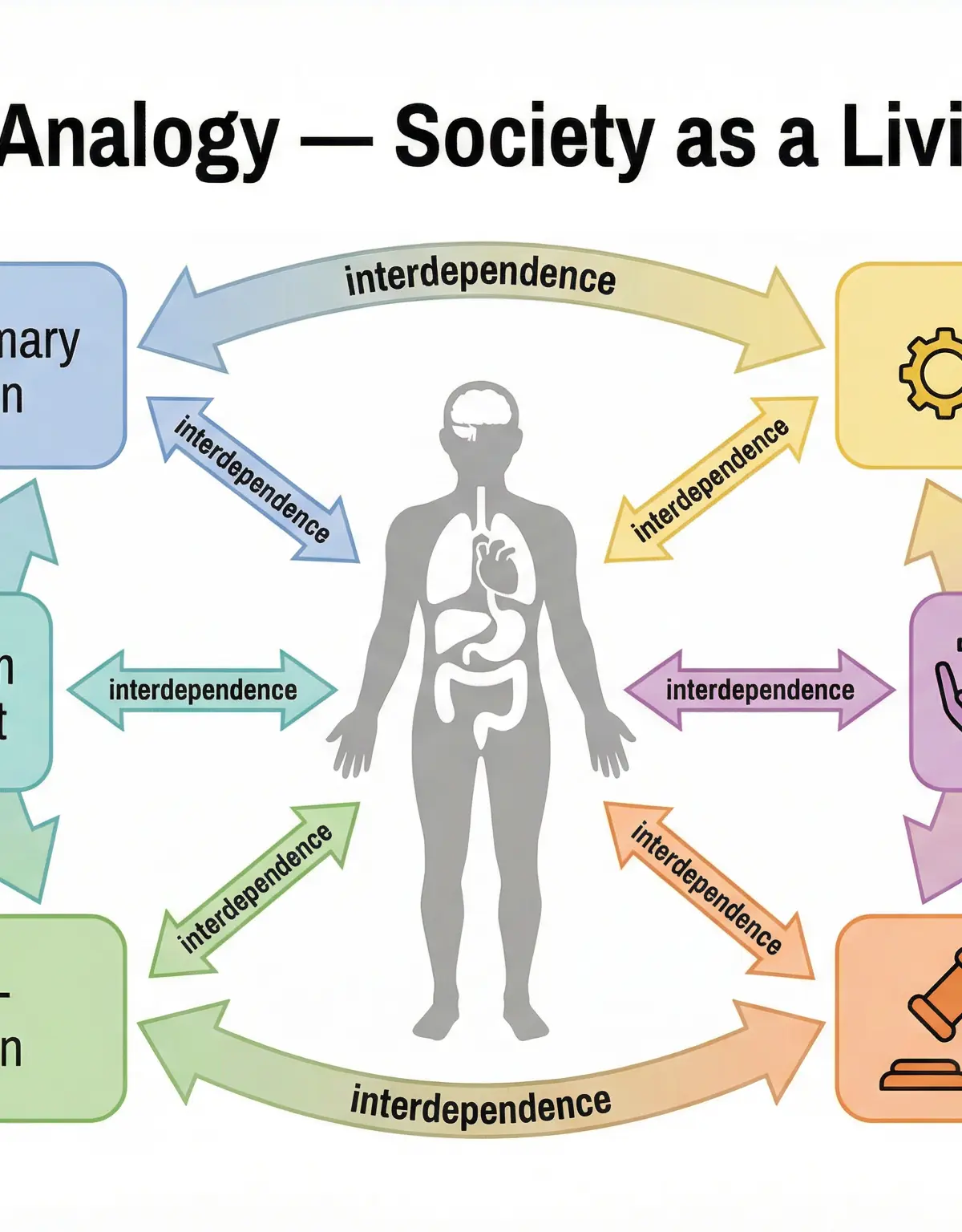
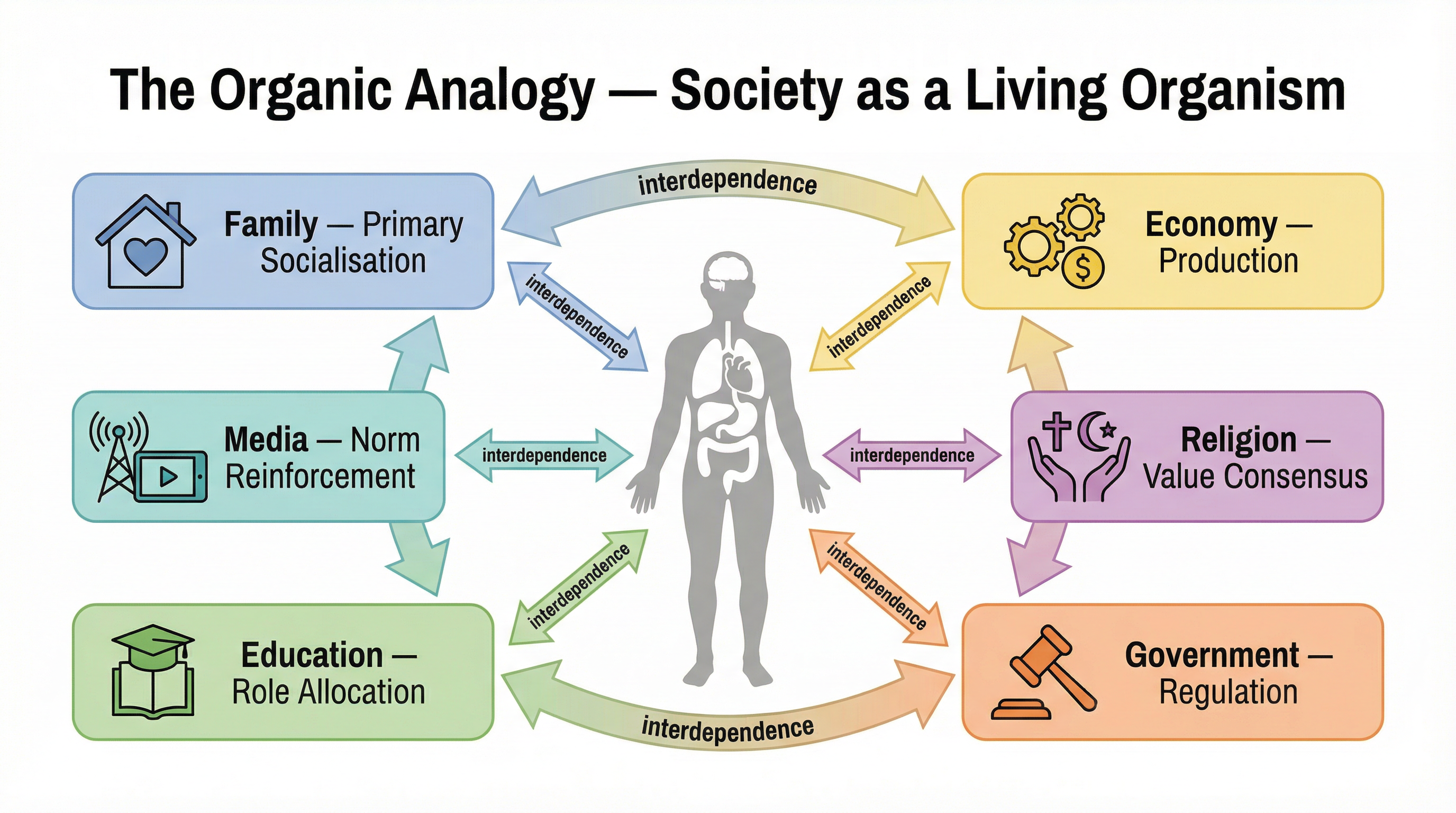
What it is: The 'Organic Analogy' is a central metaphor in functionalism, developed by Émile Durkheim. It compares society to a living biological organism, like the human body. Just as the body has interdependent organs (heart, lungs, brain) that each perform a specific function to maintain the whole, society has interdependent institutions (family, education, economy) that each perform functions to maintain social order and stability.
Why it matters: This concept is crucial for demonstrating an understanding of society as a system of interconnected parts. Marks are awarded for explaining how these institutions work together to create social solidarity and prevent 'anomie' (normlessness). Candidates must treat this as a theoretical metaphor, not a literal fact.
Key Individuals
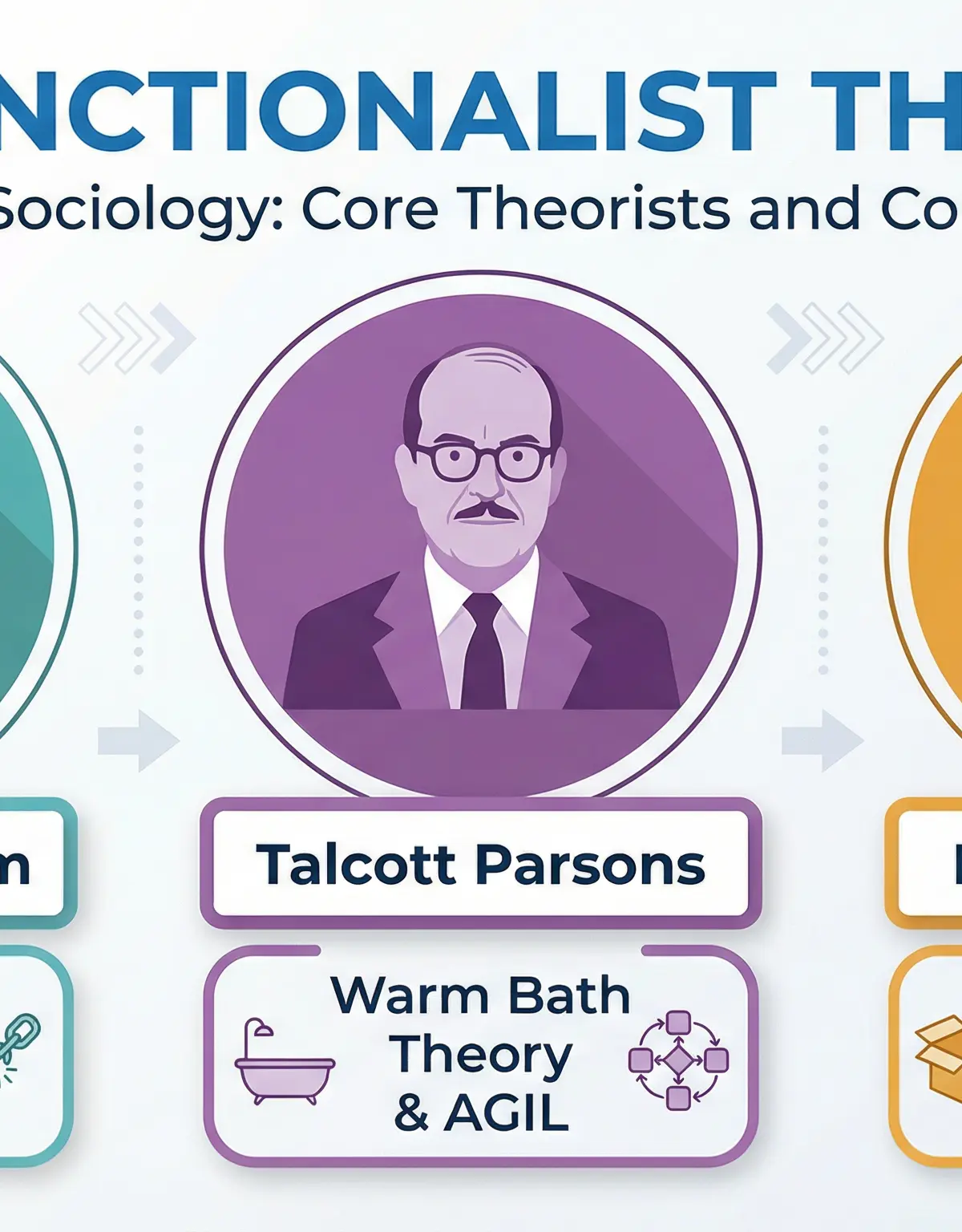
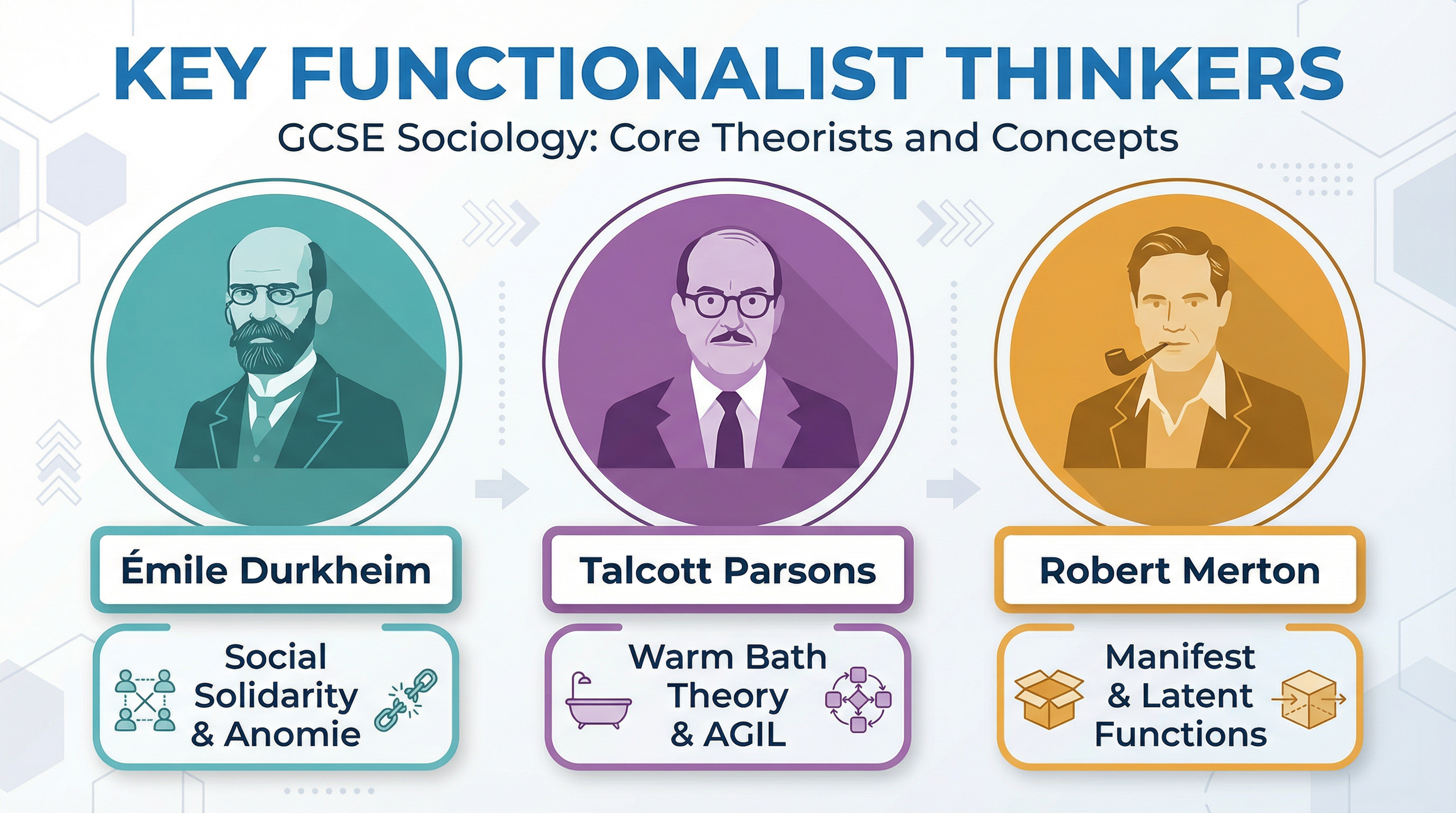
Émile Durkheim
Role: Founding father of functionalism.
Key Concepts: Social Solidarity, the feeling of community and shared identity that binds society together. Collective Conscience, the shared beliefs and moral attitudes that operate as a unifying force. Anomie, a state of normlessness or social breakdown.
Impact: Durkheim established the idea that society is a powerful force that shapes individual behaviour. His work on social integration and the functions of institutions like religion and law is fundamental to the entire perspective.
Talcott Parsons
Role: Developed and systemised functionalist theory in the mid-20th century.
Key Concepts: Functional Fit, the idea that the type of family that 'fits' society changes over time (e.g., from extended to nuclear). Primary Socialisation, the process of learning norms and values within the family. Stabilisation of Adult Personalities (the 'Warm Bath Theory'), the idea that the family provides emotional security for adults.
Impact: Parsons applied functionalist ideas specifically to the family and education, providing a detailed framework for how these institutions serve society's needs. His work is often the focus of application and evaluation questions.
Robert Merton
Role: A student of Parsons who refined and critiqued earlier functionalist ideas.
Key Concepts: Manifest Functions, the recognised and intended consequences of any social pattern. Latent Functions, the unrecognised and unintended consequences. Dysfunction, social patterns that may disrupt the operation of society.
Impact: Merton's work introduced a more critical dimension to functionalism. By acknowledging that institutions can have unintended or even negative consequences, he provided a more nuanced and realistic version of the theory, which is useful for AO3 evaluation.
Visual Resources
2 diagrams and illustrations
Interactive Diagrams
1 interactive diagram to visualise key concepts
Conceptual Flow Outline
A diagram showing the relationship between value consensus and key social institutions in functionalist theory.
Worked Examples
3 worked examples — open one to explore the question and available guidance.
Practice Questions
Try the question, then reveal an answer plan or example response
Describe two ways in which the education system performs role allocation. (4 marks)
Hint: Think about how schools sort students into different groups or pathways.
Explain the concept of the 'organic analogy'. (6 marks)
Hint: Remember to explain both parts of the analogy: the organs and the body, and the institutions and society.
Evaluate the view that the nuclear family is essential for a stable society. (12 marks)
Hint: Start with the functionalist view (Parsons) and then bring in critiques from feminists, Marxists, and postmodernists.
To what extent do conflict theories successfully challenge the functionalist view of society? (24 marks)
Hint: This is a synoptic question. Explain the core ideas of functionalism (consensus, harmony) and then show how Marxism (class conflict) and Feminism (patriarchal conflict) directly challenge these ideas.
Explain the difference between manifest and latent functions, using an example. (6 marks)
Hint: Use Robert Merton's concepts and apply them to an institution like education or religion.
Exam technique
How to turn what you know into marks
How to approach the question
Underline the key terms and command words in the question. Identify the topic (e.g., family, education) and the sociological perspective (e.g., functionalism).
How to structure your answer
- Essay questions
- Introduction setting out your argument. 2-3 points explaining the theory. 2-3 points evaluating the theory (using conflict perspectives). A strong, justified conclusion.
- Source questions
- Not applicable for Sociology GCSE.
- Explain questions
- Use the PEEL structure: Point, Explanation, Evidence (Theorist/Example), Link back to the question.
Timing
Approximately 1 minute per mark. For a 12-mark question, spend 12-15 minutes. For a 24-mark essay, allocate 25-30 minutes.
Common pitfalls
- Describing without analysing or evaluating.
- Forgetting to use sociological theorists and concepts.
- Presenting the Organic Analogy as a literal fact.
- Ignoring the 'rose-tinted' critique of functionalism.
What the command words want
- Explain
- Give reasons for something, using the PEEL structure.
- Describe
- State two things and explain each one in a separate paragraph.
- Evaluate
- Assess the strengths and weaknesses of a theory or argument, using evidence from other perspectives.
- How far do you agree
- A balanced argument with evidence for and against, leading to a clear judgement in the conclusion.
Watch or listen (optional)
Test your understanding of Functionalism
Active recall beats re-reading. Take an instant quiz now to test what you’ve learned and lock it into long-term memory.
7 days Premium · Then the free plan continues · No card, no charge