OCR · GCSE · Sociology
Interactionism and Social Action
This study guide delves into Interactionism, a key 'social action' theory for OCR GCSE Sociology. It explores how individuals build society through micro-level interactions, focusing on core concepts like labelling theory and the self-fulfilling prophecy, which are crucial for hitting top mark bands.
- 6 min read
- 3 worked examples
- 3 practice questions
- 6 key terms
Check what you remember
Read the wording for your board, then hide it and explain Social Action Theory in your own words. Rough notes are fine. This is a self-check, with no mark or grade.
Reference: OCR
A sociological perspective that focuses on the meaningful actions of individuals and the interpretations they give to their social world. Also known as a micro-approach.
Study Notes

Overview
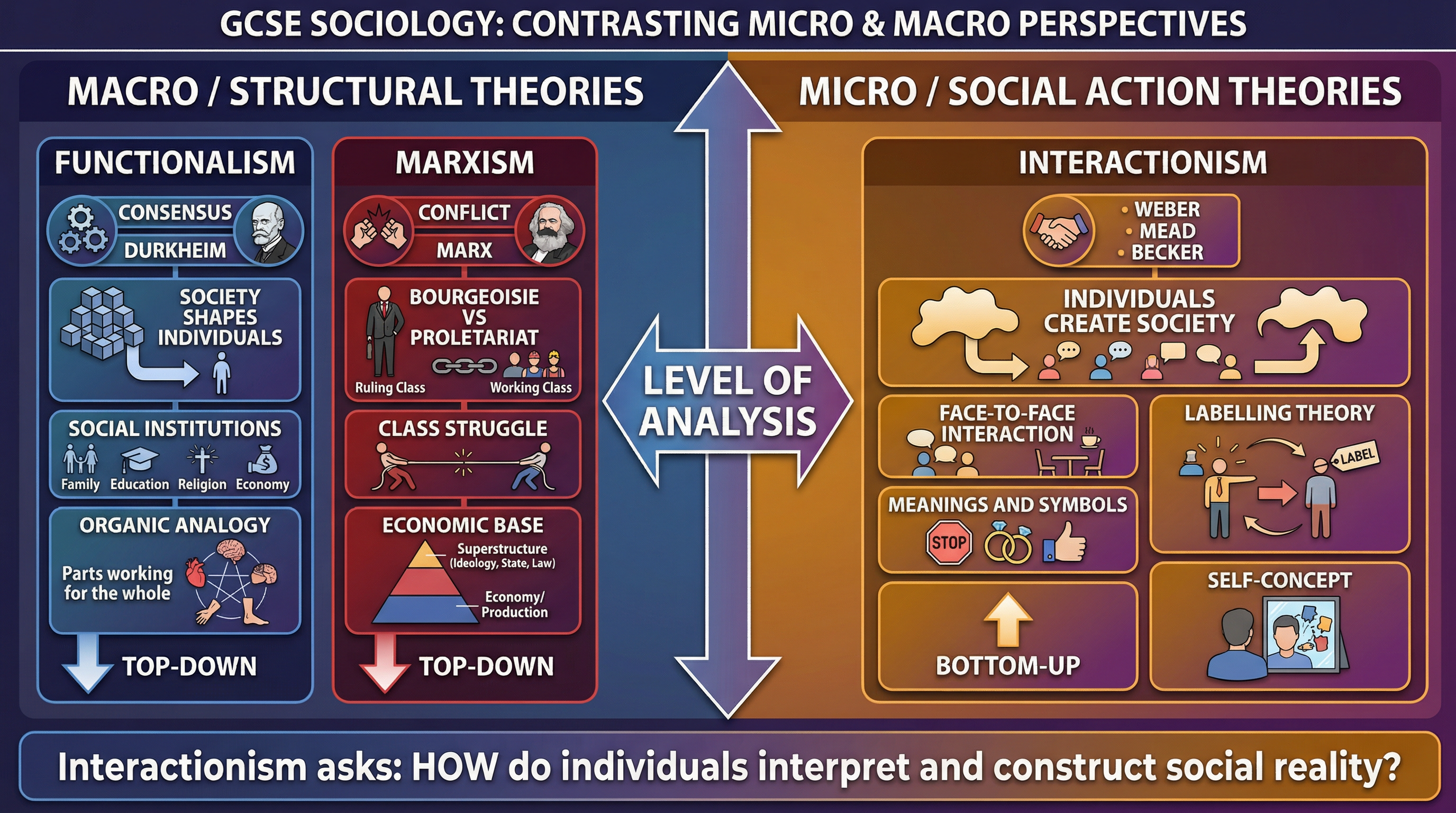
Interactionism is a major sociological perspective that candidates must understand as a 'social action' or 'micro' theory. Unlike structural theories such as Functionalism and Marxism, which see society as a large-scale system that determines individual behaviour, Interactionism focuses on the small-scale, face-to-face interactions between individuals. It argues that society is not a rigid structure but is actively created and re-created through the daily negotiations and interpretations of its members. For the OCR exam, candidates are expected to analyse how concepts like labelling, the self-fulfilling prophecy, and the 'looking-glass self' explain social outcomes, particularly in the contexts of education and crime. A key skill is the ability to contrast this bottom-up perspective with top-down structuralist views, evaluating the strengths and weaknesses of each. Credit is given for using specific studies (e.g., Becker, Rosenthal and Jacobson) to support theoretical points and for applying concepts to real-world scenarios.
Key Concepts & Thinkers
Social Action vs. Social Structure
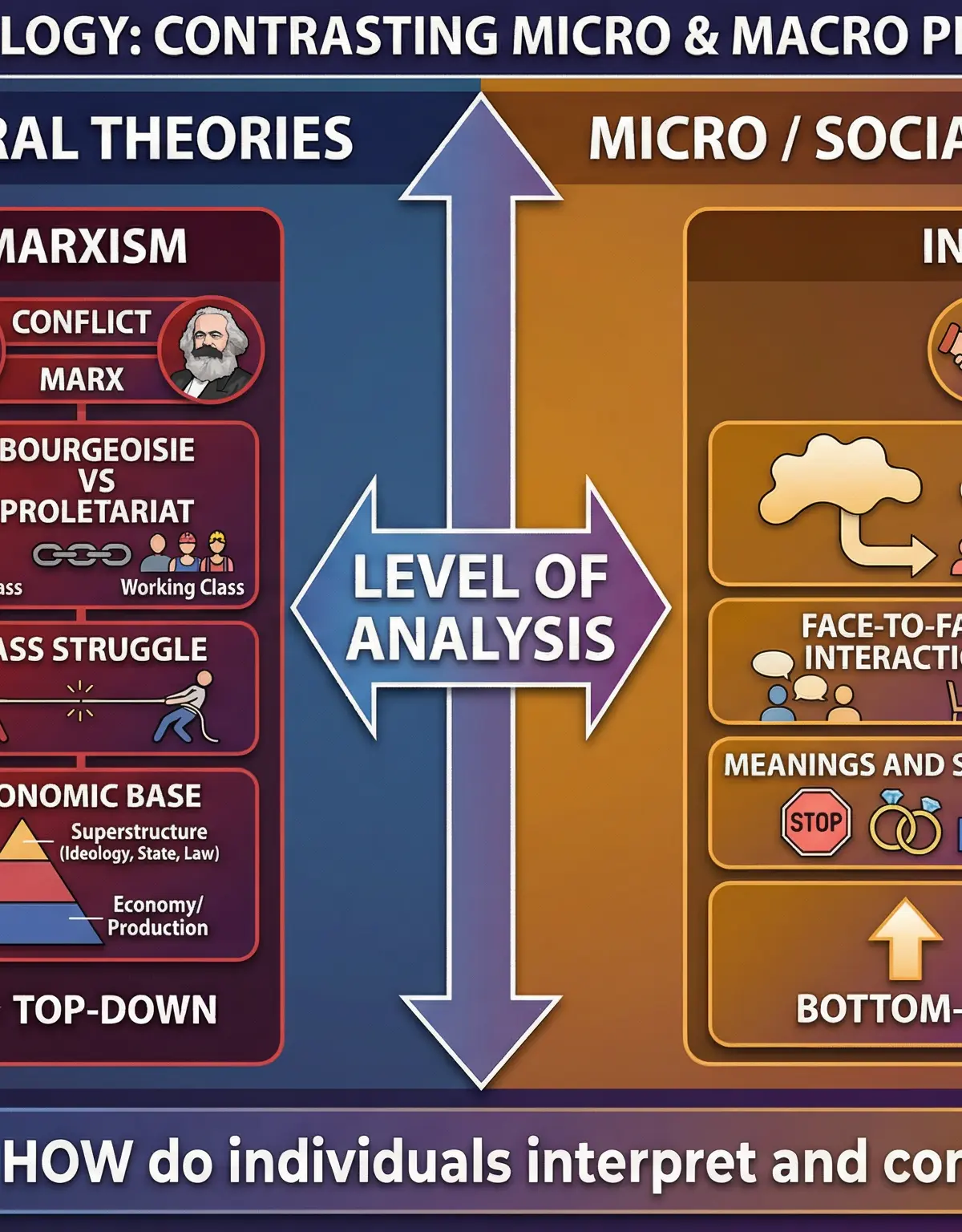
What it is: This is the fundamental dividing line in sociology. Structural theories (Functionalism, Marxism) see society as a powerful force dictating our lives (a 'top-down' or 'macro' approach). Social action theories, like Interactionism, argue that individuals and their interpretations create society (a 'bottom-up' or 'micro' approach).
Why it matters: Examiners expect you to use this distinction to frame your analysis. Starting an essay with 'Interactionism is a micro-level, social action theory that contrasts with macro, structuralist perspectives...' immediately shows a high level of understanding.
Labelling Theory (Howard Becker)
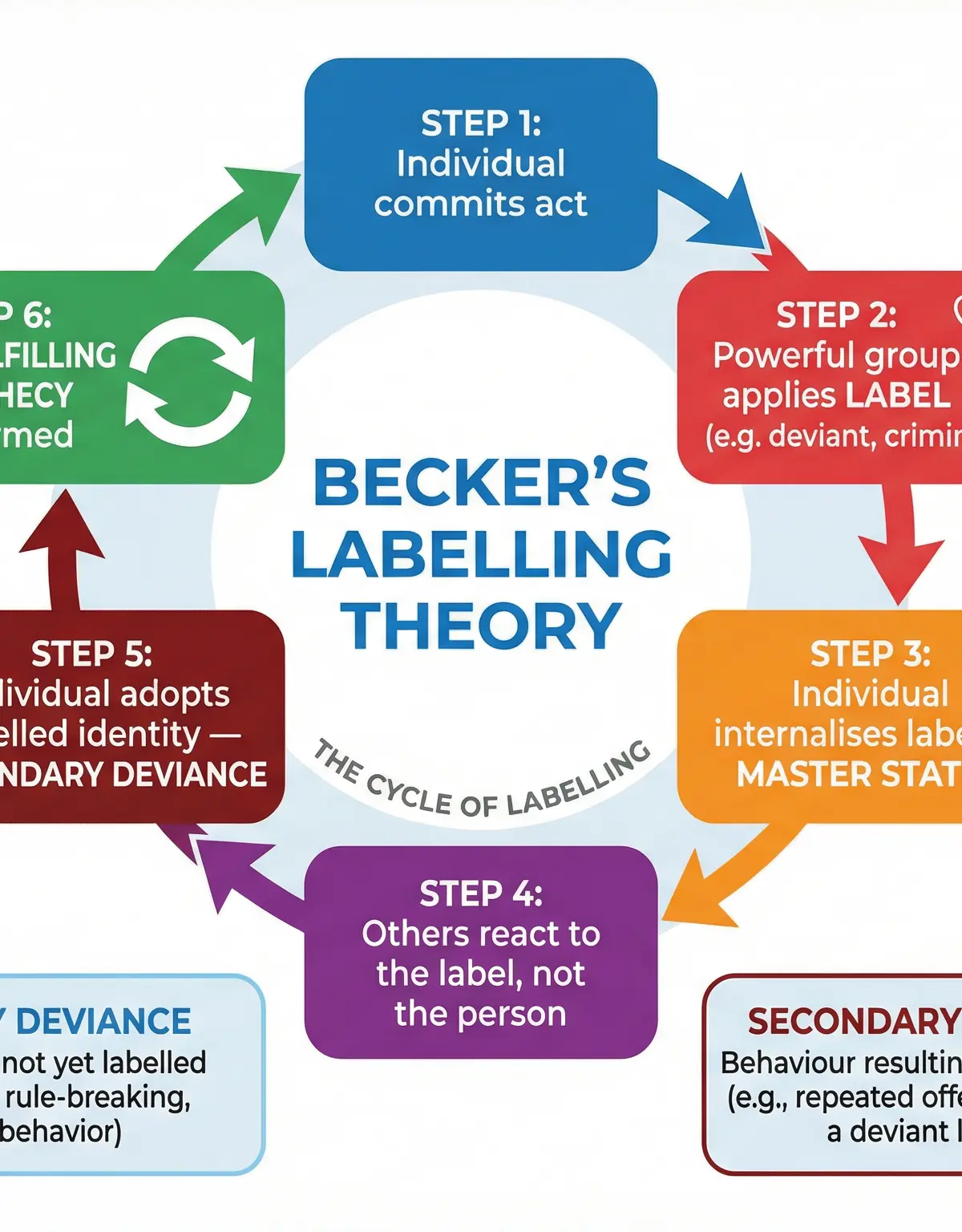
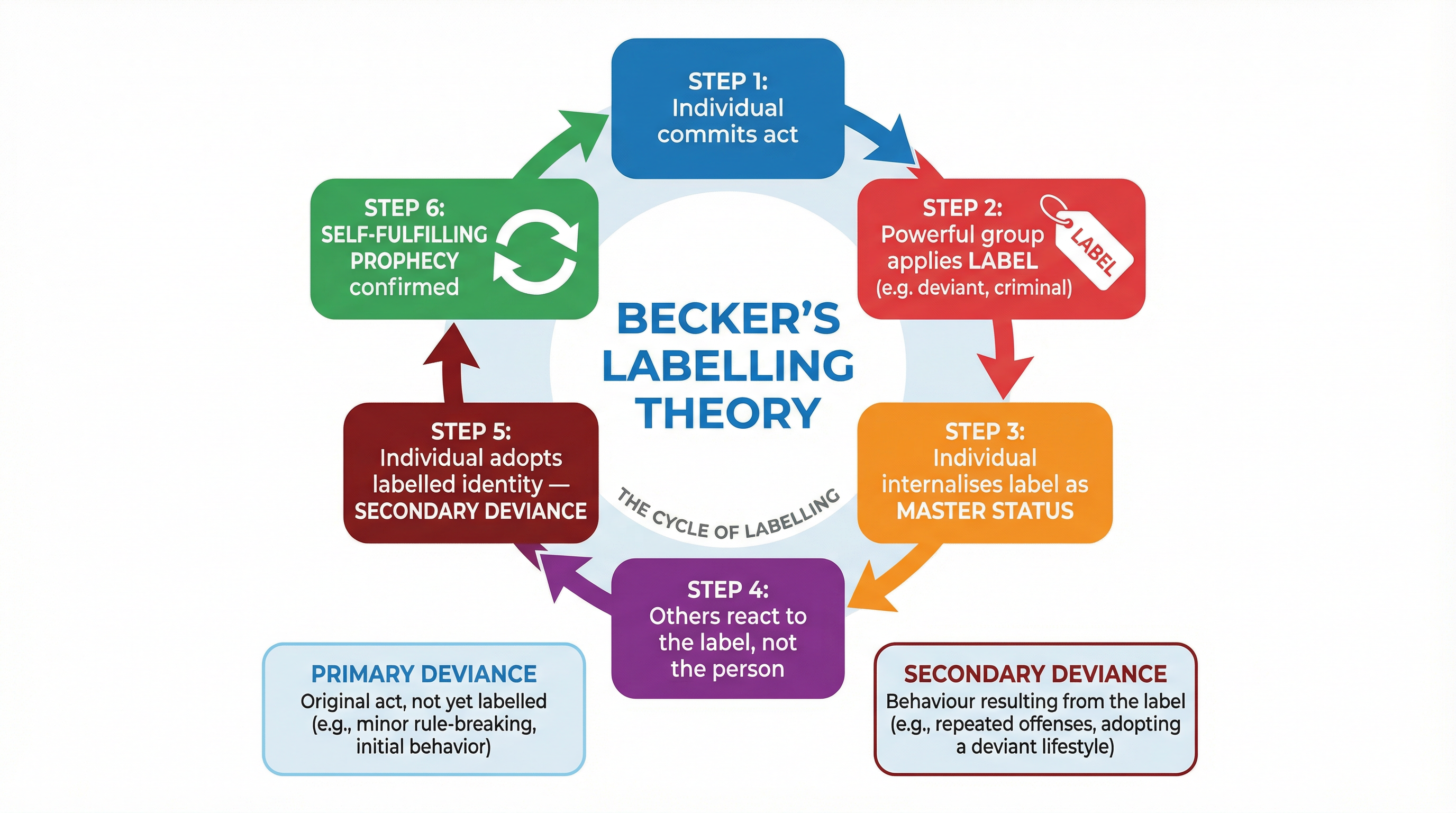
Key Idea: Becker argued that no act is inherently deviant. An act only becomes deviant when a powerful social group successfully applies a 'label' to an individual or group. The label, not the act itself, is what matters most.
Why it matters: This is central to understanding the social construction of crime. For example, police may label working-class youth as 'troublemakers' and middle-class youth engaging in the same behaviour as 'letting off steam'. This differential labelling can lead to different outcomes.
Specific Knowledge: Candidates must know Howard Becker and his book Outsiders. He famously stated: "Deviancy is not a quality of the act the person commits, but rather a consequence of the application by others of rules and sanctions to an 'offender'."
The Self-Fulfilling Prophecy (Rosenthal & Jacobson)
Key Idea: A prediction that, by the very fact of it being made, comes true. When a label is applied to someone, others treat them according to that label. The individual then internalises this label and starts to act in a way that confirms it.
Why it matters: This is a powerful concept for explaining differential achievement in education. Rosenthal and Jacobson's (1968) study, Pygmalion in the Classroom, showed that when teachers were told certain students were 'spurters', those students (though chosen at random) made greater academic progress because the teachers' expectations and behaviour towards them changed.
Specific Knowledge: Name the study Pygmalion in the Classroom and link it to teacher expectations creating a self-fulfilling prophecy for pupils.
Second-Order Concepts
Causation
Interactionism argues that the causes of social phenomena like crime or educational failure are not simply down to structural factors like poverty or class. Instead, they are caused by the meanings and interpretations that people hold. For example, the 'cause' of a student's failure might be the negative label applied by a teacher, which triggers a self-fulfilling prophecy. The long-term cause is the power of some groups to make their labels stick.
Consequence
The consequences of labelling can be profound. An individual can be rejected by social groups, struggle to find employment, and may develop a 'master status' where the label (e.g., 'criminal') dominates all other aspects of their identity. This can lead to the formation of deviant subcultures where individuals who share a label group together, further reinforcing their deviant identity (secondary deviance).
Change & Continuity
Interactionism shows how social reality is constantly changing as individuals negotiate and renegotiate meanings. However, it also explains continuity: once labels become widely accepted and institutionalised (e.g., in official statistics), they can be very resistant to change. The power structures that determine who gets to do the labelling often remain stable over time.
Significance
The significance of Interactionism is its challenge to deterministic theories. It reminds us that humans are active, thinking beings, not just puppets of society. It provides a vital tool for understanding how official statistics on crime and deviance are socially constructed and why certain groups are consistently over-represented in them. However, its significance is limited by its failure to explain where the power to label comes from in the first place (a criticism Marxists would make).
Source Skills
When given a source (e.g., a news article, a diary entry, an observation transcript), you must act as a detective. First, identify the Interactionist concepts at play. Does the source show someone being labelled? Does it describe how someone's self-concept has been affected? Explicitly use the vocabulary: "This source illustrates the concept of a 'master status' because the individual is only seen as their criminal record...". Consider the provenance: who created this source and why? A police report is written for a different purpose than a personal diary, and this affects its usefulness for an enquiry into the lived experience of deviance.
Visual Resources
2 diagrams and illustrations
Interactive Diagrams
1 interactive diagram to visualise key concepts
Conceptual Flow Outline
The process of a deviant career according to Labelling Theory.
Worked Examples
3 worked examples — open one to explore the question and available guidance.
Practice Questions
Try the question, then reveal an answer plan or example response
Describe two features of Interactionist theory. (4 marks)
Hint: Think about the level of analysis and the focus of the theory.
Explain how labelling in schools can affect pupil achievement. (6 marks)
Hint: Use the concept of the self-fulfilling prophecy and a named study.
Evaluate the view that Interactionist approaches are the most useful for understanding crime and deviance. (12 marks)
Hint: This is an evaluation question. Argue for Interactionism, then bring in a counter-argument from another perspective (e.g., Marxism or Functionalism).
Exam technique
How to turn what you know into marks
How to approach the question
1. **Identify the Command Word**: 'Explain', 'Discuss', 'Evaluate'. This tells you what to do. 2. **Identify the Topic**: What part of the specification is this about? (e.g., Labelling). 3. **Identify the Focus**: What is the specific angle? (e.g., 'in education', 'in the media').
How to structure your answer
- Essay questions
- A balanced argument is essential. Use one perspective (e.g., Interactionism) to argue one side, and another (e.g., Marxism) for the counter-argument. Always finish with a justified conclusion that weighs up the evidence.
- Source questions
- Use the source directly, then add your own knowledge. Quote or paraphrase the source and say 'This shows...', then add 'A sociologist like Becker would call this...'.
- Explain questions
- PEE: Point, Explain with sociological language, Example (using a study or real-world case).
Timing
Approximately 1.5 minutes per mark. For a 12-mark question, this means around 18 minutes.
Common pitfalls
- Confusing Interactionism with Functionalism because both sometimes discuss social roles.
- Describing studies without explaining what they show or linking them to the question.
- Failing to evaluate by just listing different theories without comparing them.
What the command words want
- Explain
- Provide reasons for something happening, using cause-and-effect language and sociological concepts.
- Describe
- Give a detailed account of two features or characteristics.
- How useful
- Analyse the source's content (what it says) and its provenance (who made it and why) to judge its strengths and limitations for a specific enquiry.
- Discuss how far you agree
- Present both sides of an argument (arguments for and against) and come to a reasoned judgement.
Watch or listen (optional)
Test your understanding of Interactionism and Social Action
Active recall beats re-reading. Take an instant quiz now to test what you’ve learned and lock it into long-term memory.
7 days Premium · Then the free plan continues · No card, no charge