OCR · GCSE · Sociology
Life Chances
This guide explores "Life Chances", a core OCR GCSE Sociology topic, examining how factors like class, gender, ethnicity, and age determine your opportunities in life. It's crucial for understanding the structure of inequality in modern Britain and for securing top marks by applying key sociological theories and evidence.
- 4 min read
- 3 worked examples
- 5 practice questions
- 6 key terms
Check what you remember
Read the wording for your board, then hide it and explain Life Chances in your own words. Rough notes are fine. This is a self-check, with no mark or grade.
Reference: OCR
The opportunities each individual has to improve their quality of life and achieve desirable things.
Study Notes

Overview
Life Chances, a concept pioneered by Max Weber, refers to the opportunities an individual has to improve their quality of life, access social rewards like wealth and power, and avoid negative outcomes like poverty and poor health. For the OCR GCSE Sociology exam, candidates must demonstrate a robust understanding of how social stratification—the hierarchical division of society into different groups—profoundly shapes these chances. Examiners expect a detailed analysis of the intersection between class, gender, ethnicity, and age, supported by both theoretical frameworks and empirical evidence. This involves contrasting structural explanations, such as those offered by Marxism and Feminism which see society's very fabric as unequal, with cultural explanations like the New Right, which focus on the values and behaviours of individuals. A high-scoring response will move beyond simple description to evaluate these competing perspectives, using specific data and sociological concepts to build a convincing argument.
Key Concepts & Theories
Social Stratification
What it is: The system by which society ranks categories of people in a hierarchy. This creates unequal access to resources and opportunities.
Why it matters: It's the foundation of life chances. An individual's position in the social strata is the single most important predictor of their future outcomes. Examiners expect you to use this term to frame any discussion of inequality.
Specific Knowledge: You should be able to link stratification to different dimensions of inequality: social class (occupation/income), gender, ethnicity, and age.
Weber's Theory of Life Chances
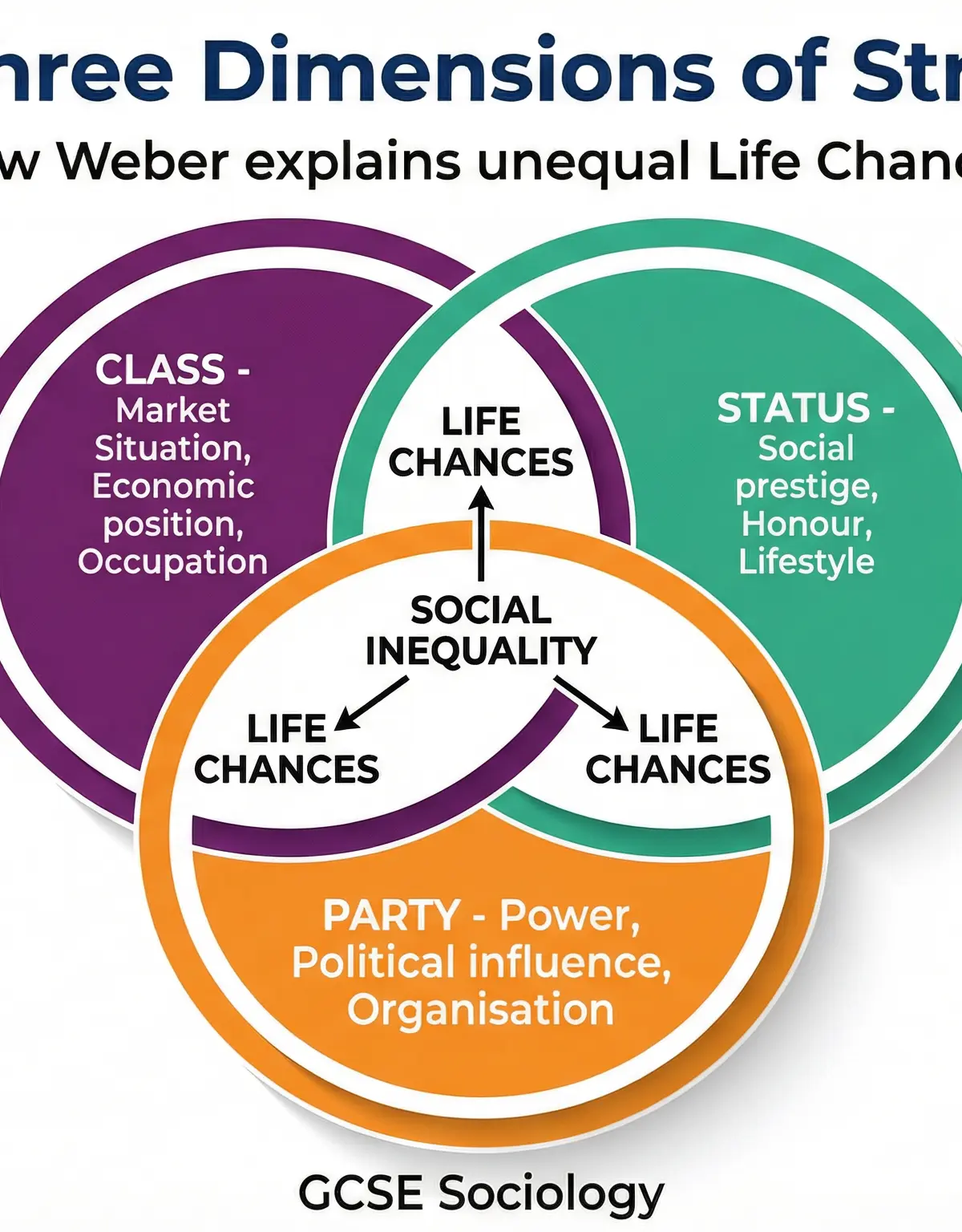
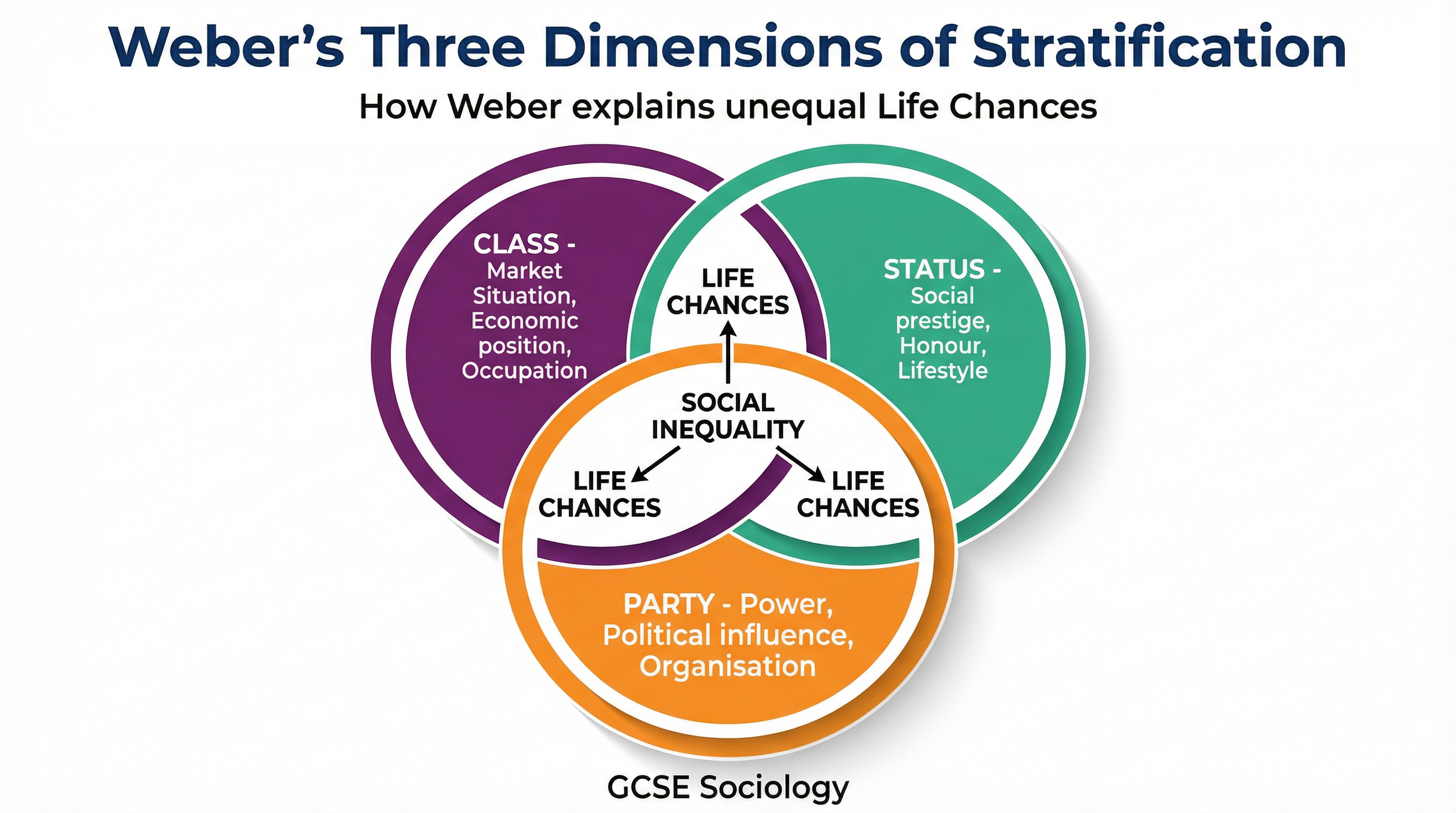
What it is: Max Weber argued that life chances are determined by a combination of three factors:
- Class: A person's economic position in society, based on their "market situation" (skills, qualifications, and occupation).
- Status: The amount of social honour or prestige a person or group has, often linked to lifestyle.
- Party: The extent to which a person can influence decision-making and exercise political power, often through groups like trade unions or political parties.
Why it matters: Weber provides a more complex model than Marx's focus on just economic class. It allows for a multi-dimensional analysis of inequality, which is essential for top marks.
Theoretical Perspectives on Inequality
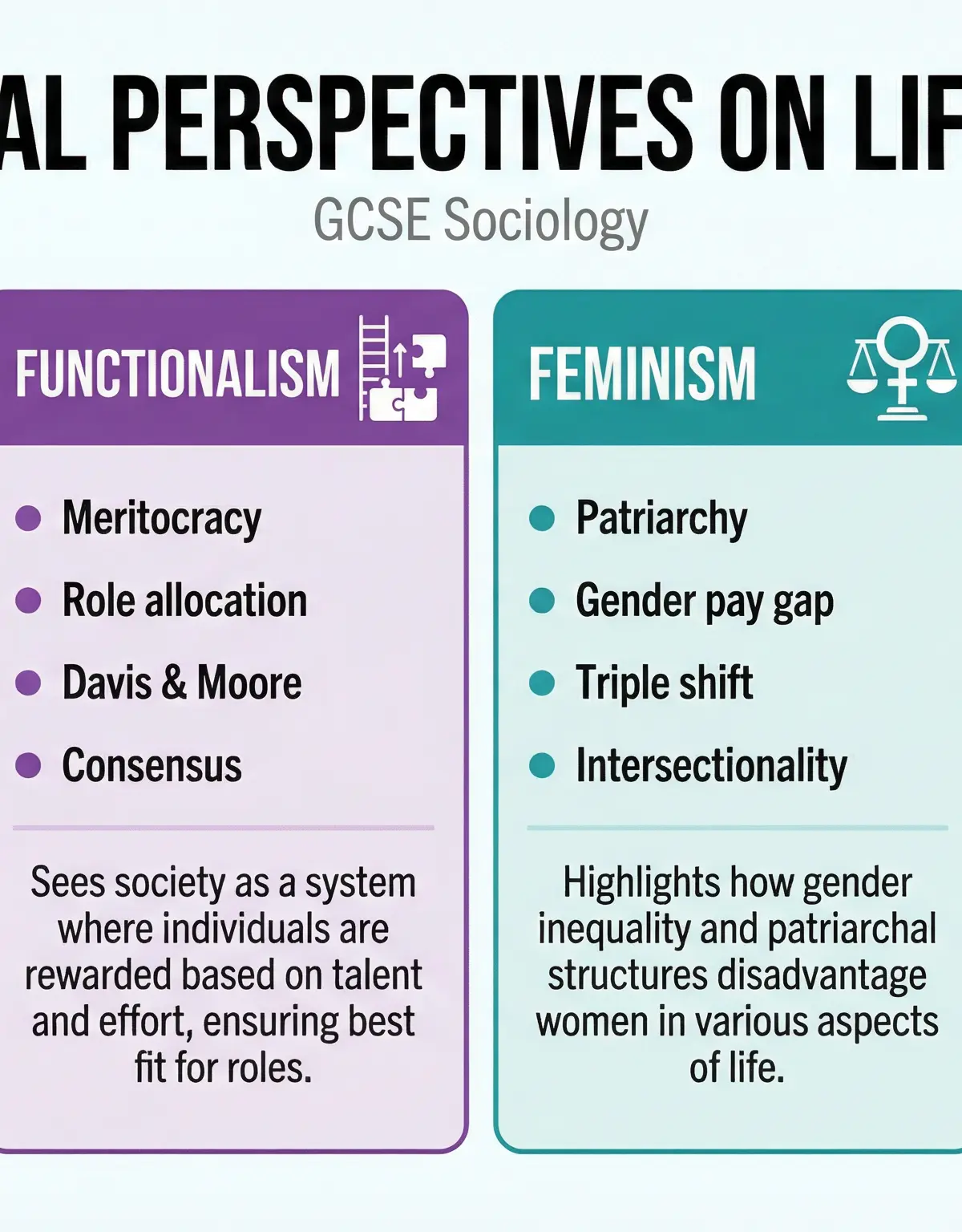
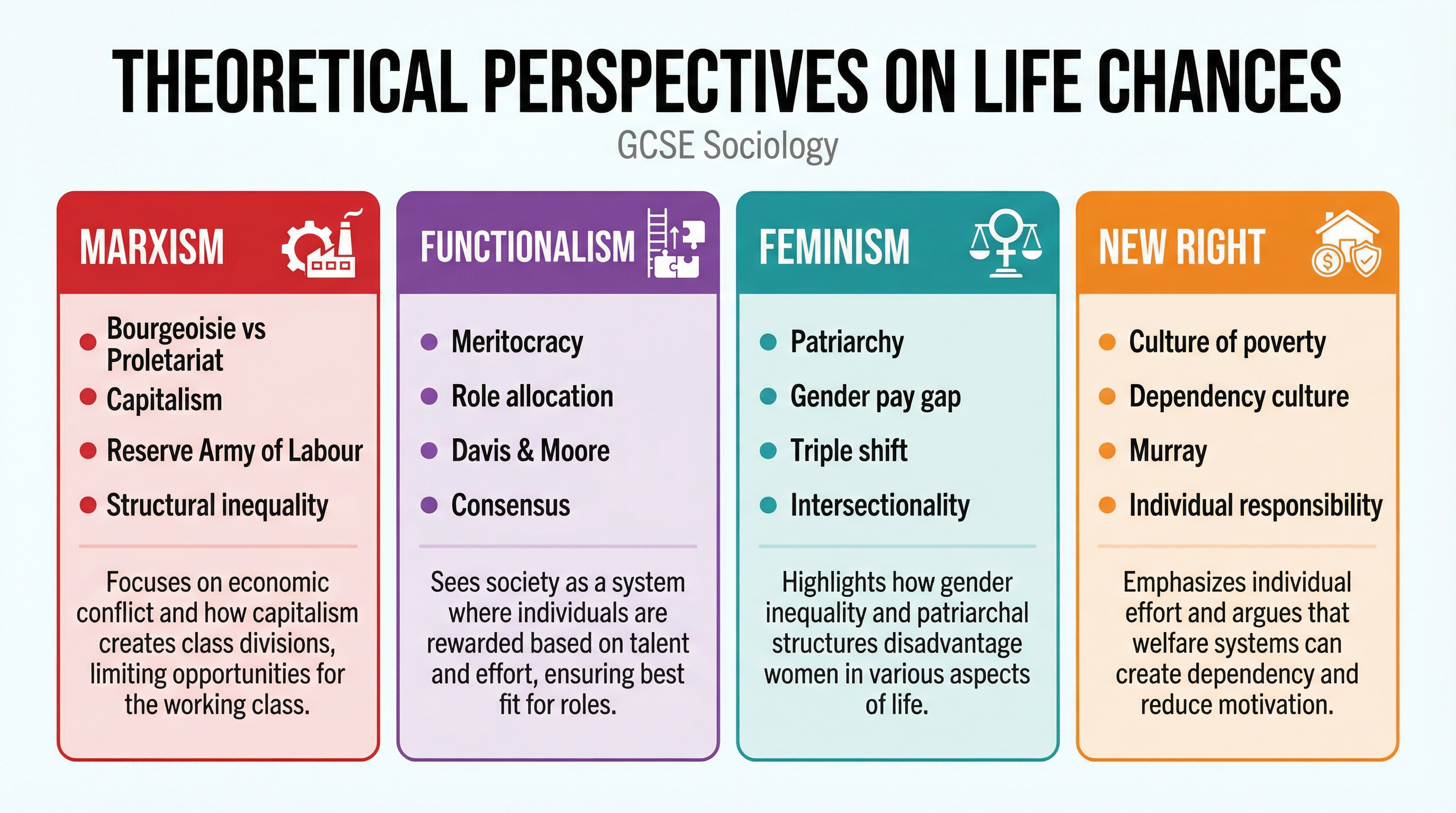
Structural Theories: These argue that inequality is built into the structure of society.
- Marxism: Sees society as a conflict between the bourgeoisie (ruling class) and the proletariat (working class). Capitalism, by its nature, exploits the proletariat, systematically limiting their life chances to the benefit of the bourgeoisie. The 'reserve army of labour' keeps wages low and workers compliant.
- Feminism: Argues that society is patriarchal, meaning it is dominated by men. This systemic bias disadvantages women in all areas of life, from the gender pay gap to the 'triple shift' (paid work, domestic work, emotional work), thereby restricting their life chances compared to men.
Cultural Theories:
- The New Right: This perspective, associated with thinkers like Charles Murray, argues that inequality is the result of cultural factors, not structural barriers. Murray famously argued that an 'underclass' exists which has a 'culture of poverty' and a 'dependency culture' on the welfare state. They subscribe to deviant norms and values (e.g., low work ethic, lone parenthood) which they pass on to their children, creating a cycle of deprivation and poor life chances.
Visual Resources
2 diagrams and illustrations
Interactive Diagrams
1 interactive diagram to visualise key concepts
Diagram could not be rendered
A timeline of key sociological thinking and evidence on inequality and life chances.
Worked Examples
3 worked examples — open one to explore the question and available guidance.
Practice Questions
Try the question, then reveal an answer plan or example response
Describe two ways in which a person's ethnicity may affect their life chances. (4 marks)
Hint: Think about specific areas like employment, housing, or the criminal justice system. Name a piece of evidence for one of them.
Explain how the New Right understands the causes of poverty. (6 marks)
Hint: Focus on culture and individual behaviour. Use the key concepts 'dependency culture' and 'underclass'.
Using sociological evidence, explain the difference between absolute and relative poverty. (8 marks)
Hint: Define both terms clearly and associate them with the correct sociologists (Rowntree and Townsend).
To what extent do structural theories provide the best explanation for gender inequalities in society? (24 marks)
Hint: This is an essay. You need to evaluate structural theories (like Feminism) against non-structural/cultural or biological arguments. Use intersectionality as a high-level evaluation point.
Explain how a sociologist might design a research project to investigate the impact of social class on health and lifestyle. (10 marks)
Hint: This is a research methods question. You need to suggest a method, explain why it's appropriate, and identify a potential challenge. Think about using official statistics or social surveys.
Exam technique
How to turn what you know into marks
How to approach the question
Break down the question. Identify the command word (e.g., 'Explain', 'Evaluate'), the key sociological topic (e.g., 'gender'), and the focus (e.g., 'life chances'). Plan your points before you start writing.
How to structure your answer
- Essay questions
- A balanced debate is essential. Introduction setting out the argument. Two to three paragraphs for one side of the debate. Two to three paragraphs for the counter-argument. A conclusion that weighs the evidence and provides a clear, justified judgement.
- Source questions
- Use the C-P-L-J method: Analyse the Content, then the Provenance (who made it and why), identify its Limitations, and make a final Judgement.
- Explain questions
- Use the PEEL structure: Point, Evidence (sociological theory or empirical data), Explanation (how the evidence supports the point), Link back to the question.
Timing
Approximately 1.5 minutes per mark. For a 24-mark essay, this means around 35-40 minutes.
Common pitfalls
- Relying on common sense instead of sociological concepts.
- Making assertions without evidence (e.g., just saying 'racism exists' without citing a study like the Lammy Review).
- Describing theories without applying them to the specific question.
- In essays, presenting two arguments side-by-side without making them 'debate' each other.
- Forgetting to write a conclusion in long-answer questions.
What the command words want
- Describe
- Give a detailed account. Two developed points are usually required.
- Explain how/why
- Provide a detailed account with reasons. Use causal language ('this leads to...', 'as a result...'). You must apply sociological concepts and theories.
- Evaluate / To what extent do you agree
- This requires a debate. You must consider both sides of the argument and come to a justified conclusion. This is the highest-tariff command word.
Watch or listen (optional)
Test your understanding of Life Chances
Active recall beats re-reading. Take an instant quiz now to test what you’ve learned and lock it into long-term memory.
7 days Premium · Then the free plan continues · No card, no charge