OCR · GCSE · Sociology
Marxism
This study guide provides a comprehensive overview of Marxism for OCR GCSE Sociology students. It delves into the core concepts of class struggle, the means of production, and the base-superstructure model, equipping candidates with the necessary knowledge and skills to excel in their exams.
- 7 min read
- 3 worked examples
- 5 practice questions
- 6 key terms
Check what you remember
Read the wording for your board, then hide it and explain Bourgeoisie in your own words. Rough notes are fine. This is a self-check, with no mark or grade.
Reference: OCR
The ruling class in a capitalist society who own the means of production.
Study Notes
Overview
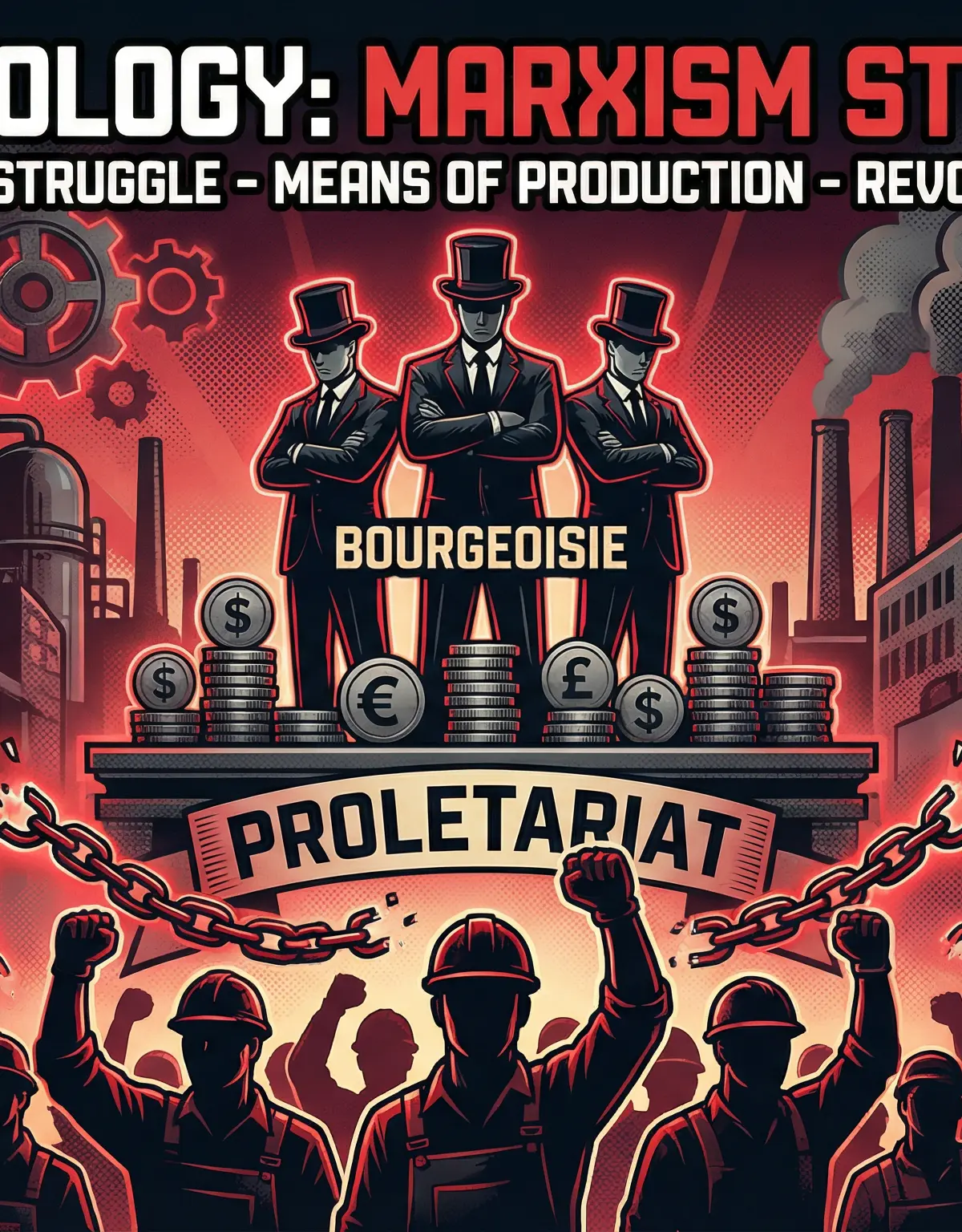
Marxism is a structural conflict theory developed by Karl Marx and Friedrich Engels. It is a cornerstone of the OCR J204 Sociology specification and a critical lens for understanding social inequality. Examiners expect candidates to demonstrate a firm grasp of its core tenets: the division of society into the bourgeoisie (the ruling class who own the means of production) and the proletariat (the working class who sell their labor), the inherent conflict between these classes, and the role of the economic base in shaping the superstructure of society. This guide will equip you with the detailed knowledge of key concepts, relevant sociologists, and the evaluation skills needed to achieve high marks. You will learn how to apply Marxist theory to the family, education, crime, and social stratification, and how to critically assess its strengths and weaknesses against other sociological perspectives.
Key Concepts & Developments
The Base-Superstructure Model
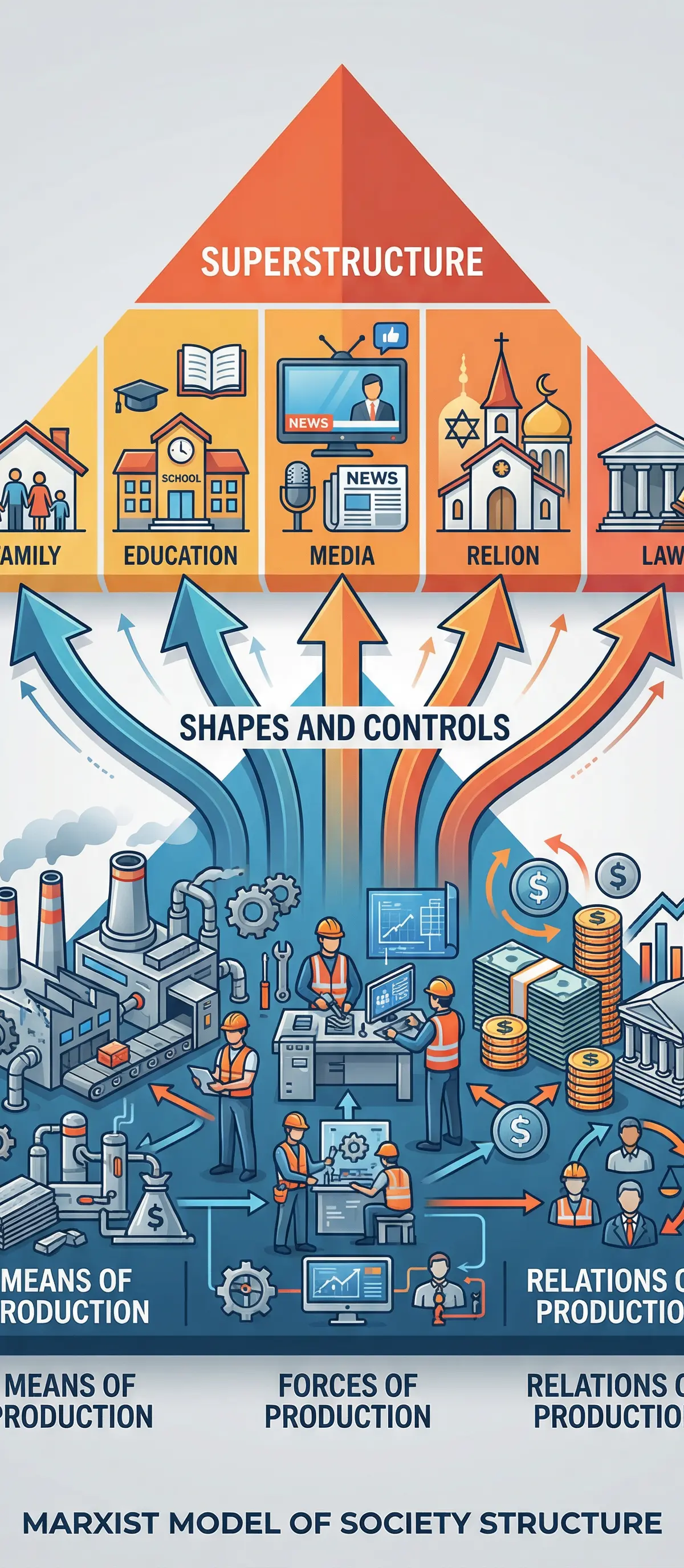
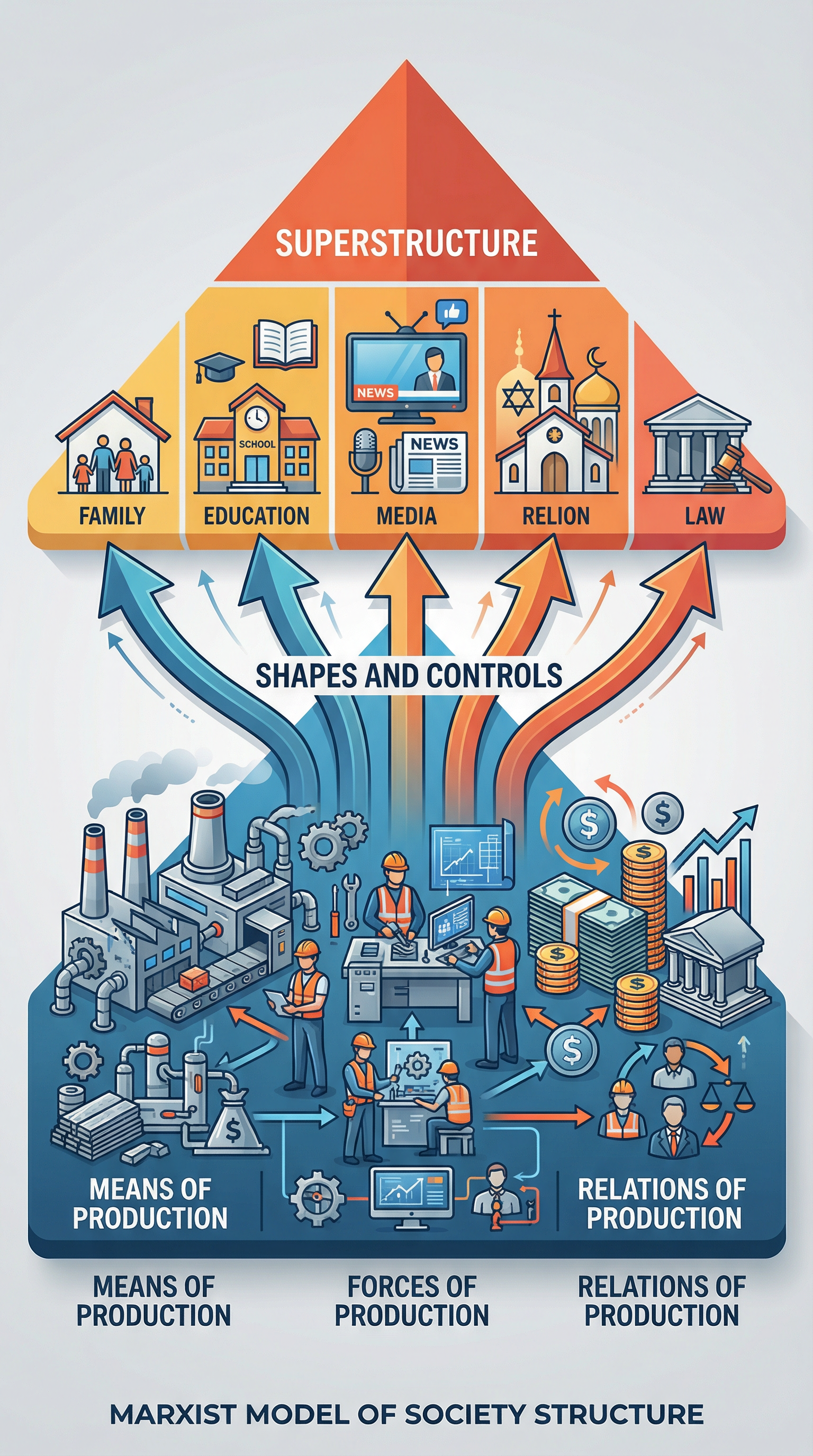
What it is: Marx argued that the economic system of a society, which he termed the infrastructure or economic base, determines the shape of all other social institutions, which he called the superstructure. The base consists of the means of production (factories, land, technology) and the relations of production (the relationship between those who own the means of production and those who do not).
Why it matters: For your exam, this is a foundational concept. You must be able to explain that the superstructure (family, education, media, law, religion) serves to maintain and legitimize the economic base. For example, the education system socializes children into accepting hierarchy and inequality, thus reproducing the conditions necessary for capitalism to thrive. Credit is given for candidates who can clearly link the base to the superstructure with specific examples.
Class Conflict and Exploitation
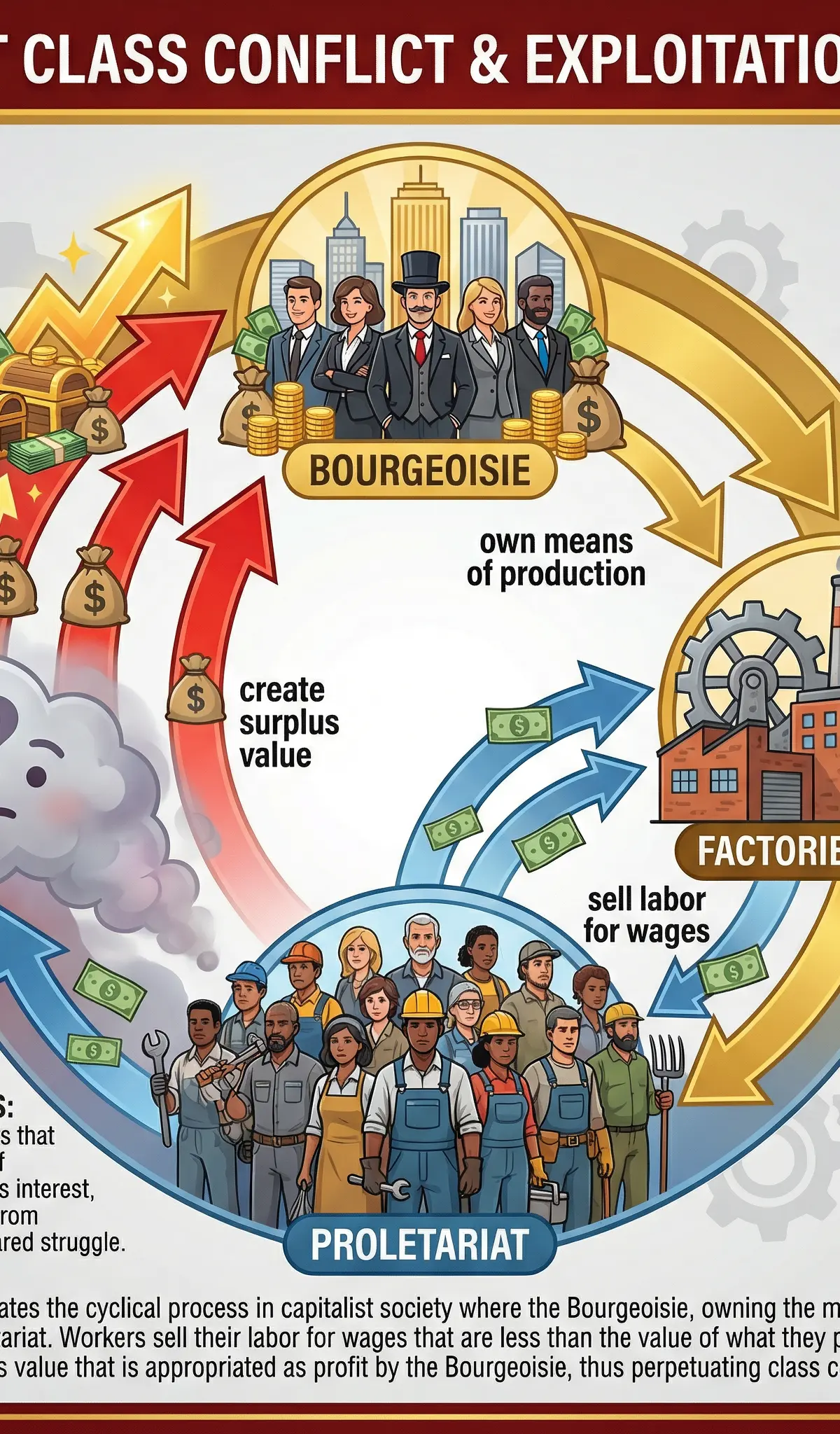
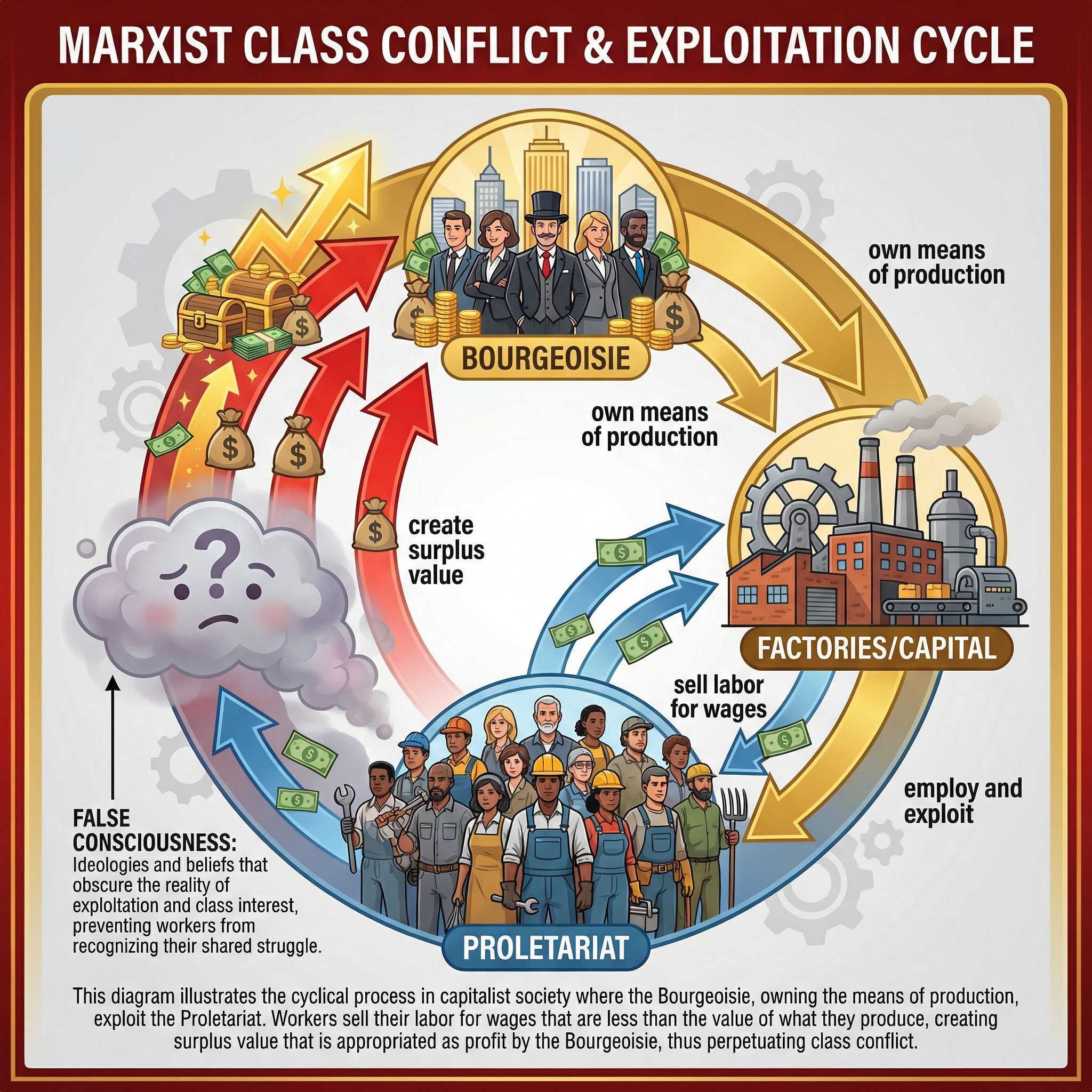
What it is: Marxism is a conflict theory. It posits that society is in a state of perpetual conflict due to competition for limited resources. In a capitalist society, this conflict is between the bourgeoisie and the proletariat. The bourgeoisie exploit the proletariat by paying them a wage that is less than the value of the goods they produce. This difference, known as surplus value, is the source of the bourgeoisie's profit.
Why it matters: This concept is central to any question on social class or inequality. Candidates should be able to define exploitation and surplus value precisely. High-level responses will explain how this exploitation leads to alienation, where workers feel disconnected from their labor, the products they make, their fellow workers, and their own human potential.
Ideology and False Class Consciousness
What it is: If the proletariat are being exploited, why don't they overthrow the bourgeoisie? Marx's answer is ideology. The ruling class control the institutions of the superstructure, which they use to spread a dominant ideology that justifies the status quo. This creates false class consciousness, a state in which the proletariat are unaware of their own exploitation and accept the capitalist system as fair and natural.
Why it matters: This is a key concept for AO2 (application) and AO3 (evaluation). You can apply it to the media, which often portrays the wealthy as deserving and the poor as lazy, or to religion, which Marx called the “opium of the people” for its role in promising a reward in the afterlife for suffering on Earth. To evaluate, you can contrast this with the idea that we live in a meritocracy.
Application to Social Institutions
The Family
Key Thinker: Eli Zaretsky
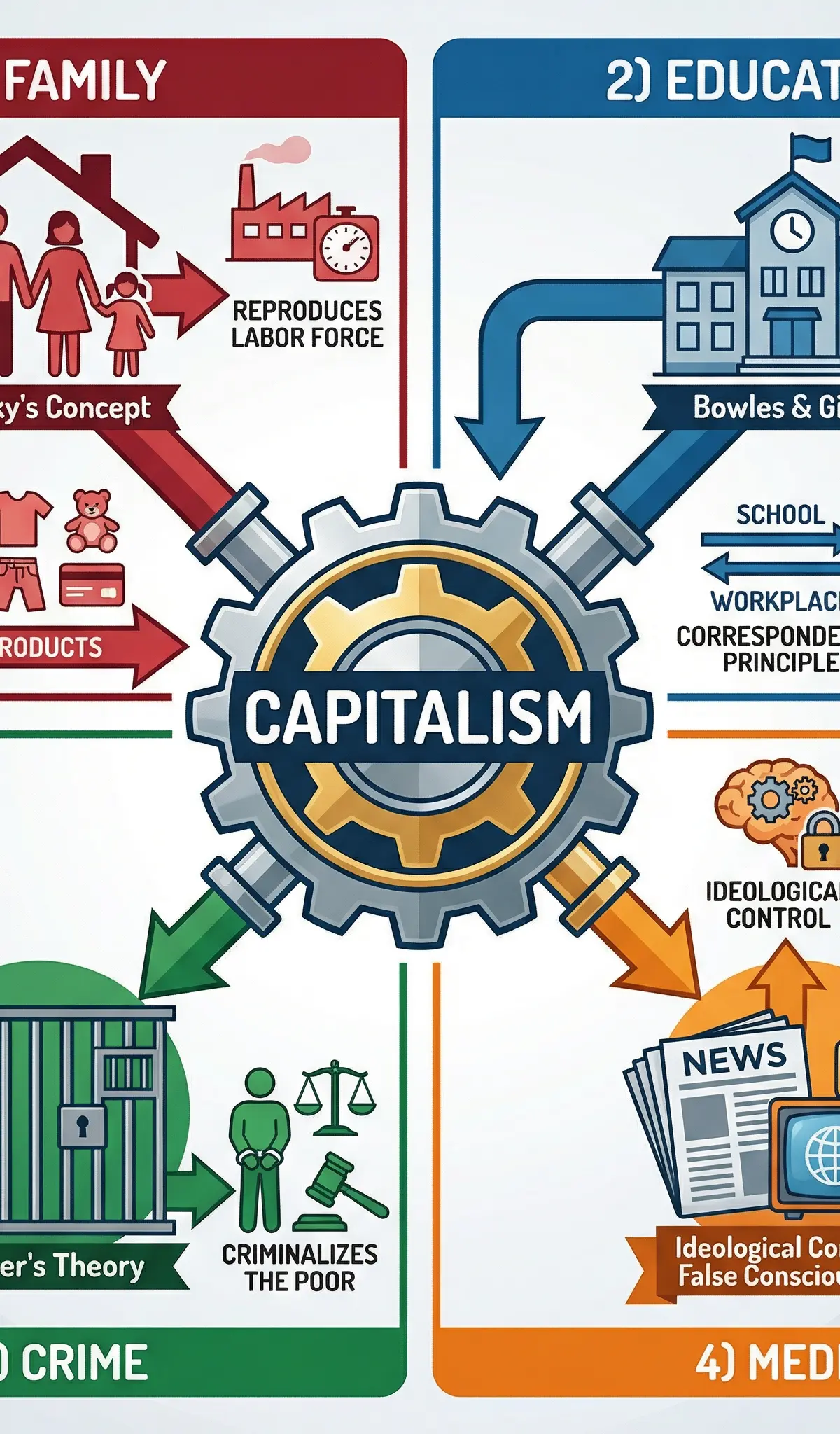
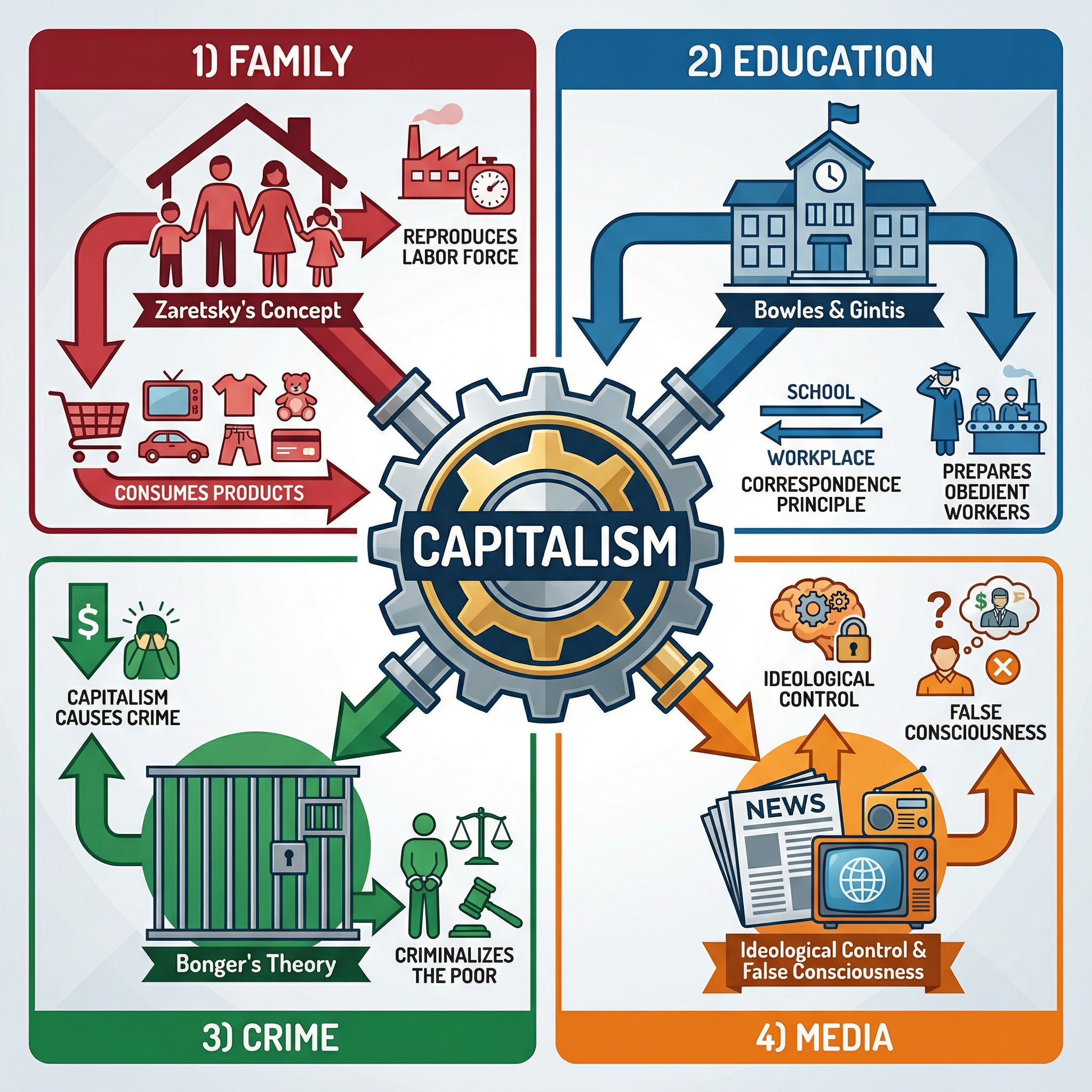
Key Concepts: Zaretsky argued the family serves capitalism in three ways: 1) It reproduces the labor force by socializing children into the norms and values of capitalism. 2) It provides a haven from the harsh realities of the capitalist workplace, allowing workers to de-stress and return to work the next day. 3) It is a unit of consumption, buying the goods and services that capitalism produces, which generates profit for the bourgeoisie.
Education
Key Thinkers: Bowles and Gintis
Key Concepts: Bowles and Gintis proposed the correspondence principle, arguing that the structures and hierarchies within the education system mirror those of the workplace. Schools reward conformity, obedience, and punctuality, preparing students for their future role as exploited workers. The hidden curriculum teaches these lessons implicitly. Paul Willis's study, Learning to Labour, provides a counterpoint, showing how working-class boys actively rejected the school's ideology, but their anti-school subculture ultimately prepared them for low-skilled manual labor.
Crime and Deviance
Key Thinker: Willem Bonger
Key Concepts: Bonger argued that capitalism is criminogenic – it causes crime. The pressure to consume, combined with the reality of inequality, leads the proletariat to commit utilitarian crimes to survive. The bourgeoisie also commit crimes (white-collar crime), but the law is selectively enforced to punish the poor and protect the rich. This maintains the illusion that crime is a working-class problem.
Second-Order Concepts
Causation
Marxist theory posits that the primary cause of social phenomena, from family structures to crime rates, is the economic structure of society. The drive for profit and the resulting class conflict are the engines of social change.
Consequence
The consequences of a capitalist economic base are exploitation, alienation, and inequality. For Marx, the ultimate consequence would be a proletarian revolution and the establishment of a communist society.
Change & Continuity
Marx saw history as a series of stages, each defined by its economic system (e.g., feudalism, capitalism). He predicted that capitalism would inevitably be replaced by communism. However, critics point to the continuity of capitalism and the failure of communist revolutions in many parts of the world as a weakness of his theory.
Significance
Marxism remains one of the most significant and influential sociological theories. It provides a powerful critique of inequality and has inspired countless social movements. For your exam, its significance lies in its ability to provide a critical perspective on the institutions and social structures you study.
Visual Resources
3 diagrams and illustrations
Interactive Diagrams
1 interactive diagram to visualise key concepts
Conceptual Flow Outline
The Marxist Base-Superstructure Model
Worked Examples
3 worked examples — open one to explore the question and available guidance.
Practice Questions
Try the question, then reveal an answer plan or example response
Outline and explain two criticisms of the Marxist view of society. (8 marks)
Hint: Think about other sociological perspectives. What do Functionalists or Feminists say?
Explain why Marxists are critical of the nuclear family. (12 marks)
Hint: Use the PEEL structure and include at least two key ideas from thinkers like Zaretsky or Engels.
Using one example, explain what is meant by the 'ideological state apparatus'. (4 marks)
Hint: Think about the institutions that control our ideas and beliefs.
Outline and explain two ways in which the media acts as an agent of ideological control. (8 marks)
Hint: Think about who owns the media and the messages it promotes.
To what extent do sociological perspectives agree that the main function of the education system is to prepare young people for work? (24 marks)
Hint: This is an essay question. You need to compare and contrast at least two perspectives (e.g., Marxism and Functionalism).
Exam technique
How to turn what you know into marks
How to approach the question
1. Identify the command word (e.g., 'Outline', 'Explain', 'Evaluate'). 2. Identify the topic (e.g., 'family', 'education'). 3. Identify the sociological perspective (e.g., 'Marxist'). 4. Plan your answer before you start writing.
How to structure your answer
- Essay questions
- Introduction setting out your argument. 3-4 developed points for the view in the question. 2-3 developed evaluation points (using other theories). A clear, justified conclusion.
- Source questions
- Not applicable for this paper.
- Explain questions
- Use the PEEL structure: Point, Evidence (sociologist/study), Explanation, Link back to the question.
Timing
Approximately 1.5 minutes per mark. For a 12-mark question, spend around 18 minutes.
Common pitfalls
- Describing theories without applying them to the specific question.
- Not using named sociologists or studies to support points.
- In evaluation questions, just listing criticisms without explaining them.
- Confusing Marxist and Feminist views on the family.
What the command words want
- Explain
- Give a detailed account including reasons or causes.
- Outline
- Set out the main points.
- Describe
- Set out the characteristics of something.
- Evaluate
- Judge from available evidence. Assess the strengths and weaknesses of a view.
Watch or listen (optional)
Test your understanding of Marxism
Active recall beats re-reading. Take an instant quiz now to test what you’ve learned and lock it into long-term memory.
7 days Premium · Then the free plan continues · No card, no charge