OCR · GCSE · Sociology
Postmodernism
This study guide delves into Postmodernism, a critical lens for understanding contemporary society in your OCR GCSE Sociology exam. It explores how globalisation, media, and consumer culture have reshaped identity and social structures, offering a powerful counter-argument to traditional theories like Marxism and Functionalism.
- 5 min read
- 3 worked examples
- 5 practice questions
- 6 key terms
Check what you remember
Read the wording for your board, then hide it and explain Postmodernity in your own words. Rough notes are fine. This is a self-check, with no mark or grade.
Reference: OCR
The historical period that postmodernists claim has followed the modern era, characterised by globalisation, media saturation, and a consumer-based economy.
Study Notes

Overview
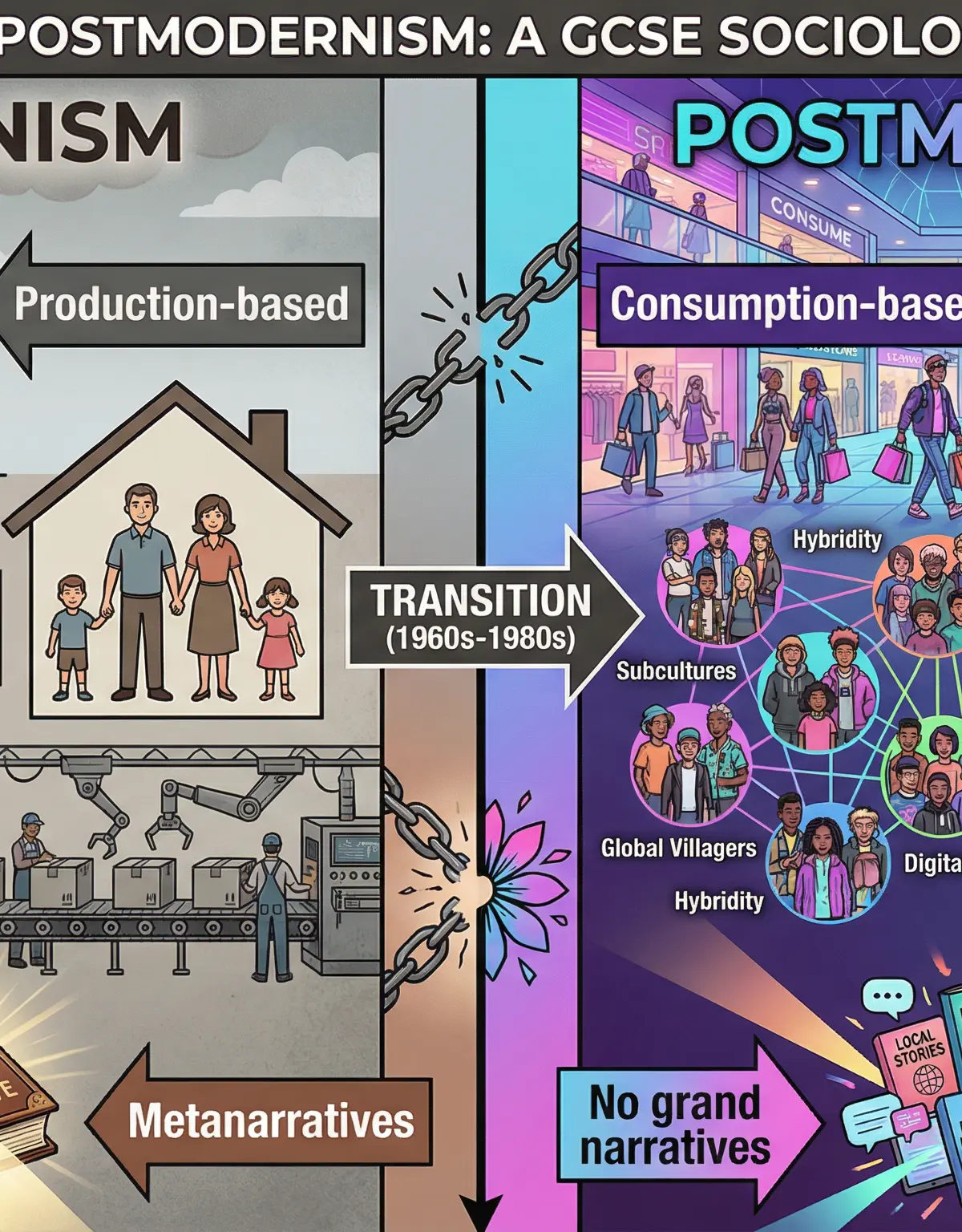
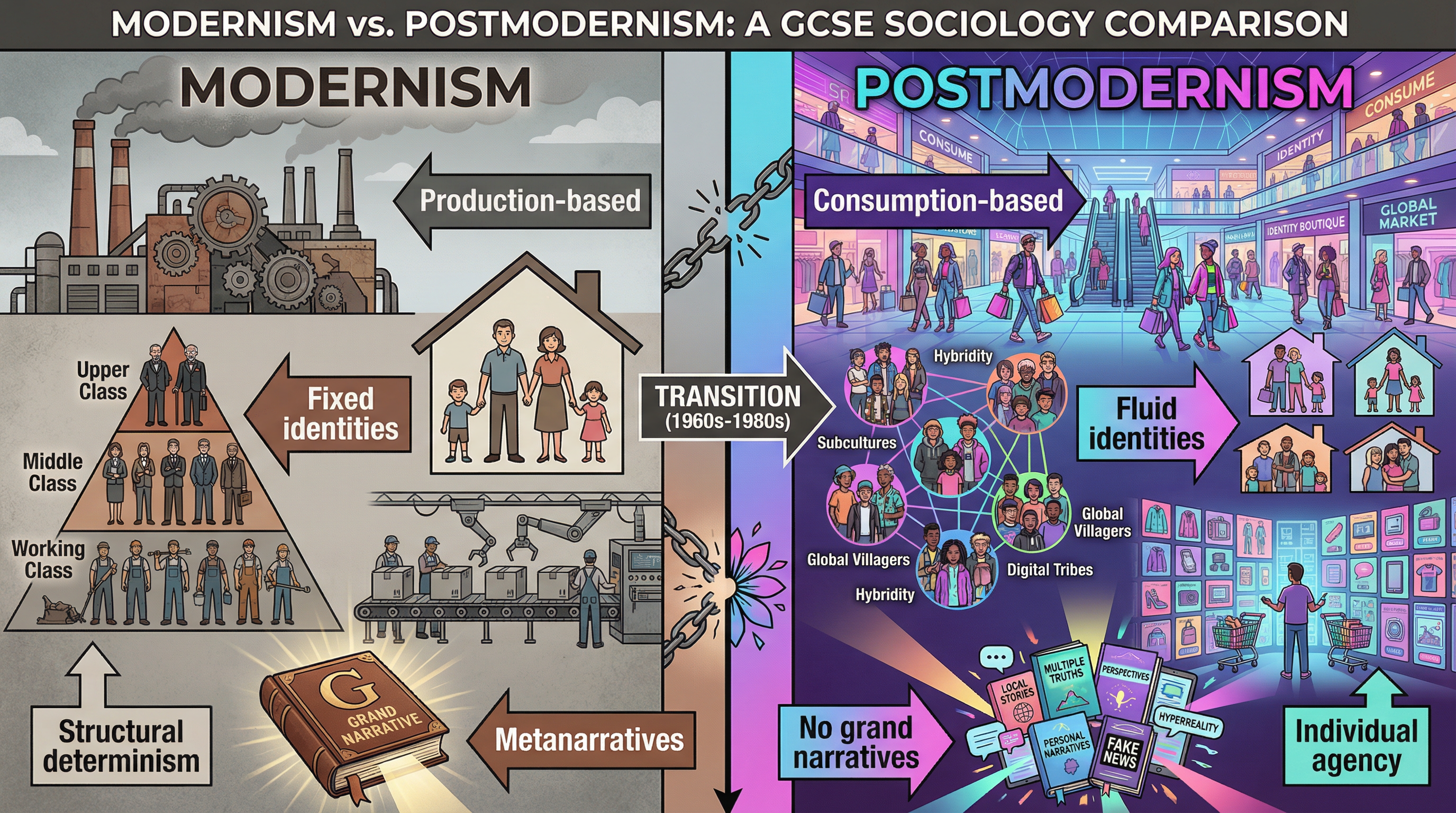
Postmodernism is a contemporary sociological perspective that challenges the grand theories of Modernity, such as Functionalism and Marxism. For the OCR J204 specification, candidates are expected to understand Postmodernism as a critique of these structural theories. The core argument is that society has shifted from an industrial, production-based model to a post-industrial, consumption-based one. This has profound implications for identity, culture, and social structures. Examiners will award marks for demonstrating how concepts like media saturation, globalisation, and consumer choice have led to a more fluid and fragmented social world. You will need to analyse how traditional divisions of class, gender, and ethnicity are now seen as less deterministic in shaping an individual's life chances and identity. This guide will equip you with the key concepts, theorists, and evaluation points needed to excel.
Key Concepts & Developments
The Shift from Production to Consumption
What happened: Postmodernists argue that society has moved from a 'modern' phase, where identity was primarily shaped by one's role in the production process (e.g., factory worker, manager), to a 'postmodern' phase. In this new phase, identity is primarily shaped by consumption patterns and lifestyle choices.
Why it matters: This is a foundational concept. For the exam, you must contrast the fixed, class-based identities of modernity with the fluid, chosen identities of postmodernity. Credit is given for explaining that individuals now define themselves by what they buy and the brands they associate with, rather than their job or social class.
Specific Knowledge: Link this to the decline of traditional manufacturing industries in the West and the rise of the service sector and global consumer brands. Theorist: Jean Baudrillard.
Media Saturation and Hyperreality
What happened: We are constantly surrounded by media, from 24/7 news and social media to streaming services and advertising. Postmodernists argue this creates a state of 'media saturation'.
Why it matters: This saturation blurs the line between reality and media representation. Baudrillard called this 'hyperreality', where simulations of reality become more real to us than reality itself (e.g., reality TV, curated Instagram feeds). For the exam, you can use this to discuss how media shapes our understanding of the world, particularly in topics like crime (moral panics) or identity (idealised body images).
Specific Knowledge: Use examples like social media influencers, deepfakes, or the way news events are packaged and presented. Key term: Simulacra (copies of things that no longer have an original). Mention theorist Baudrillard.

The Decline of Metanarratives
What happened: A metanarrative is a 'big story' or grand theory that claims to offer a total explanation of society (e.g., Marxism, Functionalism, religion). Postmodernist Jean-François Lyotard argued that in a postmodern world, people have lost faith in these all-encompassing explanations.
Why it matters: Globalisation and media exposure show us that there are many competing versions of the truth. This leads to a more sceptical and cynical view of authority and universal claims. In an exam, this is a powerful tool to critique traditional theories. You can argue that a Marxist view is just one story among many, and it no longer holds the authority it once did.
Specific Knowledge: Link this to the rise of secularisation, individualism, and a general distrust of politicians and experts. Theorist: Jean-François Lyotard.
Pick-and-Mix Identities & Globalisation
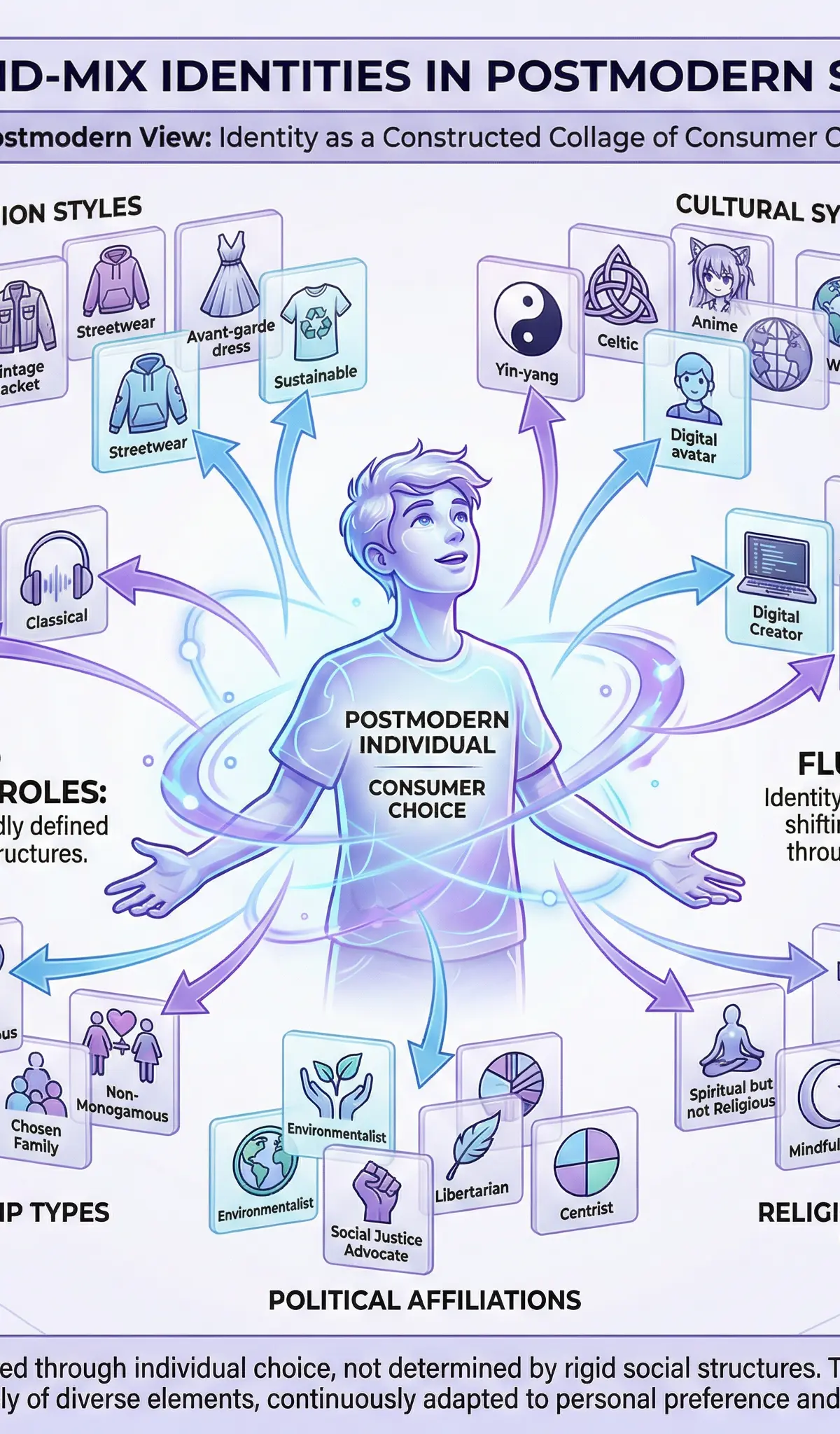
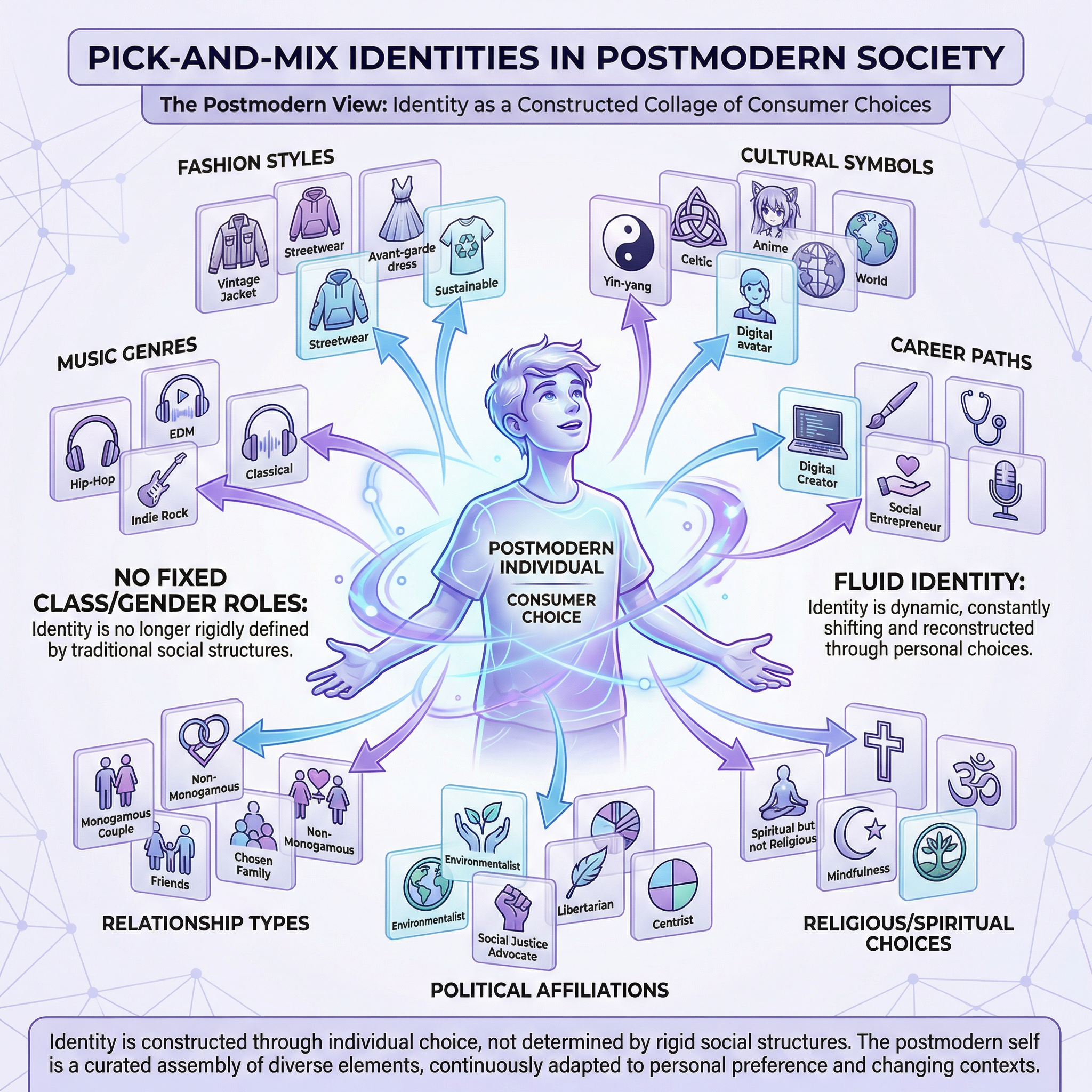
What happened: Globalisation has increased the interconnectedness of cultures. We can consume media, food, and fashion from all over the world. This, combined with the decline of tradition, allows individuals to construct their identity by 'picking and mixing' from a variety of cultural sources.
Why it matters: This directly challenges the structuralist view that identity is determined by factors like class, gender, or nationality. A candidate can now construct a hybrid identity. For example, someone might be British, love Japanese anime, listen to American hip-hop, and practice Buddhist meditation. Their identity is fluid and a product of choice.
Specific Knowledge: Use terms like cultural hybridity. Connect this to the topic of the Family, arguing that family diversity is a product of this increased choice. Connect to Stratification by arguing that global brands (like Nike or Apple) are now more important sources of identity than a traditional class position.
Podcast Episode: Postmodernism Explained
Listen to our 10-minute podcast episode for a deep dive into the key concepts, exam tips, and a quick-fire quiz to test your knowledge.

Worked Examples
3 worked examples — open one to explore the question and available guidance.
Practice Questions
Try the question, then reveal an answer plan or example response
Outline and explain two criticisms of the postmodernist view of society. (8 marks)
Hint: Think about what postmodernism ignores. Does everyone have the same amount of choice?
Describe one way postmodernism can be applied to the study of the family. (4 marks)
Hint: Think about choice and diversity.
Explain the postmodernist concept of 'hyperreality'. (6 marks)
Hint: Use the theorist Baudrillard and give a modern example.
Evaluate the postmodernist contribution to our understanding of identity. (24 marks)
Hint: This is a big essay. Argue FOR the postmodernist view (fluidity, choice, consumption) and then argue AGAINST it (persistence of class, gender, ethnicity).
Explain the difference between a 'modern' and a 'postmodern' view of identity. (8 marks)
Hint: Think production vs. consumption; fixed vs. fluid.
Exam technique
How to turn what you know into marks
How to approach the question
1. **Identify Command Word**: What are you being asked to do? (Outline, Explain, Evaluate). 2. **Identify Topic**: What part of the specification is this? (e.g., Identity). 3. **Identify Focus**: What is the specific angle? (e.g., the role of consumption).
How to structure your answer
- Essay questions
- 1. **Introduction**: Define key terms, set out your argument/judgement. 2. **For Paragraphs**: Present the argument from the question with evidence. 3. **Against Paragraphs**: Present the counter-argument with evidence. 4. **Conclusion**: Summarise the debate and deliver a final, justified judgement that directly answers the 'how far do you agree' part of the question.
- Source questions
- N/A for this paper, but analysis skills are key.
- Explain questions
- PEEL structure: Point, Evidence (sociological concepts, studies, or examples), Explanation (how the evidence supports the point), Link back to the question.
Timing
Approximately 1.5 minutes per mark. For a 12-mark question, aim for 18 minutes. For a 24-mark essay, aim for 35-40 minutes, including planning.
Common pitfalls
- Asserting class/gender are 'gone' instead of 'less influential'.
- Confusing Postmodernism with Interactionism.
- Lacking named theorists.
- Describing postmodern ideas without applying them to the question.
What the command words want
- Describe
- Set out the characteristics of a concept.
- Explain why/how
- Provide a detailed account with reasons. Use sociological concepts and evidence.
- Outline and explain
- Requires two distinct points, each one developed and explained in detail.
- Evaluate / To what extent
- Make a judgement. Present a balanced argument considering both sides (e.g., the postmodern view vs. structural views) and come to a justified conclusion.
Watch or listen (optional)
Test your understanding of Postmodernism
Active recall beats re-reading. Take an instant quiz now to test what you’ve learned and lock it into long-term memory.
7 days Premium · Then the free plan continues · No card, no charge