OCR · GCSE · Sociology
Poverty
This study guide for OCR GCSE Sociology delves into the critical topic of Poverty, a cornerstone of the Social Stratification unit. It provides candidates with the essential definitions, theoretical debates, and empirical evidence needed to achieve high marks by dissecting how poverty is defined, measured, and explained in contemporary Britain.
- 6 min read
- 3 worked examples
- 5 practice questions
- 7 key terms
Check what you remember
Read the wording for your board, then hide it and explain Social Stratification in your own words. Rough notes are fine. This is a self-check, with no mark or grade.
Reference: OCR
The division of society into a hierarchy of unequal social groups. Strata are layers, like layers of rock.
Study Notes
Overview
This guide covers the OCR J204 Component 02 topic of Poverty, a central theme in the study of social stratification. Examiners expect candidates to demonstrate a robust understanding of the different ways poverty is defined and measured, moving beyond common-sense explanations to apply rigorous sociological theory. You will need to critically analyse the causes and consequences of poverty, evaluating the key perspectives of Functionalism, Marxism, the New Right, and Feminism. High-level responses will engage with the intersectionality of poverty, linking it to gender, ethnicity, and age, and will use specific studies and data to support arguments. This topic is not just about describing hardship; it is about understanding the structural forces and ideological debates that shape wealth and inequality in modern society. Credit is given for those who can contrast cultural and structural explanations and evaluate the role of the welfare state.
Key Concepts & Definitions
Defining and Measuring Poverty
Absolute Poverty: A condition characterised by severe deprivation of basic human needs, including food, safe drinking water, sanitation facilities, health, shelter, and education. It is a fixed measure, often defined as living on less than a certain amount per day (e.g., the World Bank's $2.15 a day). The key sociologist here is Seebohm Rowntree, whose studies of York (1899, 1936) identified a 'primary poverty line' based on the minimum income needed for physical efficiency.
Relative Poverty: A condition where an individual's or household's financial resources are substantially below the average income level in their society, leading to social exclusion and an inability to participate in the normal activities of that society. This is the most common sociological definition. The key sociologist is Peter Townsend (1979), who developed a Deprivation Index of 60 indicators of a normal lifestyle. He found 22.9% of the UK population were in relative poverty.
Consensual Poverty: An approach developed by Mack and Lansley (1985) in their Poor Britain study. They asked the public what items they considered to be 'necessities' in modern life. Individuals who could not afford three or more of these items were defined as being in poverty. This method is significant because it grounds the definition of poverty in public consensus rather than expert opinion.
Subjective Poverty: This refers to whether individuals or families feel they are poor. It is a measure of personal perception and can vary significantly from objective measures.
Theoretical Explanations of Poverty
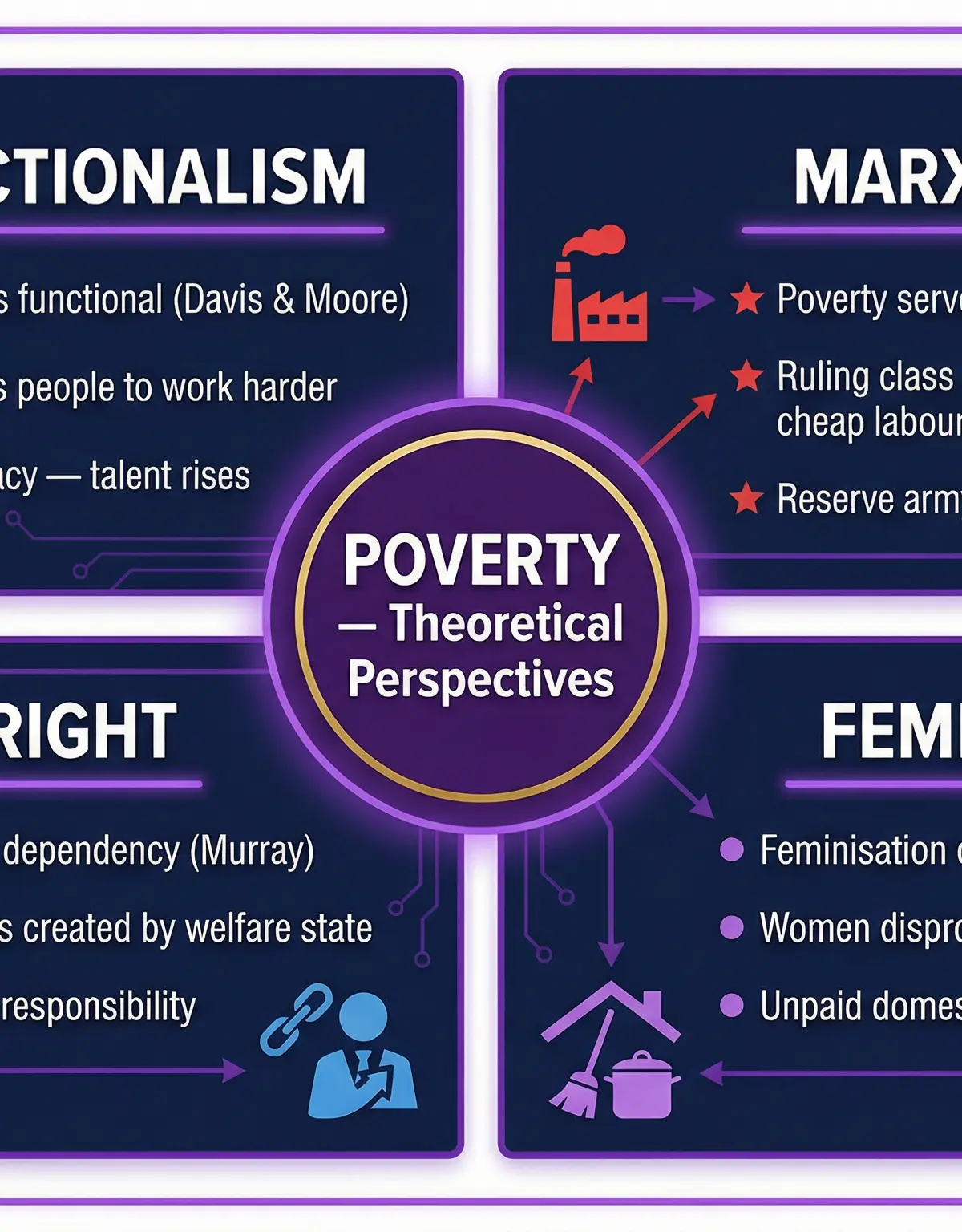
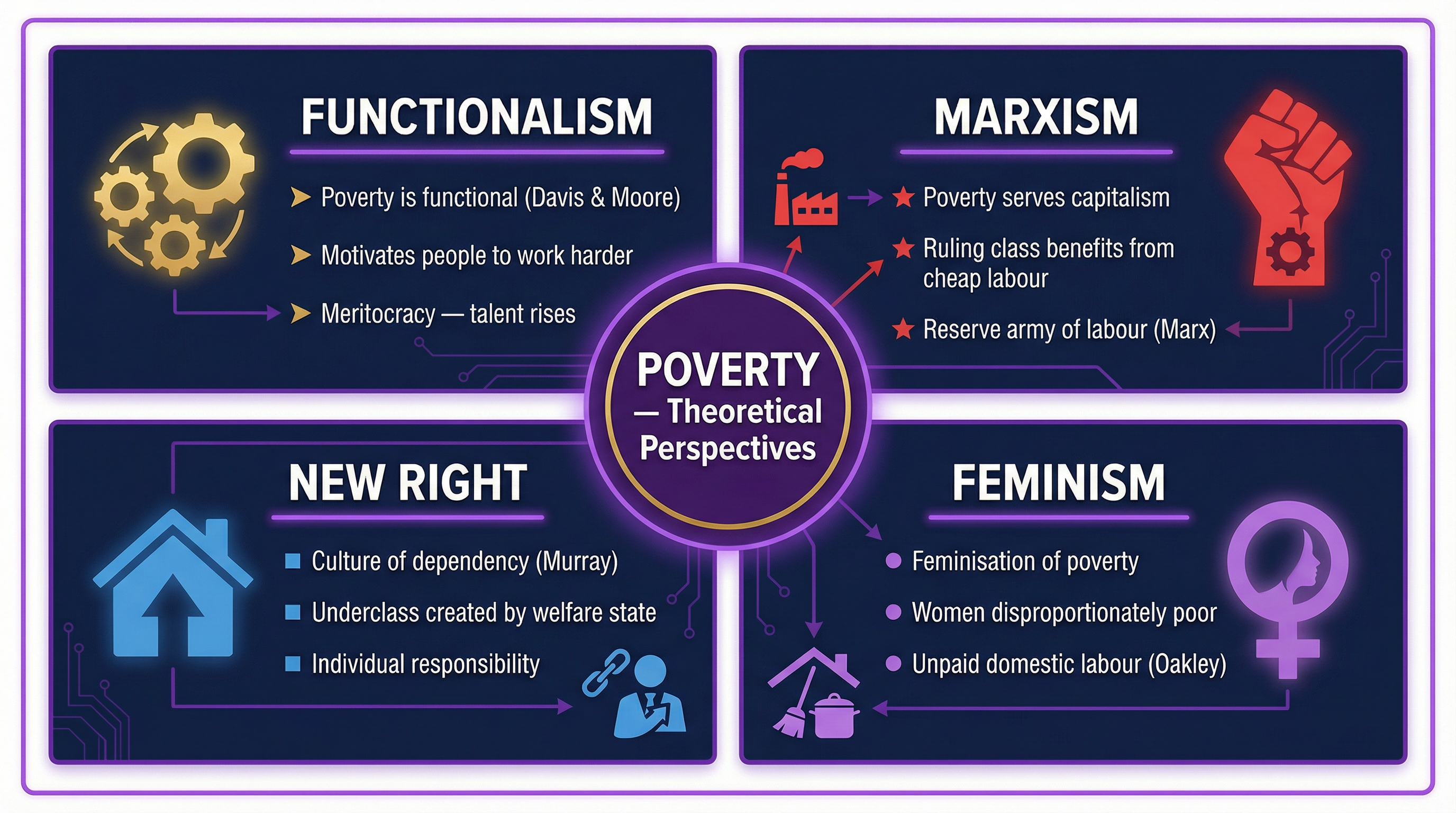
1. Functionalism
Core Idea: Inequality and poverty are necessary and functional for society.
Key Sociologists: Davis and Moore (1945).
Explanation: Functionalists argue that society is a meritocracy. To ensure the most important roles are filled by the most talented people, society offers unequal rewards (money, status). Poverty, therefore, motivates people to work harder and compete for these top positions. It is seen as a result of individuals failing to make the most of their opportunities.
Evaluation: This view is heavily criticised for ignoring structural barriers like class, gender, and ethnicity that prevent a true meritocracy. Marxists argue it legitimises inequality and blames the victims of a rigged system.
2. Marxism
Core Idea: Poverty is an inevitable product of capitalism that serves the interests of the ruling class (bourgeoisie).
Key Sociologist: Karl Marx.
Explanation: Marxists argue that capitalism is based on the exploitation of the working class (proletariat). The system requires a 'reserve army of labour'—a pool of unemployed workers—to keep wages low and maintain discipline among the workforce. Poverty is therefore a structural feature of capitalism, not a personal failing.
Evaluation: This perspective is powerful for explaining structural inequality but can be seen as overly deterministic. It sometimes overlooks the role of the welfare state in alleviating poverty and the divisions within the working class itself.
3. The New Right
Core Idea: Poverty is caused by a 'culture of dependency' created by an overly generous welfare state.
Key Sociologist: Charles Murray (1984, 1990).
Explanation: Murray argues that the welfare state creates an 'underclass' with deviant norms and values, such as a lack of work ethic and a reliance on benefits. He claims this leads to long-term unemployment, lone parenthood, and crime, which are passed down through generations. The solution, for the New Right, is to reduce welfare and enforce individual responsibility.
Evaluation: This is a highly controversial and contested theory. Critics argue it is 'victim-blaming', ignoring the structural causes of poverty like de-industrialisation. Sociologists like T.H. Marshall would argue the welfare state actually promotes social citizenship and inclusion, rather than dependency.
4. Feminism
Core Idea: Poverty is a gendered issue; women are disproportionately affected.
Key Sociologist: Ann Oakley, Sylvia Walby.
Explanation: Feminists point to the 'feminisation of poverty'. Women are more likely to be in low-paid, part-time work, take career breaks for childcare, and be lone parents. Their unpaid domestic labour is not economically valued. Patriarchal structures in both the family and the workplace trap women in poverty.
Evaluation: This perspective is crucial for highlighting the gender dimension of poverty that other theories often ignore. It effectively demonstrates how intersectionality (the combination of class, gender, and ethnicity) creates unique experiences of deprivation.
The Cycle of Deprivation
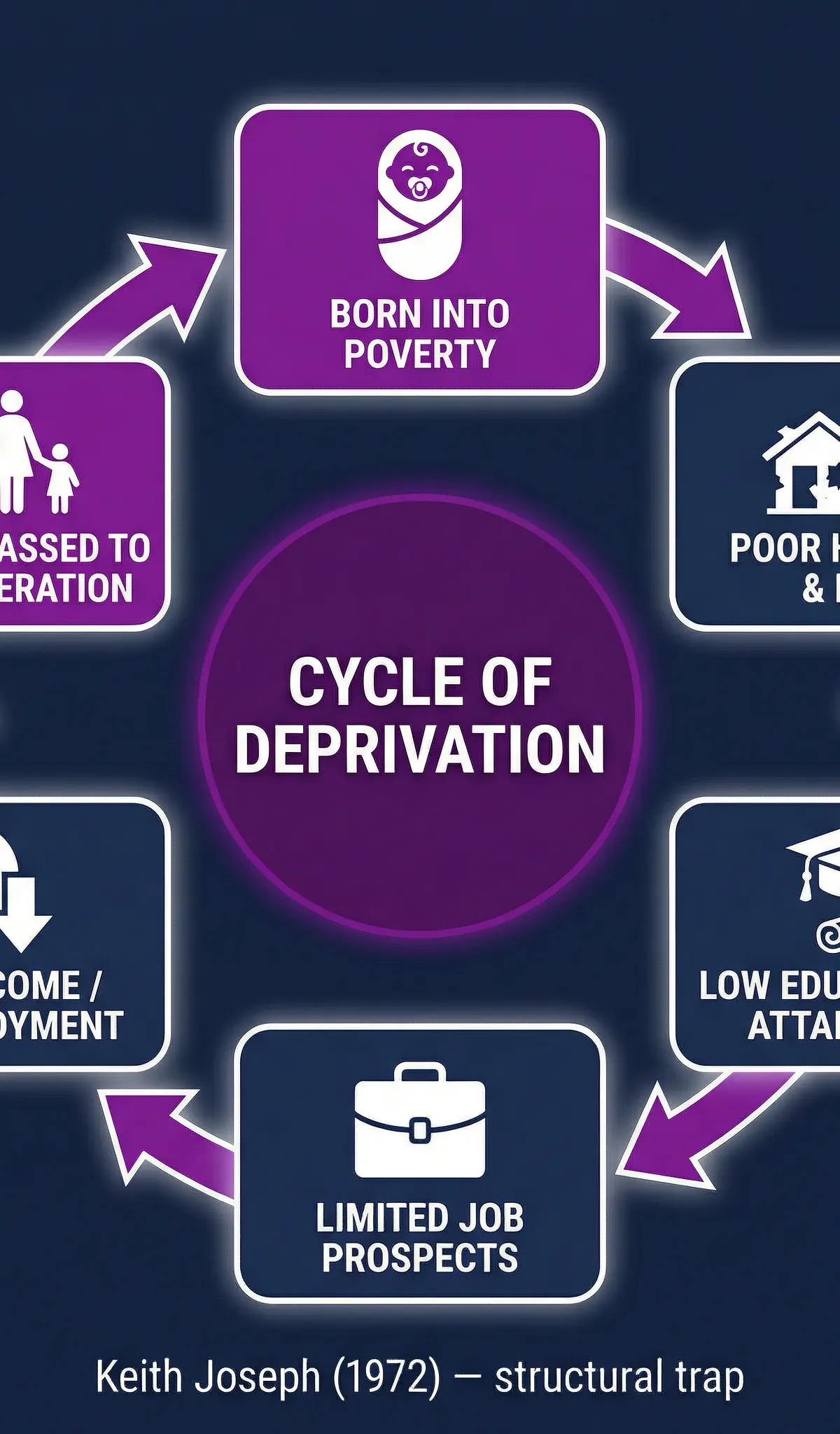
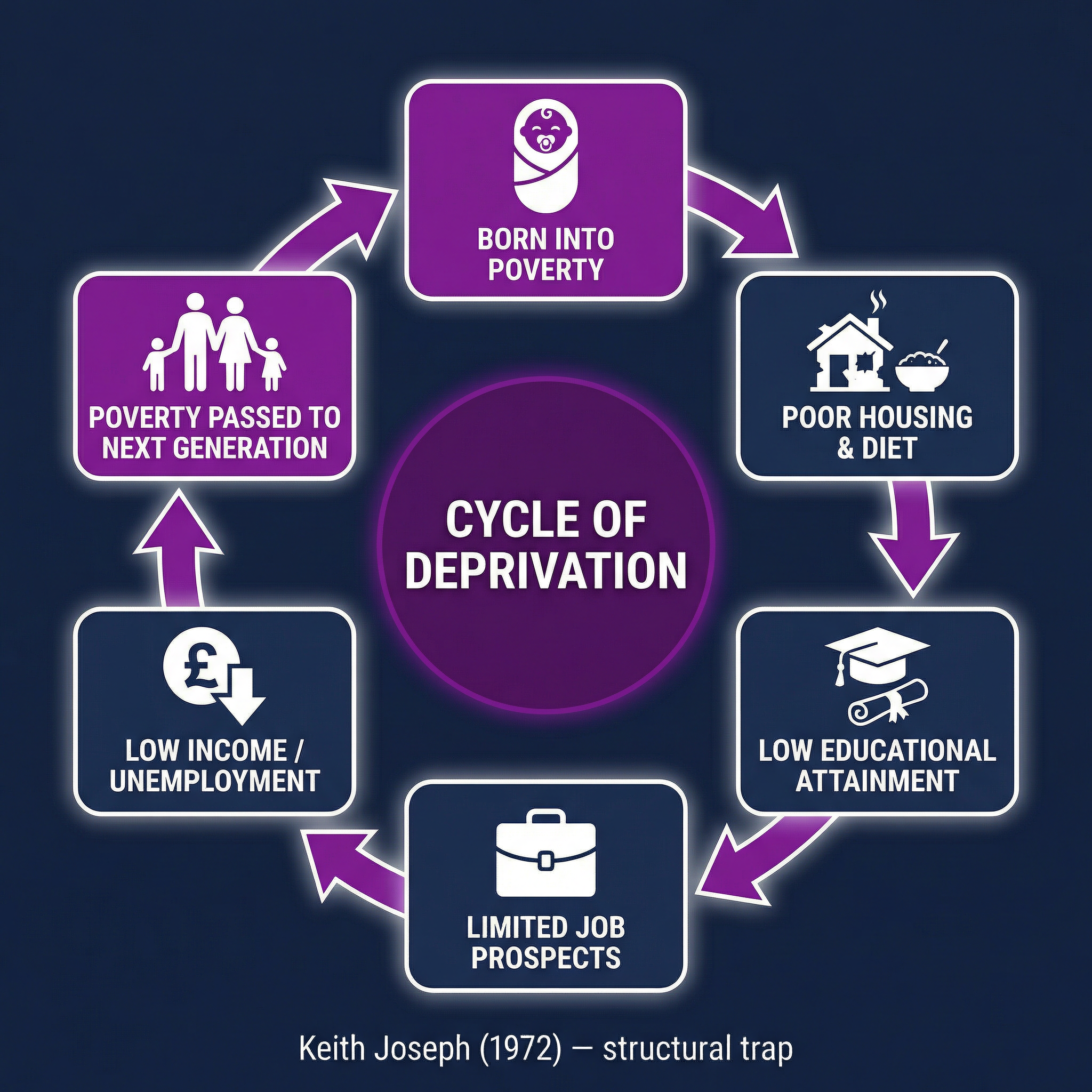
This concept, often associated with Conservative politician Sir Keith Joseph (1972) but also linked to cultural explanations like those of Oscar Lewis ('culture of poverty'), suggests that poverty is transmitted from one generation to the next. It describes a process where children born into poor families experience poor housing, diet, and health, leading to low educational attainment, which in turn leads to limited job prospects and low income in adulthood, thus passing poverty onto their own children. Examiners expect candidates to distinguish between cultural versions (blaming values) and structural versions (blaming the trap of inequality).
Visual Resources
2 diagrams and illustrations
Interactive Diagrams
1 interactive diagram to visualise key concepts
Conceptual Flow Outline
A diagram illustrating the 'Cycle of Deprivation', showing how poverty can be transmitted across generations through a series of interlinked disadvantages.
Worked Examples
3 worked examples — open one to explore the question and available guidance.
Practice Questions
Try the question, then reveal an answer plan or example response
Describe two ways in which poverty can be measured. (6 marks)
Hint: Think about the difference between a fixed, universal measure and a measure that changes with society's living standards.
Explain one cultural and one structural cause of poverty. (8 marks)
Hint: For the cultural cause, think about values and lifestyles (e.g., New Right). For the structural cause, think about how the economy or society is organised (e.g., Marxism).
Explain and briefly evaluate the Functionalist view of poverty. (12 marks)
Hint: Explain the concepts of meritocracy and role allocation. For evaluation, consider whether society is truly meritocratic.
Using Source B, identify and explain two reasons why women are at a higher risk of poverty than men. (8 marks)
Hint: Look for clues in the source about gender roles, work, and family. Link these to feminist concepts.
'Cultural factors are more significant than structural factors in explaining poverty.' How far do you agree with this statement? (24 marks)
Hint: This is a major essay question. You must evaluate the New Right (cultural) vs. Marxism/Feminism (structural). Plan your argument and come to a clear conclusion.
Exam technique
How to turn what you know into marks
How to approach the question
1. **Identify the Command Word**: 'Explain', 'Evaluate', 'Using the source'. This tells you the required skill. 2. **Identify the Topic**: What specific area of poverty is it asking about (e.g., measurement, causes, a specific theory)? 3. **Identify the Focus**: Are there any restrictions (e.g., 'in the UK today', 'two ways')?
How to structure your answer
- Essay questions
- **Introduction**: Define key terms and set out your line of argument. **Main Body**: A series of PEEL paragraphs, presenting one argument and then evaluating it (e.g., Marxist view vs. New Right view). **Conclusion**: Summarise your arguments and make a clear, justified final judgement that directly answers the question.
- Source questions
- Make a point based on the source, quote the source directly to support it, then explain the sociological meaning or connection. Repeat for the required number of points.
- Explain questions
- PEEL Structure: Make a **P**oint, provide **E**vidence (sociologist, study, statistic), **E**xplain how the evidence supports the point, and **L**ink back to the question.
Timing
Approximately 1.25 minutes per mark. For a 24-mark essay, this means allocating around 30 minutes, including 5 minutes for planning.
Common pitfalls
- Describing theories without evaluating them.
- Relying on common sense instead of sociological evidence.
- Confusing the New Right (Murray) with cultural explanations (Lewis).
- Not using named sociologists or studies to support points.
- In 'evaluate' questions, failing to write a conclusion that makes a judgement.
What the command words want
- Describe
- State two distinct points and provide a developed explanation for each.
- Explain why
- Provide at least three clear, developed reasons (causes), linking them together to show how they combine.
- Using the source
- Your answer must be grounded in the provided source material. Quote it directly and use it as the starting point for your sociological analysis.
- How far do you agree / Evaluate
- Present a balanced argument with evidence for and against the statement. You must come to a justified conclusion.
Watch or listen (optional)
Test your understanding of Poverty
Active recall beats re-reading. Take an instant quiz now to test what you’ve learned and lock it into long-term memory.
7 days Premium · Then the free plan continues · No card, no charge