OCR · GCSE · Sociology
Qualitative Research Methods
This study guide focuses on Qualitative Research Methods for OCR GCSE Sociology, a crucial area for understanding how sociologists gain deep, empathetic insight (Verstehen) into human behaviour. Mastering these methods is essential for achieving high marks in Section A, as it demonstrates your ability to think like a sociologist.
- 5 min read
- 3 worked examples
- 5 practice questions
- 6 key terms
Check what you remember
Read the wording for your board, then hide it and explain Validity in your own words. Rough notes are fine. This is a self-check, with no mark or grade.
Reference: OCR
The degree to which a research study measures what it intends to measure. In qualitative research, this means the truthfulness, authenticity, and richness of the data.
Study Notes

Overview
Qualitative research is a cornerstone of sociology, offering a powerful lens to understand the complexities of social life. Unlike quantitative methods that focus on numerical data, qualitative approaches aim to gather rich, in-depth, and valid data to uncover the meanings people attach to their actions. For the OCR J204 specification, a firm grasp of unstructured interviews, participant observation, and focus groups is non-negotiable. Examiners are looking for candidates who can not only define these methods but also critically evaluate their strengths and weaknesses using the PET (Practical, Ethical, Theoretical) framework. This guide will equip you with the precise knowledge and analytical skills to deconstruct exam questions, apply key concepts like Verstehen and rapport, and ultimately, write answers that are awarded top-band marks.
Key Qualitative Methods
Unstructured Interviews
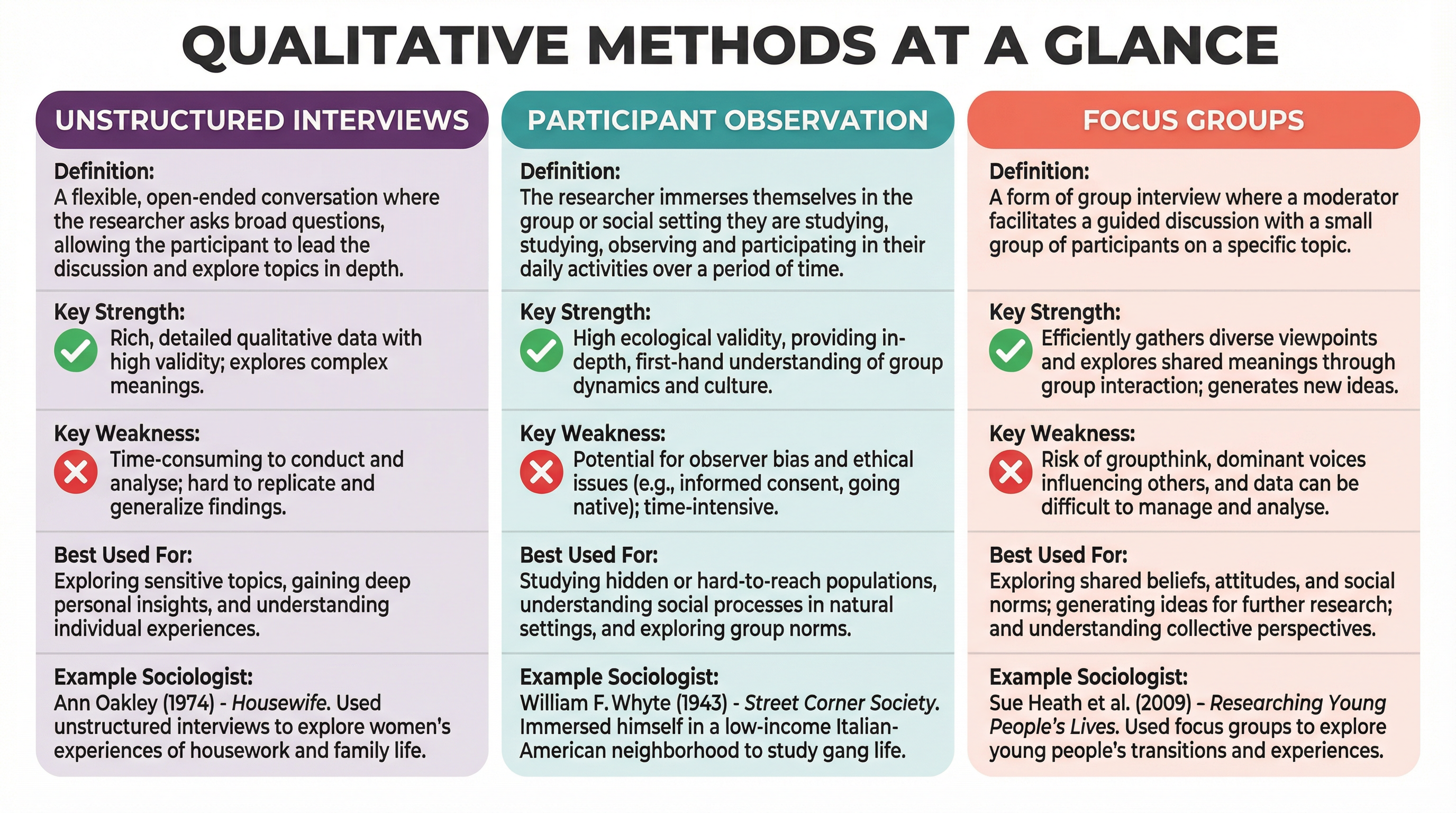
What it is: A flexible, open-ended conversation where the researcher asks broad questions, allowing the participant to lead the discussion and explore topics in depth. The goal is to build rapport and achieve Verstehen.
Why it matters: This method produces highly valid, detailed data, making it ideal for exploring sensitive topics where trust is paramount. Examiners expect you to link its use to the pursuit of rich, authentic insights.
Specific Knowledge: Ann Oakley's (1974) study of housewives is a classic example. She used unstructured interviews to explore the experience of housework, arguing it was the only way to uncover the true feelings and subjective experiences of women.
Participant Observation
What it is: The researcher immerses themselves in the group or social setting they are studying, observing and participating in their daily activities over a period of time. It can be overt (the group knows) or covert (the researcher's identity is secret).
Why it matters: It offers exceptional ecological validity, as behaviour is observed in its natural context. For the exam, you must be able to distinguish between the ethical implications of overt versus covert observation.
Specific Knowledge: William F. Whyte's (1943) 'Street Corner Society' is the key study. He spent over three years as a covert participant observer in a Boston gang, providing a groundbreaking, in-depth account of gang life that would have been impossible to obtain otherwise.
Focus Groups
What it is: A form of group interview where a moderator facilitates a guided discussion with a small group of participants (usually 6-10) on a specific topic.
Why it matters: Its unique strength is the ability to observe group dynamics and how ideas are generated and negotiated through social interaction. Credit is given for recognising this is more than just interviewing multiple people at once.
Specific Knowledge: Sue Heath et al. (2009) used focus groups in 'Researching Young People's Lives' to explore transitions to adulthood, finding that the group setting allowed young people to share and build on each other's experiences.
Second-Order Concepts: The PET Framework
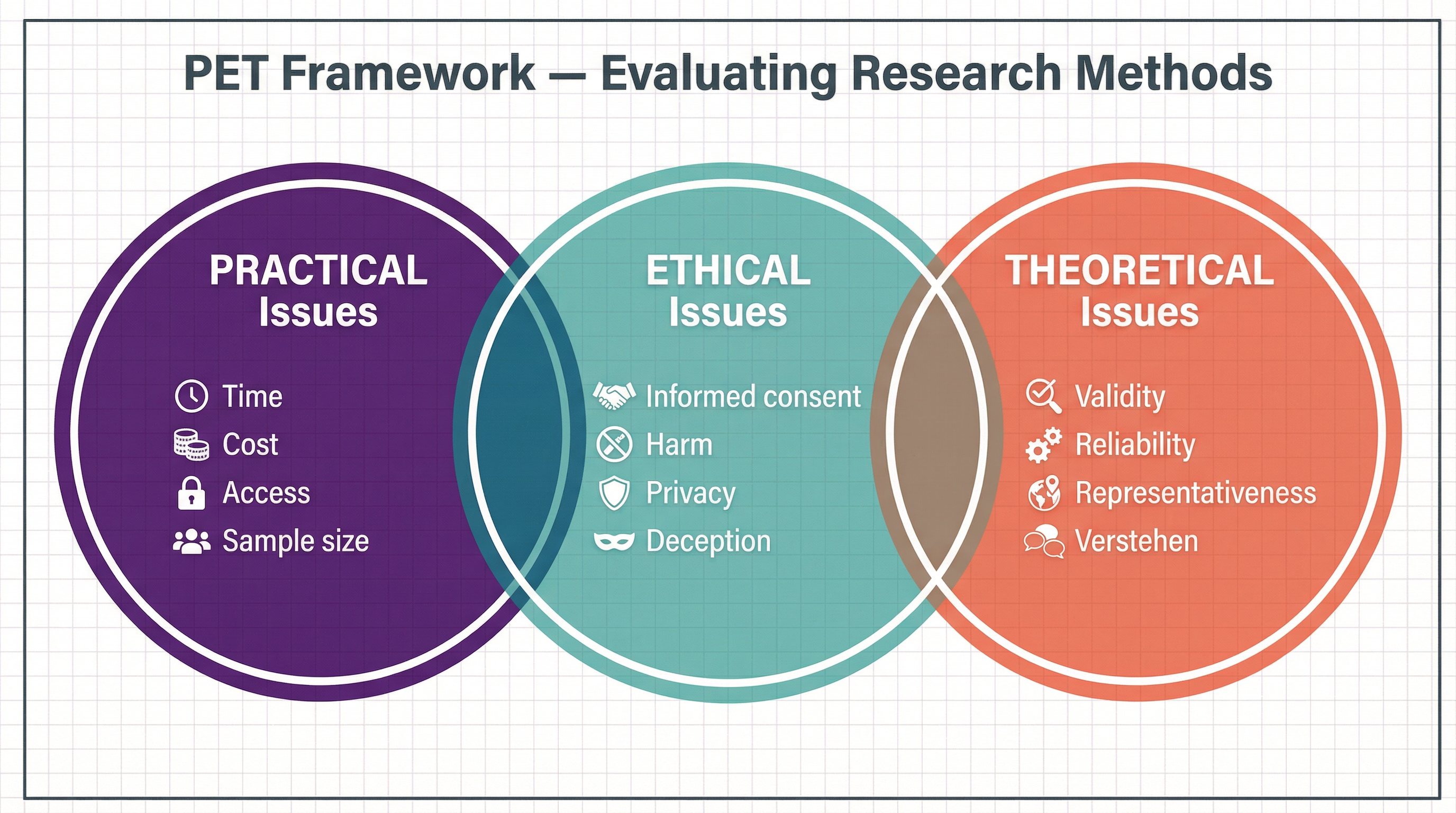
Practical Issues
These are the logistical problems of carrying out research. For qualitative methods, this often involves high costs (e.g., training skilled interviewers) and significant time commitment (Whyte's study took years). Access to the group can be a major hurdle, which is often why covert observation is attempted. Sample sizes are typically small, which can be a practical advantage but a theoretical disadvantage.
Ethical Issues
These concern the moral conduct of the researcher. The British Sociological Association (BSA) provides strict guidelines. Key issues for qualitative methods include gaining informed consent (a major problem in covert observation), preventing harm to participants (psychological or social), ensuring privacy and confidentiality, and avoiding deception.
Theoretical Issues
These relate to the quality and nature of the data produced. Validity (truthfulness and depth) is the main strength of qualitative methods. Reliability (replicability) is a key weakness, as the unique nature of the research makes it impossible to repeat exactly. Representativeness (whether the sample reflects the wider population) is also low due to small sample sizes, meaning findings are not generalisable.
Source Skills
In Section A, you will be given a source describing a piece of sociological research. Your task is to apply your methodological knowledge to it. When analysing the source, ask yourself:
- What method is being used? Identify it precisely (e.g., 'covert participant observation', not just 'observation').
- Why was this method chosen? Link the method's strengths to the topic or group in the source (e.g., 'Unstructured interviews were used to research experiences of bullying because their high validity is suited to such a sensitive topic').
- What are the limitations? Use the PET framework to identify practical, ethical, or theoretical weaknesses of the method in that specific context.
Visual Resources
2 diagrams and illustrations
Interactive Diagrams
1 interactive diagram to visualise key concepts
Conceptual Flow Outline
A concept map showing the main qualitative methods and their key features.
Worked Examples
3 worked examples — open one to explore the question and available guidance.
Practice Questions
Try the question, then reveal an answer plan or example response
Describe two practical issues a sociologist might face when conducting covert participant observation. (4 marks)
Hint: Think about the logistical challenges of being undercover.
Explain why interpretivist sociologists prefer qualitative research methods. (6 marks)
Hint: Link your answer to the core beliefs of interpretivism, such as Verstehen.
Evaluate the use of focus groups in sociological research. (12 marks)
Hint: Use the PET framework to structure a balanced argument, considering both strengths and weaknesses.
Distinguish between reliability and validity. (4 marks)
Hint: Define both terms and state which type of method is associated with each.
Explain one ethical and one practical problem with using covert participant observation. (4 marks)
Hint: Use the PET framework to guide your answer.
Exam technique
How to turn what you know into marks
How to approach the question
1. **Identify the command word**: 'Explain', 'Discuss', 'Evaluate'. This tells you what to do. 2. **Identify the topic**: What method or concept is it about? 3. **Identify the marks**: This tells you how much detail is needed. 4. **Use the source**: If it's a Section A question, underline key details in the source to use in your answer.
How to structure your answer
- Essay questions
- A balanced argument is key. Introduction setting out the debate -> Point for -> Point against -> Point for -> Point against -> Conclusion with a clear judgement ('Overall, the strengths outweigh the weaknesses because...').
- Source questions
- Identify the method/concept from the source, then use your own knowledge to explain its strengths or weaknesses in that context.
- Explain questions
- Point, Evidence/Example, Explain, Link. Make a point, back it up with sociological knowledge, explain it, and link it back to the question.
Timing
Approximately 1.5 minutes per mark. For a 12-mark question, this means around 18 minutes.
Common pitfalls
- Confusing validity (truth) and reliability (replicability).
- Giving generic, 'textbook' answers without linking to the specific source provided.
- Describing a method without evaluating it in a 'discuss' or 'evaluate' question.
What the command words want
- Explain
- Give a reason or cause. Use connective phrases like 'This is because...' or 'This leads to...'.
- Describe
- State two distinct features or characteristics of the method or concept.
- Evaluate
- Use the PET framework to judge the strengths and weaknesses of a method.
- Discuss how far you agree
- Present both sides of the argument and come to a justified conclusion. Use phrases like 'On the one hand...' and 'However, on the other hand...'.
Watch or listen (optional)
Test your understanding of Qualitative Research Methods
Active recall beats re-reading. Take an instant quiz now to test what you’ve learned and lock it into long-term memory.
7 days Premium · Then the free plan continues · No card, no charge