OCR · GCSE · Sociology
Reliability and Validity
This guide dissects the core sociological concepts of Reliability and Validity, crucial for any OCR GCSE Sociology candidate. It explores the critical trade-off between consistency and truthfulness in research, providing the analytical tools needed to evaluate methods and secure top marks.
- 6 min read
- 3 worked examples
- 5 practice questions
- 8 key terms
Check what you remember
Read the wording for your board, then hide it and explain Reliability in your own words. Rough notes are fine. This is a self-check, with no mark or grade.
Reference: OCR
The extent to which a research study can be repeated and produce the same results. It is about consistency and replicability.
Study Notes

Overview
Welcome to your essential guide to Reliability and Validity in sociological research. For OCR GCSE Sociology, mastering these two concepts is not just recommended; it is fundamental to achieving high grades. Examiners consistently report that candidates who can clearly define, distinguish, and evaluate research methods using the criteria of reliability and validity perform significantly better. This guide will equip you with the precise language and analytical framework required. We will explore the foundational definitions of reliability (consistency) and validity (truthfulness), analyze the inherent trade-off between them, and link these concepts to the major theoretical perspectives of Positivism and Interpretivism. By the end of this guide, you will be able to confidently assess the strengths and limitations of any research method presented to you in the exam, particularly in the source-based Section A and the longer 12-mark evaluation questions.
The Core Concepts: Reliability vs. Validity
Reliability: The Quest for Consistency
What it is: Reliability refers to the consistency and repeatability of research findings. If a study is reliable, it means that if another sociologist were to replicate the research using the exact same methods, they would produce the exact same results. It is the bedrock of the scientific method, which many sociologists (particularly Positivists) believe should be applied to the study of society.
Why it matters: High reliability suggests that the results are not just a fluke or a one-off. It allows for comparisons to be made over time or between different groups. Standardized methods, such as closed-question surveys or structured interviews, are the key to achieving reliability. By ensuring every participant is asked the same questions in the same way, the researcher minimizes variation and maximizes consistency.
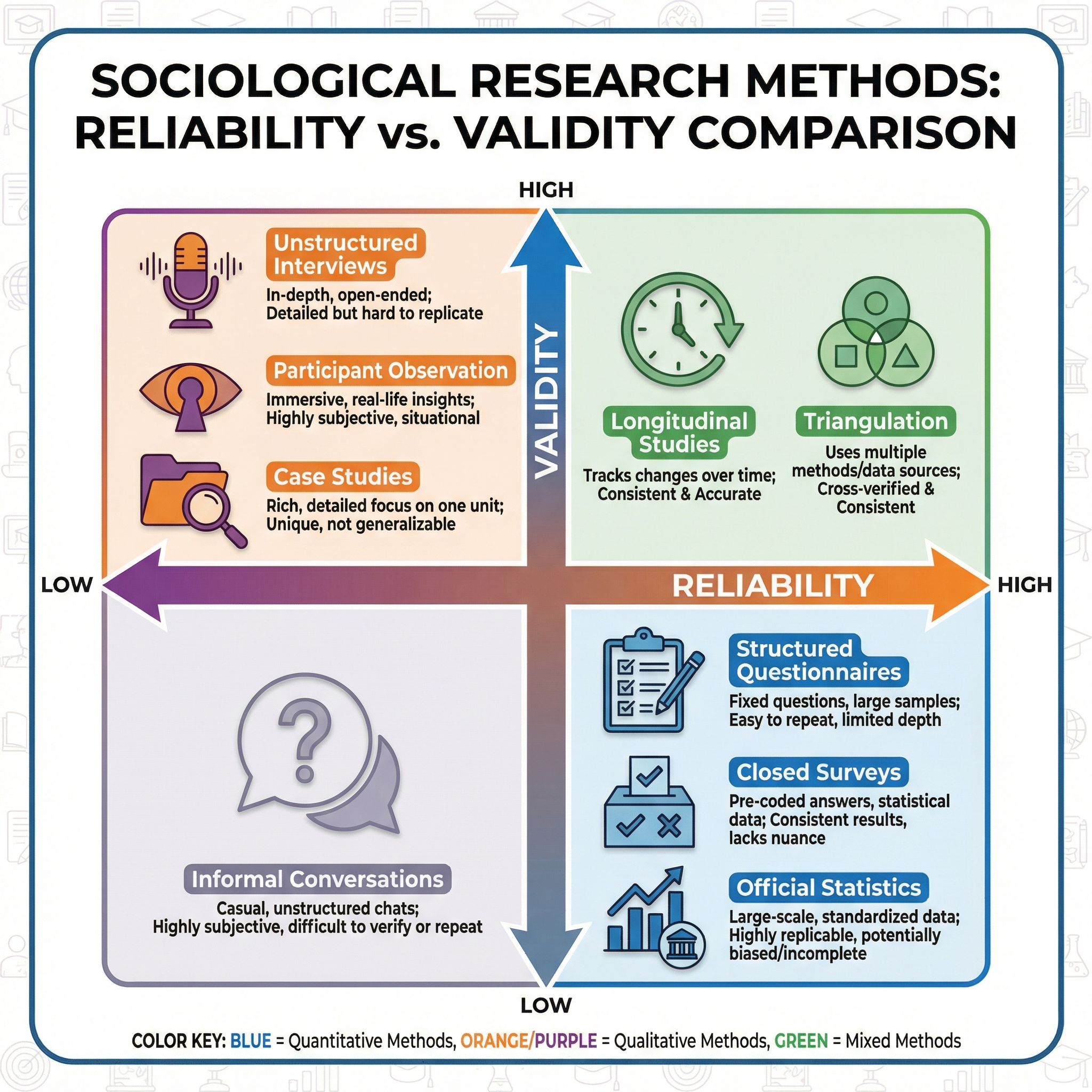
Specific Knowledge: Methods high in reliability include: Structured Questionnaires, Official Statistics, and Structured Interviews. These methods use pre-coded, fixed-choice questions that generate quantitative data, which is easily collated and compared.
Validity: The Search for Truth
What it is: Validity refers to the authenticity and truthfulness of the data. It asks whether the research provides a genuine, accurate picture of the social world. Does the data truly reflect the participants' real feelings, experiences, and behaviors? For many sociologists (particularly Interpretivists), validity is the ultimate goal of research.
Why it matters: Without validity, data is meaningless. A highly reliable survey that produces false information is useless. Achieving validity often requires methods that allow for depth, detail, and rapport. Researchers need to get close to the people they are studying to understand their world from their perspective (a concept known as Verstehen).
Specific Knowledge: Methods high in validity include: Unstructured Interviews, Participant Observation, and Case Studies. These methods generate rich, detailed qualitative data that captures the nuances of social life. However, they are often criticized for being subjective and hard to replicate.
The Great Trade-Off: Positivism vs. Interpretivism

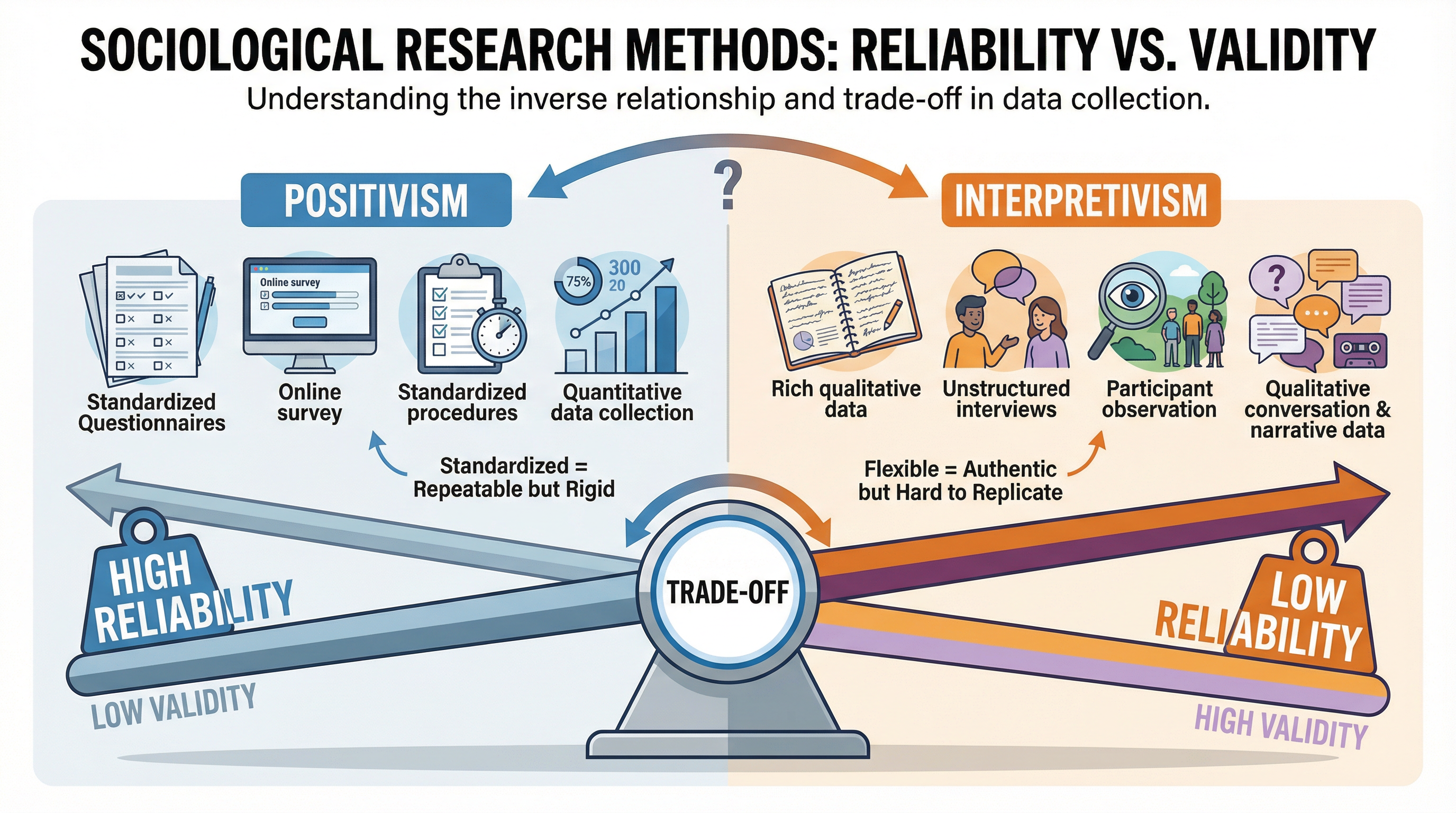
Examiners expect you to understand that there is often an inverse relationship between reliability and validity. Methods that are strong in one are often weak in the other. This trade-off is central to the debate between sociology's two main theoretical approaches.
- Positivism: Aligned with the natural sciences, Positivists argue that sociology should be objective and scientific. They prioritize reliability and use quantitative methods to uncover social facts and patterns of behavior. For them, repeatability is paramount.
- Interpretivism: Interpretivists argue that studying humans is different from studying molecules. They believe sociologists must uncover the subjective meanings people attach to their actions. They prioritize validity and use qualitative methods to gain an empathetic understanding (Verstehen) of social life.
Threats to Validity
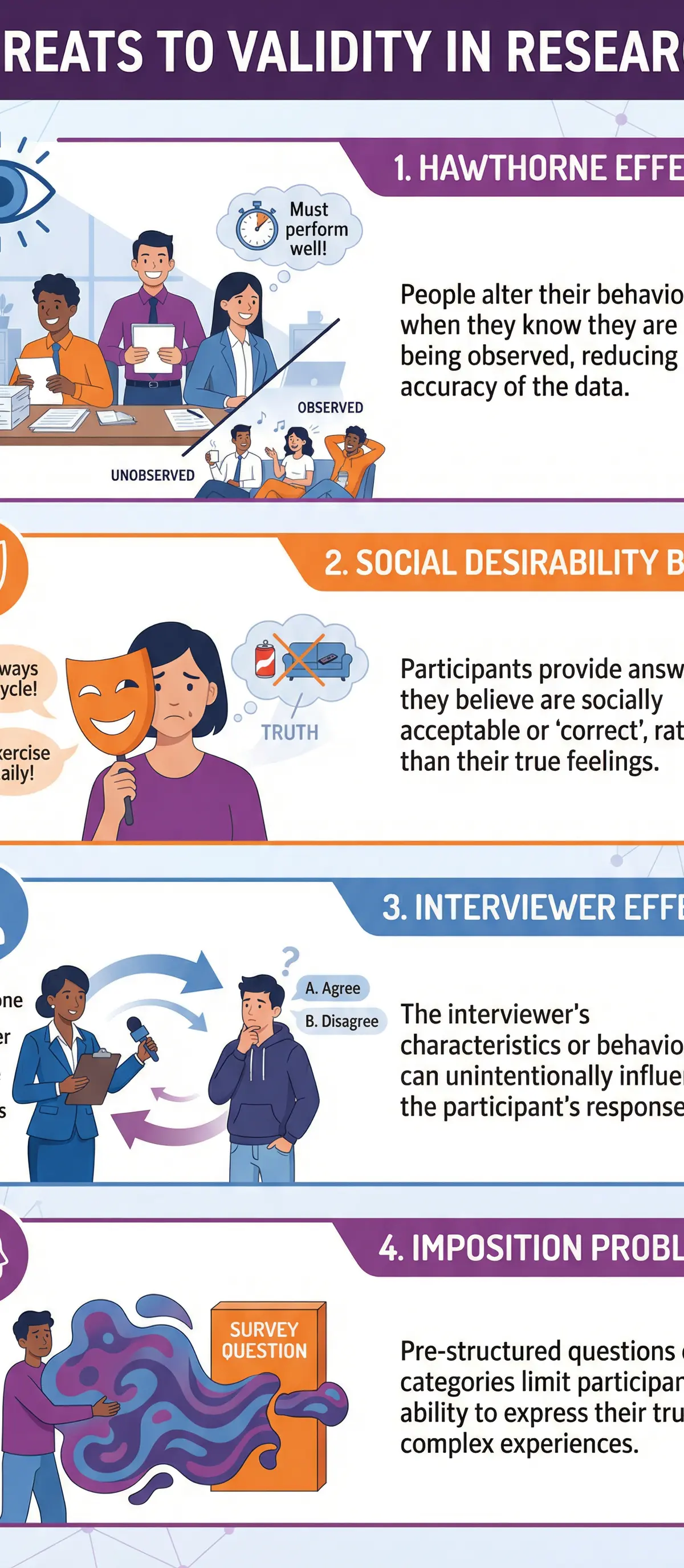
Even when researchers aim for validity, several factors can undermine the truthfulness of their data. You must be able to identify these in the exam.
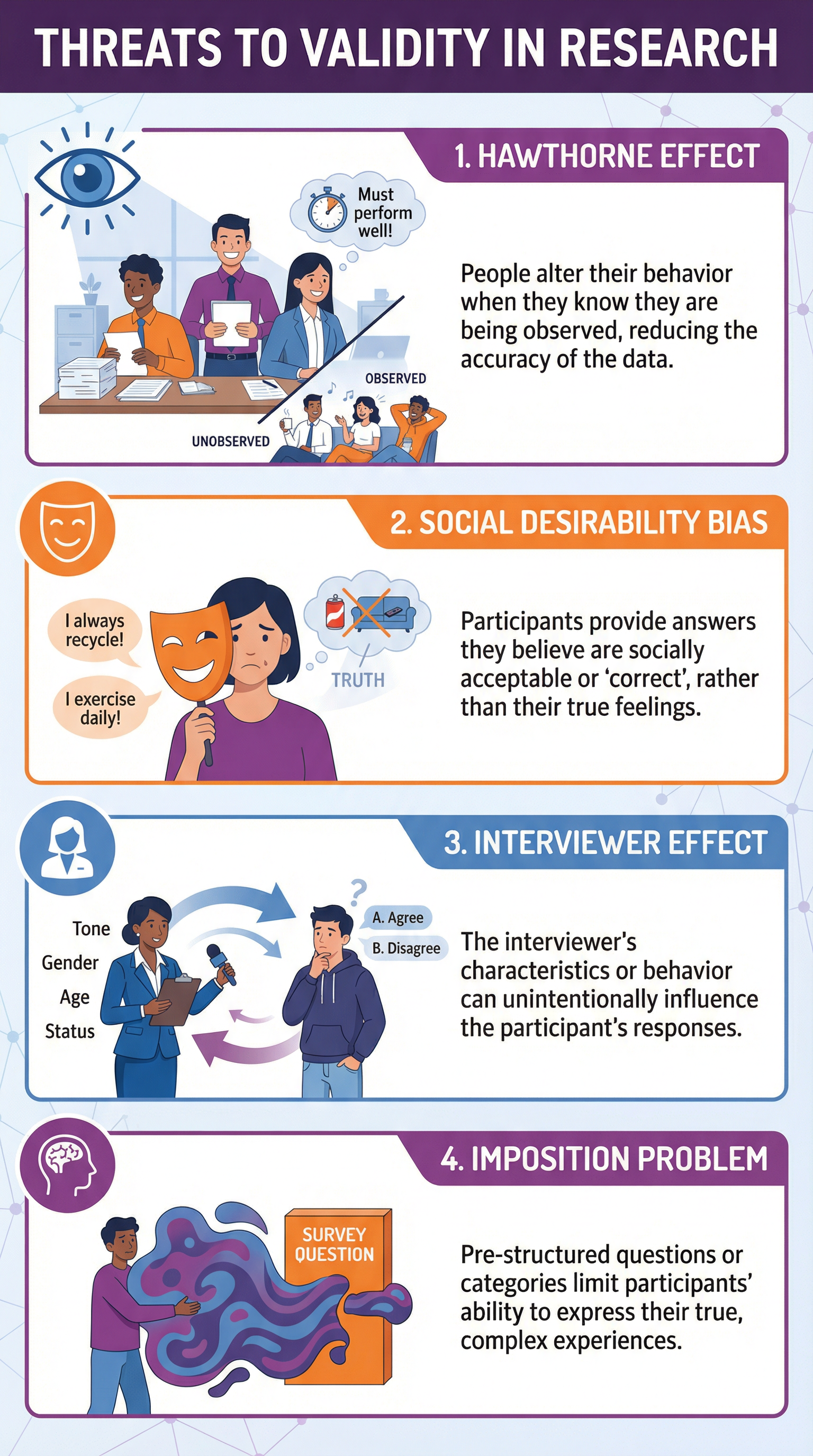
- The Hawthorne Effect: This occurs when people know they are being studied and change their behavior as a result. They may act differently simply because they are being observed, making the data an invalid picture of their normal lives.
- Social Desirability Bias: Participants may give answers that they think are socially acceptable or that paint them in a positive light, rather than giving their true opinions. This is a major issue in research on sensitive topics.
- The Interviewer Effect: The characteristics of the interviewer (e.g., their age, gender, ethnicity, or even their tone of voice) can influence the responses given by the interviewee, potentially biasing the data.
- The Imposition Problem: This applies mainly to structured methods like questionnaires. The researcher imposes their own framework of questions and answer choices, which may not reflect the participants' true thoughts or feelings. The available options may not allow them to express what they really think, thus reducing validity.
Research Methods Compared
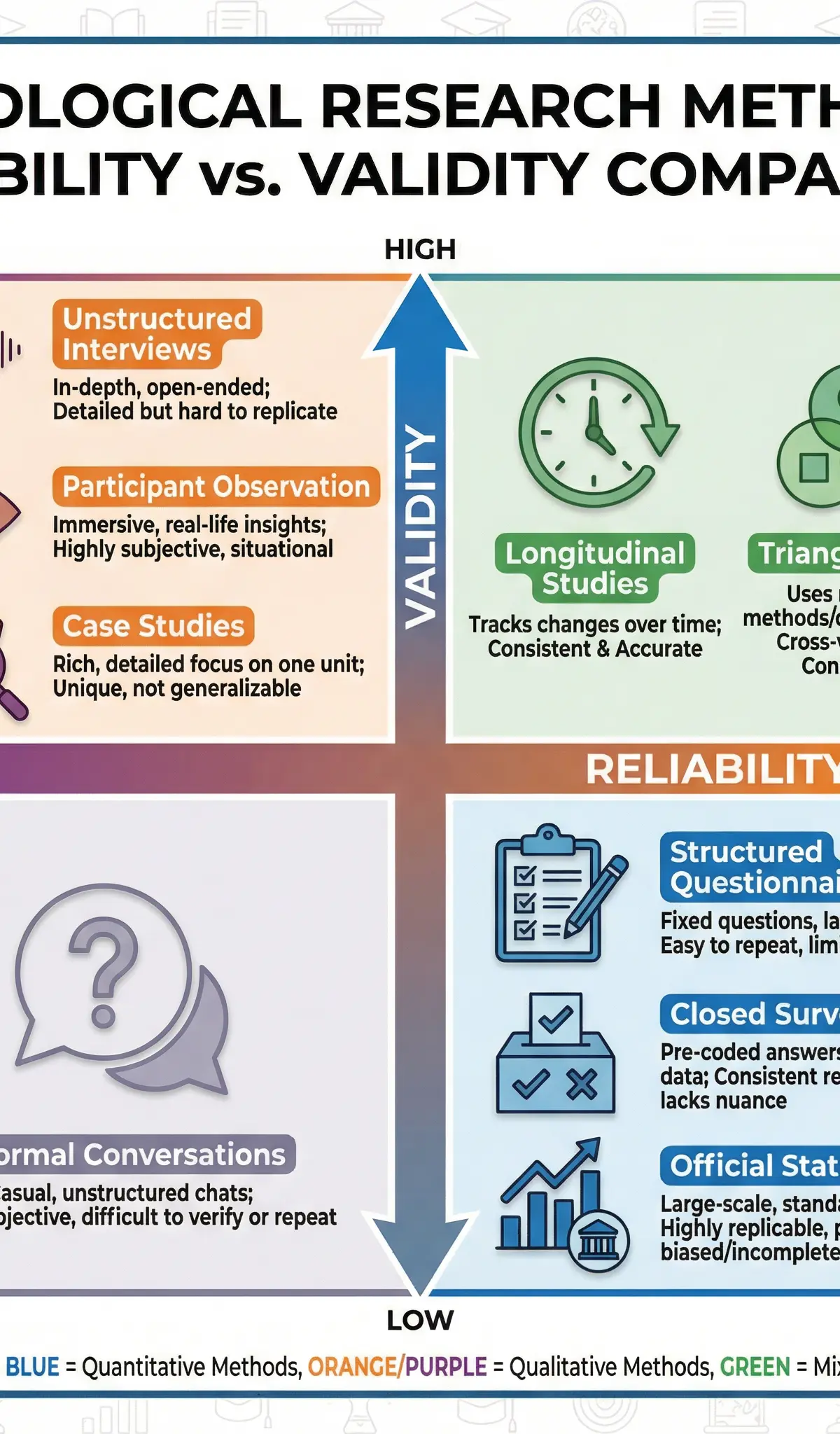
This chart helps you visualize where different methods sit on the reliability and validity spectrum. Use it to guide your evaluation in exam answers.
Visual Resources
3 diagrams and illustrations
Interactive Diagrams
1 interactive diagram to visualise key concepts
Conceptual Flow Outline
Flowchart showing the choice of research method and its impact on reliability and validity.
Worked Examples
3 worked examples — open one to explore the question and available guidance.
Practice Questions
Try the question, then reveal an answer plan or example response
Describe two strengths of using structured questionnaires in sociological research. (4 marks)
Hint: Think about the PET framework. What are the practical and theoretical advantages?
Explain why Interpretivists prefer qualitative research methods. (6 marks)
Hint: Link your answer to the core beliefs of Interpretivism and the concept of validity.
Using the source, explain two ethical issues a sociologist might face when conducting this research. (4 marks)
Hint: Focus on the specific group being studied and the method used.
Evaluate the use of participant observation in sociology. (12 marks)
Hint: Structure your answer with an introduction, paragraphs on strengths (e.g., validity), paragraphs on limitations (e.g., reliability, ethics), and a justified conclusion.
Assess the usefulness of personal documents (such as diaries or letters) in sociological research. (12 marks)
Hint: Consider their strengths in terms of validity and their weaknesses in terms of reliability and representativeness.
Exam technique
How to turn what you know into marks
How to approach the question
1. **Identify the Command Word**: Is it 'Explain', 'Evaluate', 'Assess'? This tells you what skill is being tested. 2. **Identify the Topic**: What key concepts are involved (e.g., reliability, validity)? 3. **Identify the Focus**: What specific method or source is the question about?
How to structure your answer
- Essay questions
- Introduction setting out your argument -> 2-3 points FOR the view -> 2-3 points AGAINST the view -> A clear, justified conclusion that directly answers the question.
- Source questions
- For 'how useful' questions: Content (what it says) -> Provenance (who made it, why) -> Strengths -> Limitations -> Overall Judgement.
- Explain questions
- PEE structure: Make a **P**oint, **E**xplain it using sociological concepts, and provide an **E**xample or link back to the source.
Timing
Approximately 1.5 minutes per mark. For a 12-mark question, this means around 18 minutes.
Common pitfalls
- Confusing reliability and validity.
- Describing a method without evaluating it (just listing strengths/weaknesses).
- Failing to use concepts and evidence from the item/source provided.
- Not reaching a justified conclusion in 12-mark questions.
What the command words want
- Explain
- Give a reason and explain the cause-and-effect relationship. Use phrases like 'this means that...' or 'this leads to...'.
- Describe
- Give two distinct features/points and develop each one with a sentence of detail.
- Assess / Evaluate
- Make a judgement. You must look at both sides of an argument (strengths and limitations, for and against) and come to a conclusion.
- Using the source...
- You MUST quote from or directly reference the specific information provided in the source as part of your answer.
Watch or listen (optional)
Test your understanding of Reliability and Validity
Active recall beats re-reading. Take an instant quiz now to test what you’ve learned and lock it into long-term memory.
7 days Premium · Then the free plan continues · No card, no charge