OCR · GCSE · Sociology
Roles
This study guide delves into the crucial sociological concepts of roles and status, exploring how our identities are shaped by society. It provides a comprehensive overview for OCR GCSE Sociology students, focusing on key theories, studies, and exam techniques to help you secure top marks.
- 9 min read
- 3 worked examples
- 5 practice questions
Study Notes
Overview
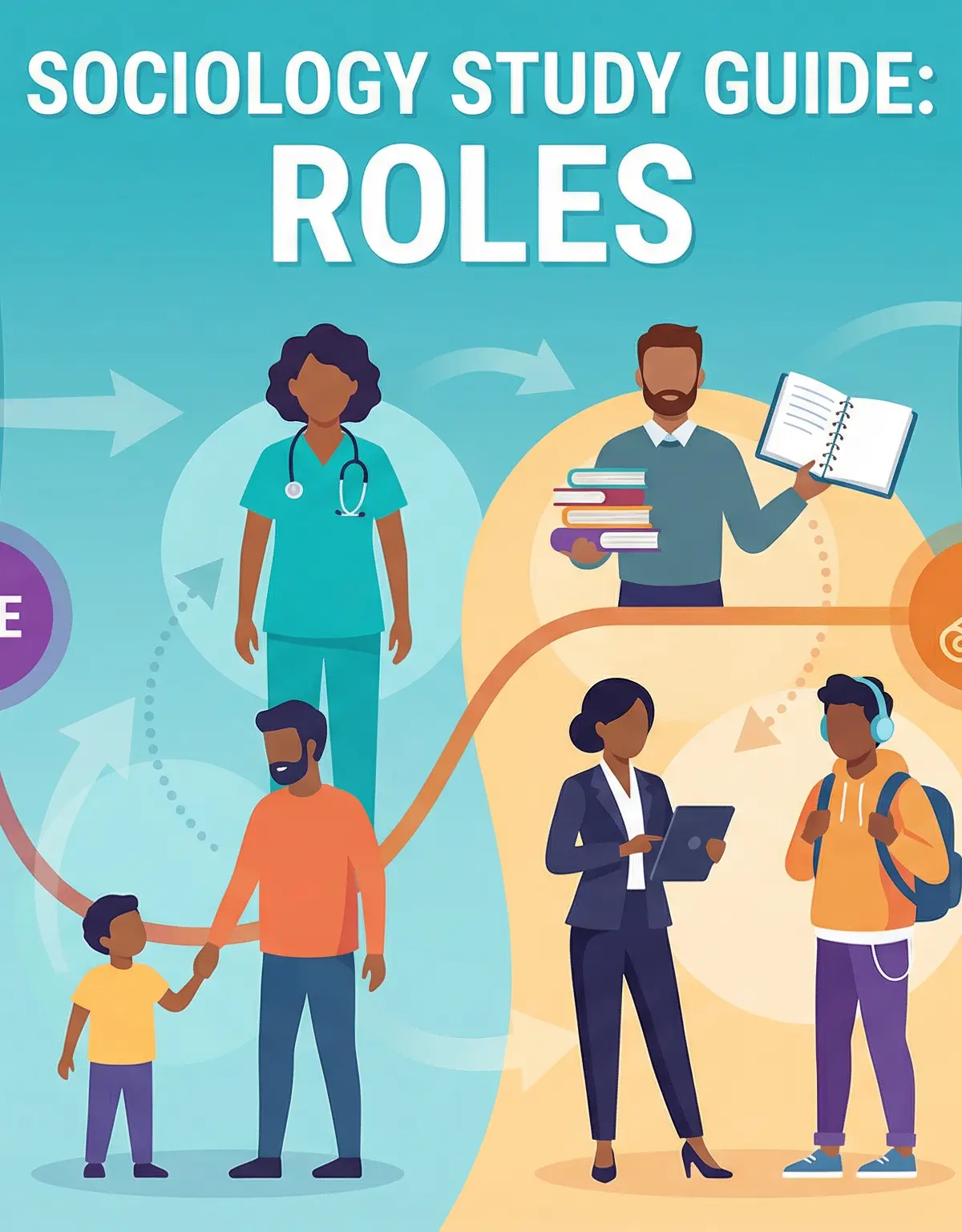
This guide explores the fundamental concepts of social roles and status, central to understanding how society is structured and how individuals find their place within it. For the OCR GCSE Sociology exam, candidates are expected to differentiate between ascribed and achieved status, analyse the process of socialisation through various agents, and critically evaluate theoretical perspectives on roles, such as Functionalism and Feminism. A key focus is on the social construction of gender roles and the dynamics of role conflict and role strain. Examiners will award marks for precise definitions, the application of sociological concepts to real-world examples, and the use of specific studies to support arguments. This topic is not just about memorising definitions; it’s about understanding the dynamic interplay between individual identity and social structure, a skill that is highly valued in sociology.
Key Concepts & Theories
Ascribed vs. Achieved Status
What it is: Ascribed status is a social position assigned to an individual at birth or involuntarily later in life, based on attributes such as age, ethnicity, or family background. In contrast, achieved status is a social position that an individual acquires through their own efforts, skills, and choices, such as becoming a doctor, an artist, or a parent.
Why it matters: This distinction is crucial for understanding social mobility and inequality. While modern societies often emphasise achieved status and meritocracy, ascribed statuses continue to significantly influence life chances. For the exam, candidates must be able to provide clear examples of both and analyse how they intersect.
Specific Knowledge: Link ascribed status to traditional societies and achieved status to modern, industrial societies. Use examples like the caste system in India (ascribed) versus the class system in the UK (more focused on achievement, though still influenced by ascription).
Role Conflict vs. Role Strain
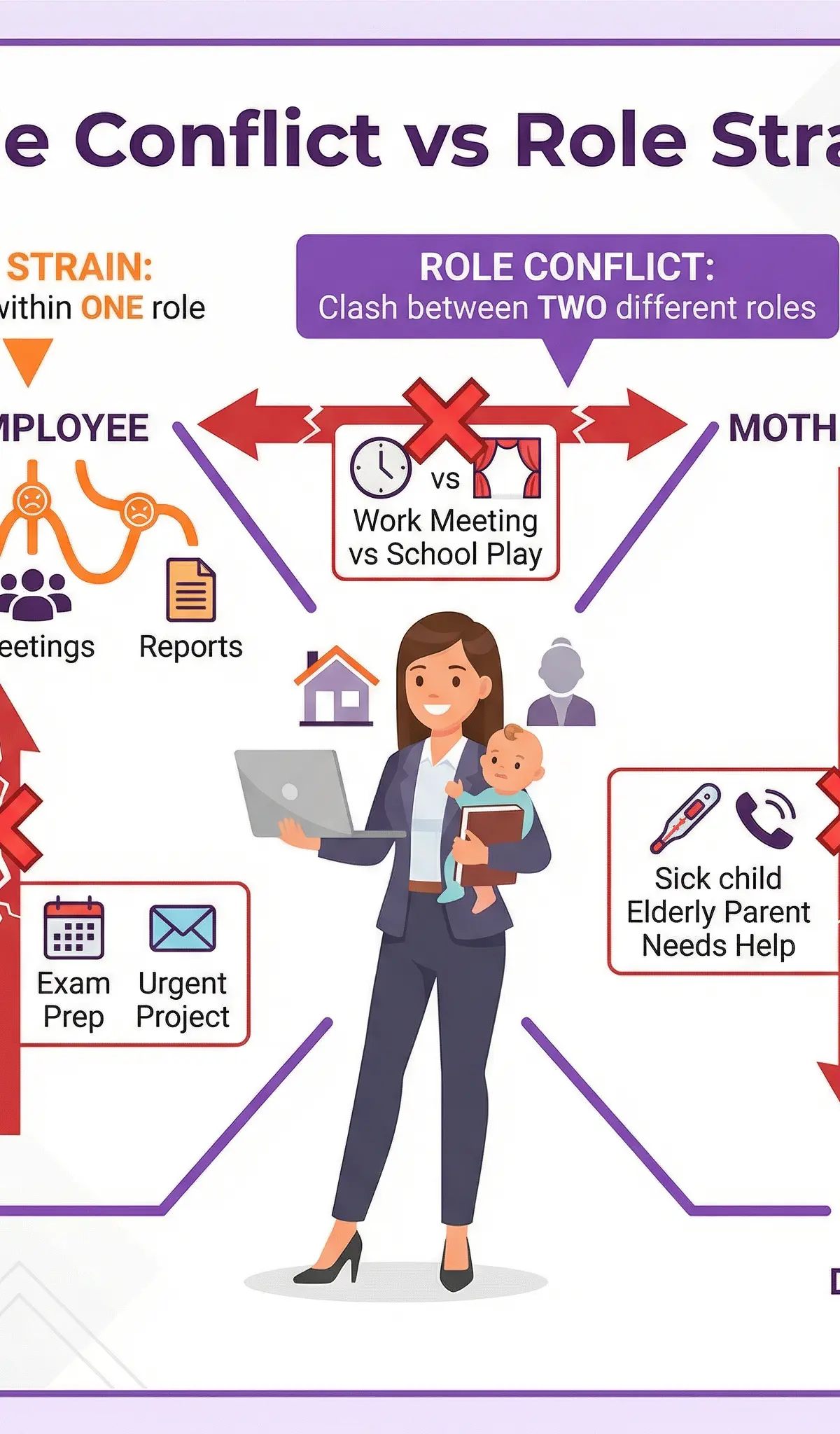
What it is: Role conflict occurs when the expectations of two or more roles held by the same person are incompatible. For example, a police officer who discovers their own child has committed a crime experiences conflict between their role as a parent and their role as an officer of the law. Role strain, on the other hand, refers to the stress or tension experienced within a single role. A student facing multiple deadlines and exams for different subjects is experiencing role strain.
Why it matters: This concept helps explain the pressures individuals face in their daily lives. Examiners frequently test this distinction, so clarity is essential. Credit is given for identifying the clash between different roles (conflict) versus the pressure within one role (strain).
Specific Knowledge: Use clear, distinct examples. For role conflict, focus on the clash between two separate statuses (e.g., employee vs. parent). For role strain, focus on the competing demands of a single status (e.g., a doctor's duty to their patients, their hospital administration, and their own ethical standards).
Agents of Socialisation and Gender Roles
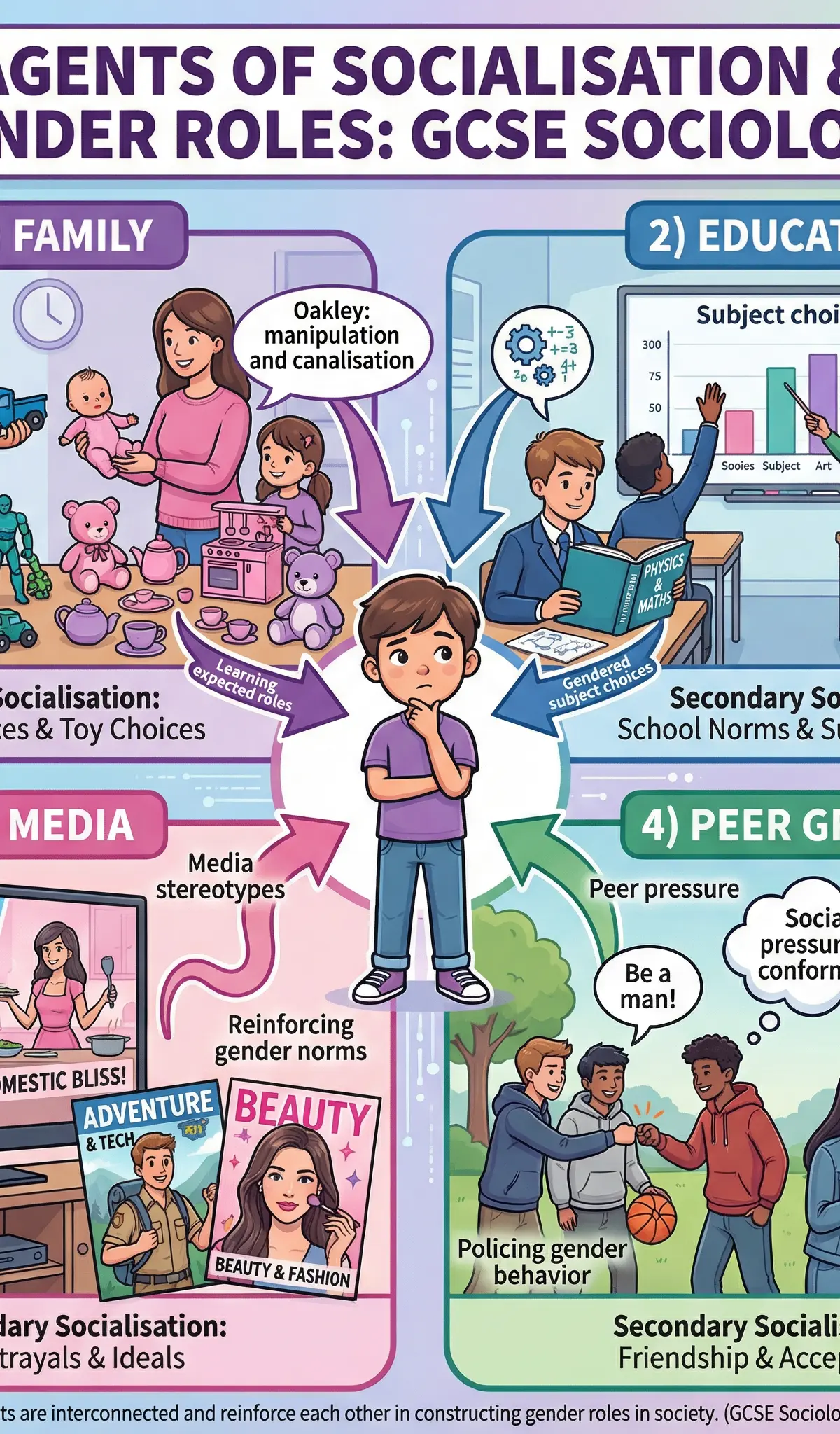
What it is: Agents of socialisation are the institutions and groups that shape our beliefs, values, and behaviours. The main agents are the family (primary socialisation) and education, media, and peer groups (secondary socialisation). These agents are instrumental in the social construction of gender roles.
Why it matters: This is a core area of sociology. Understanding how we learn to be 'male' or 'female' according to societal expectations is key. Candidates must move beyond biological explanations and focus on sociological arguments.
Specific Knowledge: Refer to Ann Oakley's work on gender socialisation. She identified two key processes in the family:
- Manipulation: Parents encourage behaviour seen as normal for the gender and discourage other behaviours.
- Canalisation: Parents channel their children's interests into gender-appropriate toys and activities.
Also, discuss the hidden curriculum in schools and stereotypical media portrayals.
Theoretical Perspectives on Roles
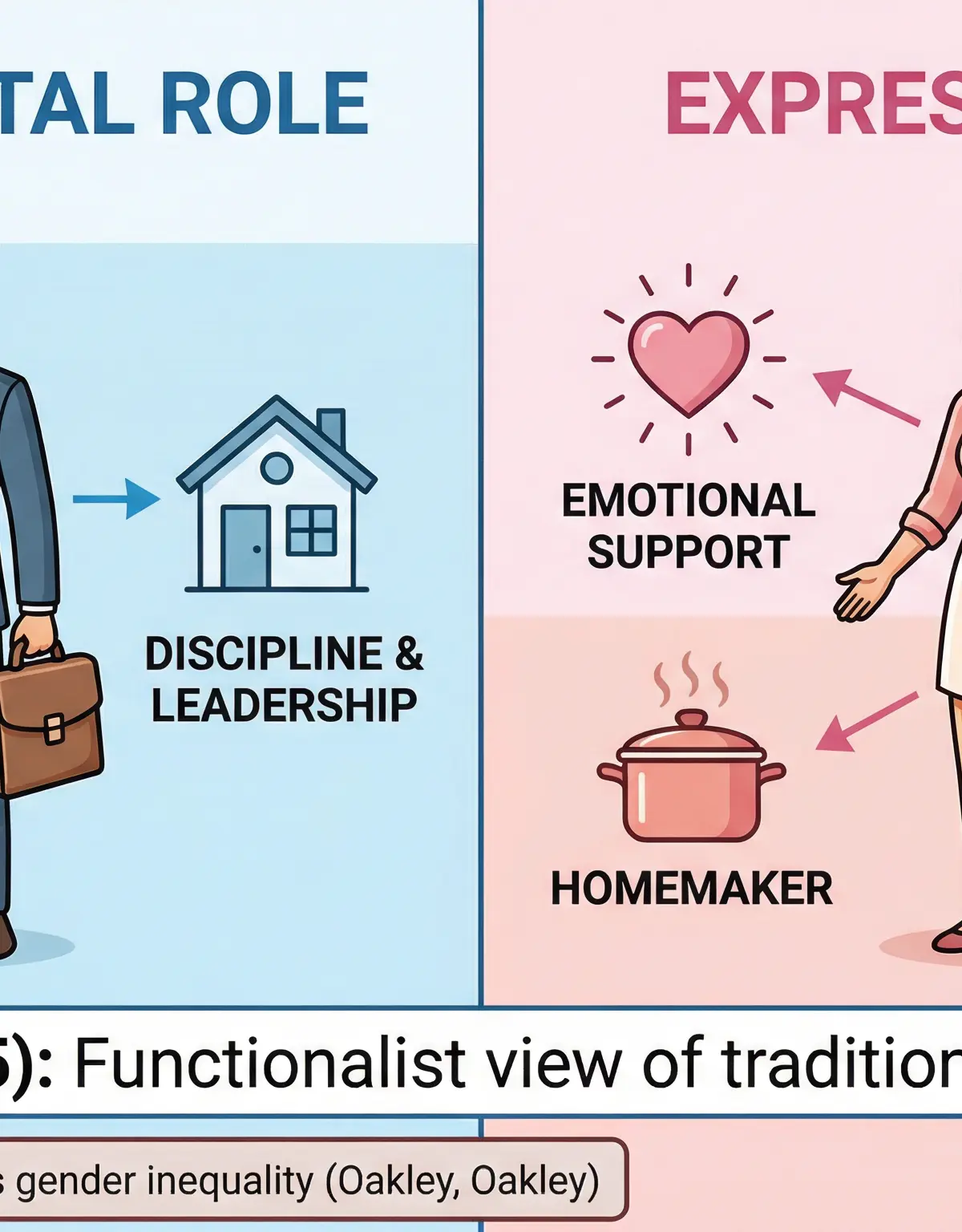
Functionalism: Functionalists, like Talcott Parsons, argue that roles contribute to social stability. Parsons identified the instrumental role (breadwinner, leader) and the expressive role (homemaker, nurturer) in the traditional nuclear family, seeing this division as functional for society.
Feminism: Feminists, such as Ann Oakley, strongly critique the Functionalist view. They argue that this division of labour is not 'natural' but a social construct that perpetuates gender inequality. The expressive role traps women in a subordinate position, dependent on men. They argue that gender roles are a source of conflict and oppression.
Why it matters: Contrasting these two perspectives is a classic exam requirement, especially for higher-mark questions. It demonstrates AO3 skills (analysis and evaluation).
Specific Knowledge: Be able to clearly state Parsons' theory and then critique it from a Feminist perspective, using Oakley as a key sociologist.
Key Individuals
Ann Oakley
Role: Feminist Sociologist
Key Actions: Conducted influential research on housework, motherhood, and gender socialisation. Critiqued the conventional family and the idea that gender roles are biological.
Impact: Oakley's work is fundamental to understanding the social construction of gender. Her concepts of 'manipulation' and 'canalisation' are essential for explaining how gender roles are learned. Her critique of Parsons is a cornerstone of the Feminist perspective on the family and roles.
Talcott Parsons
Role: Functionalist Sociologist
Key Actions: Developed the theory of the functional fit between the nuclear family and modern society. Proposed the concepts of the instrumental and expressive roles.
Impact: Parsons' theories, though now widely criticised, were highly influential and provide the classic Functionalist viewpoint that candidates must understand and evaluate. His work is the primary point of contrast for Feminist arguments.
Young and Willmott
Role: Sociologists studying the family
Key Actions: Conducted research in the mid-20th century that initially supported the idea of a traditional division of labour but later identified a trend towards the 'symmetrical family', where roles are more shared and equal.
Impact: Their work provides evidence of changing roles within the family over time, which can be used to evaluate both Functionalist and Feminist claims. It shows that roles are not static but dynamic.
Second-Order Concepts
Causation
- Socialisation: The primary cause of role adoption is the lifelong process of socialisation, where individuals internalise the norms and expectations of their culture.
- Social Structure: The organisation of society (e.g., its economic and family structures) creates and shapes the roles available to individuals.
Consequence
- Social Order: When people conform to their roles, it creates predictability and stability (a Functionalist view).
- Social Inequality: Roles can also be a source of inequality, limiting the opportunities of certain groups (e.g., women, ethnic minorities) and creating conflict (a Feminist and Marxist view).
Change & Continuity
- Continuity: Many traditional gender roles, though challenged, persist in society, as seen in the gender pay gap and the division of domestic labour.
- Change: Roles are constantly evolving. For example, the rise of the dual-income family and changing attitudes towards gender have led to more fluid and symmetrical roles in many families.
Significance
- The study of roles is significant because it reveals how individual identity is linked to the wider social structure. It helps us understand the sources of social order and conflict, and the dynamics of power and inequality in society.
Source Skills
When presented with a source on roles (e.g., an article about working mothers, statistics on domestic labour), apply the following framework:
- Content: What does the source say? Identify key data, opinions, or arguments related to sociological concepts like role conflict, gender roles, or socialisation.
- Provenance: Who created the source, when, and why? Is it from a sociologist, a journalist, or a government report? This affects its reliability and validity.
- Application: How can you use this source to support or challenge a sociological theory? For example, does it support the Feminist view of gender inequality or the Functionalist view of social stability? Explicitly quote or reference the source to support your points.
- Limitations: What are the weaknesses of the source? Is it biased? Is the data out of date? Does it present a limited view? Showing you can critically evaluate a source is key to high marks.
Worked Examples
3 worked examples — open one to explore the question and available guidance.
Practice Questions
Try the question, then reveal an answer plan or example response
Evaluate the view that gender roles are socially constructed. (12 marks)
Hint: Use the Feminist perspective (Oakley) as your main argument and contrast it with the Functionalist view or biological arguments. Come to a clear judgement.
Outline and explain one way in which education reinforces gender roles. (6 marks)
Hint: Think about the 'hidden curriculum' or subject choices.
Define the term 'ascribed status' and give one example. (2 marks)
Hint: Think about what is given to you at birth.
Explain the difference between role conflict and role strain. (4 marks)
Hint: One is between roles, one is within a role. Use examples.
Using your own knowledge, explain how the peer group can act as an agent of socialisation. (6 marks)
Hint: Think about social pressure and conformity, especially during adolescence.
Watch or listen (optional)
Test your understanding of Roles
Active recall beats re-reading. Take an instant quiz now to test what you’ve learned and lock it into long-term memory.
7 days Premium · Then the free plan continues · No card, no charge