OCR · GCSE · Sociology
Social Class
This guide provides a comprehensive analysis of Social Class for OCR GCSE Sociology (J204), focusing on core theories, life chances, and exam technique. It unpacks the debates between Functionalist, Marxist, and Weberian perspectives, equipping candidates to earn high marks across all assessment objectives.
- 6 min read
- 3 worked examples
- 5 practice questions
- 8 key terms
Check what you remember
Read the wording for your board, then hide it and explain Social Stratification in your own words. Rough notes are fine. This is a self-check, with no mark or grade.
Reference: OCR
The hierarchical division of society into layers (strata) based on unequal access to power, property, and prestige.
Study Notes
Overview
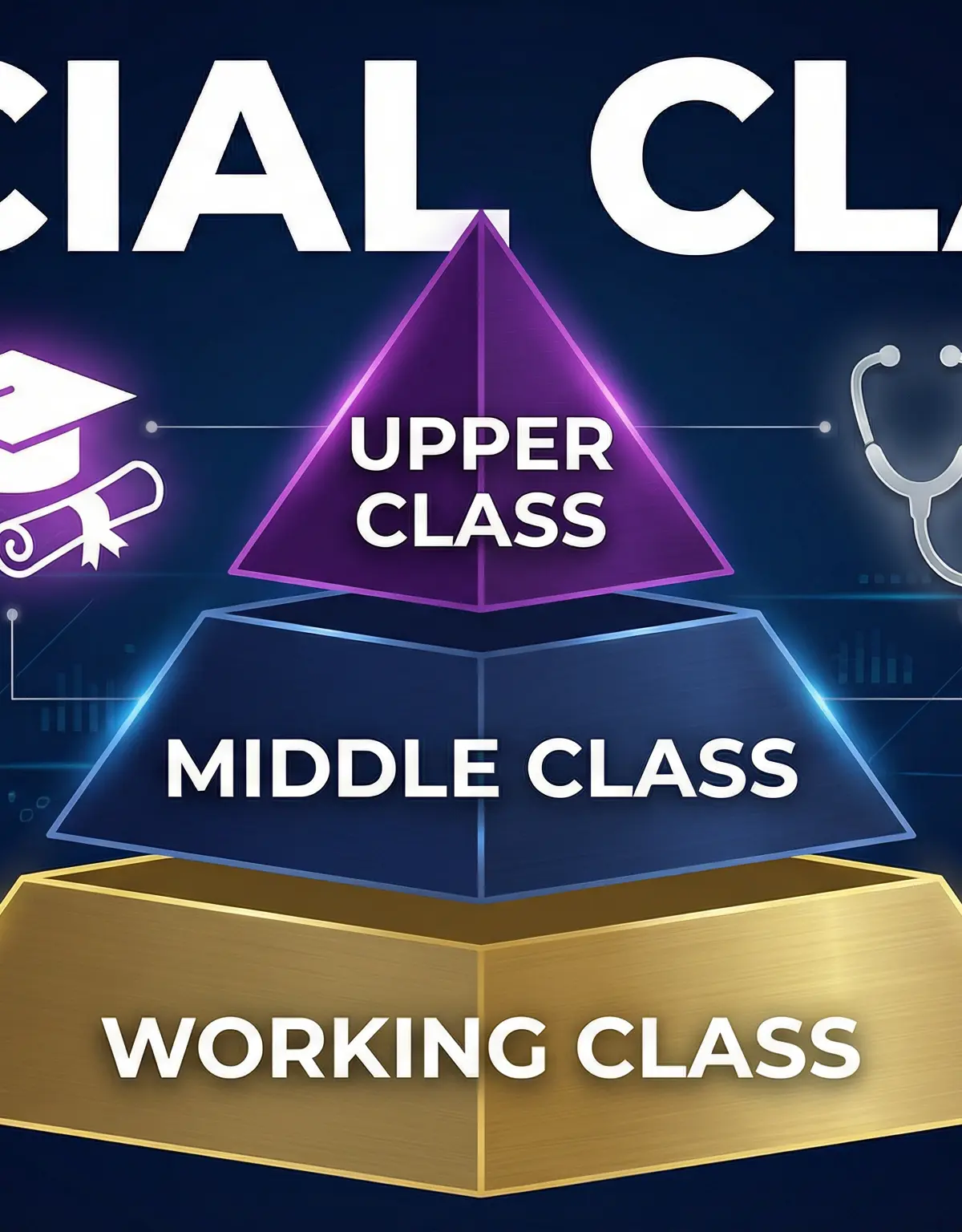
Social Class is a foundational topic in sociology, representing a major system of social stratification — the hierarchical division of society into layers based on unequal access to power, wealth, and status. For the OCR J204 specification, candidates must demonstrate a robust understanding of how society is structured and why inequality persists. This involves not just defining class, but critically evaluating the theoretical explanations for its existence. Examiners expect candidates to move beyond common-sense understandings to apply specific sociological concepts and evidence. A high-scoring response will contrast the functionalist view of meritocracy with the Marxist focus on conflict and exploitation, while also appreciating the nuanced, multi-dimensional approach of Weber. Furthermore, you must link these abstract theories to the concrete realities of differential life chances in health, education, and housing, using contemporary evidence to support your arguments.
Key Concepts: Measuring Social Class
Measurement is not neutral — how we define and measure class shapes our understanding of it. Examiners look for a comparison between traditional and modern scales.
The Registrar General's Scale (1911–2001) was based purely on occupation, dividing the population into five social classes (I–V), from Professional to Unskilled Manual. It is now considered outdated because it ignored women's independent status, the decline of manual work, and the growth of the service sector.
The NS-SEC (National Statistics Socio-Economic Classification, 2001–present) is the current official classification. It has eight categories and is more nuanced, considering employment relations and market conditions — whether someone is an employer, self-employed, or employee. Always contrast these two scales in the exam and evaluate their strengths and limitations.
Theoretical Perspectives
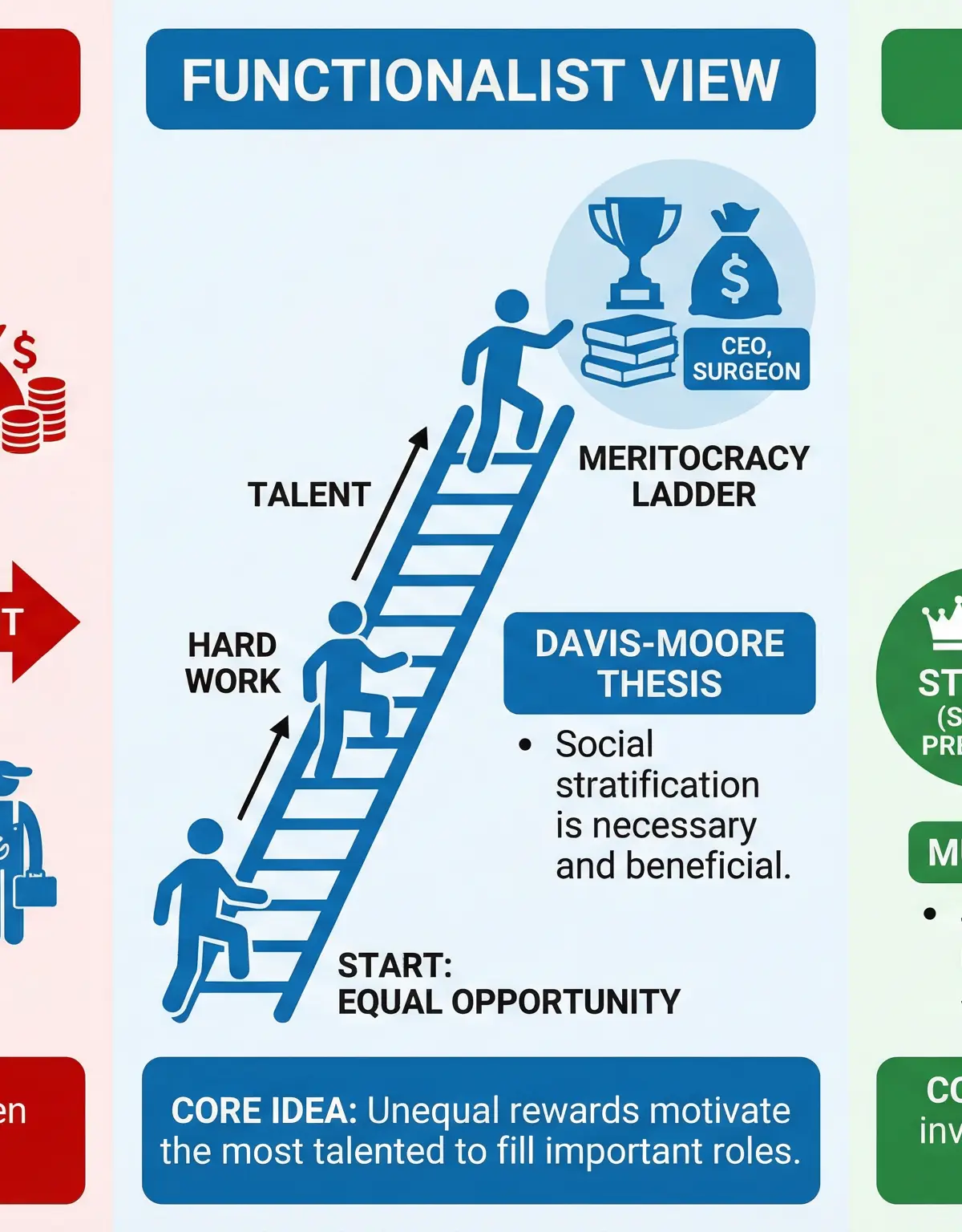
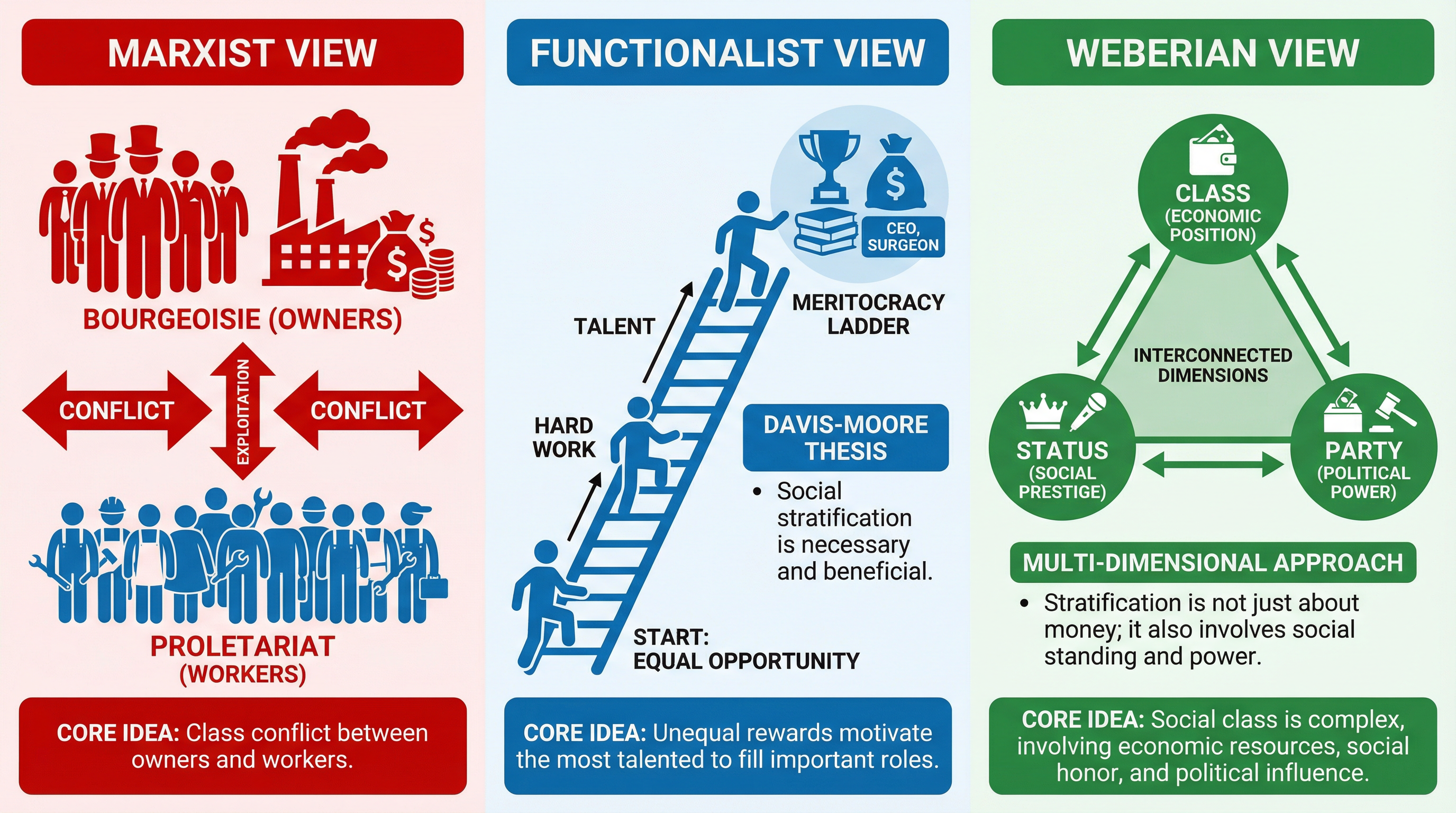
The three main theoretical perspectives on social class are the bedrock of any essay. You must be able to explain, apply, and evaluate all three.
Functionalism (Davis and Moore, 1945) argues that stratification is a universal necessity. Society needs to fill its most important roles with the most talented people. Unequal rewards — higher pay, status — provide the motivation for individuals to undergo the necessary training and sacrifice. This creates a meritocracy where position is earned. Evaluation: Critics argue this ignores how inherited wealth and cultural capital (Bourdieu) give the wealthy an unfair advantage, fundamentally undermining meritocracy.
Marxism (Karl Marx) sees class as defined by the economic relationship to the means of production. In capitalism, this creates two classes in conflict: the Bourgeoisie (owners) and the Proletariat (workers). The owners exploit workers by paying them less than the value they create, generating profit as surplus value. This is a conflict theory predicting eventual revolution. Evaluation: The rise of a large middle class and evidence of social mobility (Goldthorpe's Oxford Mobility Study) challenge Marx's rigid two-class model.
Weberianism (Max Weber) agrees with Marx on the importance of economics but adds two further dimensions. Stratification is a product of Class (economic market position), Status (social honour or prestige), and Party (political power). This multi-dimensional approach explains phenomena like status inconsistency — for example, a lottery winner who has wealth but no social status.
Social Class and Life Chances
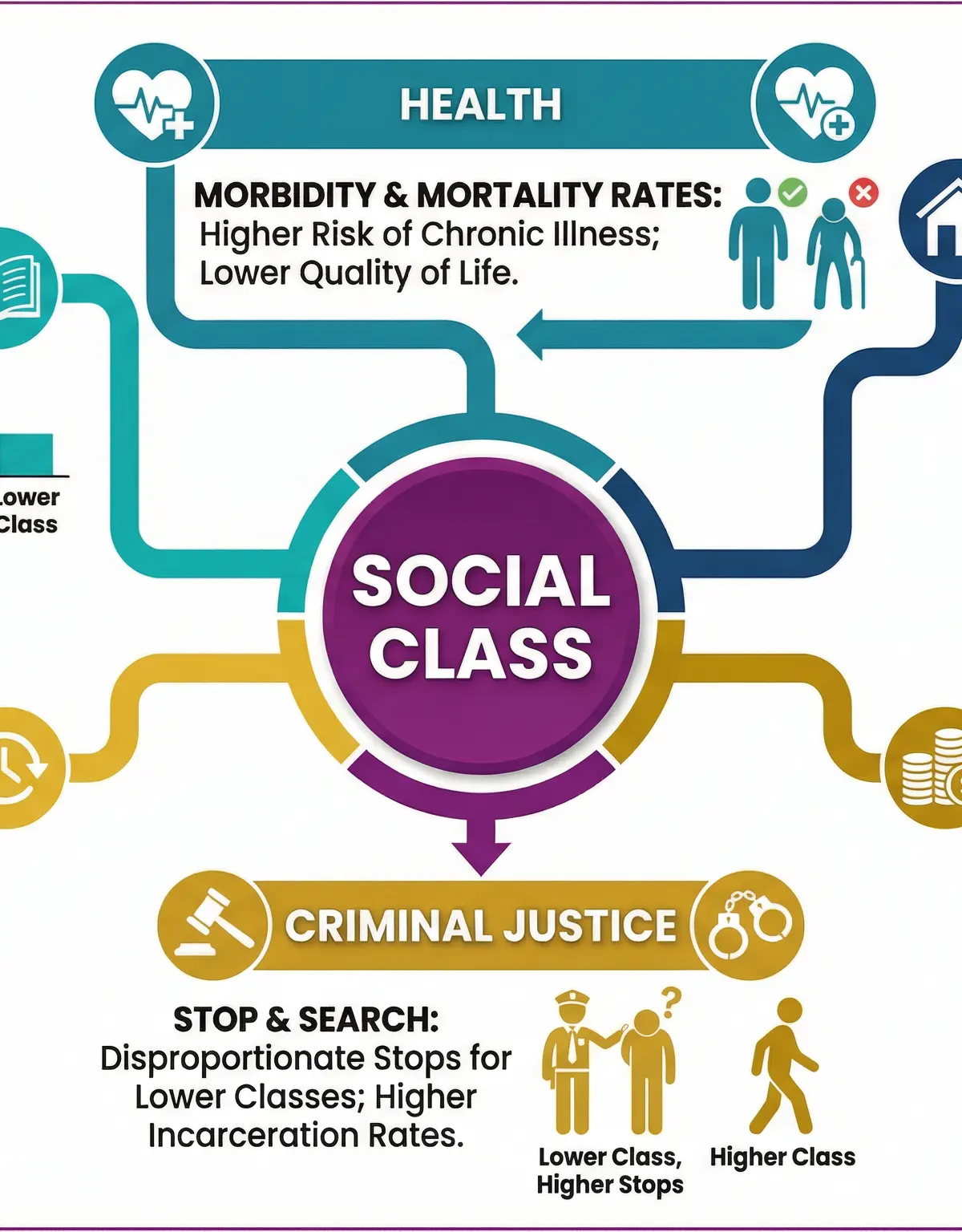
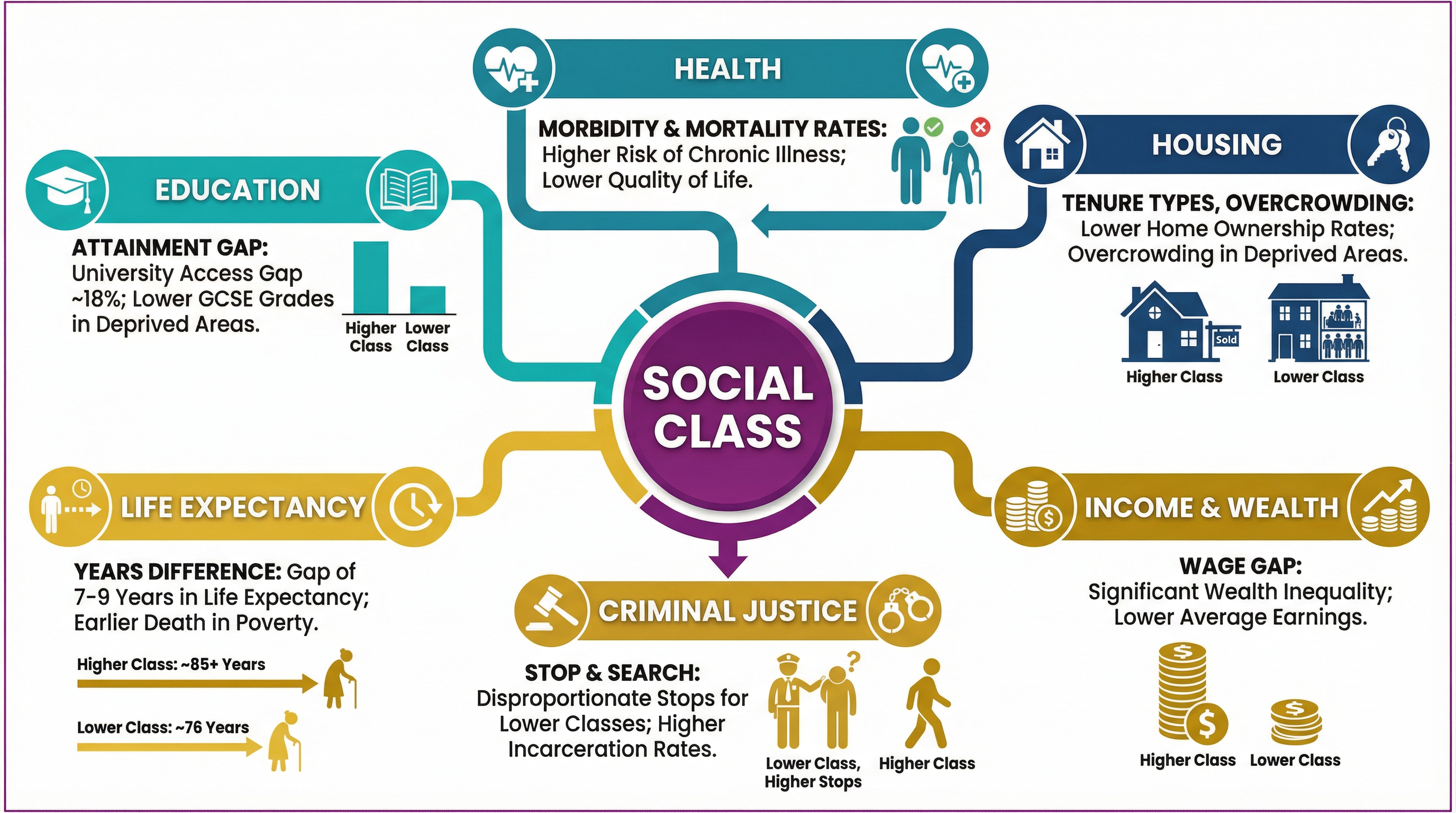
The concept of life chances — the opportunities each individual has to improve their quality of life — is central to AO2 application marks. Your social class position significantly affects your life chances across multiple domains.
In education, children from higher social classes consistently outperform their working-class peers. Bourdieu's concept of cultural capital explains how middle and upper-class families possess the knowledge, skills, and cultural resources that schools reward, giving their children an inbuilt advantage.
In health, the Black Report (1980) and the Marmot Review (2010) demonstrate a clear social gradient in health outcomes. Working-class people have higher rates of morbidity (illness) and mortality (death). Men in the most deprived areas of England live approximately nine years less than those in the most affluent areas.
In housing, lower-class families are more likely to live in rented accommodation, in areas with higher pollution, overcrowding, and fewer green spaces — all of which compound health and educational disadvantages.
Key Debates
The Underclass: The New Right thinker Charles Murray argued in the 1980s–90s that there exists a distinct underclass characterised by welfare dependency and a culture of poverty, caused by perverse welfare incentives. Critics like William Julius Wilson argue the underclass is a result of structural factors — deindustrialisation, unemployment, racial discrimination — not cultural failings. Always evaluate both sides.
Embourgeoisement: The thesis that affluent workers were becoming middle-class in attitudes and lifestyles. Goldthorpe and Lockwood's Affluent Worker Study (1960s) refuted this — while workers had acquired consumer goods, their work attitudes, social networks, and political identities remained distinctly working-class.
Visual Resources
2 diagrams and illustrations
Interactive Diagrams
2 interactive diagrams to visualise key concepts
Conceptual Flow Outline
Flowchart showing the impact of Social Class on various Life Chances.
Conceptual Flow Outline
Overview of the three main sociological theories of Social Class.
Worked Examples
3 worked examples — open one to explore the question and available guidance.
Practice Questions
Try the question, then reveal an answer plan or example response
Describe two features of the modern working class. (8 marks)
Hint: Think about the decline of traditional industries and the rise of the service sector.
Explain the difference between wealth and income. (4 marks)
Hint: Think about 'stock' versus 'flow'.
Evaluate the Marxist view of social class. (12 marks)
Hint: Start with Marx's core ideas (bourgeoisie/proletariat, exploitation) and then introduce criticisms from Weberians, Functionalists, or studies on social mobility.
Explain what sociologists mean by 'cultural capital'. (4 marks)
Hint: Think about the advantages middle-class children have in school and who developed this concept.
To what extent has the working class in the UK disappeared? (12 marks)
Hint: This is a debate. Argue that it has changed, not disappeared. Use concepts like deindustrialisation and embourgeoisement.
Exam technique
How to turn what you know into marks
How to approach the question
BUG the question: Box the command word, Underline the key concepts, Glance back at the question regularly while writing.
How to structure your answer
- Essay questions
- A clear introduction that defines key terms and sets out your line of argument. A series of balanced paragraphs that build your argument with evidence and evaluation. A conclusion that summarises and reinforces your final judgement.
- Explain questions
- PEE(L) structure: Point, Evidence (sociologist, study, statistic), Explanation of how the evidence supports your point, Link back to the question.
- Evaluate questions
- Introduction setting out the debate and your argument. Three to four PEEL paragraphs arguing for and against. A strong, justified conclusion that directly answers the question.
Timing
Approximately 1.25 minutes per mark. For a 24-mark essay, this means around 30 minutes including planning time.
Common pitfalls
- Confusing wealth (a stock of assets) with income (a flow of earnings).
- Describing theories without evaluating them — examiners reward 'however chains'.
- Relying on personal opinion instead of sociological evidence (studies, statistics, named concepts).
- Failing to distinguish between absolute and relative poverty.
What the command words want
- Explain
- Provide reasons why. Use sociological theories and named evidence to support your points.
- Describe
- Give a detailed account. Two developed points are usually sufficient. No evaluation needed.
- Using one example
- Ensure your answer is focused on a single, well-explained example with specific evidence.
- Evaluate / How far do you agree
- Make a judgement. Present both sides of the argument using 'however chains' and come to a substantiated conclusion.
Watch or listen (optional)
Test your understanding of Social Class
Active recall beats re-reading. Take an instant quiz now to test what you’ve learned and lock it into long-term memory.
7 days Premium · Then the free plan continues · No card, no charge