OCR · GCSE · Sociology
Social Control and Punishment
This guide dissects the critical topic of Social Control and Punishment for OCR GCSE Sociology. It explores how society regulates behaviour through both official and unofficial means, and why understanding these mechanisms is essential for analysing power, inequality, and social order.
- 6 min read
- 3 worked examples
- 5 practice questions
- 6 key terms
Check what you remember
Read the wording for your board, then hide it and explain Social Control in your own words. Rough notes are fine. This is a self-check, with no mark or grade.
Reference: OCR
The processes and agencies by which society regulates individual and group behaviour to ensure conformity to norms and values.
Study Notes
Overview
Welcome to your deep dive into Social Control and Punishment, a cornerstone of the OCR J202 Sociology specification. This topic examines the crucial question: how does society ensure conformity? We will explore the mechanisms, both formal and informal, that societies use to regulate behaviour and deal with those who step outside the lines. For examiners, success here hinges on your ability to move beyond common sense. You must precisely define and apply sociological terms, differentiate between agencies of control, and critically evaluate methods of punishment using the core theoretical perspectives of Functionalism, Marxism, and Feminism. This guide will equip you with the specific knowledge, analytical frameworks, and exam techniques needed to secure top marks.
Formal vs. Informal Social Control
This is the most fundamental distinction in this topic. Marks are consistently awarded for candidates who can clearly separate these two concepts and provide accurate examples.
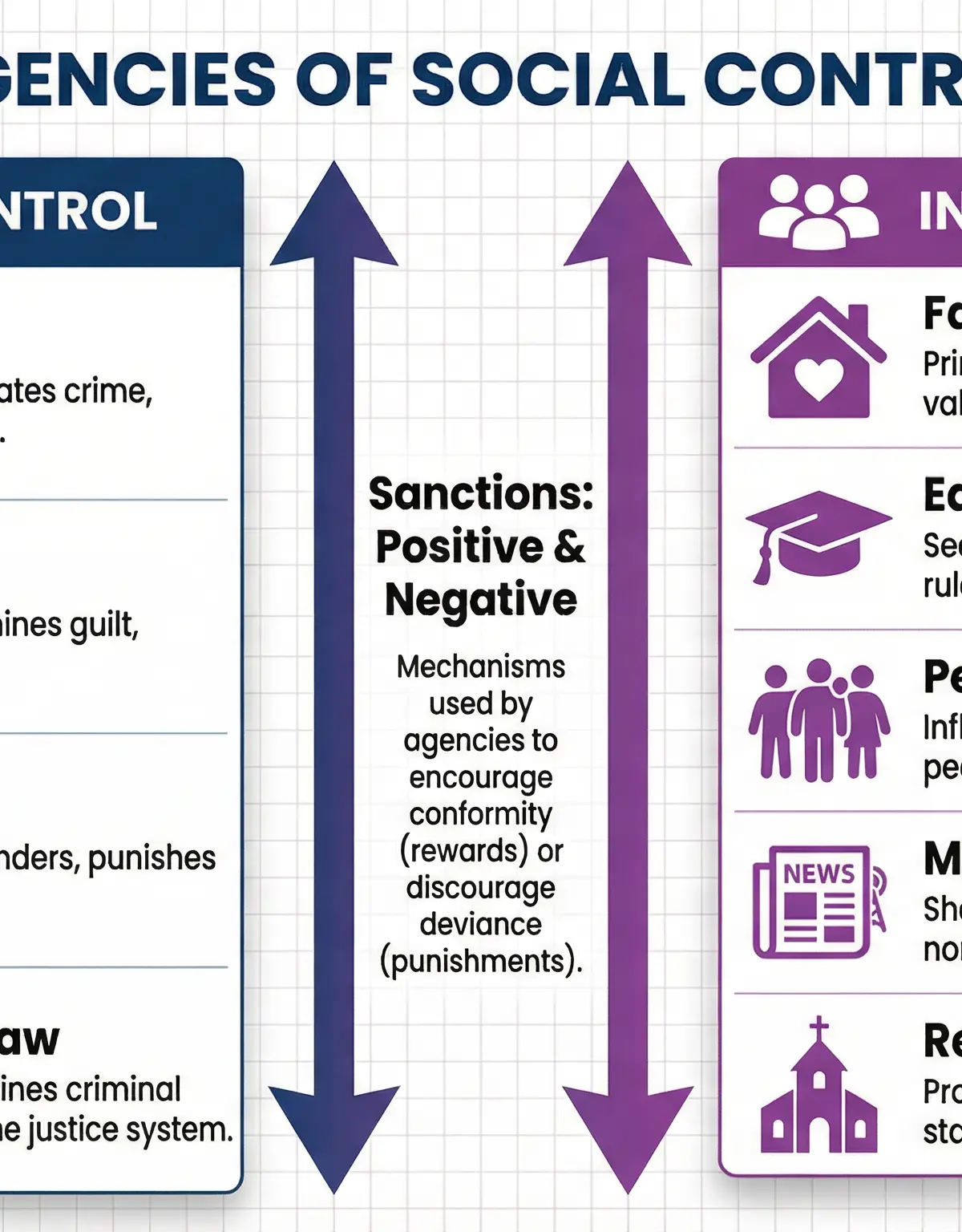
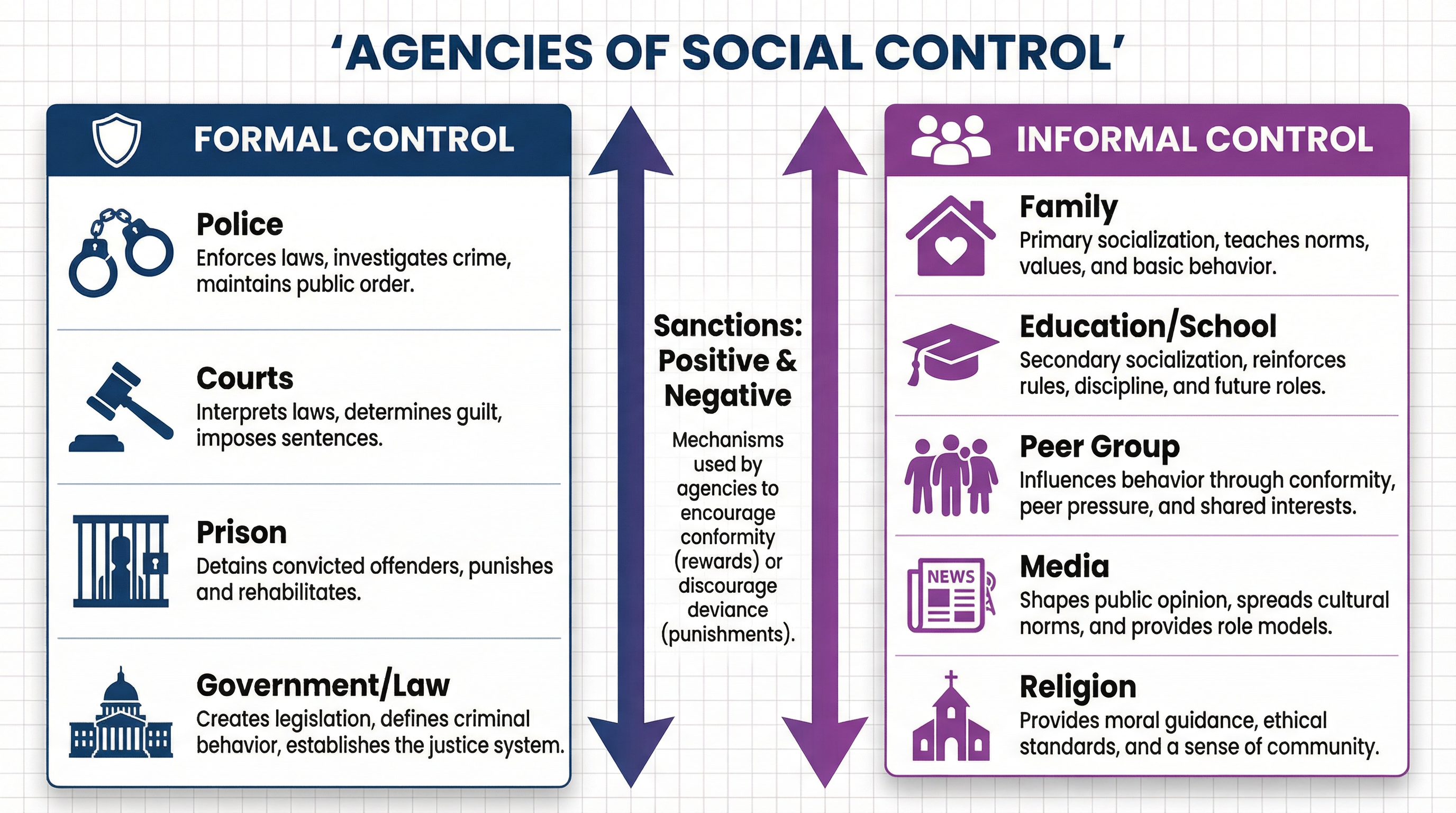
Formal Social Control
What it is: This involves official, codified systems of control enforced by the state. It is based on written laws and carried out by designated agencies with the legal authority to impose punishments (coercion).
Agencies: The main agencies are the Police, the Courts (Criminal Justice System), and the Prison Service. The Government creates the laws they enforce.
Sanctions: Formal sanctions are legal penalties. Examples include fines, prison sentences, community service orders, and capital punishment in some countries. These are negative sanctions designed to punish and deter.
Informal Social Control
What it is: This involves the unwritten rules and social pressures we encounter in everyday life. It is based on shared norms, values, and customs, and is enforced through social interaction, not legal power.
Agencies: Key agencies include the Family, Education, Peer Groups, the Media, and Religion. These are the primary and secondary agents of socialisation.
Sanctions: Informal sanctions can be positive or negative. Positive sanctions (rewards) include praise, smiles, or inclusion. Negative sanctions (punishments) include disapproval, gossip, social exclusion (being 'sent to Coventry'), or being grounded by parents.
Theoretical Perspectives on Social Control
To achieve the highest marks, you must analyse social control through different sociological lenses.
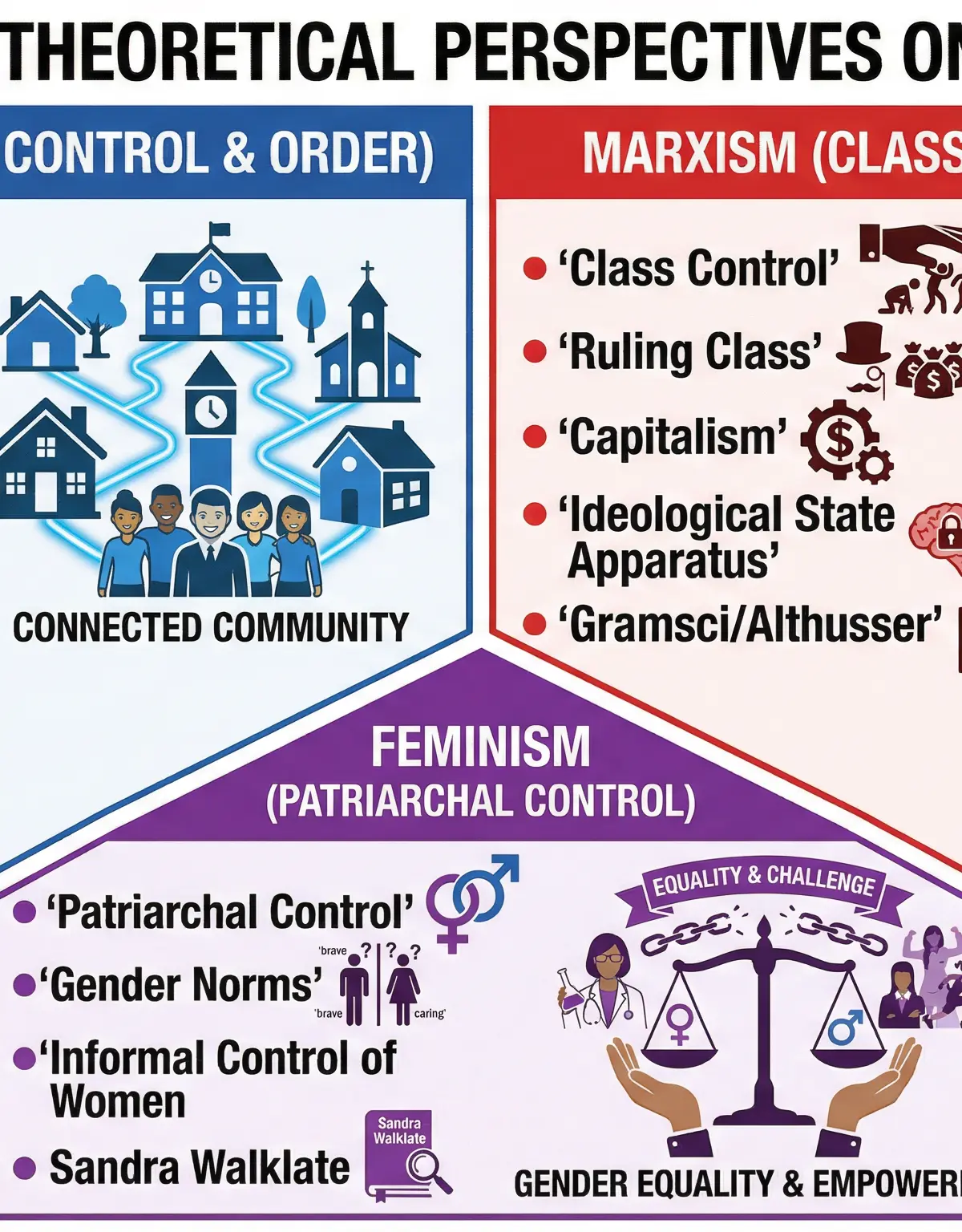
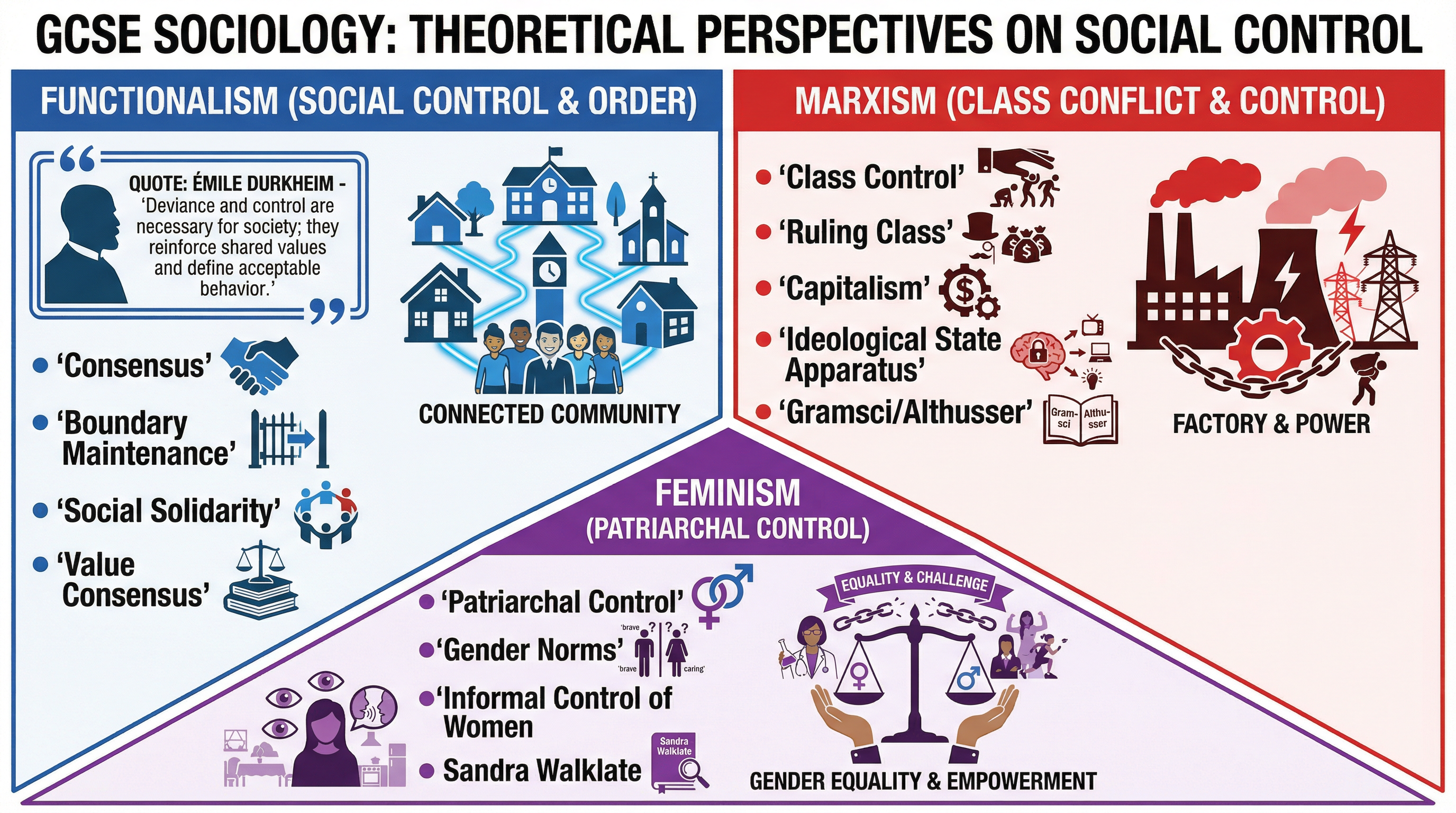
Functionalism
Core Idea: Social control is necessary to maintain social order, value consensus, and social solidarity. It benefits everyone by making society stable and predictable.
Key Thinker: Émile Durkheim argued that punishment serves to reinforce shared values and maintain moral boundaries (boundary maintenance). When a criminal is punished, it reminds everyone else of what is right and wrong, strengthening their collective conscience.
Why it matters: Functionalists see the law as a reflection of the collective will of the people. The agencies of control work to protect society as a whole.
Marxism
Core Idea: Social control is a tool used by the ruling class (bourgeoisie) to maintain power and control over the working class (proletariat). The system is rigged to protect the interests of capitalism.
Key Thinkers: Louis Althusser distinguished between the Repressive State Apparatus (RSA) (the police, courts, army - which control by force) and the Ideological State Apparatus (ISA) (education, media, religion - which control by shaping ideas). Antonio Gramsci developed the concept of hegemony, where the ruling class persuades the working class to accept its values as common sense.
Why it matters: Marxists argue that laws are not neutral. They focus on crimes of the powerless (e.g., street crime) while ignoring the more harmful crimes of the powerful (e.g., corporate fraud). The justice system disproportionately criminalises the working class.
Feminism
Core Idea: Social control is a mechanism for maintaining patriarchy (male dominance). It operates differently for men and women, often reinforcing traditional gender roles.
Key Thinker: Sandra Walklate argues the criminal justice system is patriarchal and often fails to take crimes against women, like domestic violence, seriously. Feminists also highlight the power of informal control in shaping female behaviour, such as the pressure to conform to beauty standards or the fear of male violence restricting their freedom.
Why it matters: Feminists show how both formal and informal agencies can control women's lives and bodies. The concept of double deviance suggests that women who break the law are punished for the crime itself and for deviating from expected female behaviour.
Punishment: Aims and Effectiveness
Examiners expect you to assess the different purposes of punishment.
| Aim of Punishment | Description | Sociological Critique |
|---|---|---|
| Retribution | 'An eye for an eye'. The idea that offenders deserve to be punished for their actions. | Functionalists might see this as upholding moral order. Marxists would question who gets to decide what is a 'just desert'. |
| Deterrence | Trying to discourage the individual (individual deterrence) or others (general deterrence) from committing crimes. | High rates of reoffending (recidivism) suggest prison is not an effective deterrent for many. |
| Rehabilitation | Trying to reform or 'cure' the offender so they can return to society as a law-abiding citizen. | This is a key aim of community sentences and probation, but prisons are often criticised for failing to rehabilitate. |
| Incapacitation | Removing the offender from society to protect the public. | This is the primary function of prison. However, it is expensive and does not solve the underlying causes of crime. |
| Restoration | Having offenders make amends to their victims and the community (Restorative Justice). | Often praised for its focus on repairing harm, but may not be suitable for all types of crime. |
Visual Resources
2 diagrams and illustrations
Interactive Diagrams
1 interactive diagram to visualise key concepts
Conceptual Flow Outline
A flowchart showing the breakdown of social control into its formal and informal agencies.
Worked Examples
3 worked examples — open one to explore the question and available guidance.
Practice Questions
Try the question, then reveal an answer plan or example response
Describe two informal methods of social control. (4 marks)
Hint: Think about agencies that are not part of the legal system, like family or school.
Explain how the media acts as an agency of social control. (5 marks)
Hint: Consider how the media represents certain groups and behaviours. Think about moral panics.
Explain the Marxist view of the law and the criminal justice system. (5 marks)
Hint: Focus on class inequality and the protection of ruling class interests.
Evaluate the Functionalist view of social control. (12 marks)
Hint: Start by explaining the Functionalist view (Durkheim, solidarity), then critique it using Marxism and Feminism.
To what extent do informal methods of social control have a greater impact on our lives than formal methods? (12 marks)
Hint: Argue both sides. For informal: they are constant, from birth, shape our identity. For formal: they have legal power, severe consequences.
Exam technique
How to turn what you know into marks
How to approach the question
Use the 'BUG' method: Box the command word, Underline the key terms, Glance back at the question regularly.
How to structure your answer
- Essay questions
- Introduction with criteria → Balanced argument → Counter-argument → Sustained conclusion
- Discuss questions
- Introduction setting up the debate -> Paragraph FOR -> Paragraph AGAINST -> Second paragraph AGAINST (e.g., a different theory) -> Justified Conclusion.
- Explain questions
- PEE structure: Point, Explain with sociological language, Example.
Timing
Approximately 1.5 minutes per mark. For a 12-mark question, this means around 18 minutes.
Common pitfalls
- Confusing formal and informal control.
- Describing punishment without evaluating its effectiveness.
- Using common sense instead of sociological theory.
- Not linking sanctions to specific agencies.
What the command words want
- Explain
- Give a reason and develop it with sociological concepts and evidence.
- Describe
- State a feature and provide a detailed example. Do this twice for 4 marks.
- Discuss / Evaluate / To what extent
- You MUST argue more than one side. Use contrasting theories (e.g., Functionalism vs. Marxism) and come to a justified conclusion.
Watch or listen (optional)
Test your understanding of Social Control and Punishment
Active recall beats re-reading. Take an instant quiz now to test what you’ve learned and lock it into long-term memory.
7 days Premium · Then the free plan continues · No card, no charge