OCR · GCSE · Sociology
The Impact of Social Class, Gender, and Ethnicity
This study guide for OCR GCSE Sociology delves into the core of social inequality, exploring how social class, gender, and ethnicity shape life chances in the UK. It's designed to equip candidates with the theoretical knowledge and specific evidence needed to analyse and evaluate one of sociology's most fundamental topics."
- 6 min read
- 2 worked examples
- 2 practice questions
Study Notes
Overview
Component 2 (Social Inequality) is a cornerstone of the OCR J204 specification, demanding a rigorous analysis of how society is stratified. This guide focuses on the unequal distribution of power, wealth, and status, viewed through the critical lenses of Functionalism, Marxism, Feminism, and Weberian theory. Candidates are expected to move beyond common-sense understandings to apply these sociological frameworks to the intersectional nature of class, gender, and ethnicity. Examiners award marks for the explicit use of sociological terminology and the ability to support arguments with specific studies and evidence. This topic is not just about describing inequality; it's about explaining why it exists and evaluating competing explanations. Mastering this will provide a powerful toolkit for tackling the highest-mark questions on the paper.
Key Concepts & Theories
Social Class Inequality
What is it?: The division of society into a hierarchy of social classes, based on economic factors like income, wealth, and occupation. This stratification affects everything from educational achievement to life expectancy.
Key Theories:
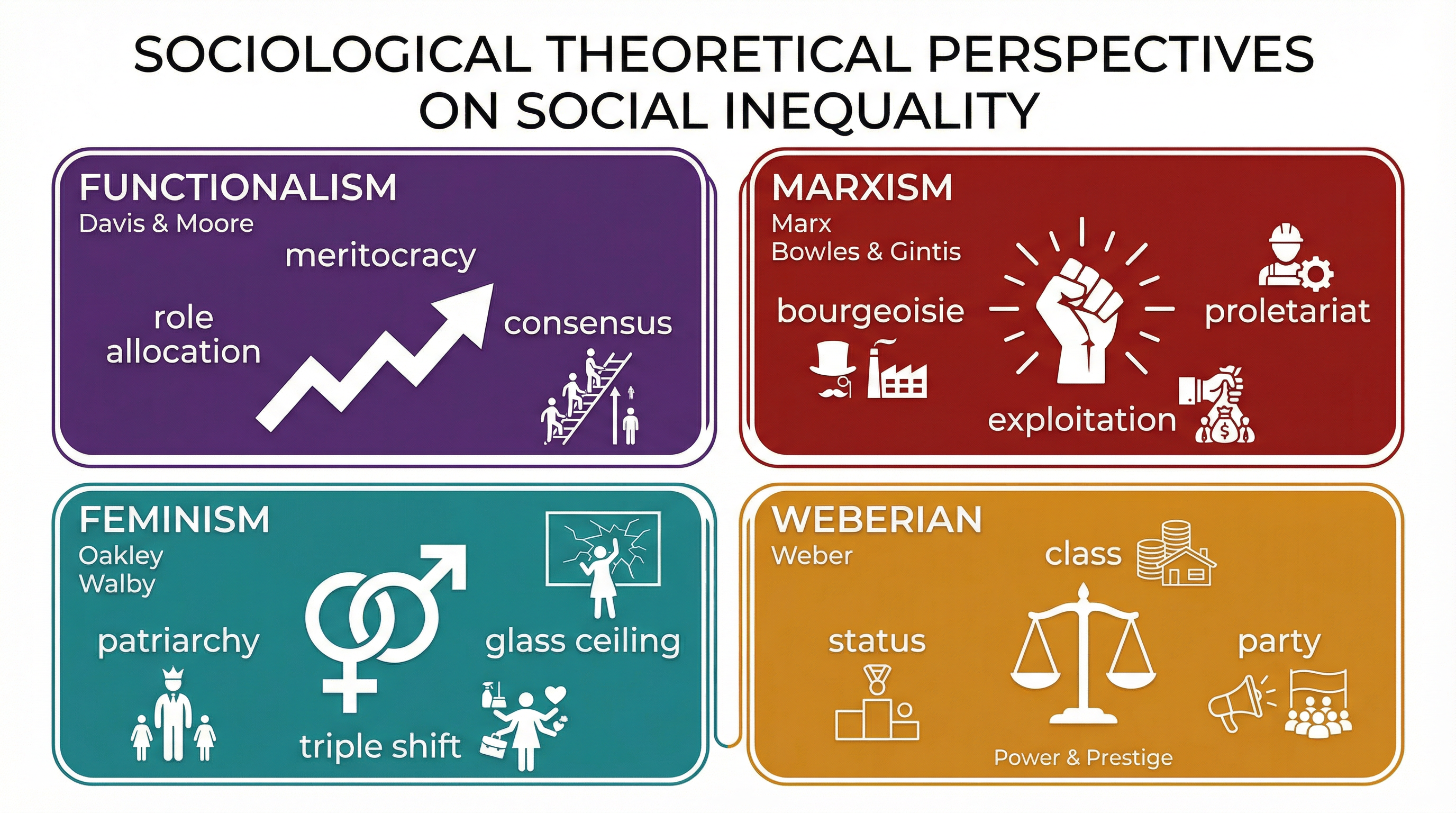
- Marxism: Argues that the fundamental division is between the bourgeoisie (owners of capital) and the proletariat (workers). This relationship is inherently exploitative, creating deep-rooted inequality. Key study: Bowles and Gintis's work on the 'correspondence principle' in education.
- Weberianism: Max Weber added layers to Marx's economic view. He argued for a three-part model of inequality: Class (economic), Status (social prestige), and Party (political power). This helps explain why a low-paid academic might have higher status than a wealthy business owner.
- Functionalism: Theorists like Davis and Moore argue that inequality is necessary and beneficial. They suggest that a system of unequal rewards motivates the most talented individuals to train for and fill the most important roles in society (role allocation).
Specific Knowledge: Candidates must know the difference between income (a flow of money) and wealth (a stock of assets). Reference studies on poverty, such as Peter Townsend's work on relative deprivation.
Gender Inequality
What is it?: The social, economic, and political inequality between men and women. It's crucial to distinguish sex (biological) from gender (a social construct).
Key Theories:
- Feminism: Argues that society is patriarchal – structured in the interests of men. Different strands of feminism (e.g., Liberal, Radical, Marxist) offer different explanations for this. Key concepts: The 'glass ceiling' (an invisible barrier to promotion for women), the 'gender pay gap', and the 'triple shift' (paid work, domestic work, and emotional work). Key study: Ann Oakley's work on the social construction of gender roles.
Specific Knowledge: Use evidence like the ONS statistics on the gender pay gap. Sue Sharpe's study ('Just Like a Girl') on the changing ambitions of working-class girls is a classic to cite for showing shifts over time.
Ethnic Inequality
What is it?: Inequality based on a person's ethnic background, which can manifest in areas like employment, housing, and the criminal justice system.
Key Concepts:
- Institutional Racism: This is a crucial concept. It refers to racism that is embedded in the normal functioning of an institution, rather than just the prejudices of individuals. Key study: The Macpherson Report (1999) into the police investigation of Stephen Lawrence's murder, which famously defined the concept.
- Ethnic Penalty: Refers to the disadvantage that ethnic minorities face in the labour market compared to white counterparts with the same qualifications and experience. Key study: Research by sociologists like Modood and Berthoud has provided extensive evidence for this.
Intersectionality
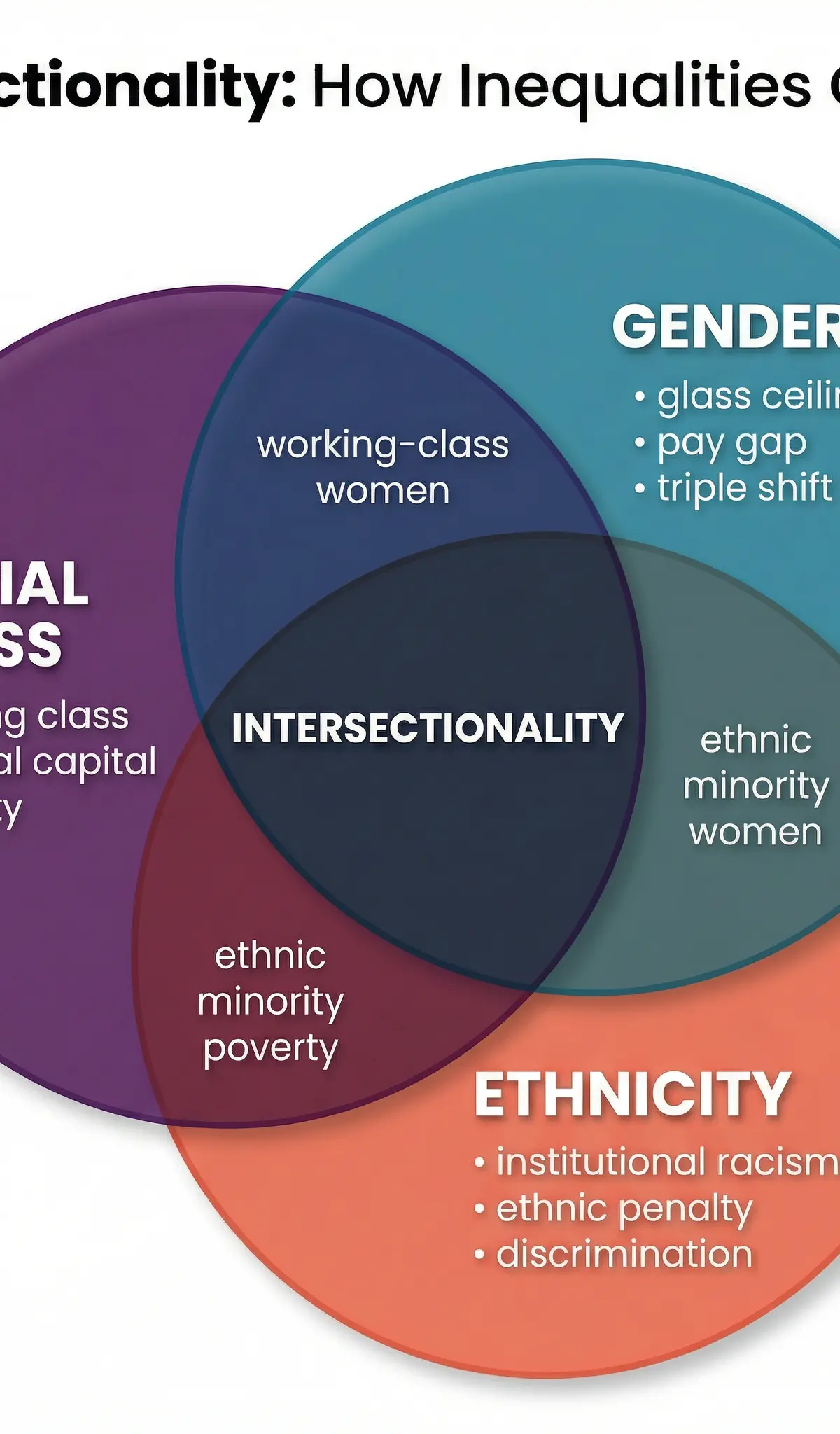
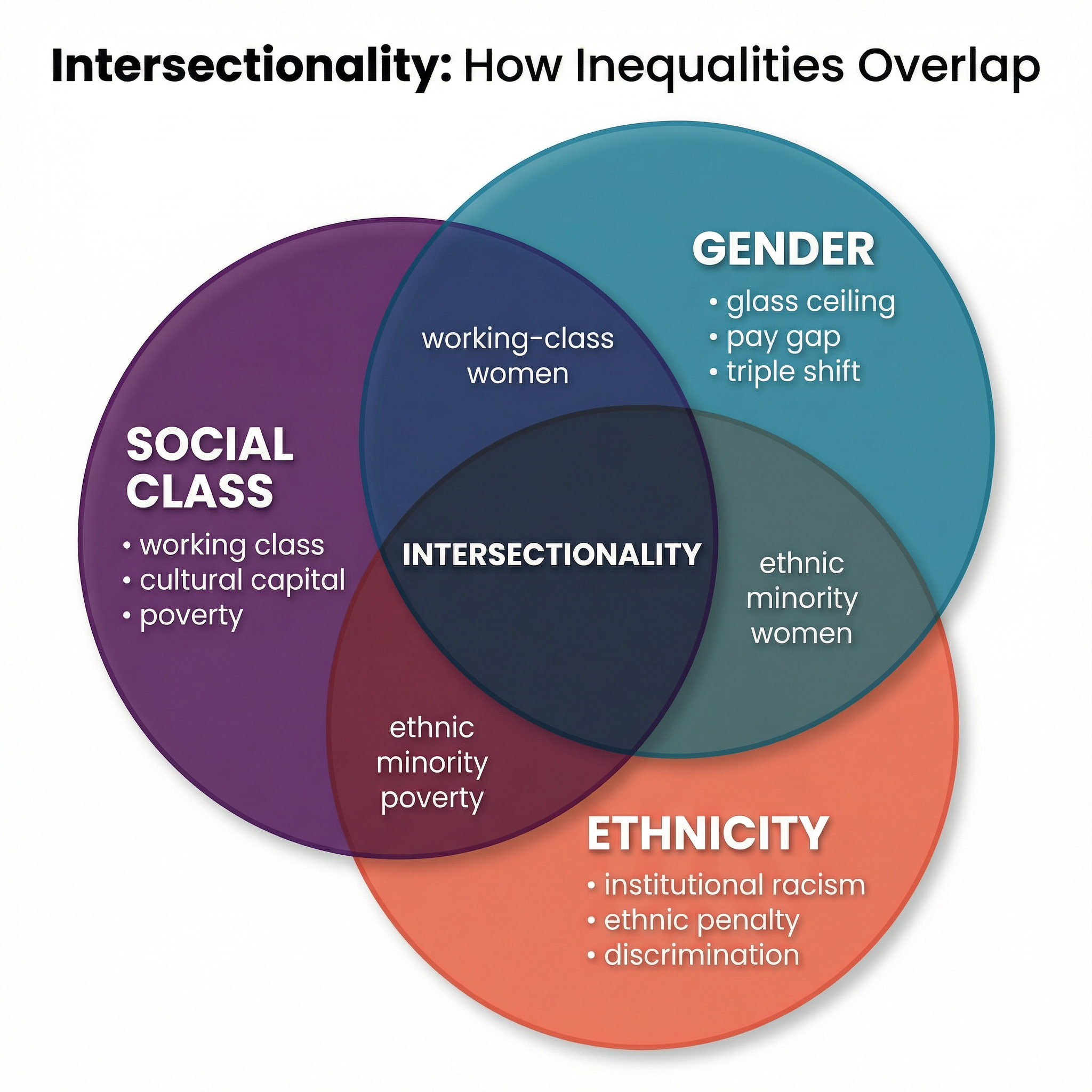
What is it?: A high-level concept, credited to Kimberlé Crenshaw, that helps to understand how different forms of inequality and identity (class, gender, ethnicity, etc.) overlap and interact. The experience of a working-class Black woman is not just the sum of being working-class, Black, and a woman; these factors intersect to create a unique experience of inequality.
Why it matters: Examiners give significant credit to candidates who can analyse the combined effects of these different social divisions, as it demonstrates a more sophisticated sociological understanding.
Second-Order Concepts
Causation
Why does social inequality persist? Long-term causes include the historical development of capitalism (Marxism) and patriarchy (Feminism). Short-term triggers for specific inequalities could be discriminatory government policies or economic recessions that disproportionately affect certain groups.
Consequence
The effects of inequality are wide-ranging: disparities in health outcomes, educational attainment, rates of criminalisation, and political representation. For example, a consequence of class inequality is the gap in life expectancy between the richest and poorest postcodes in the UK.
Change & Continuity
Change: There have been significant changes, such as the introduction of the Equal Pay Act and Race Relations Act, and the rising educational achievement of girls. Continuity: Despite these changes, significant inequalities persist. The gender pay gap still exists, and ethnic minorities still face discrimination in the labour market. The richest 1% still own a disproportionate amount of the nation's wealth.
Significance
This topic is significant because it reveals the deep structural forces that shape individual lives. It challenges the purely meritocratic idea that everyone has an equal chance to succeed and forces us to consider how society could be made fairer and more just.
Source Skills
When presented with a source (e.g., a table of data on income by ethnicity, a news article about sexism), candidates must not just describe it. The key is to use the source as evidence to support a sociological argument. Quote specific data points. For example: 'As Source A shows, the median hourly pay for employees from the Bangladeshi ethnic group was 20.2% less than for White British employees, which provides clear evidence of the 'ethnic penalty' in the labour market.' Always question the provenance: who created the source and for what purpose?"
Worked Examples
2 worked examples — open one to explore the question and available guidance.
Practice Questions
Try the question, then reveal an answer plan or example response
Describe two ways in which a person's social class background might affect their educational achievement. (8 marks)
Hint: Think about both material (money) and cultural factors. Use sociological concepts.
Evaluate the view that functionalist theories of social inequality are no longer relevant today. (24 marks)
Hint: Start by explaining the functionalist view (Davis and Moore). Then, critique it using Marxist, Feminist, and Weberian ideas. Come to a justified conclusion.
Watch or listen (optional)
Test your understanding of The Impact of Social Class, Gender, and Ethnicity
Active recall beats re-reading. Take an instant quiz now to test what you’ve learned and lock it into long-term memory.
7 days Premium · Then the free plan continues · No card, no charge