OCR · GCSE · Sociology
The welfare state
This study guide provides a comprehensive overview of the Welfare State for OCR GCSE Sociology students. It critically examines its origins in the 1942 Beveridge Report, its core components, and the conflicting sociological perspectives that are essential for achieving high marks.
- 6 min read
- 3 worked examples
- 5 practice questions
- 6 key terms
Check what you remember
Read the wording for your board, then hide it and explain Welfare State in your own words. Rough notes are fine. This is a self-check, with no mark or grade.
Reference: OCR
A system whereby the state takes responsibility for the health, education, and financial well-being of its citizens.
Study Notes
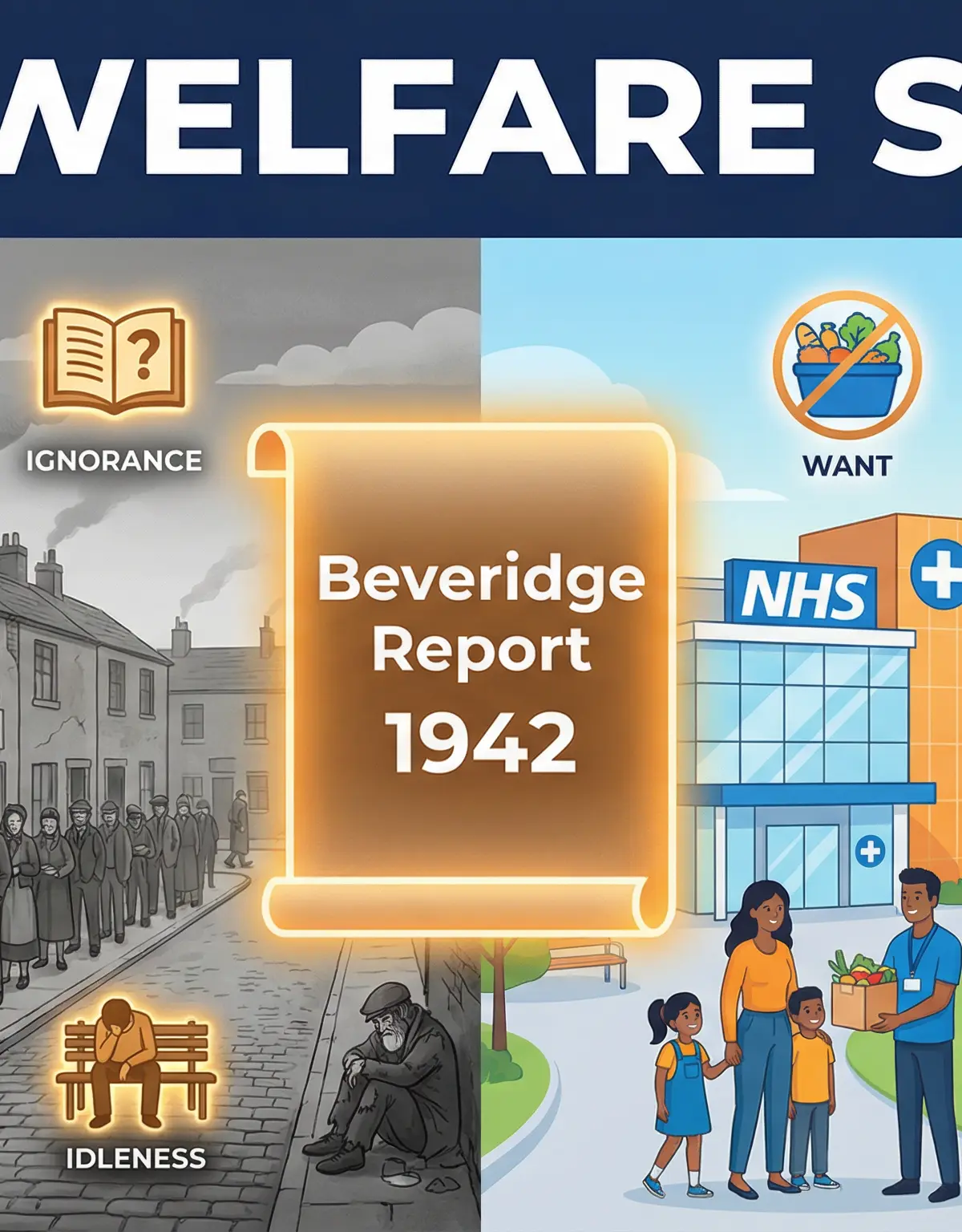
Overview
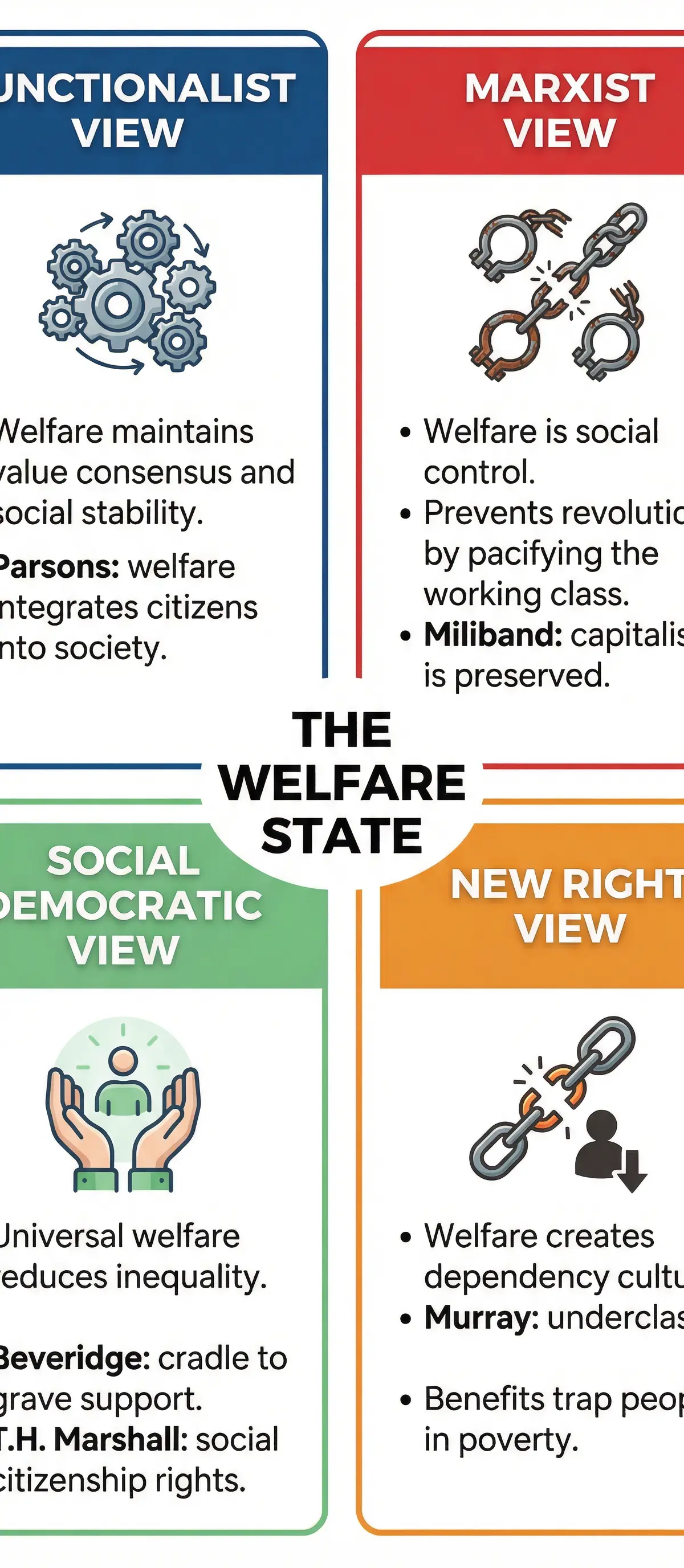
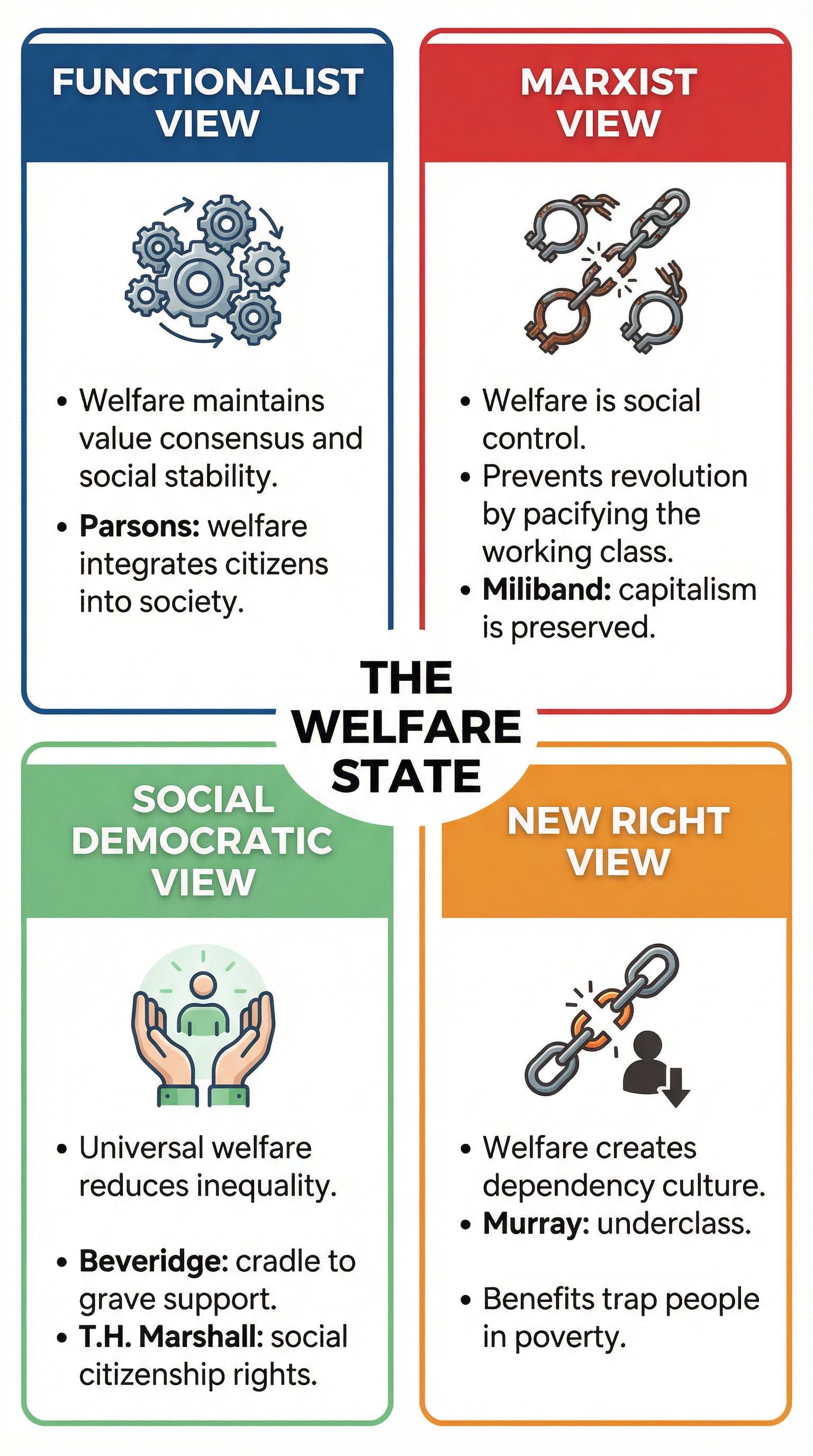
The Welfare State is a cornerstone of modern British society and a critical topic within the OCR GCSE Sociology specification, particularly under the 'Social Inequality' component. Examiners expect candidates to demonstrate a robust understanding of its development, from the post-war consensus inspired by the Beveridge Report to the contemporary landscape of welfare pluralism. This guide will analyse the ideological battles between Social Democratic principles of universalism and New Right critiques of dependency, providing the theoretical knowledge and specific examples needed to excel. Marks are awarded for not just describing the system, but for critically evaluating its impact on social stratification, poverty, and the life chances of different social groups. A key focus for high-level responses is the ability to contrast universal and means-tested benefits and to deploy sociological theory with precision.
Key Events & Developments
The Beveridge Report
Date(s): 1942
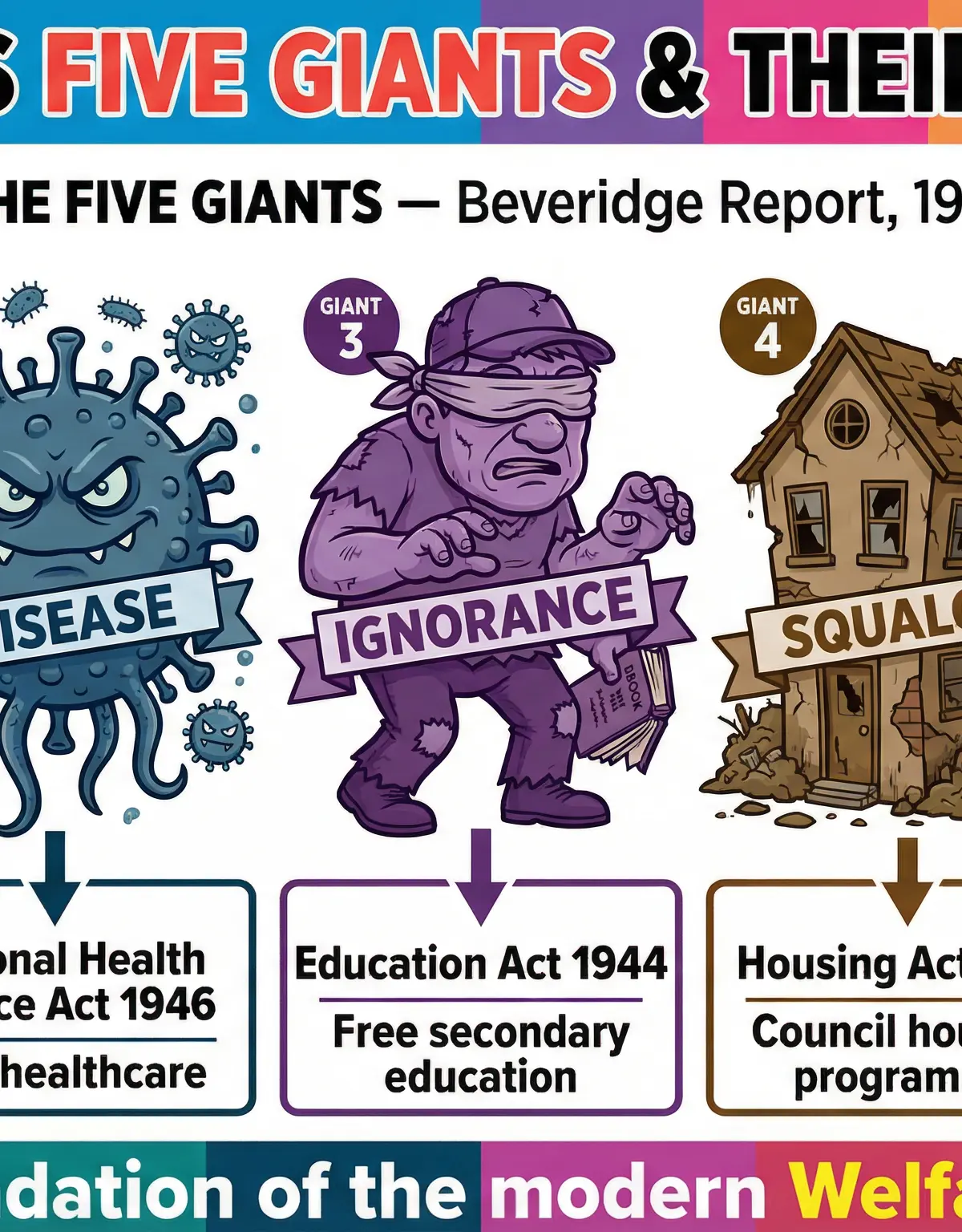
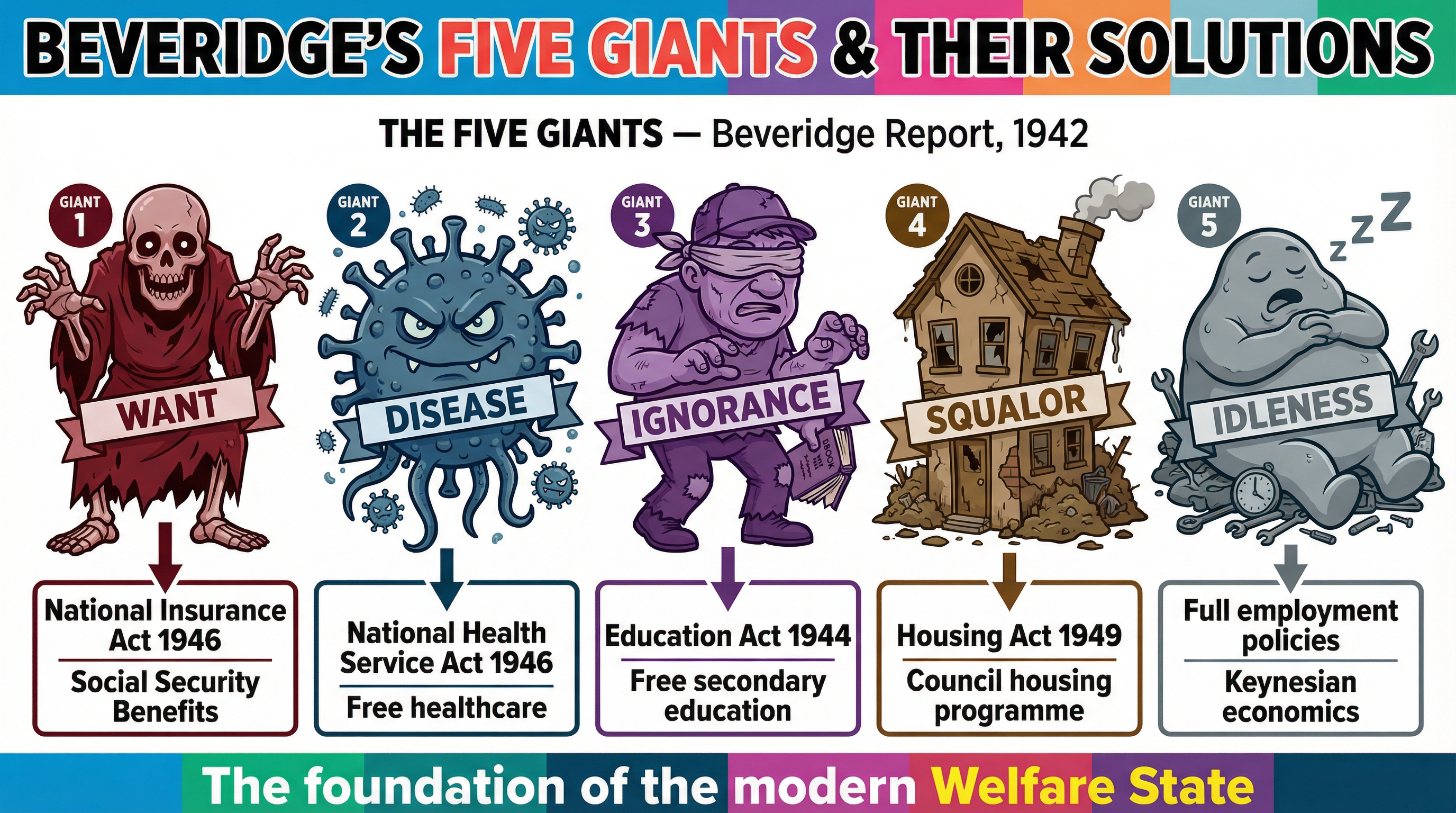
What happened: Sir William Beveridge, a civil servant, published 'Social Insurance and Allied Services'. The report identified 'Five Giants' that plagued British society: Want (poverty), Disease (ill health), Ignorance (poor education), Squalor (bad housing), and Idleness (unemployment).
Why it matters: This report formed the blueprint for the post-war Labour government's welfare reforms. It established the principle of a universal welfare system funded by national insurance, designed to provide support 'from the cradle to the grave'. Candidates must know the Five Giants and the solutions proposed.
Specific Knowledge: William Beveridge, Five Giants, 'cradle to the grave', National Insurance.
The Creation of the NHS
Date(s): 1948
What happened: The National Health Service Act of 1946 came into effect, creating a comprehensive, universal, and free-at-the-point-of-use health service for the entire UK population.
Why it matters: The NHS is the most famous and cherished part of the Welfare State. It represented a direct attack on the 'Giant' of Disease. For the exam, it serves as the primary example of a universalist social policy.
Specific Knowledge: Aneurin 'Nye' Bevan (Health Minister), 1948, universalism.
The Rise of the New Right
Date(s): 1979-1990s
What happened: The election of Margaret Thatcher's Conservative government marked a significant ideological shift away from the post-war consensus. Influenced by New Right thinkers, the government sought to 'roll back the state' and reduce welfare spending.
Why it matters: This period introduced market principles into welfare and promoted individualism over collectivism. It is the basis for the major critical perspective on the welfare state. Candidates must understand the concepts of 'dependency culture' and the 'underclass'.
Specific Knowledge: Margaret Thatcher, Charles Murray, dependency culture, privatisation.
Key Individuals
William Beveridge
Role: Economist and social reformer
Key Actions: Authored the 1942 Beveridge Report.
Impact: Provided the intellectual foundation for the entire post-war Welfare State. His work is the essential starting point for any discussion of the topic.
Aneurin 'Nye' Bevan
Role: Labour Minister for Health (1945-1951)
Key Actions: Drove the legislation to create the National Health Service, overcoming opposition from doctors.
Impact: He is considered the architect of the NHS, the most significant single element of the British welfare system.
Charles Murray
Role: American New Right sociologist
Key Actions: Wrote about the concept of an 'underclass' in the 1980s, arguing that the welfare state created a perverse incentive structure that trapped people in poverty and encouraged family breakdown.
Impact: His controversial theories provide the main ammunition for New Right critiques of welfare. Examiners expect candidates to be able to explain and criticise his views.
Second-Order Concepts
Causation
The Welfare State was caused by a combination of long-term and short-term factors. The shared experience of the Second World War created a desire for a fairer society (short-term trigger), building on a growing awareness of poverty from social surveys by Rowntree and Booth in the late 19th and early 20th centuries (long-term cause).
Consequence
The immediate consequence was a dramatic reduction in absolute poverty and improved public health. Long-term consequences are more debated, including the high cost to the taxpayer and the ideological debates about its impact on individual behaviour and social inequality.
Change & Continuity
Change: The welfare state has moved from a universalist model (everyone contributes, everyone benefits) towards a more means-tested, pluralistic model where private and voluntary sectors play a larger role. Continuity: The core principle of a state safety net and the existence of the NHS have remained, despite significant reforms.
Significance
The creation of the Welfare State was arguably the most significant domestic policy development of 20th-century Britain. It fundamentally reshaped the relationship between the citizen and the state and remains a central point of political and sociological debate.
Source Skills
When presented with a source on the welfare state (e.g., a government report extract, a newspaper article, or statistics on poverty), candidates should first identify its perspective. Is it supportive (Social Democratic), critical (New Right), or analytical? Use the source's content and provenance (who wrote it and when) to support your sociological points. For example, a 1985 article from The Sun newspaper discussing 'benefit scroungers' would be excellent evidence of the New Right ideology prevalent at the time.
Visual Resources
2 diagrams and illustrations
Interactive Diagrams
1 interactive diagram to visualise key concepts
Diagram could not be rendered
A timeline showing the key legislative and political milestones in the history of the UK Welfare State.
Worked Examples
3 worked examples — open one to explore the question and available guidance.
Practice Questions
Try the question, then reveal an answer plan or example response
Describe two policies that formed the basis of the post-war welfare state. (4 marks)
Hint: Think about the solutions to two of Beveridge's 'Giants'.
Explain the Marxist view of the welfare state. (6 marks)
Hint: Focus on concepts like social control, false consciousness, and the interests of capitalism.
Explain and briefly evaluate the New Right view of the welfare state. (12 marks)
Hint: Explain 'dependency culture' and the 'underclass' thesis, then use a different perspective to criticise it.
Describe what is meant by 'welfare pluralism'. (4 marks)
Hint: Think about who provides welfare beyond just the government.
Discuss how far sociologists would agree that the welfare state reinforces patriarchy. (12 marks)
Hint: Start with the Feminist argument, then bring in a counter-argument from a different perspective.
Exam technique
How to turn what you know into marks
How to approach the question
Look for the command word (e.g., 'Explain', 'Discuss') and the key sociological focus (e.g., 'social control', 'inequality'). Underline them.
How to structure your answer
- Essay questions
- Start with a clear introduction that defines the terms and outlines your argument. Present at least two contrasting sociological perspectives in separate paragraphs. Finish with a justified conclusion that answers the 'how far' or 'discuss' part of the question.
- Source questions
- Analyse the source's Content (what it says), Provenance (who made it and why), and then evaluate its Usefulness and Limitations for the specific enquiry.
- Explain questions
- Use the PEEL structure: Point, Evidence (sociologist, study, or specific policy), Explanation, Link back to the question.
Timing
Approximately 1 minute per mark. For a 12-mark question, spend 12-15 minutes.
Common pitfalls
- Describing policies without linking them to sociological theory.
- Only using one perspective in a 'discuss' question.
- Confusing the New Right and Marxist critiques.
- Forgetting to mention housing, education, and social security as parts of the welfare state alongside the NHS.
What the command words want
- Describe
- Give two clear points and develop each one with a sentence of detail or an example.
- How useful
- This requires evaluation of a source. Always address both its strengths (usefulness) and weaknesses (limitations) based on its content and provenance.
- Explain why
- Provide at least two distinct reasons (causes), and explain how they lead to the outcome in the question. Use connective words like 'consequently' or 'this led to'.
- How far do you agree
- You must present both sides of the argument. Use one perspective that agrees and another that disagrees. Your conclusion must state your judgement clearly (e.g., 'I largely agree...').
Watch or listen (optional)
Test your understanding of The welfare state
Active recall beats re-reading. Take an instant quiz now to test what you’ve learned and lock it into long-term memory.
7 days Premium · Then the free plan continues · No card, no charge