Study Notes
Overview
Social Control is a cornerstone of the WJEC GCSE Sociology specification, focusing on the mechanisms societies use to ensure conformity and maintain order. For examiners, this topic is a test of a candidate’s ability to differentiate between the overt and covert ways behaviour is regulated. A strong response will demonstrate a clear understanding of the distinction between formal control, enforced by official state agencies like the police and judiciary, and informal control, exercised by social institutions like the family and peer groups. Candidates are expected to analyse the specific methods—or sanctions—these agencies use, from legal punishment to social ostracism. Furthermore, high-level analysis requires engagement with the core theoretical debate: do these control mechanisms serve the common good, as Functionalists argue, or do they perpetuate the power of a dominant class, as Marxists contend? This guide will equip you with the precise terminology, theoretical knowledge, and analytical frameworks needed to deconstruct exam questions and secure maximum marks.
Formal vs. Informal Social Control
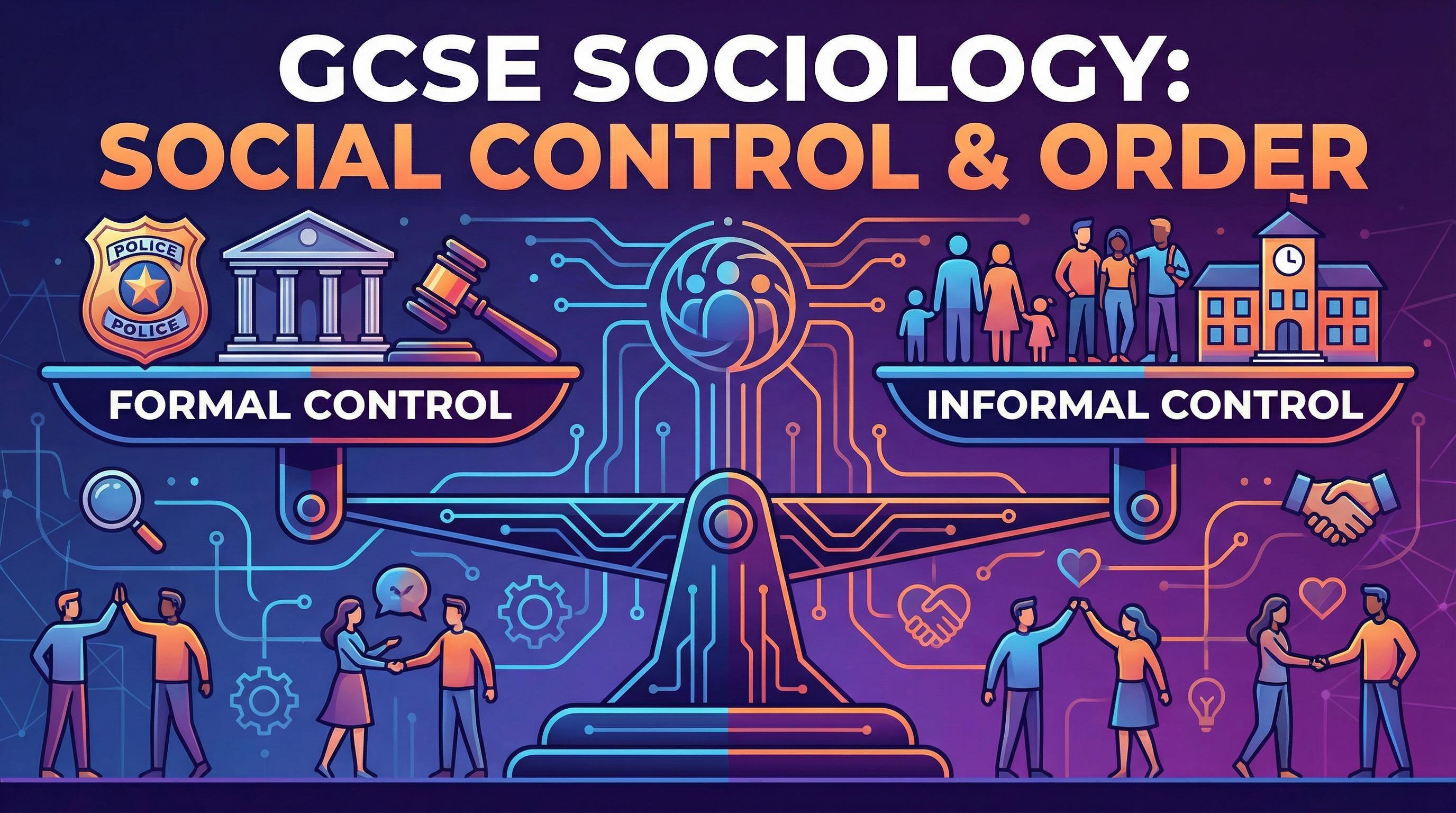
At the heart of this topic is the fundamental distinction between formal and informal social control. Marks are explicitly awarded for demonstrating a clear understanding of this dichotomy.
Formal Social Control
This is the enforcement of laws and official rules by agencies given legal authority by the state. It is explicit, codified, and often involves the threat of legal punishment.
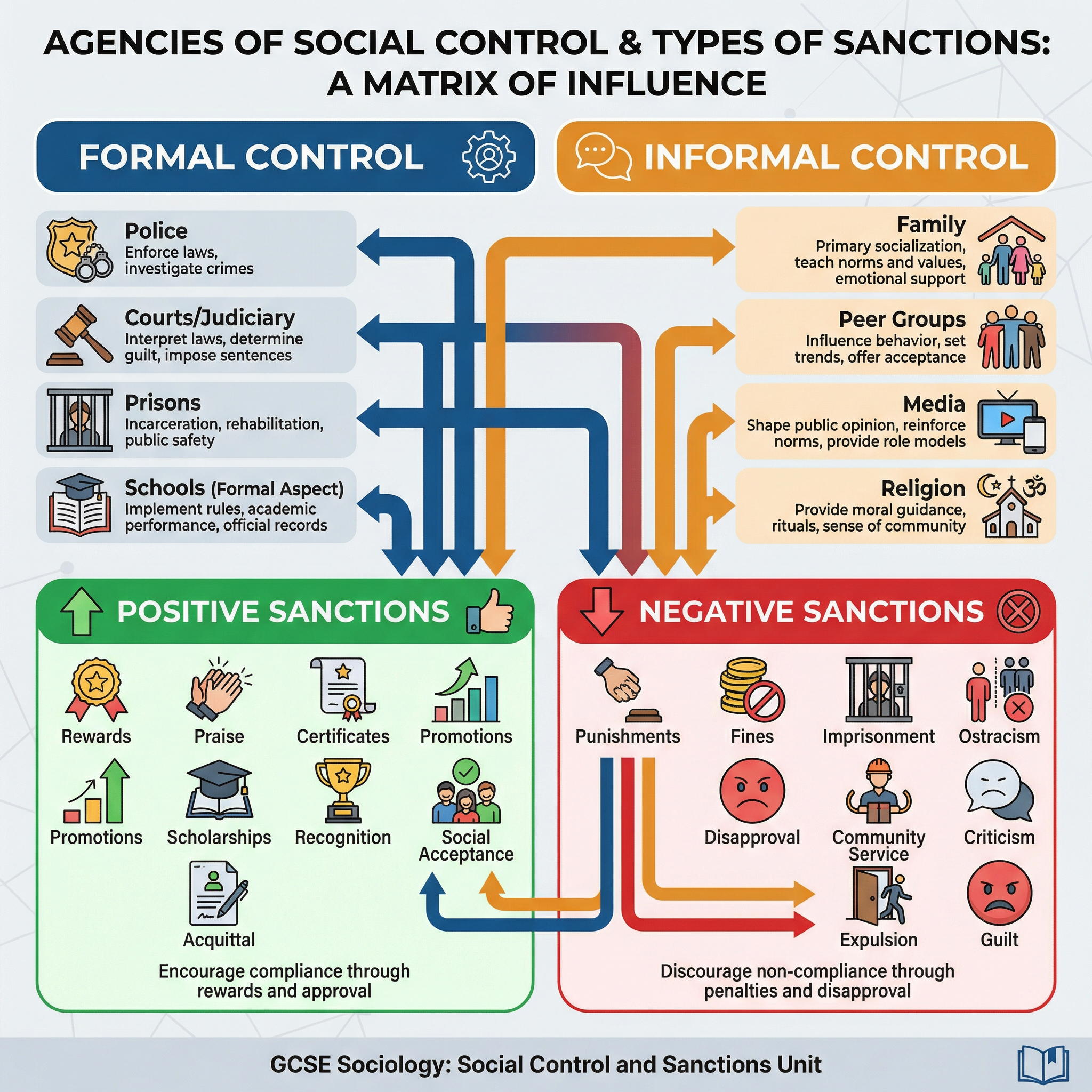
- Agencies: Police, Courts, Judiciary, Prisons, Parliament (Government), and the formal aspects of the Education system.
- Mechanisms: The use of sanctions, which are rewards or punishments to enforce norms. Formal sanctions are officially recognised.
- Positive Formal Sanctions: Official rewards for conforming to rules (e.g., a medal for bravery, a promotion, an acquittal in court).
- Negative Formal Sanctions: Official punishments for breaking rules (e.g., a fine, a prison sentence, a formal warning, expulsion from school).
Informal Social Control
This is the enforcement of social norms and values through unofficial social pressures. It is often subtle, unwritten, and relies on the power of social relationships.
- Agencies: Family, Peer Groups, Media, Religious Institutions, and the informal aspects of the Education system (e.g., peer pressure in the playground).
- Mechanisms: The use of informal sanctions.
- Positive Informal Sanctions: Unofficial rewards for conformity (e.g., praise from parents, a smile, a nod of approval, acceptance into a friendship group).
- Negative Informal Sanctions: Unofficial punishments for deviance (e.g., criticism, disapproval, being ignored or ‘sent to Coventry’ (ostracism), gossip).
Theoretical Perspectives on Social Control
Examiners expect candidates to apply sociological theories to this topic, especially in higher-mark evaluation questions. The central debate is between consensus and conflict theories.
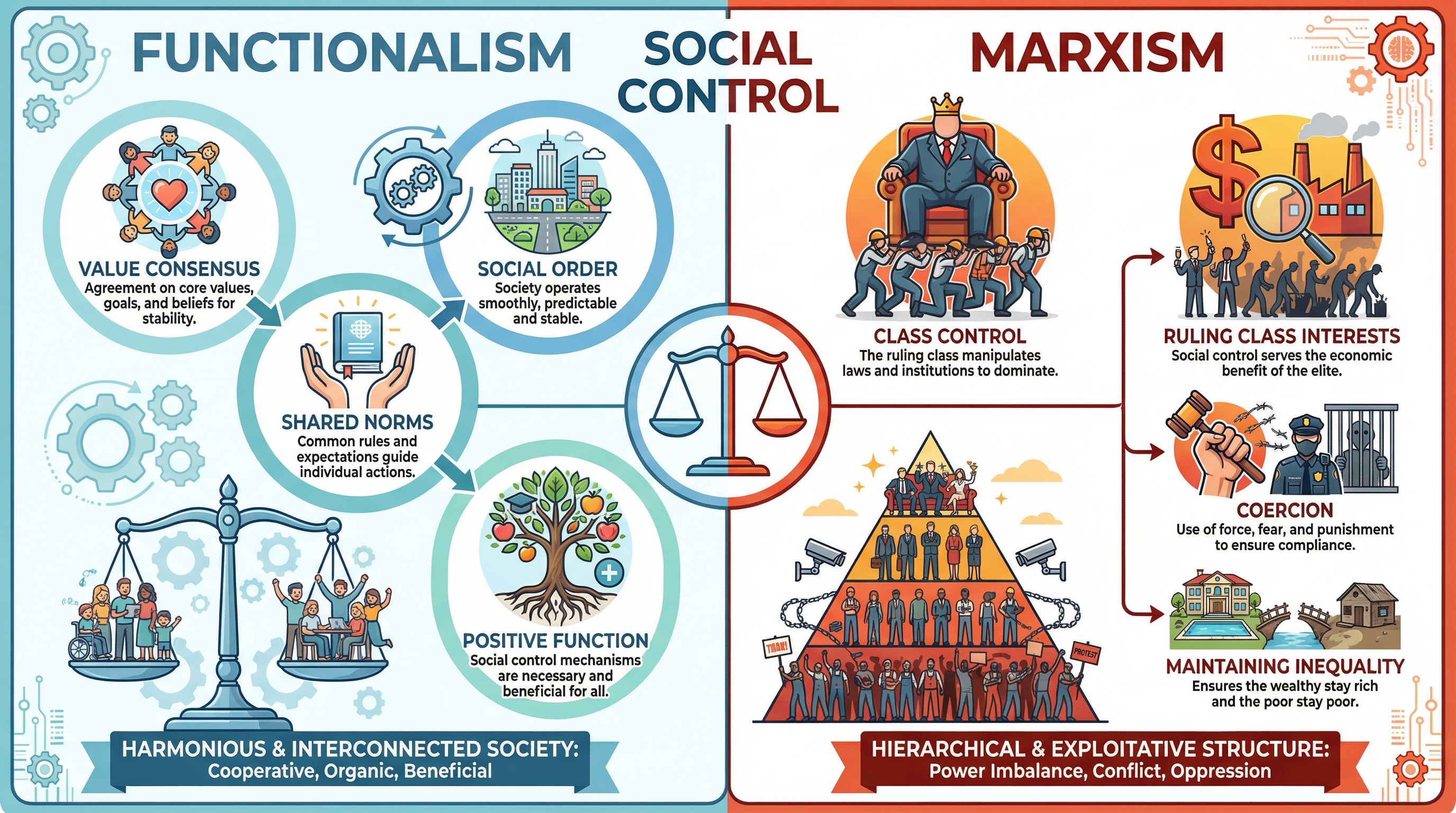
Functionalism: Control for Consensus
Functionalists, like Émile Durkheim, view social control as a vital and positive function for society. They argue:
- Maintains Social Order: Without control, society would descend into anomie (a state of normlessness and chaos).
- Enforces Value Consensus: Social control reinforces the shared norms and values that most people agree on, creating social solidarity.
- Benefits Everyone: The agencies of control (police, courts) work on behalf of the whole of society to keep people safe and maintain a stable social structure.
Marxism: Control for Conflict
Marxists, following the ideas of Karl Marx, see social control as a tool used by the ruling class (the bourgeoisie) to maintain power and control over the working class (the proletariat).
- Protects Ruling Class Interests: The laws and the agencies that enforce them are not neutral; they are designed to protect the private property and wealth of the powerful.
- Coercion not Consent: Order is maintained not because everyone agrees on the rules, but because the working class is forced to comply through the threat of punishment (coercion).
- Maintains Inequality: Social control mechanisms suppress dissent and revolution, ensuring the capitalist system and its inherent inequalities continue unchallenged.